Friday, July 15, 2011

Sounds of Silence and Talking Donkeys

Last Friday, I was honored to be the lay leader again for Shabbat services at Congregation Adas Emuno, and I thought I'd share with you some of that experience.

First, we opened by reading together the lyrics written by Paul Simon from the Simon and Garfunkel song, Sounds of Silence.  Here they are:

The Sounds of Silence
Paul Simon


Hello darkness, my old friend

I've come to talk with you again

Because a vision softly creeping

Left its seeds while I was sleeping

And the vision that was planted in my brain
Still remains

Within the sound of silence


In restless dreams I walked alone

Narrow streets of cobblestone
'Neath the halo of a street lamp
I turned my collar to the cold and damp

When my eyes were stabbed by the flash of a neon light

That split the night
And touched the sound of silence


And in the naked light I saw

Ten thousand people, maybe more
People talking without speaking
People hearing without listening
People writing songs that voices never share

And no one dared

Disturb the sound of silence


"Fools", said I, "You do not know

Silence like a cancer grows
Hear my words that I might teach you

Take my arms that I might reach you"

But my words, like silent raindrops fell

And echoed

In the wells of silence


And the people bowed and prayed

To the neon god they made
And the sign flashed out its warning
In the words that it was forming

And the sign said,
"The words of the prophets are written on the subway walls
And tenement halls"

And whispered in the sounds of silence

I believe that the song is familiar to most, it was a big hit back in the 60s, but half a century later, you just never know, so here's a video from YouTube that plays the song while displaying the lyrics:


Paul Simon's lyrics draws on the Biblical polemic against graven images and idol worship, but brings a modern sensibility to it, and an insistence on social justice that has its roots in the Nevi'im, the books of the prophets, who truly came from the margins of ancient society, not the centers of power such as court or Temple.  There is also an echo of the commandment to not stand idly by while another is being harmed here, in the insistence that we not remain silent in the face of injustice.  It is a reminder of the silence that greeted the Holocaust, a protest against contemporary evils, and a call to action.

We then proceeded with the service, and later, before we reached the Mi Shebeirach prayer for healing, we read together the lyrics from the Leonard Cohen song, If It Be Your Will:


If It Be Your Will
Leonard Cohen


If it be your will
That I speak no more

And my voice be still

As it was before
I will speak no more
I shall abide until
I am spoken for
If it be your will


If it be your will
That a voice be true
From this broken hill
I will sing to you

From this broken hill

All your praises
They shall ring

If it be your will

To let me sing


If it be your will
If there is a choice
Let the rivers fill

Let the hills rejoice
Let your mercy spill

On all these burning hearts in hell
If it be your will

To make us well


And draw us near

And bind us tight

All your children here
In their rags of light

In our rags of light

All dressed to kill

And end this night

If it be your will


This is a song about pain and suffering, about going through hell physically, and/or emotionally, and praying for healing.  Here is another YouTube video with a recording of Leonard Cohen:


After completing the healing prayer, it was time for the Dvar Torah, literally, a word of Torah, and the parsha or Torah portion for last week was Parsha Balak, Balak being the name of the king of Moab who figures prominently in the story being told in that section.  It's actually a rather unique section of the Torah, because the focus is not on the Jewish people or any individual member thereof.  After all, once we get past the preliminaries, Genesis is about Abraham, Isaac, Jacob, and his sons, and then the other four books are about Moses mainly, and sometimes about Aaron and his sons and grandsons, and Miriam, but mainly its Moses, and the Israelites collectively. 

But in this story, the focus is on Balaam, who is a sorcerer and also a prophet of God, but not one of the Israelites.  Balaam is a Midianite.  And this is an important point, in my opinion.  What this indicates is that you do not have to be Jewish, or an Israelite, or Hebrew, to worship God, or even be a prophet. You can trace this understanding back to the story of Noah, where a basic religion and ethical code for all the peoples of the world is presented. And so there are priests, shamans, and prophets who come from other peoples, and the outlook is that each people forges their own relationship with God. It has to be done as a community, the individual is not enough, the group must take responsibility for itself and its conduct. And every community, every people, has to make its own deal with God, to create their own just society. In the Torah, the Jewish people were chosen, and chose to accept a special covenant, special responsibilities, and special hardships. But there are as many relationships with God, pathways to God, as there are communities.  This stands in contrast to later, universalist religions where there is only one path to God that all must follow, and where the emphasis is on the individual relationship to the divine, rather than on the community.

So, the story begins with King Balak of Moab, who viewed the Israelites wandering through the desert as enemies, and is not willing to give them safe passage.  So he sends messengers to the Land of Midian, to speak with Balaam, and ask Balaam to come with them to Moab and to put a curse on the Israelites. But God appears to Balaam and tells him not to go, saying, "You shall not curse the people because they are blessed!" So he refuses, but King Balak sends more prestigious messengers, offering to reward Balaam with great riches, and this time God tells Balaam he can go, but he must only speak the words that God tells him to.
  Here's an excerpt, in English translation of course, from Numbers 22:

21. In the morning Balaam arose, saddled his she-donkey and went with the Moabite dignitaries.

22. God's wrath flared because he was going, and an angel of the Lord stationed himself on the road to thwart him, and he was riding on his she-donkey, and his two servants were with him.

23. The she-donkey saw the angel of the Lord stationed on the road with his sword drawn in his hand; so the she-donkey turned aside from the road and went into a field. Balaam beat the she-donkey to get it back onto the road.

24. The angel of the Lord stood in a path of the vineyards, with a fence on this side and a fence on that side.

25. The she-donkey saw the angel of the Lord, and she was pressed against the wall. She pressed Balaam's leg against the wall, and he beat her again.

26. The angel of the Lord continued going ahead, and he stood in a narrow place, where there was no room to turn right or left.
27. The she-donkey saw the angel of the Lord, and it crouched down under Balaam. Balaam's anger flared, and he beat the she-donkey with a stick.
28. The Lord opened the mouth of the she-donkey, and she said to Balaam, "What have I done to you that you have struck me these three times?"
29. Balaam said to the she-donkey, "For you have humiliated me; if I had a sword in my hand, I would kill you right now."
30. The she-donkey said to Balaam, "Am I not your she-donkey on which you have ridden since you first started until now? Have I been accustomed to do this to you?" He said, "No."

31. The Lord opened Balaam's eyes, and he saw the angel of the Lord standing in the road, with a sword drawn in his hand. He bowed and prostrated himself on his face.

32. The angel of the Lord said to him, "Why have you beaten your she-donkey these three times? Behold, I have came out to thwart you, for the one embarking on the journey has hastened against me.

33. When the she-donkey saw me, it turned aside these three times. Had she not turned aside before me, now also I would also have killed you and spared her [the she-donkey]."

34. Balaam said to the angel of the Lord, "I have sinned, for I did not know that you were standing on the road before me. Now, if it displeases you, I will return."

35. The angel of the Lord said to Balaam, "Go with these men, but the word I will speak to you-that you shall speak." So Balaam went with Balak's dignitaries.

Now, this too is quite unusual.  Where else in the Hebrew Bible do we find a talking animal?  That's a motif that comes up commonly in myths, folktales, and nowadays in cartoons (can you imagine Eddie Murphy as the donkey?).  And the angel as well is much more conversational and personal than the typical supernatural messengers that appear in the sacred text.  All in all, the story of a talking donkey is a comedy, and a bit of a farce, and it may well be that this was a folktale that originated among the Midianites or Moabites, and not the Israelites, and then later became incorporated into the Torah.  It certainly has elements that indicate it is more like oral tradition than written scripture.  For that alone, I think this is a wonderful section of the Five Books of Moses.

After this encounter, Balaam arrives in Moab, and tells Balak to build seven altars, and offer sacrifices to God, which he does. And then Balaam blesses instead of curses the Israelites, saying, "How can I curse whom God has not cursed, and how can I invoke wrath if the Lord has not been angered?" King Balak is angry, takes Balaam to a second location, builds altars and offers sacrifices, and again Balaam has no choice but to bless the Jewish people. King Balak then tries a third location, with the same result. This illustrates a difference in mode of thinking, with the nonliterate, oral mindset of Balak, who thinks in concrete terms, and imagines the divine to be local, immanent, tied to a particular place.  In contrast, the story shows that for the monotheism of the Israelites, God is omnipresent (a similar theme is found in the book of Jonah, where it is shown that it is impossible to run away and escape from God).  This conception requires an abstract mode of thought that is all but impossible without literacy, and the religion of Moses is quite clearly a religion based on the sacred text received at Mount Sinai, a religion rooted in the written word.

So, Balaam makes with a blessing, the beginning of which is part of Jewish liturgy, but which then goes into a brutal, agonistic mode (this from Numbers 24):

5. How goodly are your tents, O Jacob, your dwelling places, O Israel!
6. They extend like streams, like gardens by the river, like aloes which the Lord planted, like cedars by the water. 

7. Water will flow from his wells, and his seed shall have abundant water; his king shall be raised over Agag, and his kingship exalted.

8. God, Who has brought them out of Egypt with the strength of His loftiness He shall consume the nations which are his adversaries, bare their bones and dip His arrows [into their blood].

9. He crouches and lies like a lion and like a lioness; who will dare rouse him? Those who bless you shall be blessed, and those who curse you shall be cursed.

And then Balaam concludes with a prophecy about the end days and redemption, when the evil of Assyria, Esau, and the Amalek will be defeated. This is the first apocalyptic vision of armageddon that appears in the Bible.  The word armageddon comes from the Hebrew Har Megiddo, Har meaning mountain, so it literally is a geographical location, Mount Megiddo.  But for those interested in the so-called end days, this is where it all begins.

The parsha concludes with a second story, where the enemies of the Israelites try a new tactic, getting the Israelites to sin and thereby lose God's favor, and they do so by sending in Moabite and Midianite women to seduce the men.  God's anger at this immorality is reflected in the outbreak of disease in the Israelite camp, but we perhaps can understand it in contemporary terms as an outbreak of STDs, and it might even be that this was an early form of biological warfare (perhaps comparable to the early settlers in the New World giving the Native Americans diseased blankets?).  The response is quite extreme in this story, as God tells Moses to execute the guilty ones.  But what happens is that one of the leaders of the Israelites is cavorting in public with a Midianite princess, until Pinchas, the grandson of Aaron and therefore a priest, kills them both with his spear. Not only is this violent, but also phallic, as the way, I believe, the story is understood is that the couple are caught in the act, speared together in a manner that Sigmund Freud would certainly have much to say about.  It's brutal, but again these are ancient times, and the Israelites were not that much more advanced over their neighbors back then, it was a constant struggle according to the stories in the Bible.  But in this instance, the ritual sacrifice ends the plague, which perhaps can be understood as the threat of execution put the fear of God into the men, and put an end to the promiscuous behavior that spread the disease.

The point, I believe, is not to sanitize these stories, but to understand them, not necessarily taking them literally, but as a reflection of a struggle to emerge out of the oral, tribal, agonistic mode of life, and evolve into something new, and better, a people governed by law and justice, ethics and rationality. It was a long and difficult struggle, but the Israelites were engaged in it long before others were.  And we understood that you don't make progress by forgetting your history, and editing out all of your mistakes and failures and wrongdoings, but by remembering them, and striving not to repeat them, and to make things better.


The progress can be seen in the concluding lines of the Haftarah accompanying this Torah portion, taken from the Prophet Micah (6: 7-8), which comes after another apocalyptic vision:

Will the LORD be pleased with thousands of rams, or with ten thousands of rivers of oil? Shall I give my firstborn for my transgression, the fruit of my body for the sin of my soul? He hath showed you, O man, what is good; and what does the LORD require of you, only to do justly, and to love mercy, and to walk humbly with your God?

For me, those this sums up better than anything what the Torah tries to teach us, what is the basis of our religion.

The service then proceeded as usual, but before the Mourner's Kaddish, I read a poem by Solomon ben Judah Gabirol, one of the Hebrew Poets of Medieval Spain, translated into English by the 19th century Jewish American poet, Emma Lazarus:


Almighty! what is man?

But flesh and blood.

Like shadows flee his days,

He marks not how they vanish from his gaze,
Suddenly, he must die-
He droppeth. stunned, into nonentity.
Almighty! what is man?

A body frail and weak.

Full of deceit and lies,

Of vile hypocrisies.
Now like a flower blowing,

Now scorched by sunbeams glowing.

And wilt thou of his trespasses inquire?

How may he ever bear
Thine anger just, thy vengeance dire?
Punish him not, but spare,

For he is void of power and strength!


Almighty! what is man?
By filthy lust possessed,

Whirled in a round of lies,

Fond frenzy swells his breast.

The pure man sinks in mire and slime,

The noble shrinketh not from crime,

Wilt thou resent on him the charms of sin?

Like fading grass,

So shall he pass.
Like chaff that blows
Where the wind goes.

Then spare him, be thou merciful, O King,

Upon the dreaded day of reckoning!


Almighty! what is man?

The haughty son of time

Drinks deep of sin,

And feeds on crime

Seething like, waves that roll,

Hot as a glowing coal.

And wilt thou punish him for sins inborn?

Lost and forlorn,

Then like the weakling he must fall,

Who some great hero strives withal.

Oh, spare him, therefore! let him win

Grace for his sin!


Almighty! what is man?

Spotted in guilty wise,

A stranger unto faith,

Whose tongue is stained with lies,

And shalt thou count his sins so is he lost,

Uprooted by thy breath.
Like to a stream by tempest tossed.

His life falls from him like a cloak,

He passes into nothingness, like smoke.

Then spare him, punish not, be kind, I pray,

To him who dwelleth in the dust, an image wrought in clay!


Almighty! what is man?

A withered bough!
When he is awestruck by approaching doom.

Like a dried blade of grass, so weak, so low

The pleasure of his life is changed to gloom.

He crumbles like a garment spoiled with moth;
According to his sins wilt thou be wroth?

He melts like wax before the candle s breath,

Yea, like thin water, so he vanisheth,

Oh, spare him therefore, for thy gracious name,

And be not too severe upon his shame!


Almighty! what is man?

A faded leaf!

If thou dost weigh him in the balance lo!

He disappears a breath that thou dost blow.

His heart is ever filled
With lust of lies unstilled.

Wilt bear in mind his crime
Unto all time?

He fades away like clouds sun-kissed,

Dissolves like mist.

Then spare him! let him love and mercy win,

According to thy grace, and not according to his sin!


The medieval mentality is also different from our own, less comforting and gentle, but it too is part of our long history, a tradition that encompasses the ancient and medieval as well as the modern and contemporary, a tradition of balance and harmony, orality and literacy, and a tradition of freedom, justice, and memory.


Thursday, July 7, 2011

Edmund Carpenter 1922-2011

The passing of Edmund Carpenter on July 2nd is a loss for the field of media ecology, for anthropology, and for scholarship is general.  Ted Carpenter's contributions were not always well acknowledged, but certainly of great significance to us all.


It is especially sad that he passed away during the Marshall McLuhan Centenary, as he was McLuhan's closest collaborator and greatest influence during the years that McLuhan formulated his most seminal work that led to the publication of The Gutenberg Galaxy and Understanding Media.   As McLuhan's colleague at the University of Toronto from the late 40s to the late 50s, Carpenter might well be considered an important member of what has been termed the Toronto School, but unlike McLuhan, he was not a Canadian, but rather was born in Rochester, New York (the site of the 5th annual MEA meeting), lived for many years in California, and most recently resided in New York City and the Hamptons out on Long Island.

Carpenter worked with McLuhan in Toronto as part of the interdisciplinary Explorations group, obtaining a grant from the Ford Foundation in 1952 that, among other things, funded the creation of a journal called Explorations (after which the MEA's Explorations in Media Ecology was named), which Carpenter edited.  This was the moment when media ecology as a unified field, rather than as separate strands of intellectual inquiry, first coalesced.  Although only 9 issues were published, Explorations had a significant impact on a select and fortunate network of intellectuals during the 1950s, creating in its readership the beginnings of a community and invisible college of what we would call media ecologists.

An anthology consisting of selected articles from Explorations was published in 1960, under the title of Explorations in Communication, edited by Carpenter and McLuhan.  It is sadly out of print, but truly a major work in the media ecology literature.  Christine Nystrom once remarked to me that most of the main ideas that made McLuhan famous in the 1960s can be found there.  Certainly, the "Acoustic Space" chapter co-authored by Carpenter and McLuhan, represents one of the key insights about sensory biases as they relate to media, and Carpenter's piece, "The New Languages," was frequently reprinted, and enormously influential and in the field of communication, especially mass communication, and what would become known as media studies; also, it is a pioneering work in what would become known as media literacy. 

As an anthropologist, Carpenter played a role in the adoption of the anthropological concept of culture into McLuhan's work, as opposed to the more literary view of the popular arts that can be seen in McLuhan's first book, The Mechanical Bride.  And especially, Carpenter was interested in language, and the differences between different languages, in vocabulary, grammar, and worldview.  He was a proponent of what is known as the Sapir-Whorf Hypothesis, otherwise referred to as linguistic relativism, that languages play a central role in thought, perception, and culture, a view that was attacked and repressed by Chomsky and his followers, and is only recently being retrieved and resurrected.  And Carpenter identified the anthropologist Dorothy Lee as a major influence on himself and McLuhan, although the influence on McLuhan may have been indirectly, through Carpenter. 

Lee is the only author to contribute more than one piece to Explorations in Communication, aside from McLuhan and Carpenter themselves, and while she did not publish extensively otherwise, and has been largely forgotten outside of media ecology circles, she was known as a stronger advocate of linguistic relativism than even Benjamin Lee Whorf, so that some feel it only appropriate to refer to the Sapir-Whorf-Lee Hypothesis.  Her position is articulated in "Linguistic Reflection of Wintu Thought," but it is in the chapter entitled, "Lineal and Non-Lineal Codifications of Reality" that Lee's contribution becomes abundantly clear, as she provides the basis for the key insight about nonlinearity which McLuhan associated with electronic media.  Both articles were also included in her own book, Freedom and Culture, another important work in the media ecology intellectual tradition that is sadly out of print; I know from correspondence with Walter Ong that he thought very highly of that book, which begins to bridge the gap between linguistic anthropology and orality-literacy studies.

Explorations in Communication also included 4 contributions by McLuhan, "Classroom without Walls," "The Effect of the Printed Book on Language in the 16th Century," "Media Log," and "Five Sovereign Fingers Taxed the Breath," and some of the other chapters are "Tactile Communication" by Lawrence Frank, "Time and Tense in Spanish Epic Poetry" by Stephen Gilman, "Buddhist Symbolism" by Daisetz Suzuki, "The Language of Poetry" by Northrup Frye, "Kinesics and Communication" by Ray Bridwhistell, "Space Conception in Prehistoric Art" by Sigfried Giedion, "The Moving Eye" by Jacqueline Tyrwhitt, "Pure Color" by Fernand Léger, "The Oral and Written Traditions" by David Riesman, "Reading and Writing" by H. J. Chaytor, "Channel Cat in the Middle Distance" by Jean Shepherd, "Joyce's Wake" by W. R. Rodgers, and "Communications Revolution" by Gilbert Seldes.  Truly fertile soil for McLuhan's media ecology.

Carpenter, along with Harold Innis, also helped to shift McLuhan's attention towards the concept of media, and Carpenter himself was a pioneer in using the media, having his own radio and television program for the Canadian Broadcasting Company, so in this as well he set an example for McLuhan to follow (and of course vastly exceed).  And working with and in different media led him to think about their differences, to argue that each medium is a language with its own grammar and worldview, thereby broadening the Sapir-Whorf-Lee Hypothesis (Louis Forsdale later suggested that McLuhan's perspective on media was an extension of the Sapir-Whorf Hypothesis).  Carpenter also stated that languages are media, an argument that many traditionalists in communication had trouble with, but that makes perfect sense from a media ecology approach.

Carpenter is considered a pioneer in visual anthropology, as Harald Prins, John Bishop, and Michael Wesch have made clear, and the work he did founding and leading an interdisciplinary program in Anthropology and Art at San Fernando Valley State College (today known as California State University-Northridge) from 1959-1967 was simply amazing, as can be seen in the documentary, Oh What a Blow that Phantom Gave Me! By Bishop and Prins.  We were fortunate to have been treated to a preview screening of the film at the 4th annual MEA meeting at Hofstra University on Long Island, and I've used it many times in classes.  It is incredibly rich in ideas about language, art, culture, and media, and I highly recommend it to anyone with an interest in media ecology. 


Unlike most documentaries of that sort, this one is quite affordable, only $24.95 direct from the filmmaker, via Media-Generation.  Here's a preview:


McLuhan brought Carpenter with him to Fordham University when McLuhan was given the Albert Schweitzer Chair in the Humanities during the 1967-1968 school year, and Carpenter had an important impact on what might be called the New York School of media ecology (in later years, he would teach courses at various schools in the metropolitan area, including New York University, the New School, and Adelphi University).  He also held the Carnegie Chair at the University of California, Santa Cruz for a year, and had a position at the University of Papua, New Guinea, where he conducted anthropological research that was captured on film, and included in the Bishop and Prins documentary. 

Carpenter was condemned by his colleagues for experimenting on the tribal peoples that he visited in Papua, capturing their first reactions to media such as photographs, sound recording, radio, and film.  He himself seemed ambivalent about the fact that he had interfered with these cultures, but in the film you can see them using a steel, mass produced razor blade to perform the ritual scarification that figured in their rites of passage, so they were not exactly pristine.  You can also see them attending Roman Catholic mass, and the church is well known for its effort to change tribal cultures, so again, they were not free from foreign influences, and some tribesmen also wore articles of "civilized" clothing.  Moreover, the New Guinea government was mounting efforts to reach the tribal populations through education, exposing them to movies, radio, and literacy. 

Here's another excerpt from the Bishop and Prins documentary:


And of course the very presence of an anthropologist taking notes changes things, as the documentary also shows us, by way of a tribe member who had "invented" his own form of "writing" which just amounted to making marks on paper, but this already deviates from what Ong termed primary orality, where the members of the culture do not even know of writing.  It was only a matter of time before the tribe members were introduced to these other media, an event that would otherwise occur without anyone observing and analyzing, so there is ample justification for what Carpenter did.

Carpenter's conclusions are quite clear, and essential for the field of media ecology:  that media swallow cultures rather than the other way around, that culture does not have a significant effect on the way that individuals use or relate to different media, but that media have significant effects on cultures, on thought, feeling, worldview, and ways of life.

The title of the Biship and Prins documentary is taken from the title of Carpenter's most important and popular book in media ecology, Oh What a Blow that Phantom Gave Me, published in 1972. 


The title is an allusion to Don Quixote, and his encounter with the windmill, and the book was Carpenter's follow-up to McLuhan's Understanding Media, which Carpenter stated that he made unacknowledged contributions to. Oh What a Blow that Phantom Gave Me begins with the words,


"Electricity has made angels of us all. Not angels in the Sunday school sense of being good or having wings, but spirit, freed from flesh, capable of instant transportation anywhere. The moment we pick up a phone, we’re nowhere in space—everywhere in spirit.  That is Saint Augustine’s definition of God: a being whose center is everywhere, whose borders are nowhere." 

This is another book that is sadly out of print, but available electronically in various ways, including in hypertextual format online, courtesy of Mike Wesch, at .   This work was preceded by They Became What They Beheld in 1970, with Ken Heyman given co-authorship credit having done for this book what Quentin Fiore did for McLuhan's The Medium is the Massage, as an experimental, visually oriented publication.  Other major works by Carpenter include Eskimo (1959), Eskimo Realities (1973), Patterns That Connect (completing the work of anthropologist Carl Schuster, in 1996), and Two Essays: Chief and Greed (2005).

Carpenter's relationship with McLuhan after the Fordham year became somewhat strained, which Carpenter attributed in part to McLuhan's illness, and the after effects of the major brain surgery he had that year, and this is reflected in the essay that he wrote, "Remembering Explorations," published in the spring 1992 issues of Canadian Notes and Queries, and in abridged form as an appendix in Donald Theall's 2001 book, The Virtual Marshall McLuhan.  But he also was quite generous in taking care of McLuhan in the Hamptons after McLuhan had his debilitating stroke.

I've heard that Carlos Castaneda of New Age fame was one of Carpenter's students, and he also was a mentor to one of McLuhan's daughters, Teri, who published a number of books about Native Americans as T.C. McLuhan.  I've also heard that he was quite the ladies' man in his time, which is perhaps reflected in the fact that he was twice divorced.  


But it seems he found his soul mate in Adelaide DeMenil, who was also very much his collaborator, doing the camerawork in New Guinea, working with him on many research projects (I recall him mentioning about frequently visiting a dig in Siberia near the arctic circle, where some of the oldest human remains were found), and in curating museum exhibits.

We were fortunate indeed to have Ted Carpenter as a featured speaker at the MEA's 6th Annual Meeting held at Fordham, and it was a great honor to meet him, and Adelaide, and then to be able to publish his talk about McLuhan, simply entitled "Marshall," in Explorations in Media Ecology (5:3, 2006).  That brief essay is an altogether brilliant bit of writing.

Ted Carpenter was truly one of the great ones, in media ecology, and in scholarship and the arts in general, and he will most certainly be missed, and remembered.

Friday, July 1, 2011

Green Green Lantern

So, since I wrote about the recent X-Men prequel in my last post, The Magneto Question, I might as well say a few words about the recent Green Lantern movie in this next one.


First, let me acknowledge that yes, the critics are right, the movie's plot is a bit of a mess, looks like five different writers worked on it, and the seams are showing, there are logical inconsistencies, non sequiturs, lapses and lacunas, etc., etc.  

But for all that, I enjoyed it, it was visually appealing, not artsy but attractive, and another nice use of 3D technology that doesn't hit you over the head with it.  Overall, it resembled less the other super heroes movies of recent years, and more the Star Wars films in its look and sensibility.  And it was exciting, despite the problems with the plot.

You can get some sense of the look of the film from the trailer (but of course it really needs to be seen on the big screen):


Let me add that, in my opinion, the Green Lantern comics superhero is a great subject for a major motion picture, and I was thinking that way for a long time now, going back to the first great Superman movies of 1978 and 1983 that starred Christopher Reeve.


Not that they were the perfect comic book adaptations, but they were entertaining films that capitalized on the new interest in science fiction and special effects that followed the introduction of Star Wars in 1977.  There were two more Superman films made in 1983 and 1987, neither very good, as well as a Supergirl movie in 1984, also not particularly memorable, before the more recent Superman Returns in 2006.  Then there were the two Batman movies with Michael Keaton in 1989 and 1992, with further sequels starring Val Kilmer in 1995, and George Clooney in 1997, before the series was rebooted with Batman Begins in 2005 and The Dark Knight in 2008, with Christian Bale in the lead role.


If you're wondering why I'm not mentioning Spider-Man or some of the other superheros, it's because I'm focusing on the the DC line of comics in this post, and the superheroes associated with them, who appear in Warner Bros. movies because DC is owned by TimeWarner.  And admittedly, Batman is the second most popular DC character after Superman, but Green Lantern is much closer to Superman in sensibility, as a truly superpowered hero, albeit one whose powers are derived from a ring that does or creates whatever the user wants it to, limited only by the individual's will power.  

The idea of will power was a powerful one in the early 20th century, albeit one with some problematic associations due to Leni Riefenstahl's Nazi propaganda film, Triumph of the Will.  But there was a great deal of talk at that time about will power, much as we talk today about how you can do anything if you put your mind to it, and how you define your own reality (aka The Secret).  Where there's a will, there's a way, we used to say.  It fit in well with the emphasis on individualism that had become the dominant ideology in the west, particularly in conjunction with the rise of literacy and print culture, before it was eroded by the electronic media.

But the point I was getting at is that Green Lantern was up there with Superman as one of the DC Universe's "big guns" so to speak (I believe that metaphor comes from World War Two), and the association between the two can be heard in one of the top hits of the sixties, Donovan's Sunshine Superman:


And here are the lyrics:


Sunshine came softly through my a-window today
Could've tripped out easy a-but I've a-changed my ways
It'll take time, I know it but in a while
You're gonna be mine, I know it, we'll do it in style
'Cause I made my mind up you're going to be mine


I'll tell you right now
Any trick in the book now, baby, all that I can find
Everybody's hustlin' just to have a little scene
When I say we'll be cool I think that you know what I mean
We stood on a beach at sunset, do you remember when?
I know a beach where, baby, a-it never ends
When you've made your mind up forever to be mine


Hmm, hmm, hmm, hmm, hmm
I'll pick up your hand and slowly blow your little mind
'Cause I made my mind up you're going to be mine
I'll tell you right now
Any trick in the book now, baby, all that I can find


Superman or Green Lantern ain't got a-nothin' on me
I can make like a turtle and dive for your pearls in the sea, yeah!
A you-you-you can just sit there a-thinking on your velvet throne
'bout all the rainbows a-you can a-have for your own
When you've made your mind up forever to be mine
I'll pick up your hand and slowly blow your little mind
When you've made your mind up forever to be mine


I'll pick up your hand

Okay, so it's just a little passing reference, but in those days, any kind of reference was very rare indeed.  Not that it's all that common today.  

But the point I was getting at is that Green Lantern is an excellent subject for a movie, and one that was long overdue.  In a way, maybe, too long overdue.  If they had gone for Green Lantern back in the eighties, the story would have been much simpler, as he was a Silver Age superhero, perhaps the first who was truly a space age hero, a test pilot with the right stuff out of the mold of Chuck Yeager, a bit of a swinging bachelor, not a womanizer like Star Trek's Captain Kirk though, as he had a girlfriend, Carol Ferris, who was more independent-minded back then than the stand-by-your-man version in the film.

The early take on Green Lantern was that he was a space cop assigned to our space sector, a sheriff mostly on his own, with occasional interaction with the Guardians of the Galaxy on the planet Oa, and his fellow Green Lanterns.  The movie has one thread along those lines, with Hal Jordan's origin story, and his earthly nemesis, Hector Hammond with the supersized skull.

But in the past few decades, more of the Green Lantern back story has been filled in, making him less self-confident before he gains the ring, more human and fallible, while making his alien enemy Sinestro, the renegade Green Lantern into an early mentor, and putting more emphasis on his working with the Green Lantern Corps off planet, and with the Guardians on Oa.  These other threads made for a movie on a much grander scale than it would otherwise have been, but also for a more confusing end product, as the various elements really needed to be dealt with one at a time to create a coherent storyline.

I do understand what happened.  There are all these cool items in the Green Lantern mythos, the Green Lantern Corps made up of aliens from every part of the universe, 3600 strong, one for each sector (how they arrived at these divisions is never explained, but it is a nice round and mystical number, a multiple of 9 and therefore of 3, and 12 for that matter).  There's the idea of a Green Lantern boot camp (part of a shift in presenting the Corps more like a military force as opposed to police or peace officers) run by a tough, pig-like alien.  There's the alien Sinestro (love those unsubtle sixties names for villains) who is thought to be the greatest of the Green Lanterns before Hal Jordan arrives, but who turns out to be a control-freak, we-must-have-order Hitler type, and is drummed out of the Corps, gains a yellow ring, and becomes a renegade supervillain.  There's the planet Oa where the central green lantern battery resides, along with the Guardians of the Galaxy who formed and powered the Green Lantern Corps, and give them their orders.  There's Parallax, the fear entity, fear being the opposing force to will power, and whose color is appropriately enough, yellow (in the Silver Age comics, Green Lantern's weakness was that his ring was powerless against anything colored yellow).

And while the film deviated from the comics in the way some of these elements were dealt with, it did try to cram them all in, along with the human villain Hector Hammond, and the Green Lantern origin story.  Too much, too much.

Sure, it was great to see the alien Lanterns, and Oa, and the Guardians, and outer space action, that was the real beauty of the film.  So why not stick with those elements?  Because, for some reason, the producers of this, and most superhero movies, feel obliged to begin with the hero's origin story.  Now, if you spoke to anyone who knows anything about superhero narratives, I am confident they would tell you that almost all origin stories are the least interesting aspect of the hero, and the whole point typically has been to get past them as quickly as possible, and into the real action.  Before he gets the ring, Hal Jordan is ordinary, uninteresting, and for the most part, unsympathetic (apart from the tragedy of witnessing his father's death as a child, but there was no room for any real psychological subtlety in the film).

Let me reiterate here.  Origins are boring!

Why bore us with a Green Lantern, for example, who is so very, well green?  That's what I meant here by titling this post Green Green Lantern, with apologies to my friend Paul Levinson, whose most recent book is New New Media.  Green Green Lantern is bumbling, insecure, foolish, and lacking in serious purpose.  Now, I know this is supposed to humanize the character, make him easier to identify with, and make the movie more broadly appealing.  But these are modern-day myths and romances, and they require something more from the narrative.  Like the Homeric epics, we need to be brought in medias res, into the midst of things, into the action, that's what works best.  

If you feel that an origin is absolutely necessary, put it in as a brief flashback later on in the film.  Want an example?  How about the first X-Men film?  And the second?  And the third?  Only after two sequels are we getting to the origins in two (so far) prequels.  And hey, look at Star Wars, and consider the difference in reception between the first trilogy, and the second three prequels.  For that matter, look at Star Trek too, and the failure of the last television series, Enterprise, another prequel.  Origins are boring, too much green, in between (and all around).  And especially for DC's heroes, who are more iconic, mythic, less rounded than Marvel's heroes with hang ups.

Why does Green Lantern have to be son green?  That's my question, but I suppose I should note that green was a popular color for comics (initially, they only had four to work with), and DC has a hero called Green Arrow as well as Green Lantern.  In the Green Lantern comics most recently, it's explained that green is the color of will power (why, I don't know).   But there are other connotations.  Green is the color of money, at least in the United States, where we have our greenbacks (the color of money is also, typically, the color of pool tables).  Green in recent years is the color of environmentalism, a better fit for the Green Arrow character (a Robin Hood-like archer) than Green Lantern.

Green is also the color of Islam, and I wonder what the reception and interpretation of the character is over in the middle east?  Note that Green Lantern's secret identity is Hal Jordan, the connection no doubt unintentional.  Of course there are other human Green Lanterns, the golden age Green Lantern (whose power was magical in nature rather than scientific, and whose weakness was wood rather than yellow) is Alan Scott, while the other human Green Lanterns in the GL Corps are Guy Gardner, John Stewart (the Green Lantern who is black, that is, African American), and Kyle Rayner (the youthful Green Lantern).  And with all of those other alien Lanterns, diversity is very much a part of the contemporary Green Lantern narrative.

Speaking of religion, there is a religious element to the oath that Green Lanterns take as they charge their rings.  It goes like this:

In brightest day, in blackest night,
No evil shall escape my sight
Let those who worship evil's might,
Beware my power... Green Lantern's light!

Yeah, I know, the rhyme is a bit hokey, but it was appealing when I was a kid, and the Silver Age heroes of the sixties were primarily meant to appeal to young readers.  The golden age Green Lantern had a different oath:
...and I shall shed my light over dark evil.
For the dark things cannot stand the light,
The light of the Green Lantern!
Now, that sounds downright biblical!  No rhyme there, but it sounds like Hebrew poetry, or rather the English translation of Hebrew poetry, where parallel structure rather than rhyming is used, and lines often begin with "and" (like the prayer that goes, "And you shall love the Lord your God..." which comes from Deuteronomy).

Notice that in both versions of the oath, the operative element is light, not being green.   When it comes to being green, well, I think you know who put it best:


Of course, green is also the color of envy and jealousy, the green-eyed monster, and sickness as well, and there are other negative connotations...


But maybe Leonard Cohen put it best:


In other words, what would be best is less green, more lantern!


Monday, June 20, 2011

The Magneto Question

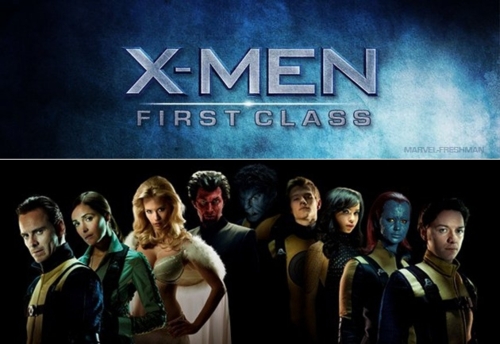
So, I thought I'd just say a few words about the recently released film, X-Men: First Class, which is the 5th film based on the Marvel Comics series originally launched in 1963 by Stan Lee and Jack Kirby.  It's also the second prequel, and essentially relates the origin of the X-Men.


Now, I'm not going to go all fan-boy on you and write about whether the films are true to the original comics in their depiction of characters and plot lines, whether they diverge for reasons good or bad, etc.  As an old, old time comics reader, I have mixed feelings about all that, but as a media scholar I think it clear that when it comes to film adaptations, original texts are nothing more than raw material. 

And comics in general, have served as quite a  productive laboratory for raw material, as numerous authors have worked and reworked the characters and narratives over half a century, or more.  There is a wealth of material to draw on, and the task becomes one of developing a coherent and captivating narrative and spectacle without entirely losing the connection to the original, the character's integrity, the basic story's key elements, etc.

So, X-Men: First Class emerges out of the comics own reworking and revising of its own material, its back story and history, as X-Men leader and mentor, Professor Charles Xavier, aka Professor X, was originally nothing more than an enemy to Magneto, the supervillain and leader of the Brotherhood of Evil Mutants (yes, that is what they called themselves!).  But for more sophisticated times, their early history was re-imagined as one of friendship, leading to a split, as along the lines of Martin Luther King and Malcom X.  So Professor X and Magneto, or Charles and Erik, are at once colleagues, friends, rivals, frenemies (to use a recent coinage), and foes, and the film, while featuring a legion of superpowered mutants, focuses on their early relationship, as can be seen from at least some of the trailers:


The main theme of the X-Men comics, especially for the past several decades, has been bias, stereotyping, prejudice, scapegoating, oppression, etc., directed at mutants.   As alluded to above, one source for this is the civil rights movement, and the history of African-Americans in the United States.  The opposition between the nonviolent leadership of Martin Luther King and the militant stance of Malcom X, central to Spike Lee's 1989 cinematic masterpiece, Do the Right Thing, is played out in a less threatening, more distanced manner, through the conflict between the two mutant leaders. 

This requires a shift in the way Magneto is portrayed, from pure villain, an evil mutant, to something significantly more ambiguous.  He becomes the realist to Xavier's idealist, the defender of his people, a classic hero trait.  Indeed, over the past few decades, the comics have shifted wildly in their portrayal of this character, at some points turning him into a reformed criminal, a genuine superhero, and at other points making him out to be a terrorist and mass murderer. 

No doubt, this reflects some of our own ambivalence about terrorists.  As much as we abhor them, especially after 9/11, there is the difficult lack of clarity about how to define a terrorist.  Back when Reagan was president, I remember how many of us found it ridiculous when, in one of his speeches, he spoke about fighting terrorists while supporting freedom fighters.  What a case of semantic confusion!  And given our nation's birth in revolution, within American culture we identify with the freedom fighters, the rebels and revolutionaries, fighting against the evil empire (another Reaganism).  Our anti-authoritarianism supports all that anti-government politics that, most recently, has taken the form of the Tea Party (back in Boston, a revolutionary, and anti-authoritarian action).  And it leads us to make heroes out of outlaws, e.g., Jesse James, Al Capone, etc.  Magneto, then, moves into the outlaw-hero mode, at least at times.

Another, more recent, source of inspiration is the gay rights movement, as for example the line, "Mutant and Proud" is repeated several times in X-Men: First Class.  Along similar lines is the theme of scientists developing a "cure" for mutation, and forcing it on mutants who may not want it.  This appears first in comics, and then makes its way to the movies, for example the most recent of the sequels, X-Men:  Last Stand:


Here we see Magneto as militant leader and as terrorist, most dramatically in the destruction of the Golden Gate Bridge.

But there is a third major source of inspiration that cuts close to the bone for me, and that's Jewish history, especially in the 20th century.  The Holocaust is a major touchstone for any discussion of prejudice and scapegoating, and the theme of genocide comes up repeatedly in the comics, as well as actual images of concentration camps (often in alternate future scenarios where anti-mutant sentiment is carried out to its extreme). 

But there is more than metaphor at work here, as Magneto is depicted as having been sent to a concentration camp as a child, losing his parents there, and being shaped by the traumatic experience.  This is shown in the first X-Men movie, at the very beginning, where we see Magneto as a boy, reacting to the loss of his parents with an initial, sadly limited display of his magnetic powers.  The same scene is shown in X-Men: First Class, now fleshed out as he suffers at the hands of a mutant-obsessed Dr. Mengele-type Nazi doctor, whose brutality permanently scars the young Erik.  That same doctor becomes the villain of the film as the action shifts to 1962, eventually intersecting with JFK's Cuban Missile Crisis.

Interestingly, I've come across a fan-film on YouTube, put together from scenes from the first X-Men movie and its sequels (but not X-Men: First Class) in 2009 that's called X-Men Origins:  Magneto Trailer.  It's intended to give a sense of what that sort of movie would look like, and in a sense that's what X-Men: First Class really is, but it's useful in this context because it brings together key moments from Ian McKellen's portrayal of the contemporary, old Magneto from the first 3 films:


You might note that, apart from the Holocaust setting, there actually is nothing Jewish about this character who is presented to us as Jewish.  If anything, Ian McKellen provides a very British counterpoint to Patrick Stewart, as does Michael Fassbender as the young Magneto (he was raised in Ireland) to James McAvoy's young Xavier (he was raised in Scotland).  I mean, absolutely nothing Jewish about him, aside from the fact that he is identified as Jewish, and sent to a concentration camp.  Being Jewish, then, is reduced to a symbol, first of being a victim, then of the idea of never again (the slogan of the Jewish Defense League founded by extremist Meir Kahane, who some saw as a terrorist), of an "Old Testament" (from a Christian point of view) eye for an eye approach in contrast to Xavier's turn the other cheek (no crucifixion in this instance, but he does lose his ability to walk, the wheelchair having been a symbol of leadership in the postwar era, as FDR's disability became widely known), of going too far.  And I can't help but wonder if his character doesn't, in this sense, reflect the negative view that all too many hold of the State of Israel today, of employing unnecessary force, disproportionate responses, occupying territory and oppressing the inhabitants, etc. 

Is Israel like Magneto?  No, of course not. But the contemporary character of Magneto reflects, in certain ways, popular negative views of the Jewish state, misconceptions and ignorance about the historical, cultural, political and military context of the Middle East, and ironically enough, bias and prejudice against the Jewish people (some of which is held by Jews themselves, a not uncommon phenomenon among groups subjected to this sort of treatment).  You know, in the aftermath of the Holocaust, Jews were seen mainly as victims, and the question everyone seemed to be asking was, how could you (meaning us Jews) let it happen?  And specifically, how could you let them march you off without a fight to the concentration camps to be killed?  There was not only incredulity in the way the questions were posed, but also a hint of ridicule. 

At that time, it was not well understood how manipulate the Nazis were, how deceptive they were about where they were taking their Jewish captives, and how weakened the Jews were by a prolonged prelude of deprivation.  Nor was it well known that there were some groups that did take up arms and fight against the Nazi war machine.  But as far as I can recall, no one praised the Jews for our long history of nonviolence, as they did in making a secular saint out of Mahatma Gandhi, or Martin Luther King, or countless Christian martyrs and clergy.  Maybe people only esteem nonviolence when it's successful?  Or maybe that's the problem with prejudice, whatever you do or don't do, you're wrong.

Back in the days when Stan Lee and Jack Kirby, both Jewish, were making the Marvel Universe from scratch, Magneto was not Jewish.  He was a concentration camp survivor, yes, but Jews were not the only ones who were interned there.  He was not Jewish, but you can understand that the character reflected some aspects of Jewish experience, as did Spider-Man (early on identified as Woody Allen turned superhero) and the Fantastic Four's The Thing, aka Benjamin Grimm (a rough and tumble lower east side type), as did Superman earlier on, and The Spirit, and much of the comic output at mid-century.  But there were no characters identified as Jewish until recently, in some ways reflecting Jewish reticence (keep a low profile, and one bag packed for that matter), no doubt also the feeling that the mainstream reader could not relate to or sympathize with Jewish characters, but maybe perhaps too the sense that prejudice would distort the message that the characters are meant to convey.

Truth be told, we have not figured out how to deal with Jewish characters in these kinds of popular narratives.  Comedy, yes, no problem, and drama, sure, we can work with that.  But adventure, science fiction, fantasy, horror, not so much.  I should note, though, that Marvel Comics did introduce a good Jewish mutant back in the 80s, a young girl named Kitty Pryde who has the power to become intangible. Here's an image from Marvel's Ultimate line of comics, a more recent reworking of their original, ongoing universe, one where her Star of David is more frequently and prominently seen:


Kitty does appear make a brief appearance in one or two of the X-Men movies, I don't recall which off hand, but anyway she is never identified by name, let alone religion.  I also want to honorably mention Willow Rosenberg, from the TV series, Buffy the Vampire Slayer:


I only saw an occasional episode of the series on reruns until just recently, when I've been going through the entire run, and just started on the 7th and last season.  So, early on, Willow mentions the fact that she's Jewish on occasion, but that's about it.  She still uses crosses to ward off vampires, becomes a witch and therefore identified as a Wiccan in later seasons, and that, along with being a lesbian, dominates her identity.  Oh, I should add that Joss Whedon clearly draws on the X-Men comics at the end of season six, when Willow loses control and becomes Dark Willow, a reference to the well known (in the comics world) Dark Phoenix character and storylines.  That happens after Willow's lover is murdered, so I guess that makes her a bit like Magneto, after all.

So, what's the point of all this.  To be honest, I'm really unsure, and to be honest, I'm not altogether comfortable in bringing it up, but I did feel that I should say something about my discomfort with Magneto's Jewish identity.  Maybe I'm overly sensitive as the child of Holocaust survivors myself, but Magneto is a murderer, whatever else he may be, and I don't know, maybe it's happened, but have you ever heard of a Holocaust survivor murdering anyone?  I tried googling it, but all that I saw coming up, in an admittedly cursory search, were news stories about survivors being murdered.  So for me, this new back story just doesn't ring true.

Maybe it's just that being Jewish works well for the storyteller, we really have been telling some all time great stories for the past four thousand years, but when it comes to being characters in other people's narratives, well, that's where the trouble begins, the bias and the scapegoating, that's when they prick us and we start bleeding, profusely.  Maybe. 

Or maybe it's just that, for me, when it comes to the movies' Magneto, the character just doesn't hold any attraction?


Thursday, June 16, 2011

Everywhere a Sign

So, I don't know if they play the song on the radio more often in the summer than at other times of the year, but it just seems that whenever the weather warms up I start to hear the song, "Signs" which was originally performed by the Five Man Electrical Band in 1970, and written by band member Les Emmerson.  It really is one of the great protest songs of the 60s (some of you may not know that "the 60s" extended into the first few years of the 70s, and didn't quite get started until 1962), it always gets me in a mood to shout "right on!" (well, maybe not exactly, but something like that), but it also has an underlying spiritual and religious quality that I find quite endearing. 


So I checked over on YouTube and it turns out there's a plethora of videos set to the song.  It seems that folks just can't resist the temptation to create a montage of signs to go along with the tune.  Here's one that seems to be particularly popular, and uses the longer version of the song (the difference being a short instrumental intro before the singing starts):


And here are the lyrics:

And the sign said "Long-haired freaky people need not apply"
So I tucked my hair up under my hat and I went in to ask him why
He said "You look like a fine upstanding young man, I think you'll do"
So I took off my hat, I said "Imagine that. Huh! Me workin' for you!"


Sign, sign, everywhere a sign
Blockin' out the scenery, breakin' my mind
Do this, don't do that, can't you read the sign?


And the sign said anybody caught trespassin' would be shot on sight
So I jumped on the fence and-a yelled at the house, "Hey! What gives you the right?"
"To put up a fence to keep me out or to keep mother nature in"
"If God was here he'd tell you to your face, Man, you're some kinda sinner"


Sign, sign, everywhere a sign
Blockin' out the scenery, breakin' my mind
Do this, don't do that, can't you read the sign?


Now, hey you, mister, can't you read?
You've got to have a shirt and tie to get a seat
You can't even watch, no you can't eat
You ain't supposed to be here
The sign said you got to have a membership card to get inside


And the sign said, "Everybody welcome. Come in, kneel down and pray"
But when they passed around the plate at the end of it all, I didn't have a penny to pay
So I got me a pen and a paper and I made up my own little sign
I said, "Thank you, Lord, for thinkin' 'bout me. I'm alive and doin' fine."


Sign, sign, everywhere a sign
Blockin' out the scenery, breakin' my mind
Do this, don't do that, can't you read the sign?

Now, if you are at all into semiotics, aka semiology, you might well regard this song as an anthem celebrating that field.  After all, semiotics was defined as the "science of signs" and alternatively as the study of signs, and the key term of sign refers to anything that has meaning beyond itself, anything that has significance, is significant, anything that signifies.   

The term sign in semiotics is used in much the same way that the term symbol has been used in other approaches, although in semiotics, symbol is a subset of sign, along with icon (i.e., visual images), and index (i.e., natural objects like tracks left by an animal, smoke as an indication of fire, yellow skin as a symptom of jaundice, the appearance of storm clouds "announcing" that it's about to rain, or a dog growling as a warning that it will attack if its space is violated).  In other fields, symbol may be similarly differentiated and limited to digital codes, or simply contrasted to signals (the equivalent of the index in semiotics), or may be used in as broad a manner as semioticians use sign (as Susanne K. Langer does, for example).

Semiotics and semiology share a common root with semantics, the root sem referring to meaning, and I should note that there is also some connection to general semantics:  Korzybski considered Charles Saunders Peirce, the 19th century pragmatist philosopher and founder of semiotics, to have developed his own version of a non-Aristotelian approach.  In general semantics, the term symbol is used more commonly than sign, Korzybski followed Pavlov in distinguishing between symbol reactions and signal reactions, combining them under the heading of semantic reactions.  Of course, his key term was abstracting, rather than symbol or meaning, but I digress.

So, anyway, I don't think it would come as any surprise that some hip semioticians have used the line, "sign, sign, everywhere a sign" in their publications on semiotics.  I don't have any specific quotations handy, but I know I've seen it used a number of times.  I'm fairly certain the prolific communication scholar Arthur Asa Berger was one of the scholars who did so.  

But I don't want to talk semiotics here.  Instead, I want to bring in some media ecology.  But first, let's take a break and check out another version of the song,   In 1990 a band called Tesla (note the electricity connection, and pardon the pun) did a live acoustic version of the song that became a big hit, and all in all, I think they did a very good job of it, albeit with a few minor, profane adjustments to the lyrics:


So now, where was I?  Oh yes, In Orality and Literacy, Walter Ong states, in taking issue with Jacques Derrida's rather absurd claim that writing preceded speaking, that "words are not signs."  This has to be understood as something more than a rejection of semiotics, however.  Ong reminds us that words are primarily utterances, speech, and therefore sounds, acoustic phenomena.  We call the written word words, but in reality writing is a secondary symbol system, the letters or characters standing for sounds, in the case of the alphabet or syllabic writing, for sounds that we put together to form words, in the case of logographic writing (e.g., Chinese ideograms) for the sounds of a word in its entirety.

So, Ong doesn't want us to confuse the written representation of a word with the genuine word itself as a speech-act (whether actually occurring, or in potential).  So, why does that make the term sign problematic, given its relatively abstract definition, which can be applied to anything we perceive as meaningful in some way?  The problem lies not in the definition, but the etymology of the word, which is decidedly visual, referring to a mark, a token, or more basically, a gesture, a pointing out.  Even the ways in which we explain the process of signfication tends to invoke visual terms, that a sign stands for something else, points to something else, re-presents something else.  Signs are seen, not heard, are shown, discerned, revealed, read.  They can be found in the clouds, the flight of birds, in tea leaves, in the stars and planets, in the entrails of a sacrificial lamb, in the palm of your hand.

And of course, signs are a medium for the public display of written messages.  That's what the song is all about.  The lyrics repeat the phrase, "the sign said" and sure, that's how we talk about it, but technically, signs do not say anything, they don't speak (leaving out new kinds of electronic screens), they display, and we read them.  Technically, yes, but there's a more important point to be made here.

The song protests the ubiquitous nature of signage--everywhere a sign.  And while there's a quick nod to their visual pollution of the natural environment, which relates back to First Lady Jackie Kennedy's Keep America Beautiful campaign, and the particular complaint against the postwar proliferation of billboard advertising, the main issue is one of control.  Signs are used to control behavior, telling us what we have to do and what we are not allowed to do--do this, don't do that.  Through the use of the written word, signs convey authority, so that beyond someone telling you what to do, they point to the sign for support, legitimacy, and power--can't you read the sign? 

So, the point is that in a literate culture, the practice arises of putting up signs that not only identify things and relate information, but also that command.  And this practice has been especially relied upon in the west, and in the modern, typographic era, where increasing literacy rates increased the efficacy of written signage.  What we have done, in effect, has been to provide an overlay of the written word onto the natural environment, and more to the point, onto the artificial environment of roads and buildings that we have created for ourselves.
 
Go for a drive and signs are essential.  Walk down a street and see how many signs surround us.  And sure, advertising has become a big part of it, but it's also signs that name each street and that name or at least number each house and building.  One of the problems our soldiers faced in Iraq, in mounting counterinsurgency efforts, is that many of the roads there had no name, and the houses had no number.  How then, to find anything, or anyone?  

And back in 1945, when we occupied Japan, we ran into a different kind of problem, as they were more of a literate society, but one based on the Japanese syllabary and Chinese ideograms rather than the alphabet.   So, in Japan, they named or numbered the blocks, not the streets, and they numbered houses not in linear, spatial order, but in the order that they were built, so the oldest house would be number 1, for example, and the next one built would be number 2, and so on.  Edward T. Hall wrote about some of these intercultural differences regarding the human use of space, which he termed proxemics, in his classic work, The Hidden Dimension.

Signs are semiotic, and semantic, in that they tell us what things mean.  That's why we look at the little sign next to the painting in the art museum, to give us some meaning, some context, some idea of what the image is about.  Even just knowing the identify of the painter helps to explain the painting to us, and before there was the sign in the museum, there was, dating back to the Renaissance, the artist's signature.

So, we have overwritten our world by way of signs, turning it into a book.  Nature was once held to be a book, a complementary volume to scripture, and from this idea came modern science.  McLuhan made the point that the medieval grammarians (grammar being the ancient/medieval study of language and literature, of meaning and interpretation, which would relate to general semantics and media ecology) pioneered this approach to studying both God's word and God's works.  

But we weren't satisfied with just seeing the world as a book to be read, we wound up filling it with our own marginalia. 

So, this situation makes perfect sense to members of a typographic culture.  But for those born into the new electronic culture that television had given rise to, the ubiquity of signs suddenly shifts from background, routine and environmental, to the foreground of consciousness.  Their function, to control and coordinate, are likewise make visible and obvious, and are seen as oppressive.  The electronic kids of the postwar baby boom chafed at the restrictions of the posted sign, their static nature, all status quo, put into sharp relief against the dynamism of electronic media.  So this generation rose up in rebellion against many things, including signs.

It is therefore no accident that the song begins, seemingly in medias res, with the line:  And the sign said "Long-haired freaky people need not apply" (starting the sentence with "And" has a biblical resonance to it, relating to an ancient Hebrew poetic tradition, and you may have noticed that I begin sentences this way quite often).  It is an acknowledgement of the generation gap that existed at that time, a gap much wider than any that exists between baby boomer parents and their offspring.  Throughout the song, signs are hostile to hippies, to the young, and generally, to people who are trying to live freely, openly, and ethically.  Signs divide and conquer, they keep you out and support unfair claims of property rights.  Perhaps most damning of all,

Signs are sins!
Si(g)ns

Now that's heavy!  Well, I have more to say about this, but maybe we need to take another break.  And since I brought up the first line of the lyrics, I think it worth including on this post that a fellow called Fatboy Slim (real name Norman Cook) created an electronic dance piece called "Long Haired Freaky People" drawing on the first line of "Signs" which certainly is an homage of sorts:


And before continuing on, let me also mention that I thought that Sarah Brimley's video set to Fatboy Slim recording was quite impressive:


Now, let me see, ok, yeah, so the song ends with the narrator turning the tables:  So I got me a pen and a paper and I made up my own little sign.  Now holding aside the question of whether his writing a note and sticking into the collection plate can be called a sign or not, the important point is the shift from signs as a read-only mode of communication to a read-write mode, and this of course presages the further evolution of electronic culture from television to new media, which are also referred to, quite aptly in this instance, as participatory media.  The counterculture ethic that this song expresses is the yearning for participation, and the new electronic media have made that possible.

So now here we are over four decades after "Signs" was released, and we are now in the process of writing over our environment once again, only this time electronically.  For one, we are seeing more and more electronic signs, which are dynamic (sometimes causing problematic distractions for drivers) and could and will potentially provide messages tailored to the individual passerby.  Through our mobile devices, we also are making it possible to access information about places, using GPS tracking to create a virtual electronic environment to overlay the physical place, using the built-in camera to recognize places and provide information about them, and using QR codes posted in the environment to link to material online.

We are continually remaking our environments, and typically not by building from scratch, but by overlaying the new on top of the old.  So now, we are adding to the ubiquity of signs, ubiquitous computing, and in doing so, maybe the written signs will become less necessary, and the environment will be better off, at least visually, for it.

So, we have gone from the age of signs, to the age of networks. And I think that's an improvement over all, but there still may be a new protest song in there, somewhere, sometime.

Oh, and by the way, if you want to hear a live version from the original Five Man Electrical Band, you can catch it towards the end of a clip from a 2004 television appearance, but you have to watch it over on YouTube, as embedding is disabled for this one:  Five Man Electrical Band live on Mike Bullard Show (and yes, they've aged, but still retain that spirit of rebellion). 

And that's all for now, so this is Lance Strate, signing off...