Some online interactions that I've had recently got me thinking about how the idea of a system can become problematic in certain ways.
As Walter Ong has explained, the term system is a visual metaphor, with roots in astronomy, as in the solar system.

The image above is a diagram of the Copernican, heliocentric system, rendered by none other than Galileo Galilei. And the term system comes into popular use in the era of Copernicus and Galileo, that is, in the era of typography. As McLuhan has noted, the Gutenberg galaxy (by which he meant the typographic media environment and the print culture it gave rise to) heightened the importance of the visual sense, stressing its use in isolation from the other senses, an unnatural mode of perception, but one essential to the habit of reading.
What is also unnatural is the way that the visual sense is used by literates, focusing on a fixed point of view at a fairly close distance. That's how we read, but most other uses of vision require us to use our eyes quite differently, whether we're scanning our environment for threats and opportunities, or attending to another person's facial expressions, gestures, and stance in interaction. Reading amounts to training our eyes to see in ways that run counter to our natural instincts and inclinations, and this in turn results in some rewiring of the brain's neural pathways.
As a consequence, print culture has been characterized by visualism, as the cultural trend is referred to, and this is quite different from the use of images and imagistic language in oral and preliterate cultures, and in cultures where literacy is limited. It is also quite different from our own contemporary image culture, which is associated with audiovisual media.
Visualism is very much connected to the rise of modern science, which is based on the empirical method, which is to say that it is based on observation. In particular, it's based on the idea that we can be observers standing apart and outside of what we observe, as outsiders looking on, spectators, peeping toms, voyeurs, etc. In other words, visualism brings with it objectivism, the idea of objectivity, that you can observe phenomena in a detached, uninvolved manner, that the phenomena are unaffected by the act of observation, and that it is possible to separate ourselves from our subjectivity.
To be objective is to treat the objects of our observation as objects, to engage in objectification. McLuhan notes that this has its roots in the ancient world, and from it comes the idea of nature as something separate and apart from human beings. In objectifying nature, we think of it as something that can be opposed, contained, controlled, defeated, possessed, and manipulated. Camille Paglia in Sexual Personae makes the great point that this a delusion, but a delusion that has resulted in most of the great works and progress that have been accomplished in science, technology, and art.
Literacy is also associated with linearity, and this goes back to the first writing system, cuneiform, developed by the Sumerians in Mesopotamia circa 3500BCE, as Denise Schmandt-Besserat has shown. Linear thinking is very much apparent in Aristotle's logic, which takes us step by step through a thinking process, and also evolved as a method for organizing the process of categorizing information (e.g., if an item is a member of a category, and that category is a member of a larger category, then that item is also a member of that larger category). And as Eric Havelock, along with Ong and McLuhan have shown, literacy leads to the use of more high-level abstractions, whereas the oral mindset favor more concrete verbal formulations. Again, logic and abstract thinking take us farther away from reality, but are also associated with progress in science and technology.
So, returning to the idea of system, it is very much a part of this historical development, and there is no question that visual charts, graphs, tables, and diagrams are enormously useful. So what's the problem with system then?
For Ong, it's a symptom of a larger shift that was centered in many ways in Ramism, an approach to education and knowledge introduced by Peter Ramus (1515-1572), made possible by the printing revolution, and indeed reflecting the biases of the typographic medium. Ramus shifted the emphasis in education away from dialogue, debate and disputation, the understanding that scholarship and knowledge is based on an ongoing conversation.
Instead, what Ramus emphasized is that knowledge can be understood as a set of facts, organized logically and presented in visual form, as an outline or diagram or the like, and Ramist education was based on conveying knowledge in this manner.

This may be a more efficient way to summarize, organize, and present knowledge, but the human element is abstracted out of it, and with its removal we also lose any sense of human subjectivity. Rather than primary sources read against one another, we get a textbook. Rather than learning about the method of knowledge acquisition, and especially its character as an ongoing, never ending activity, we are given the impression of a field or discipline as established, set, fixed, closed, and complete. A system.

Indeed, part of the problem is the idea of a system as having boundaries, as in the mathematical notion of a set. Even if you take into account that sets can overlap, and/or be nested within one another, we still lose the idea of open-ended discourse, as opposed to a limited set of facts that can be listed, presented for visual display, complete and bounded.

The cell membrane is another basis for comparison with the idea of system. And while membranes are by their very nature permeable, they still must maintain a strict boundary between what is in the system and what is outside of the system, that is, what is the system's environment. This is an important idea, and I want to be clear that the idea itself is not the problem, but rather its overemphasis.

And then there is the well known diagram of the particles that make up an atom, which has for long been presented in a manner quite similar to that of the solar system. But of course we know that this is not at all an accurate representation for whatever is going on down at that level. Indeed, subatomic physics in certain respects defies visual representation.
Now, admittedly, I've been using examples related to the solar system, of systems with clear boundaries, and I should acknowledge that there are other kinds of systems. For example, the nervous system:

And the subway system:

But while there is no membrane, per se, we still are presented with a sense of closure, the system as complete and contained within the diagram. And of course this also applies to the Ramist diagram shown above, which amounts to a kind of outline turned over on its side.
But there is more to the idea of system than just visualism. System also is associated with systematizing, that is, an attempt to reduce activity down to an established set of steps or procedures. We can recognize in this sense of system a scientific orientation and the full application of operationalism, that is, operational definitions, so again it is quite useful. But operationalism also gives rise to a mechanical and technical orientation, what Lewis Mumford considers machine ideology, and Jacques Ellul terms la technique. Again, there is the removal of the human element, as occurs when a handicraft is mechanized, and for this reason the emphasis on mechanization and technologization has been criticized by scholars such as McLuhan, Mumford, Ellul, and Neil Postman.
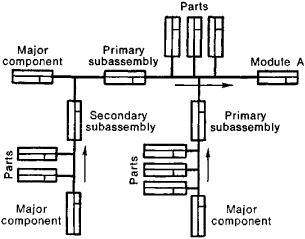
The assembly line, as depicted above, is a linear approach to systematization taken to an extreme. And while the electric circuit counters the linearity of mechanization, the technological bias towards systematization is still present:

And of course, it is readily apparent in computer programming (Ramist diagrams are considered to be an ancestor of the computer program and flowchart):

And here's one more example, just for good measure (and humor):

So, system reflects a technological mentality, reducing human activity to a standardized program, especially one that can be made into a visual model or chart. Again, we return to the principle of containment and control that is also associated with visualism.
Now, the online interactions I mentioned at the beginning of this post had to do with general semantics, which Alfred Korzybski referred to as a non-Aristotelian system. And he did not use the term system casually, he was very much interested in systematizing his insights into human thought and behavior, and developing general semantics as a "teachable system," to invoke a phrase he used in a letter he wrote to Robert Maynard Hutchins. And by this he meant a simple, easy to learn, set of steps, specifically geared for common folk, as opposed to something that only academics and intellectuals could understand. His goal to improve the common person's ability to think clearly and evaluate reality was commendable, and general semantics itself represents an important contribution to human understanding.
But the irony is that he failed to realize that the idea of a non-Aristotelian system is oxymoronic, in that the idea of a system in general, in being visual and logical, is itself an Aristotelian formation. Korzybski didn't realize that he was using an Aristotelian method to present a non-Aristotelian approach. Consider, for example, Korzybski's primary model, the structural differential:
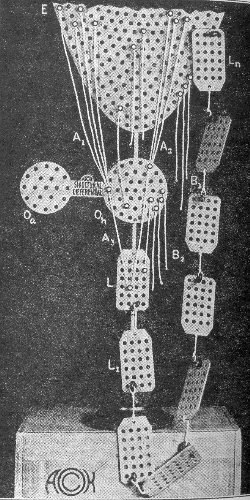
The broken parabola at the top is meant to represent the fact that we can only experience part of reality. The parabola is broken to convey the sense of incompleteness of knowledge and experience, and yet the fact remains that the shape is complete, albeit irregular, rather than being infinite. The model itself represents human experience in a systematized fashion, a process of abstracting from direct perception to symbolic representation, from naming to labeling, from less to more general categories, etc. But human experience does not work along clearly delineated, orderly steps. Like reality itself, human experience is unbounded.
I want to make it clear that I am not trying to dismiss the value of general semantics or the importance of Korzybski. But we also have to understand that he was a product of his times, his major work on general semantics, Science and Sanity, was published in 1933, and he was also biased due to his training as engineer and the kind of faith in science that was common in the early 20th century, but since has been adjusted significantly. Korzybski very much privileged the visual sense, arguing that images are closer to the direct experience of reality than words, again reflecting how his thinking was colored by his background in science and engineering. Even his famous saying, the map is not the territory, reflects a visual bias.
So, Korzybski tried to create a containable method to represent an uncontainable reality, and this amounted to a contradiction and flaw in general semantics as a discipline and movement. He formulated general semantics as a response to the new way of understanding the universe introduced by Einstein's revolution in physics. But as McLuhan has discussed, this scientific revolution, paralleled by the revolution in art known as modernism, are related to the advent of electric technology and communications beginning in the 19th century, which results in a transition away from the typographic media environment, print culture, and visualism. Korzybski was marching into the future facing backwards, or looking through the rearview mirror as McLuhan liked to put it. But that should come as no surprise, as this is what we all do. Had he lived a little later, I believe he would have come to understand the limits of visualism, and the need to move beyond it.
As Walter Ong has explained, the term system is a visual metaphor, with roots in astronomy, as in the solar system.
The image above is a diagram of the Copernican, heliocentric system, rendered by none other than Galileo Galilei. And the term system comes into popular use in the era of Copernicus and Galileo, that is, in the era of typography. As McLuhan has noted, the Gutenberg galaxy (by which he meant the typographic media environment and the print culture it gave rise to) heightened the importance of the visual sense, stressing its use in isolation from the other senses, an unnatural mode of perception, but one essential to the habit of reading.
What is also unnatural is the way that the visual sense is used by literates, focusing on a fixed point of view at a fairly close distance. That's how we read, but most other uses of vision require us to use our eyes quite differently, whether we're scanning our environment for threats and opportunities, or attending to another person's facial expressions, gestures, and stance in interaction. Reading amounts to training our eyes to see in ways that run counter to our natural instincts and inclinations, and this in turn results in some rewiring of the brain's neural pathways.
As a consequence, print culture has been characterized by visualism, as the cultural trend is referred to, and this is quite different from the use of images and imagistic language in oral and preliterate cultures, and in cultures where literacy is limited. It is also quite different from our own contemporary image culture, which is associated with audiovisual media.
Visualism is very much connected to the rise of modern science, which is based on the empirical method, which is to say that it is based on observation. In particular, it's based on the idea that we can be observers standing apart and outside of what we observe, as outsiders looking on, spectators, peeping toms, voyeurs, etc. In other words, visualism brings with it objectivism, the idea of objectivity, that you can observe phenomena in a detached, uninvolved manner, that the phenomena are unaffected by the act of observation, and that it is possible to separate ourselves from our subjectivity.
To be objective is to treat the objects of our observation as objects, to engage in objectification. McLuhan notes that this has its roots in the ancient world, and from it comes the idea of nature as something separate and apart from human beings. In objectifying nature, we think of it as something that can be opposed, contained, controlled, defeated, possessed, and manipulated. Camille Paglia in Sexual Personae makes the great point that this a delusion, but a delusion that has resulted in most of the great works and progress that have been accomplished in science, technology, and art.
Literacy is also associated with linearity, and this goes back to the first writing system, cuneiform, developed by the Sumerians in Mesopotamia circa 3500BCE, as Denise Schmandt-Besserat has shown. Linear thinking is very much apparent in Aristotle's logic, which takes us step by step through a thinking process, and also evolved as a method for organizing the process of categorizing information (e.g., if an item is a member of a category, and that category is a member of a larger category, then that item is also a member of that larger category). And as Eric Havelock, along with Ong and McLuhan have shown, literacy leads to the use of more high-level abstractions, whereas the oral mindset favor more concrete verbal formulations. Again, logic and abstract thinking take us farther away from reality, but are also associated with progress in science and technology.
So, returning to the idea of system, it is very much a part of this historical development, and there is no question that visual charts, graphs, tables, and diagrams are enormously useful. So what's the problem with system then?
For Ong, it's a symptom of a larger shift that was centered in many ways in Ramism, an approach to education and knowledge introduced by Peter Ramus (1515-1572), made possible by the printing revolution, and indeed reflecting the biases of the typographic medium. Ramus shifted the emphasis in education away from dialogue, debate and disputation, the understanding that scholarship and knowledge is based on an ongoing conversation.
Instead, what Ramus emphasized is that knowledge can be understood as a set of facts, organized logically and presented in visual form, as an outline or diagram or the like, and Ramist education was based on conveying knowledge in this manner.
This may be a more efficient way to summarize, organize, and present knowledge, but the human element is abstracted out of it, and with its removal we also lose any sense of human subjectivity. Rather than primary sources read against one another, we get a textbook. Rather than learning about the method of knowledge acquisition, and especially its character as an ongoing, never ending activity, we are given the impression of a field or discipline as established, set, fixed, closed, and complete. A system.
Indeed, part of the problem is the idea of a system as having boundaries, as in the mathematical notion of a set. Even if you take into account that sets can overlap, and/or be nested within one another, we still lose the idea of open-ended discourse, as opposed to a limited set of facts that can be listed, presented for visual display, complete and bounded.

The cell membrane is another basis for comparison with the idea of system. And while membranes are by their very nature permeable, they still must maintain a strict boundary between what is in the system and what is outside of the system, that is, what is the system's environment. This is an important idea, and I want to be clear that the idea itself is not the problem, but rather its overemphasis.
Now, admittedly, I've been using examples related to the solar system, of systems with clear boundaries, and I should acknowledge that there are other kinds of systems. For example, the nervous system:
And the subway system:
But there is more to the idea of system than just visualism. System also is associated with systematizing, that is, an attempt to reduce activity down to an established set of steps or procedures. We can recognize in this sense of system a scientific orientation and the full application of operationalism, that is, operational definitions, so again it is quite useful. But operationalism also gives rise to a mechanical and technical orientation, what Lewis Mumford considers machine ideology, and Jacques Ellul terms la technique. Again, there is the removal of the human element, as occurs when a handicraft is mechanized, and for this reason the emphasis on mechanization and technologization has been criticized by scholars such as McLuhan, Mumford, Ellul, and Neil Postman.
The assembly line, as depicted above, is a linear approach to systematization taken to an extreme. And while the electric circuit counters the linearity of mechanization, the technological bias towards systematization is still present:
And of course, it is readily apparent in computer programming (Ramist diagrams are considered to be an ancestor of the computer program and flowchart):
And here's one more example, just for good measure (and humor):
So, system reflects a technological mentality, reducing human activity to a standardized program, especially one that can be made into a visual model or chart. Again, we return to the principle of containment and control that is also associated with visualism.
Now, the online interactions I mentioned at the beginning of this post had to do with general semantics, which Alfred Korzybski referred to as a non-Aristotelian system. And he did not use the term system casually, he was very much interested in systematizing his insights into human thought and behavior, and developing general semantics as a "teachable system," to invoke a phrase he used in a letter he wrote to Robert Maynard Hutchins. And by this he meant a simple, easy to learn, set of steps, specifically geared for common folk, as opposed to something that only academics and intellectuals could understand. His goal to improve the common person's ability to think clearly and evaluate reality was commendable, and general semantics itself represents an important contribution to human understanding.
But the irony is that he failed to realize that the idea of a non-Aristotelian system is oxymoronic, in that the idea of a system in general, in being visual and logical, is itself an Aristotelian formation. Korzybski didn't realize that he was using an Aristotelian method to present a non-Aristotelian approach. Consider, for example, Korzybski's primary model, the structural differential:
The broken parabola at the top is meant to represent the fact that we can only experience part of reality. The parabola is broken to convey the sense of incompleteness of knowledge and experience, and yet the fact remains that the shape is complete, albeit irregular, rather than being infinite. The model itself represents human experience in a systematized fashion, a process of abstracting from direct perception to symbolic representation, from naming to labeling, from less to more general categories, etc. But human experience does not work along clearly delineated, orderly steps. Like reality itself, human experience is unbounded.
I want to make it clear that I am not trying to dismiss the value of general semantics or the importance of Korzybski. But we also have to understand that he was a product of his times, his major work on general semantics, Science and Sanity, was published in 1933, and he was also biased due to his training as engineer and the kind of faith in science that was common in the early 20th century, but since has been adjusted significantly. Korzybski very much privileged the visual sense, arguing that images are closer to the direct experience of reality than words, again reflecting how his thinking was colored by his background in science and engineering. Even his famous saying, the map is not the territory, reflects a visual bias.
So, Korzybski tried to create a containable method to represent an uncontainable reality, and this amounted to a contradiction and flaw in general semantics as a discipline and movement. He formulated general semantics as a response to the new way of understanding the universe introduced by Einstein's revolution in physics. But as McLuhan has discussed, this scientific revolution, paralleled by the revolution in art known as modernism, are related to the advent of electric technology and communications beginning in the 19th century, which results in a transition away from the typographic media environment, print culture, and visualism. Korzybski was marching into the future facing backwards, or looking through the rearview mirror as McLuhan liked to put it. But that should come as no surprise, as this is what we all do. Had he lived a little later, I believe he would have come to understand the limits of visualism, and the need to move beyond it.
General semantics was in part the basis for systems theory, or what Bertalanffy called general system theory, following Korzybski's example, and there the idea of system takes an interesting turn. The systems view is decidedly nonlinear, a sensibility that Korzybski's general semantics pioneered. And in its holistic approach, systems theory runs counter to the analytic mode that alphabetic literacy also is associated with, and Korzybski criticized as elementalism. The systems view therefore does not favor a step by step, systematic and systematizing approach to processes. So it is, in may respects, a further evolution in the kind of thinking that general semantics emphasizes. But systems thinking does retain a visual element:

Consider as an alternative to system the idea of network, especially in its decentralized form:

Although still visual, we no longer have clear boundaries, especially when you consider that the outer nodes are connected to other nodes outside of the diagram. And as we start to get into more full scale representations of social networks, it is not just the outer connections that take us away from the idea of clear boundaries, but also the density of inner connectivity, which goes beyond our ability to fully grasp and contain:
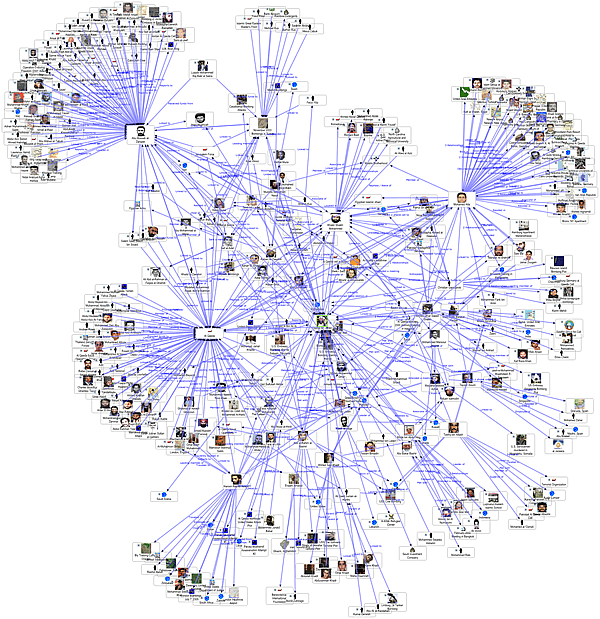
And network is of course what the internet, the network of networks, is all about:

The above image represents the entirety of internet interactivity, circa 2006. Rather than the simplicity of the solar system, we get something approaching the complexity of the universe itself.
I'm not saying the idea of network is the final answer to life, the universe, and everything, just that it provides a necessary corrective to the idea of system. We make connections upon connections upon connections, the complexity increases exponentially, and at some point it results in an effort to simplify and systematize, an effort that is in some ways necessary, but also potentially dangerous if taken too far, clung to too rigidly, or otherwise reified. But that is an essential tension in thinking and scholarship, and the accumulation of knowledge and the growth in understanding.
The idea of network, while de-emphasizing the sense of boundaries and completeness, still does not free us from the visual, or even a sense of the fixed. Alternatives to system can be helpful here, in giving us other connotations such as interaction, and especially relationship. A relational view is very much at the heart of the systems approach of Gregory Bateson and Paul Watzlawick, Korzybski emphasized relation, and for Einstein of course the concept of relativity was key. Ong described his approach as relational as well. Relational tends to be associated with a dyadic, dialectic approach, not that it has to be, but another term, one that conveys a greater sense of complexity, would be ecology. This brings us to the ecological view that is synonymous with systems thinking, as Fritjof Capra, and also Luhmann have indicated.
And that brings us to media ecology, a phrase and field formally introduced by Postman. Is media ecology free from the problem of being presented as a system? No it isn't. Christine Nystrom tried to systematize the field in her doctoral dissertation over forty years ago, and I myself have been working on various ways to summarize it, at least to provide an introduction to the field. McLuhan's laws of media are presented as a system that is whole and complete (as in, there are no other laws, the tetrad is a perfect set of ratios). In fact, the laws of media constitute basic principles about how a system functions when a change is introduced, but that's besides the point, which is that the tetrad constitutes, or at least is taken to be a system.

By taken to be, I mean that it is used as a system by others. This happens even to Ong, despite his own strong criticism of visualism and system. Orality and Literacy is his most popular work, and one of the main attractions is that it summarizes this area of study, presenting it in a relatively systematic form. The best known part of the book, the third chapter on orality and oral cultures, is not exactly Aristotelian in its logical organization. But Ong's list of some psychodynamics of orality (and I put the extra emphasis there to highlight the fact that he describes it in this highly qualified, incomplete manner) has been used by others in a systematic fashion. By this, I mean used as a kind of checklist, by which some modern form of secondary orality like rap music or online messaging can be analyzed based on the characteristics of primary orality listed by Ong, following his list step by step by step. I am certain Ong never intended for this to happen, but it happens nevertheless.
And let me be repeat that I too have worked on and continue to work on some forms of systemizing, although in my book Echoes and Reflections I try to present media ecology as a network of relations among different scholars, rather than a system with boundaries. But as I continue on with my work on media ecology as a field, I realize that I have to be very cognizant of the problem of the system, of presenting the field as a system (or worse, an ism), and of presenting it in such a way as it can be used as one by others. The problem may be unavoidable, but may be mitigated by being aware of that potential.
I find it useful to recall that Ong and McLuhan emphasized and favored an acoustic orientation that was distinct from visualism. An acoustic orientation tends to be open-ended and dialogue-oriented, and while sight tends to emphasize spatial dimensions, sound is a sense that is intimately associated with time. The acoustic orientation also places us firmly within the world, in a subjective position where the world is all around us, surrounding us, all sound being surround sound. We can never stand apart from nature in this way, and although the danger is in seeing yourself as the center of the universe, the benefit is that this is very much an ecological orientation, a view that favors living in harmony with the world, rather than being in conflict with nature as an other.
For McLuhan, an acoustic orientation is our natural mode of human existence, while visualism is a historical and cultural aberration that coincides with the rise and fall of the west. And in the new electronic era, we return to the auditory world of the tribe and village. But it is not a return back to a previous mode, but rather a turning of the wheel moving forward, as Ong indicates through his phrase secondary orality, which he explains is quite distinct from the primary orality that preceded literacy. Our electronically mediated acoustic orientation is something new and unprecedented, and as it is the result of working our way through and past our prior visualism, it retains some elements of it.
And that is the best way to proceed, to incorporate the best features of different media environments, in search of a sustainable balance. In that pursuit, an ecological understanding, and an open, relational, dialogic approach, combining system, network, and an acoustic element such as resonance (a term favored by McLuhan's associate, Tony Schwartz), is what we need.


 Posts
Posts


