Friday, September 9, 2011

Stepping Up For An Ecology of Mind

So, in a post I put up here last year, The Lure of Bateson, I wrote about Nora Bateson's documentary, An Ecology of Mind, about her father, Gregory Bateson, who was a major figure in the areas of cybernetics and systems theory, in anthropology and psychotherapy, and in communication and media ecology.  His book, Steps to An Ecology of Mind, was endorsed wholeheartedly by Neil Postman back when I was a doctoral student, and the film itself is a marvelous presentation of the man and his intellectual approach.  But I already wrote about that, and included some clips, so you can go click on the link, that's The Lure of Bateson again, and take a look.

But first, let me note that the documentary will be screened this coming Monday evening, September 12, at 6:30 PM, at the American Museum of Natural History.  I understand that it is almost sold out, if it hasn't been already, but that they are going to open up a second room so more folks can see it.  Tickets are $12, and $6 for students with ID.  Of course, if you came to the conference I organized at Fordham University last October on behalf of the Institute of General Semantics, or to the Media Ecology Association's annual meeting in June of 2010 at the University of Maine, you would have had a chance to see the film for free.  Just saying...

Anyway, here's the write-up that appears over at the museum's website:

An Ecology of Mind is an intimate and personal portrait of Gregory Bateson, celebrated anthropologist, philosopher, author, naturalist, and filmmaker. Directed by his daughter Nora Bateson, who will lead a discussion after the screening, this film includes footage from Bateson’s own films shot in the 1930s in Bali with Margaret Mead and in New Guinea along with photographs, filmed lectures, and interviews. Through contemporary interviews, and his words, Bateson reveals her father's practical approaches to the enormous challenges confronting the human race and the natural world.
And there's a very sweet picture of the Batesons there as well:


But, here's the difference that makes a difference.  This screening will be followed by a panel discussion that will include your humble servant, sneaking in along with several other people that you might actually want to see.  Here's what it says:

Following the screening there will a discussion featuring director Nora Bateson with Mary Catherine Bateson, anthropologist and writer; Mary Pipher, psychotherapist and author; Lance Strate, co-founder and former president of the Media Ecology Association; Susan Oyama, professor of psychology at John Jay College; and Rex Weyler, cofounder of Greenpeace International.

 Pretty cool, huh?  Oh, and the if you want to head on over to the AMNH website to see all this, and maybe score a ticket or two, here's the URL:  http://www.amnh.org/calendar/event/An-Ecology-of-Mind.  And maybe I'll see you there!


Thursday, September 8, 2011

Media @ the Center: A McLuhan Centenary Symposium at Fordham

Here's something I've been working on recently, coming up soon!  I hope to see you there!


MEDIA
@
THE CENTER
°
°
A
Marshall McLuhan
Centenary Symposium
@
Fordham University
°
°
September 17, 2011
°
°
Sponsored by
President Joseph M. McShane, SJ
Provost Stephen Freedman
Dean of Faculty John P. Harrington
Dean of Fordham College Rose Hill Michael E. Latham
Dean of the Graduate School of Arts and Sciences Nancy A. Busch
Dean of the School of Professional and Continuing Studies Isabelle Frank
&
Department of Communication and Media Studies
°
°
Fordham University Lincoln Center Campus
McNally Auditorium
Law School Building
140 W. 62nd Street, Between Columbus and Amsterdam Avenues
New York, New York
Free and Open to the Public
°
°
°°°°°°°°°°°°°°°°°°°°°°°°°°°°°°°°°°°°°°
Marshall McLuhan & John Culkin 
@ Fordham University, circa September 1967

°°°°°°°°°°°°°°°°°°°°°°°°°°°°°°°°°°°°°°°°°°
9:00-10:30 AM           McLuhan @ Fordham

Moderator:           Lance Strate, Fordham University

Panelists:              John Carey, Fordham University
Jacqueline Nardi Egan, QD Healthcare Group
Pete Fornatale, WFUV
Anthony Perrotto, Independent Video Producer
Paul Ryan, New School for Social Research
°
°
11:00 AM-Noon                  McLuhan & Theology

Moderator:           John M. Phelan, Fordham University

Presentation:                   "Marshall McLuhan's Theological Anthropology"
Joseph Kim, Lancaster Bible College

Discussants:         Babette Babich, Fordham University
Eric McLuhan, University of Toronto
Paul Ryan, New School for Social Research
°
°


°
°
1:30-3:00 PM              McLuhan & New Media

Moderator:           Janet Sternberg, Fordham University

Presentations:                 "Digital McLuhan"
Paul Levinson, Fordham University

                                          "Understanding New Media"
Robert K. Logan, Ontario College of Art and Design

                                          "Confessions of a Would-Be Twitter Novelist"
Robert Blechman, St. George's University
°
°
3:30-4:30 PM              Keynote Address

Moderator:           Andrew McLuhan

                                          "Media and Formal Cause"
Eric McLuhan, University of Toronto
°
°
4:30-5:00 PM              Reception and Book Signing
for Media and Formal Cause
by Marshall and Eric McLuhan
°
°


°
°
7:00-9:30 PM              Media @ the Center

Moderator:                       Lance Strate, Fordham University

Pecha Kucha:                   "The Medium is…"

Screening:                                    The Gutenberg Galaxy
1961 television program produced by Gary Gumpert

Panelists:                          Daniel Czitrom, Mount Holyoke College
Paul Grosswiler, University of Maine
Gary Gumpert, Urban Communication Foundation
Joshua Meyrowitz, University of New Hampshire
Dominique Scheffel-Dunand, University of Toronto
°°°°°°°°°°°°°°°°°°°°°°°°°°°°°°°°°°°°°°°
Photograph courtesy of John Carey
°°°°°°°°°°°°°°°°°°°°°°°°°°°°°°°°°°°°
Media @ the Center
A McLuhan Centenary Event
Continues
@ Fordham University's McNally Auditorium
on
September 25, 2011

1:00-5:00 PM                        Preview Screening of Connected, a new film by Tiffany Shlain
                                    Followed by a Panel Discussion

Moderator:                       Lance Strate

Panelists:                          Susan Maushart
T.C. McLuhan
Terence P. Moran
Robert Seidman
Frederick J. Wertz


Monday, September 5, 2011

Poetry and Play vs. Clarity and Precision

Have you ever heard anyone mention that Marshall McLuhan's writing is difficult to understand? Have you yourself ever said something along those lines?  Comments to that effect come up time and time again, to the extent that it has become a commonplace, one that McLuhan himself was quite familiar with.


Jerome Agel, the individual who produced McLuhan's bestseller, The Medium is the Massage, with illustrator Quentin Fiore (along with the sequel, War and Peace in the Global Village, Buckminster Fuller's I Seem To Be A Verb, Carl Sagan's Cosmic Connection, and authored and edited numerous books of his own, including The Making of Kubrick's 2001, and The Radical Therapist) once told me a joke that was going around back in the sixties:

     Did you know that McLuhan's Understanding Media has been translated into 22 languages?

     Really?  Has it been translated into English yet?  


Why was McLuhan so hard to understand?  It is not entirely clear to what extent it may have been a deliberate strategy, and if so to what end, or to what extent it was due to other factors, and to what extent they were or were not within his ability to control.  I have heard and read different explanations coming from a variety of sources, including McLuhan biographies and McLuhan interviews, and the bottom line is that it doesn't matter much anymore, the text is what it is, and you either have to deal with it, or not.  


There are writers who are deliberately obscure, writers whose opaque writing style serves to disguise a lack of content, or at least a lack of anything significant and original to say, and some of McLuhan's critics have wrongly placed him in this category.  McLuhan is not one of these.  If anything, he overflows with content and significance.  There is too much to say, and it is all packed in too tightly, condensed, compressed, exploding outward. Reading McLuhan has been described as trying to take a drink from a fire hose.  Neil Postman used to point out in doctoral seminar that others have written dissertations and books based on just one of McLuhan's sentences.


I also recall Postman emphasizing that some books are worth reading, even if they are difficult to understand.  Writing that here and now, it seems painfully obvious, but students need to be reminded of it, and more and more need to be taught it in the first place.  The struggle is worth the effort, for great books like Understanding Media, and indeed there is some benefit to the struggle itself (the medium being the message in this instance as well). 


So, I got into this discussion over on Peter Montgomery's McLuhan listserv about McLuhan's use of language, and how he used a number of terms in ways that seem idiosyncratic, or perhaps drew on older or archaic meanings, etymological subtleties, or simply created his own specialized vocabulary.  A good example is how McLuhan used "corporate" to mean something like communal, rather than to refer to corporations. 

Another potential point of confusion is that when he talked about the characteristic of being connected, McLuhan specifically was referring to lineal connections, linearity as associated with writing, the alphabet, mechanical technology, industrialism, and what they now call Fordism, and not the interconnectivity associated with electronic communications,  computer networks, and the nonlinearity of an ecological and systems view, not to mention McLuhan's own notion of the global village.  Those of us who teach McLuhan, who assign McLuhan's books and articles as readings to our students, have a very practical need to deal with these concerns of intelligibility and interpretation.
 

So, in the course of discussing McLuhan's word choice, I noted that while it may have been "informed and acute" (as one person put it), it was in the service of poetry and play, rather than clarity and precision.  This led to a bit of criticism of my remarks, and a query that I seemed to prefer clarity and precision.  So, here's my response:
 
I have no preference between poetry and play, and clarity and precision, in the abstract.  I agree that they are not polar oppositions, but they can be opposing tendencies, and I'm not sure it makes sense to separate them from the writer's purposes and goals, and the reader's motivations.  Poetry and play is clearly what is to be valued in art, and I think they are preferable in religion, although I know that some prefer a liturgy and sacred text in plain language.  

McLuhan's style is one that captures the imagination, and inspires thought and exploration, at least for some readers.  But it clearly alienates other readers, creating this either/or situation of, either you "get it" or you don't, and for this reason I can't help but wonder if his reception might not have been better in many ways if he had employed more clarity and precision.  

Obviously, clarity and precision is the standard for scientific writing, and to a large extent in news reporting, and generally if the goal is to inform and to educate.  In essay writing, while eloquence is desirable, I'd say that clarity and precision are at least as important, if not more so (and eloquence can be achieved without going to the extreme of poetry and play).  

I don't consider McLuhan to be the best example of media ecological essay writing, but rather Walter Ong and Neil Postman. Postman, as I recall, pointed to George Orwell as a model for essay writing.  McLuhan, as I understand it, pointed to Joyce as a model.  Both Orwell and Joyce share a common concern with language, but their differences make an enormous amount of difference.

As for my personal preference, it would be towards balance, and as for where that balance lies, that would depend upon what would be appropriate for the situational context.

By the way, I can't help but note that clarity and precision go hand in hand with hot media (a hot medium being well-defined, high in resolution and fidelity, and therefore requiring less participation in meaning-making than a cool medium), and poetry and play with cool media (a cool medium being
ambiguous rather than well-defined, low in resolution and fidelity, and therefore requiring more participation to make sense out of than hot medium).  

And McLuhan?  He was a decidedly cool medium. Very cool indeed!


Monday, August 29, 2011

Life in Glass Houses

In my last post, Ad-ding Interactivity, I touched on ubiquitous computing and mobile devices, and here I'd like to add a little bit more, via this video released by Corning Glass earlier this year.  Here, we see a mix of older notions of ubiquitous computing, with computer technology embedded into the environment, in walls, mirrors, tables, desks, refrigerators, cars, etc., along with the more recent addition of portable computer gadgets (e.g., cell phones).


Here's what Corning had to say about it:


Watch "A Day Made of Glass" and take a look at Corning's vision for the future with specialty glass at the heart of it.


Learn more about Corning at corning.com. Search for career opportunities at corning.com/careers.


Of course, Corning would place the emphasis on glass, a substance that is quite ubiquitous in and of itself, so much so that it becomes quite, well, transparent.  In a fashion that McLuhan would certainly approve of, Corning wants to make the invisible environment visible, reverse figure and ground, and make us aware of how much we live in glass houses, and how much more so we may in the future.

Looking into the future, this emphasis on glass brings to mind a few other visions of the future.  One is computer scientist David Gelernter's book Mirror Worlds, which imagines a future when software allows us to create electronic maps that effectively cover almost all of the territory (and yes, Korzybski would still remind us that they can never actually be the territory).  Gelernter ignored the political implications of such innovations--all's well that end's orwell?  That does not justify the fact that he was a victim of the unabomber,  I hasten to add.

On the other hand, science fiction writer David Brin gives us a vision of technology in the service of democracy in his nonfiction book, The Transparent Society. Admittedly idealistic, possibly impractical, I am certain McLuhan would agree that the bias of the electronic media is towards no barriers to communication, no secrets, free flows of information, and letting it all hang out, as we used to say in the sixties.  

The end of privacy is not necessarily a good thing, it has its advantages and disadvantages, but Brin's view is that this is the direction we are heading into, so rather than fight it, let's direct it to serve the people, rather than merely observe us.  Let's have the surveillance of all by all, including and especially the surveillance of the rich and powerful by the rest of us.  No doubt,  wikileaks comes to mind, but for a moderate approach, I'd recommend the Sunlight Foundation.  And please note that the idea is not a complete abolition of all privacy, no cameras in bathrooms and bedrooms required!

There is something to say about living in glass houses, it does drastically cut down on stone throwing, much more so than self-evaluation of sin.  On the other hand, glass gives us reflective surfaces as well as transparent ones, a point emphasized in regard to interface design in Jay David Bolter and Diane Gromala's book, Windows and Mirrors.  And this brings to mind an old Yiddish parable--interestingly, I found one nice version of it on a site devoted to Primitive Christianity, and I'm sure they won't mind me sharing it here as well:


A very rich young man went to see a rabbi in order to ask his advice about what he should do with his life. The rabbi led him over to the window and asked him:
“What can you see through the glass?"
“I can see men coming and going and a blind man begging for alms in the street.”
Then the Rabbi showed him a large mirror and said to him:
“Look in this mirror and tell me what you see.”
“I can see myself.”
“And you can’t see the others. Notice that the window and the mirror are both made of the same basic material, glass; but in the mirror, because the glass is coated with a fine layer of silver, all you can see is yourself. You should compare yourself to these two kinds of glass. Poor, you saw other people and felt compassion for them. Rich—covered in silver—you see yourself. You will only be worth anything when you have the courage to tear away the coating of silver covering your eyes in order to be able to see again and love your fellow man.”


It is worth pondering whether our future days made of glass, if Corning's vision does come to pass, leave us in a state similar to Narcissus, entranced by our reflections, or whether they will provide us with clear vision, not only of the ways things are, but the way things could be, and ought to be.


Thursday, August 25, 2011

Ad-ding Interactivity

In a previous post, Everywhere a Sign, I mentioned how, as literates, we wrote over our environment with signs, and otherwise remade our world in the image of the written and printed word, and how we are doing the same sort of thing now, coating and revising our environment via the electronic media.

In a sense, we already accomplished this early in the 20th century, as our environment is permeated by radio waves, so that almost anywhere we go, we can pick up a broadcast signal.  Mobile telephony adds an interactive dimension to the ether, making it possible not only to have two-way communications (which was always an option, after all, through amateur radio, Ham, CB, walkie-talkies, etc.), but interactive data transmission.

So, through mobile devices, we turn a non-electronic environment into an electronic one (and again, this began with the transistor radio, but becomes fully realized with the cell phone).  This realizes the goal of ubiquitous computing, not by embedding computer technology into the environment as was previously imagined, but by the combination of an environment permeated by the software of wireless signals rather than the hardware of gadgets, and by embedding computer technology in us, ourselves.  After all, we are our environment, in the sense that all we know of our environment is the internal map that we construct, not what's actually out there.  That was Korzybski's main argument, after all.

Perception is a response to a stimulus that we mistake for the stimulus itself.

But, back to the main point.  We may not have our personal technologies literally embedded and merged into our bodies in the manner of science fiction cyborgs, not quite, and not yet, but many of us keep our devices with us at all times, walking around with blue tooth devices on our ears, essentially treating them as appendages to our body.  Of course this brings to mind McLuhan's emphasis on media as extensions of the body.  It's just a matter of how we frame things to refer as to whether we refer to media as extensions or environments.  As I like to point out, whatever extends our bodies comes between our bodies and our environment, and whatever comes between our bodies and our environment becomes our new environment.

So, the point is that mobile devices are transforming our environment.  This is happening, in part, through augmented reality programs and technologies, but here I just want to point out how mobile devices allow us to add an electronic overlay to print media.  

QR codes constitute a simple example of this.  In one sense, they are a new kind of bar code, one that's more robust--we've all encountered bar codes that are a little worn and won't scan, QR codes don't degrade so easily.  But mobile devices can read QR codes via their cameras--remember when adding cameras to cell phones seemed like an unnecessary extravagance?--the QR code can represent a URL, and mobile devices use their browsers to go to that web page.  This is old news to many, I know, and I apologize if this seems obvious, but I know it isn't to some folks reading this blog.  Anyway, here's a QR code for Blog Time Passing:


If you click on it, it'll just take you to a page with the same QR code, but if you scan it with a mobile device it'll bring you back to this blog.

But I want to point to a couple of sophisticated and creative examples of how mobile devices can turn print media into interactive media.  First here's one that has great relevance, given the current victory of the rebellion in Libya:


This ad taken out by Reporters Without Borders, really more of a public interest message about freedom of the press than a commercial advertisement, is quite creative, entertaining, and dramatic in making its point.  It uses a QR code to get to the video mouth, which is placed over the mouth of the dictator in the print image, to add animation and give voice to the journalists whose voices were otherwise stilled by the leaders of repressive regimes.

And now for something much less serious, indeed, a bit of childlike play:


This Norwegian ad is certainly an app-ed expression of the potential merging of print and electronics.  While the idea of an electronics-based form of smart paper is still in the works, and may one day supersede print, this demonstrates how mobile devices can make any dumb, old print medium into a smart one.  Shades of the Scarecrow in the Wizard of the Oz!

Well, if all this seems too much like the weird virtual world of the Disney film Tron, just keep in mind that no matter how hi-tech we get, we'll always need duct tape!


quack quack!


Tuesday, August 23, 2011

The Rueful Reuben

Shelley Postman shared this video with me a while ago, and I've been meaning to post it here on Blog Time Passing.  It's a marvelous bit of fun, one that speaks to some issues that exist within the Jewish community, and that can be generalized to other groups as well.  In one sense, it serves as a parable of the conflict between orthodox and reform, literal, and liberal, fundamentalist and metaphorical approaches to a sacred text or canon or tradition.  In another sense, it reflects the conflict between east and west coasts, specifically between New York as an old world, elitist center, and Los Angeles as the new world where people feel free to recreate their identities.  But go ahead, take a look, it's worth your while:


Over on YouTube, the write-up for A Reuben By Any Other Name is as follows:

Noble Savage Productions and Sonny Boy Studios are thrilled to announce that we have completed our short comedy "A Reuben By Any Other Name." The film takes a humorous look at the differences between Orthodox and Reform Judaism played out in terms of the differences between the New York and Los Angeles versions of the Reuben sandwich. Brilliant performances are provided by an ensemble cast of familiar faces from film and television - Jasmine Anthony (Stephen King's 1408, Commander in Chief), Anita Barone (The War at Home, Daddio), Paul Ben-Victor (In Plain Sight, Entourage), Larry Cedar (The Crazies, Deadwood), Pamela Cedar, Alanna Ubach (Hung, Legally Blonde), and Matt Winston (John from Cincinnati, Little Miss Sunshine). Are you an Orthodox or Reform Reubenite? Watch the film and find out!

And so, you might be wondering which category do I fall into?  Well, I don't keep kosher, although I do have some preferences that are rooted in the kosher laws, and I avoid some foods for the same reason.  It's aesthetic, and cultural, for me, rather than religious.  But in this, I'm pretty much with the little girl.   The delis I remember from when I was growing up, including the Pastrami King in Kew Gardens, Queens, which was often referred to in the columns of famous New York Daily News columnist Jimmy Breslin, were kosher, and something like the Reuben sandwich was never on the menu.  My first encounter with it was in Greek diners in New York City, although I later saw that some Manhattan delis served it as well.  But I really don't see how the Reuben could be a Jewish sandwich, no more than the Philly cheesesteak, or your basic, run-of-the-mill cheeseburger.  It's just not kosher!


If you have a similar encounter with the Reuben, or a different one, well, feel free to share in the comment section, I'd be interested to hear about it! 
And so, the lesson is, both sides are right, both sides are wrong, and no one knows where the truth lies, so why don't we all just get along?  And have a good laugh at ourselves in the process?


Sunday, August 21, 2011

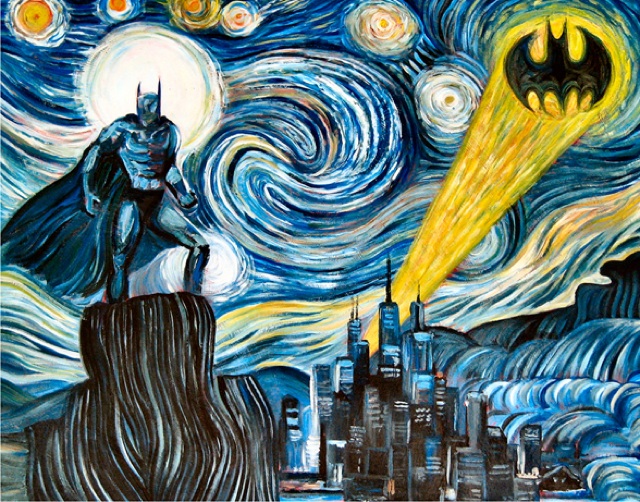
Van Gogh's Bats

So, back in the long, long ago of 2007, the early days of Blog Time Passing, I put up a post that featured the visual mash-up between Van Gogh's Starry, Starry Night and the typical Weather Channel weather map, created by my colleague and friend, Ed Wachtel.  You can check out that ancient post here:  Wachtel's Van Gogh Weather Map.

So, I was quite tickled to come across this image on Scott Beale's blog over on Laughing Squid:


The Dark Starry Knight, A Batman Themed Tribute to Vincent van Gogh


The image was created by James Hance, and is available for sale as a poster, along with many others, including a number of rather charming and creative Muppet-themed mash-ups.   Check them out on his website by clicking here, and scroll down to find this particular poster. 

And hey, while I'm at it. let me end this post on a good note:


Monday, August 15, 2011

The Orality of Morality

So, I didn't really plan to keep going on the topic of morality, it just came up in online discussion, first about McLuhan and Morality, and then on The Medium of Morality, where I wrote about morality viewed as a medium.  And based on a comment on that post left by Mike Plugh, I figured just a bit more elaboration would be worthwhile here, so here's just one more post on the subject.

While considering morality as a medium in and of itself, we can also talk about morality as it relates to the medium of writing, and the medium of speech.  Language, which exists primarily as speech, is the basis of morality as a medium (just as it's the basis of writing, printing, radio, etc.), and for the vast majority of human history, language exists only in spoken form, which is why I have give this post the title of The Orality of Morality.  

In oral cultures, morality does not exist in the form of written rules, it is not codified in that sort of permanent form, nor is it expressed in abstract formulations such as laws.  Rather, morality is established informally, by norms that are unspoken but known, understood, and for the most part accepted within the culture (where the population is small and pressure to conform is high).  When morality is expressed, it is expressed in the form of narrative, as myths and parables, which are recited and performed as ritual drama.  Because there is no fixed text, variation and multiformity is the rule, so that flexibility and change comes easily.  This means that a culture's morality can easily adapt to changing circumstances.

When writing is introduced into a culture, and eventually there's a written document that serves as the basis of morality, the flexibility of oral tradition is lost, and ideas take hold along the lines of literal interpretation, letter of the law, original intent, orthodoxy, fundamentalism, and an either/or approach that introduces the possibility of heresy, not to mention conversion, in regard to religious morality. 

An emphasis on interpretation of texts, which is always required but not always highlighted, allows for a retrieval of some aspects of orality, the restoration of dialogue and flexibility.  This introduces a new problem, however, as time passes and the text becomes less and less relevant to the contemporary situation, requiring greater and greater interpretative leaps, both to understand the meaning of the text, and to make it relevant.  A further problem is introduced as the interpretations are turned into fixed texts themselves, and therefore replace flexibility with new rigidities.

At a certain point, the distance between a long tradition of interpretation and the original text prompt some adherents to call for a return to the original text.  But a return to the original text can only result in new interpretations.  This has the effect of wiping away interpretations that no longer seem relevant, allowing for new interpretations not limited by earlier ones and therefore better able to speak to the present day, simplifying a system that may seem to have grown overly complex, and restoring some bit of flexibility to the system.

And then the cycle begins anew.  As literates, we are able to articulate, analyze, and think abstractly about morality, and this has truly led to evolution and progress in respect to morality, but not without cost.  The price we pay is that loss of flexibility, of concrete grounding, of the dialogic quality of response, which Martin Buber noted is the basis of responsibility.  The loss is so very deep and significant that we keep trying to restore it, or compensate for it, trying to find a way back to the orality of morality.