Sunday, June 17, 2007

Oh, What a Blog!

It figures! Not long after I published the last post, I received an e-mail from Fernando Gutiérrez informing me of some of his blog entries about the convention. But first, I neglected to mention in the previous post that Peter Fallon's photos can be found on his blog, which has three entries about the MEA convention:

Watch for Dr. Fallon on a Webcast Friday Evening

The Marshall McLuhan Award for Outstanding Book in the Field of Media Ecology 2007

The Marshall McLuhan Award for Outstanding Book in the Field of Media Ecology 2007 -- Some Pictures from the Awards Ceremony

And now then, here are Fernando's blog entries:

Media Ecology en “El Universal”

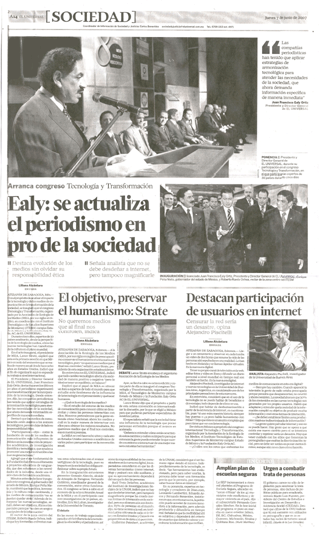
This one features a scanned image of the "Society" page of El Universal, one of Mexico's major papers (like our New York Times or Washington Post), p. A14 in fact (that's the first section of the newspaper), dated June 7th, and the entire page is devoted to the MEA convention. Here's the image:

The top photo shows the president of El Universal speaking, with Fernando just to the right of him, and Thom Gencarelli to the right of Fernando. I'm the farthest to the left in the second group on the stage. In the photo below, there's the president of El Universal again on the left, flanking the Governor of the state of Mexico, and holding up the rear, just to the right of the president you can see part of my head. And, as you can see, there's an article devoted to me below, as well as one on the first featured speaker, Alejandro Piscitelli from Argentina, who is also the focus of Fernando's next post:
Media Ecology en “El Centro”
and our keynote speaker, Eric McLuhan, is the subject of
Eric McLuhan’s latest work: Foreword is Forearmed

This is followed by a lengthy listing/linking of online references to the convention, mostly from the Spanish-language media:
Notas sobre la Octava Convención Anual de la Media Ecology Association
There are a number of quotes from my welcoming remarks, but I've already included them in a previous post, so if you want to check on the Spanish translation-quotation, just click on the link. Fernando also lists blog entries, including this one from Piscitelli:

La web 2.0 revive en Atizapan de Zaragoza, Estado de Mexico
and he's got a nice shot of the stage:


And there's another link entitled
Media Ecology Association en Imágenes
meaning, MEA in Images, which includes some of the photos I included in the last entry, and also this one from the opening ceremony:


Here's the Governor:


And here I am:


Now, here are a couple of nice shots of Jay David Bolter:


and one of Jay together with Katherine Hayles:


Fernando also has a post analyzing the audience for the streaming video that they made available through the convention website:
Estadísticas de la transmisión OnLine de la Octava Convención Anual de la Media Ecology Association
and a post containing another set of images:
Octava Convención Anual de la Media Ecology Association en Imágenes
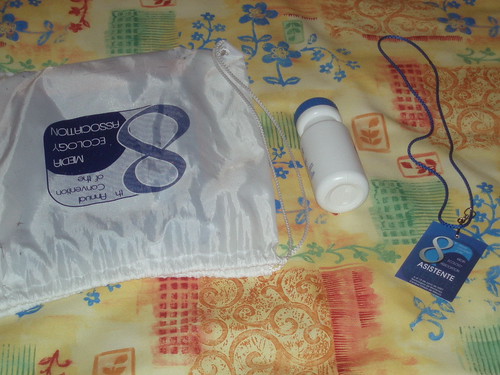
Again, some of the images I already included in a previous post. One I didn't include is this shot of the convention swag that Tech gave out:


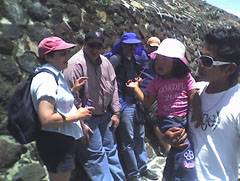
But better yet, here's one from our trip to the pyramids of Teotihuacan. That's me in the NY Mets cap, hyperventilating from the climb, with Ellen Rose on the left and Robert Francos looking terribly sheik on the right:

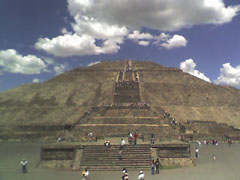
and just to give you a sense of proportion, Fernando also had a picture of the Pyramid of the Sun which we climbed to the top:


This doesn't entirely get across the enormity of it, or the difficulty of climbing the steep, uneven steps, but it's a start.

Anyway, Fernando further posts
Comments about the Eighth Annual Convention of the Media Ecology Association
mostly from the MEA listserv, followed by
Web Stats de la Octava Convención Anual de la Media Ecology Association
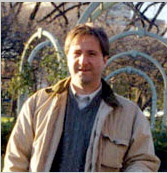
showing all the hits we had. And while this predates the convention, here's Fernando's picture from his blog:

Which gives me the opportunity to say:


Thank You, Fernando!!!

Saturday, June 16, 2007

Oh, What a Photo... and Video!

Well, some stuff from the MEA convention is being posted on Flickr and PhotoBucket by various folks. For example, here's a picture of my friend, Thom Gencarelli, MEA VP and convention co-coordinator:


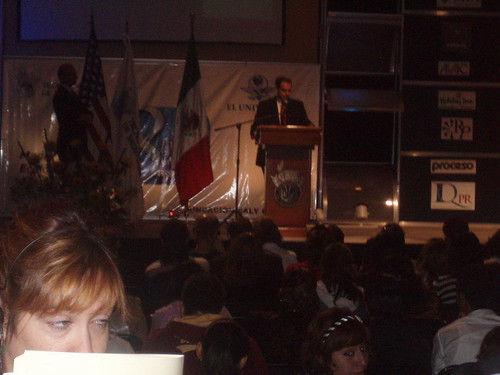
And here's one from the opening of the convention:


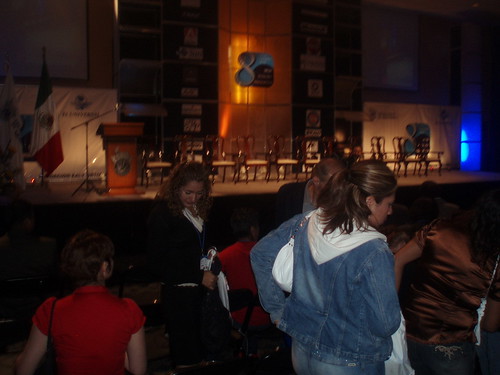
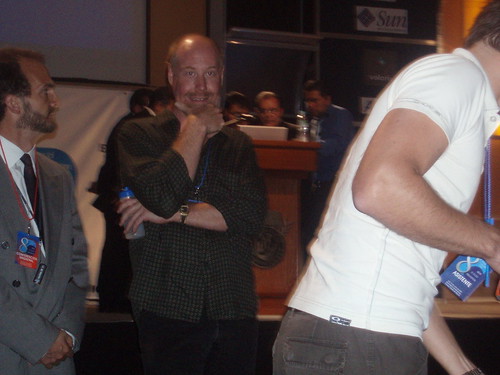
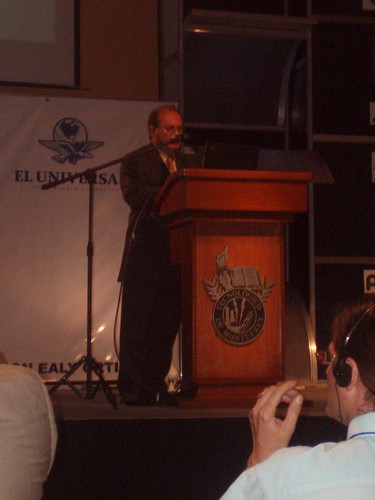
This shot gives a pretty good overview of the stage that was set up for our plenary sessions:


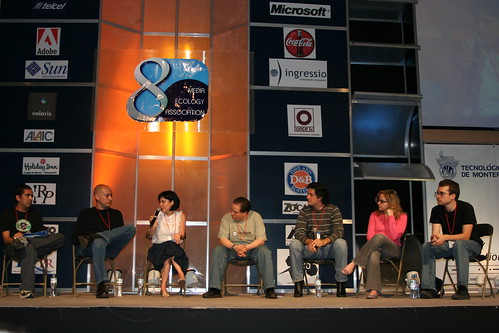
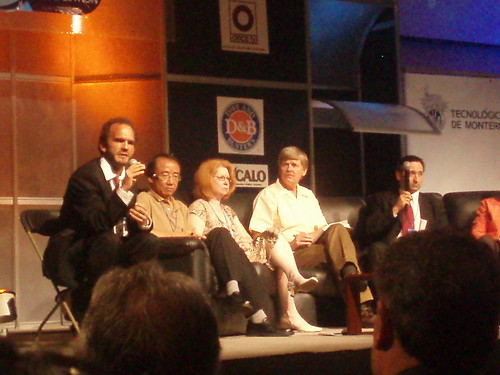
And this one is a nice medium shot of the stage, taken during a breakout session:


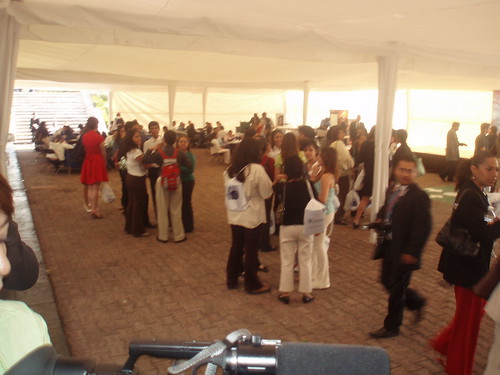
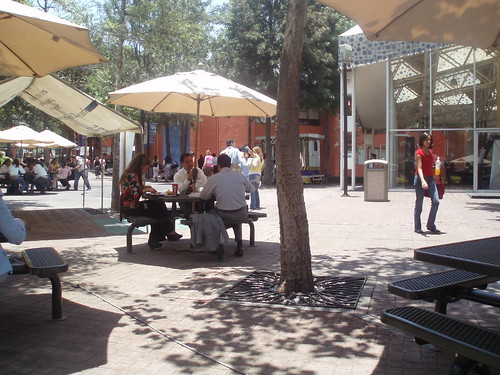
Here's part of the registration and exhibition area, which was outdoors, covered in part by a tent:


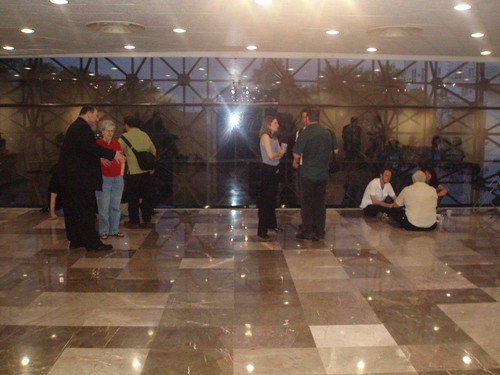
Here's a couple of pictures from the receptions that were held each evening:


You can see me on the left in this one:


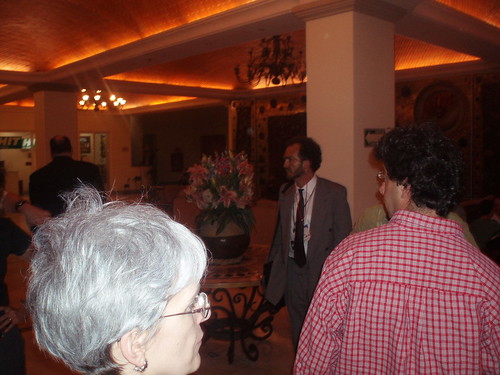
Here's a shot taken at our hotel, with Thom again, and Mary Ann Allison, Barry Liss in the checked shirt I think, and I believe that's the back of my head on the left:


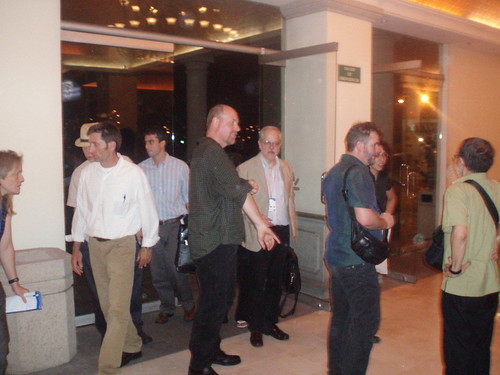
And another from the hotel, including from right to left, the back of Casey Lum, David Holmes, Phil Marchand (in the sports jacket), and Phil Rose.


This picture is from the plenary session on the legacy of Neil Postman, with Thom, Casey Lum, Sue Barnes, Bob Albrecht, Fernando Gutiérrez, and Janet Sternberg's elbow.


And there's Thom and Phil Rose, waiting for another session to start:


Here's Octavio Islas, giving one of the featured presentations:


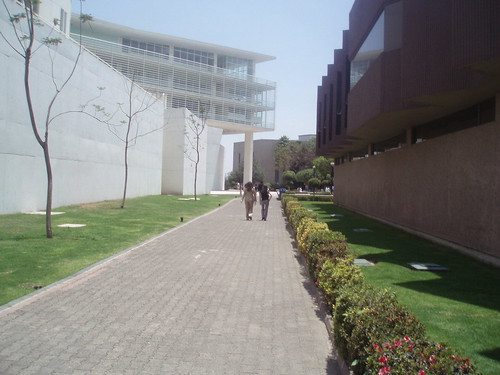
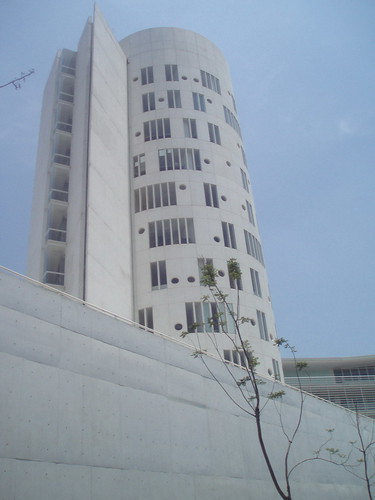
And some images of Tech's gorgeous campus:


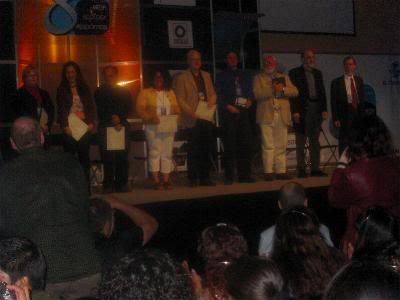
Peter Fallon has also posted some pictures from our Awards Ceremony, including an image of the Award winners being applauded as a group:


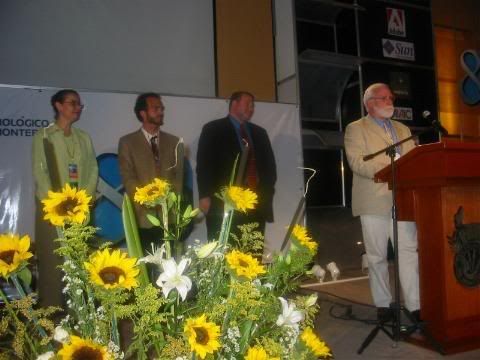
And here's a couple of Peter receiving the Marshall McLuhan Award for best book from me, Thom, and Janet:


And now this, last but far from least, here's a YouTube video, taken from somewhere in the audience, of Governor Enrique Peña Nieto's welcome to the Media Ecology Association:


And, that's all for now, but I'm sure there'll be more to come.

Friday, June 15, 2007

Oh, What a Blow!

So, I am taking the opportunity to feed my blog my President's Address from the 8th Annual Convention of the Media Ecology Association. It was delivered on the evening of Friday, June 8, 2007. I should note that this is not the final version that will eventually be published in our online Proceedings on the MEA website. And it is also a little different from the actual speech that I delivered. But the differences are, and will be, relatively minor.

As I was preparing this address, it occurred to me that it would lend itself quite nicely to a call-and-response format. But I was torn over whether I should attempt it. I had never done anything like that before, after all. And what if no one responded? Academic audiences have a tendency to be reserved and reticent, and this could come across as hokey, to say the least. What if I were to (forgive me for saying) blow it? Or come across as a blowhard?

But then again, this was Mexico, where the oral tradition had not been as completely repressed as it has been in the United States. And this was the MEA, and media ecologists are not your typical academics. So, I heeded the call (it really did call to me, and I just gave in to it), and people responded. Of course, there's no way to capture that in the written text.

So, for what it's worth, here's the blow:

Oh, What a Blow That Phantom Gave MEA!

The title of my address, "Oh, What a Blow That Phantom Gave MEA!" is an allusion to one of the classic works in the media ecology intellectual tradition, Edmund Carpenter's 1972 book, Oh, What a Blow That Phantom Gave Me! Carpenter's title was itself an allusion to that singular literary achievement produced by Miguel de Cervantes, Don Quixote. This means that the title of my talk is an allusion to an allusion. Literary theorists would refer to this sort of thing as intertextuality. Semiologists would speak of it as an example of the seemingly endless chain of signifiers. Analytic philosophers would note that an allusion is a different logical type from an allusion to an allusion, which would be a member of a higher order. Practitioners of general semantics would see this as a form of self-reflexiveness. New media scholars such as Jay David Bolter would call it remediation. And as for the Freudians, they just might psychoanalyze it as the future of an allusion.

Of course, you don't have to be a Freudian to interpret our dream, now almost nine years old, of forming an association that would be international in its scope, and dedicated to the study, research, criticism, and application of media ecology in every conceivable context. There were times in the past when it seemed like an impossible dream, and I know some of you are groaning at my allusion to the song from the Broadway show, Man of La Mancha. Some of you may even be expecting me to start singing at this point, but fortunately for you I don't do show tunes. Instead, I simply wish to note that since the founding of the Media Ecology Association in 1998, our field of inquiry has undergone a dramatic rise in recognition and respect. And while our quest is far from over, from the looks of things it certainly seems like the Media Ecology Association is here to stay.

And we are here to make the world a better place. But before we make the world a better place, we need to understand the world, we need to understand our environment. And to understand our environment, we need to understand media, to understand technology and technique, to understand symbols and symbol systems, to understand codes and modes of communication, to understand the means, the methods, and the materials, the form and the substance that make up our world.

This is no easy task. As the late Paul Watzlawick explained, there are two levels of communication. There is the content level, where we send and receive information about the world. And there is the relationship level, where we communicate about our communication, about how we will interact with each other, about what our roles and identities are in relation to each other, and about how to interpret the messages that we send and receive on the content level. The relationship level is the level that guides, regulates, and controls the content level, the level where the computer is programmed, the rules of the game are written, the language is invented and modified, and the social reality is constructed. But even though the relationshp level is where the power resides, we tend to ignore it and only pay attention to the content level. This is another was of saying, in the words of Marshall McLuhan, that the medium is the message.

When we first fall in love, we can see nothing else but the relationship, we idealize the relationship, we also worry about the relationship, but we rarely think objectively and critically about the relationship. After the relationship is established, we become used to the relationship, it becomes part of everyday life, and we begin to take it for granted and stop thinking about it at all. The relationship becomes a phantom, and it is not until something goes wrong with the relationship, until one or both parties fall out of love that we cry, "Oh, what a blow that phantom gave me!"

It is the same with communication. At first, we are enamored of our new media, fascinated by their every nuance. But it doesn't take long before they become part of our routine, fade into the background, and become second nature to us. Our attention shifts to the content that we send and receive, and we only become aware again of our means of communication when they break down, or when they break us down. In other words, it is the bias of all media to become environmental, and therefore, to become invisible. As Ted Carpenter put it:

"New media allow us to escape from old environments, but soon imprison us in new environments, namely themselves. For one brief moment we have a clear image of ourselves and our environment, both hitherto invisible because they were too close. They became visible by becoming obsolete."

"The appearance of the telegraph and onset of the electronic age allowed Marx to see the structure of the past economic system and Freud to see the nature of literate individualism. Both viewed man and society as separable, in opposition. These were backward glances, the views of men dissatisfied with what they saw in the past, but with no awareness that new environments soon would surround them."

As McLuhan would put it, they marched backward into the future, looking into the rearview mirror. And when you are only looking at where you've been, and not at where you are going, sooner of later you will have cause to say, "Oh, what a blow that phantom gave me!" As media ecologists, our job is to understand the past without confusing it with the present, to uncover patterns of change, and use them to understand the future. We study history so that we do not have to repeat it, and with apologies to George Santayana, because those who do not remember the past are condemned to cry out, "Oh, what a blow that phantom gave me!"

McLuhan said that, "nothing is inevitable provided we are prepared to pay attention," and media ecology is a way to prepare people to pay attention. As media ecologists, we prepare ourselves to understand the present by studying the past and the future. We are historians and we are futurists, because we understand that the two are inseparable. As Jose Ortega y Gasset wrote in his famous treatise, The Revolt of the Masses, "It is false to say that history cannot be foretold. Numberless times this has been done. If the future offered no opening to prophecy, it could not be understood when fulfilled in the present and on the point of falling back into the past. The idea that the historian is on the reverse side a prophet, sums up the whole philosophy of history."

In an early survey of our field, William Kuhns referred to media ecologists as post-industrial prophets. He paid special attention to Lewis Mumford, Sigfried Giedion, Jacques Ellul, Harold Innis, Marshall McLuhan, Walter Ong, Norbert Wiener, and Buckminster Fuller. Peter Drucker was another prominent media ecologist and futurist, and he was the first to characterize the postindustrial environment as a knowledge society. Moreover, when Neil Postman formally introduced the term "media ecology" in 1968, he emphasized the fact that media ecologists ask questions about the future. And he went on to say that, "their questions also have to do with our chances of survival, and how to prepare ourselves intellectually and emotionally for media environments most of us do not quite believe in, and which we may not be able to control."

McLuhan was fond of the Ezra Pound quote that, "the artist is the antenna of the race." Likewise, the late Kurt Vonnegut characterized writers and artists as our culture's equivalent of "the canary in a coal mine." He explained that at one time canaries were taken down into the mines because if toxic fumes were present, the canaries would collapse long before human beings were affected, and thereby provide ample warning for the miners. And along the same lines, as media ecologists, it is our job to function as a distant early warning system, to use another of McLuhan's pet phrases. And to do this, we have to have the courage of Don Quixote, to open ourselves up and absorb the phantom's blow. And we also need the common sense of Sancho Panza to recognize the blow for what it really is, to use that blow to understand the phantom itself, and to communicate our findings with clarity. And as Postman put it, clarity is courage.

It certainly seems that Cervantes anticipated the power of typography as an agent of change. According to Elizabeth Eisenstein, the diffusion of the printing press was slower on the Iberian peninsula than in Germany and Italy, but took off during the late 15th century. Cervantes himself was born at the end of the incunabula, the first hundred years of the Gutenberg galaxy. He was born into an environment transformed by the sudden diffusion of a multitude of mass produced books, a society that seemed to be saying, in regard to the printed word, "oh, what a blow that phantom gave me!"

As you know, Don Quixote's problems began when he started to read too many books. He neglected his business affairs, spent all of his money on books, and devoted all of his time to reading them. Here we have an early parable about media addiction. And Don Quixote went mad from reading too many books. This also has a contemporary parallel in our concerns about the effects that electronic media such as television, videogames, and the internet are having on people's intelligence, their connection to reality, and their behavior, especially in regard to violence. And it has an ancient parallel in the Bible, for example in the 115th Psalm of David, where we can find the following warning about idols: "They that make them shall be like unto them." The title of another of Carpenter's books, They Became What They Beheld, is an allusion to this psalm. And what the psalmist says, in effect, is that anyone who worships graven images will wind up saying, "Oh, what a blow that phantom gave me!

And Plato in the Phaedrus warns that the technology of writing will weaken the mind by undermining memory, and result in a decline of civility by instituting a form of discourse that is impersonal and unresponsive. And yet, at the same time he was a victim of literacy, which facilitates abstract thinking. Plato constructed a reality as fanciful as that of Don Quixote, the reality where ideal forms, abstract ideas, are more real than concrete material substance. Had he realized what was happening to him, Plato might well have cried out, "Oh, what a blow that phantom gave me!"

Cervantes was an innovator, the inventor of the modern novel, and media ecologists understand that there is common ground between the invention of gadgets and machines on the one hand, and linguistic invention, rhetorical invention, and artistic invention on the other. He invented Don Quixote, a character held captive by the invisible bonds of the written word, and if only the Knight of the Sorrowful Face had been aware of his predicament, he might have said, "Oh, what a blow that phantom gave me!"

Cervantes also invented Don Quixote's companion, Sancho Panza, an illiterate steeped in the oral tradition. As a member of an oral culture, Sancho has a proverb for every occasion. And as Walter Ong explains, communication in an oral culture relies on formulas and clichés, and sayings and aphorisms. These are the basic media of oral culture. Rooted in his orality, Sancho Panza remains close to the human lifeworld, as Ong puts it, and his mindset is situational and concrete, rather than abstract and decontextualized. This is the source of his common sense. It is for this reason that Jacques Ellul argued that literacy is a prerequisite for propaganda, and propaganda, we might say, is the deliberate creation of Don Quixotes. And McLuhan in turn emphasized the point that you cannot propagandize members of an oral culture, you cannot sell them on abstract ideas or ideals, and make them lose touch with concrete reality.

With the coming of the book, as Lucien Febvre and Henri-Jean Martin describe it, and in the age of mechanical reproduction, to use Walter Benjamin's famous phrase, it becomes a handicap to be illiterate, and it is not surprising that Sancho Panza's social and economic status is quite low. Sancho may be a squire to Don Quixote's knight, but as far as Cervantes is concerned, he is no squire, he is only a page . . . in a book. Even though Sancho does not use the technology of typography himself, he is still affected by it, just as we are subjected to the effects of airplanes whether we ride on them or not, and to the effects of television and computers, whether we use them or not. And so, while Sancho Panza does not suffer the madness brought on by reading, and he is not directly changed by print media in the manner of Don Quixote, he still has cause to cry out, "Oh, what a blow that phantom gave me!"

The way that Don Quixote saw his world was colored by the books he read, and more generally by the book as a medium. And while his view of the world was extreme to the point of insanity, we might take note of what Carpenter wrote in his famous essay from the fifties, entitled "The New Languages." He began by stating, "English is a mass medium. All languages are mass media. The new mass media—film, radio, TV—are new languages, their grammars as yet unknown. Each codifies reality differently; each conceals a unique metaphysics." He later went on to argue, "Each medium, if its bias is properly exploited, reveals and communicates a unique aspect of reality, of truth. Each offers a different perspective, a way of seeing an otherwise hidden dimension of reality. It's not a question of one reality being true, the others distortions. One allows us to see from here, another from there, a third from still another perspective; taken together they give us a more complete whole, a greater truth." And so, Don Quixote's losing battle against a windmill might be taken as a sign of madness in the seventeenth century, but in the nineteenth century he would have been recognized as a Luddite fighting against industrialization. And in the twenty-first century, some might take him for a media ecologist crying out, "Oh what a blow that phantom gave me!"

Don Quixote was driven mad by books that depicted the earlier age of feudalism, a system that no longer existed in early modern Europe, and could not exist in the media environment of that time. He imagined himself in a wonderland, but the looking glass that he stepped through was a rearview mirror. What Don Quixote saw in the rearview mirror was more than mere nostalgia for times gone by, it was a romantic image of a past that never existed, an idealized form of the past. He was misled by a simulation, to use the term made famous by the late Jean Baudrillard, by a hyperreality, specifically by what was then the new literary form that we call fiction. And in response to that literary simulation that had undermined his sense of reality, Don Quixote would have had every right to complain, "Oh, what a blow that phantom gave me!"

Speaking of the future of a delusion, Christopher Columbus was not all that different from Don Quixote, in that he sailed west not to find the future, which is what the New World represented, but to find the past, in the form of the Indies, the continent of Asia. He was so fixated on looking into the rearview mirror that he went to his grave believing that he had discovered a new route to the Orient. Columbus set sail during the incunabula, and because his story and his mistaken claims were disseminated far and wide by way of the printing press, it was many years before the mistake was corrected and he was acknowledged as the true discoverer of the Western Hemisphere. In the meantime, another explorer, Amerigo Vespucci, took his eyes off of the rearview mirror, realized that he had arrived at a brand new continent, and published an account of his discovery. And exactly five hundred years ago, a French cartographer drew up the first map in which the new land mass was named after Vespucci. And the map was disseminated far and wide by printers, who identified the New World by this new name, America. As Daniel Boorstin relates, by the late 1530s, that name had been so well publicized, so broadly accepted, and so effectively preserved by the print media that it was impossible to change. Yes, once Columbus's error was discovered, there were concerted efforts to rename the western hemisphere Columbia, but it was just too late. Had Columbus been alive to witness this sequence of events, he no doubt would have said in regard to the printing press, "Oh, what a blow that phantom gave me!"

Don Quixote looked into the rearview mirror and saw the Age of Chivalry, but he did not understand what he was seeing. If only he had available to him one of the great books in the media ecology intellectual tradition, written by the medieval historian Lynn White, Jr., and entitled Medieval Technology and Social Change. As Professor White explains it, it was the introduction of a new technology that resulted in both chivalry and feudalism. In the 8th century, the Islamic Empire had conquered almost all of the Iberian peninsula and was on the verge of invading the vastly outnumbered Franks to the north. The leader of the Franks, Charles Martel, somehow saw the potential in an innovation that had recently made its way west from Asia where it had originated. The invention that he adopted was nothing more than the humble stirrup, a device that enabled a rider on horseback to keep from falling even while off balance. Martel was the first to see in this technology the potential for a new form of warfare, mounted shock combat, the type of battle depicted in the medieval joust. In other words, Martel reinvented the stirrup and introduced a new technique for fighting. And so, he outfitted his men to fight on horseback, and together they turned back the Islamic invasion. Mounted shock combat against foot soldiers was the medieval equivalent of a tank facing off against infantrymen, and the innovation came as a terrible shock to the invaders. And as they beat a hasty retreat, no doubt many of them were heard to say, "Oh, what a blow that phantom gave me!"

Martel, realized the importance of this new military technology, but he also recognized the expense of outfitting one knight on horseback. So, he seized lands from the Church and gave them to his vassals in return for their oaths of allegiance and service. And, the first legends about knights in shining armor clustered around the grandson of Charles Martel, the Emperor Charlemagne. Extending the work of his grandfather, Charlemagne ordered the freemen who could not afford to maintain themselves in horse and armor to work together to outfit one of their number as a knight. In this, we can see the beginnings of the concept of chivalry, whose root meaning is horsemanship, and the beginnings of the feudal system, in which the knight earns his position by defending his people and his king. It was a social contract based on public responsibility, and the knight who could not fulfill his responsibility would forfeit his position. To sum it all up, in the words of Lynn White, Jr.:

"Few inventions have been so simple as the stirrup, but few have had so catalytic an influence on history. The requirements of the new mode of warfare which it made possible found expression in a new form of western European society dominated by an aristocracy of warriors endowed with land so that they might fight in a new and highly specialized way. Inevitably this nobility developed cultural forms and patterns of thought and emotion in harmony with its style of mounted shock combat and its social posture . . . 'it is impossible to be chivalrous without a horse.' The Man on Horseback, as we have known him during the past millennium, was made possible by the stirrup, which joined man and steed into a fighting organism. Antiquity imagined the Centaur; the early Middle Ages made him the master of Europe."

If not for the stirrup, all of Europe would have fallen under Moslem rule, and Portugal and Spain would have remained firmly a part of the Islamic Empire. Without the stirrup, the Normans would have failed in their invasion of England, and Great Britain would never have existed. Under Moslem rule, there would have been no Italian Renaissance, and therefore the Germans would not have had sufficient motivation to develop the printing press with moveable type. Without typography, Don Quixote would have retained his sanity, but he would have lived in a Spain where there was no Ferdinand and Isabella, and therefore no Columbus, and no Vespucci, whose voyages were sponsored by the Spanish crown. And therefore, there would be no America, no United States, no Canada, no Mexico. And most distressing of all, there would have been no Media Ecology Association. And that would leave us all standing around this place, looking at each other, wondering what in God's name we are doing here, and of course saying to one another, "Oh, what a blow that phantom gave me!"

The story of the stirrup brings to mind an old English nursery rhyme, a part of oral tradition that was first written down in the 14th century. Benjamin Franklin, who gave us the age of electricity, was fond of this rhyme and printed a version of it in Poor Richard's Almanack, but the version I will read is the older one:

For want of a nail the shoe was lost.

For want of a shoe the horse was lost.

For want of a horse the rider was lost.

For want of a rider the battle was lost.

For want of a battle the kingdom was lost.

And all for the want of a horseshoe nail.

And we can add to this poem that, after he lost his kingdom, the king thought about that one little nail, and he cried out to the heavens, "Oh, what a blow that phantom gave me!"

This nursery rhyme expresses the idea that our environment is a complex system composed of parts that are interdependent and interrelated in dynamic interaction, generating the phenomenon that Buckminster Fuller called synergy. Under such conditions, it is possible for a small change to have catastrophic results, just as a tiny pebble dropped into still water creates ripples much larger than its own circumference. We also commonly speak of events snowballing out of control, and then there is the well known idea that a butterfly flapping its wings in China, creating an atmospheric disturbance that turns into a feedback loop and becomes self-perpetuating and subject to growth, results in a hurricane in the Caribbean. And in regard to that Chinese butterfly half a world away, our friends on the Caribbean islands would surely be saying, "Oh, what a blow that phantom gave me!"

As media ecologists, we understand that our invisible environment includes those modest technologies that we constantly overlook and take for granted, the media that hold things together, such as nails and stirrups, those inventions that make up what Sigfried Giedion called "anonymous history." They include, as Lewis Mumford reminds us, the containers we use for storage, not to mention our dwellings and our settlements. They include, as Harold Innis reminds us, the staples on which our economies and systems of communication are based, such as papyrus, parchment, paper, and the electromagnetic spectrum. And they include, as Marshall McLuhan stressed, our media of communication and perception, from speech and hearing, to reading and writing, to the television and the computer.

As Neil Postman explained in Technopoly, "Technological change is neither additive nor subtractive. It is ecological." And he went on to conclude, "A new technology does not add or subtract something. It changes everything." And that includes ourselves. As Katherine Hayles explains, with the introduction of the technologies of information and cybernetics, with the medium of the computer which functions as a writing machine, we became posthuman. Whether this is a change for the better or for the worse is open to debate. Walter Ong argued that "human consciousness evolves," and had faith that electronic communications and digital media would ultimately bring us to a higher plane. Jacques Ellul argued that technology dominates us so completely that the only value that remains in effect in our culture is efficiency, and human freedom is forsaken and forgotten. But whether the change is viewed optimistically or pessimistically, what Postman, Hayles, Ong, and Ellul all are saying is, "Oh, what a blow that phantom gave me!"

So as we look ahead to an uncertain future, it seems clear that the Media Ecology Association is needed, to take that blow, and find that phantom, to teach people how to shift their focus away from the rearview mirror, and to look ahead and get a sense of where we are going. The MEA is needed, and I am happy to say that the MEA is here. Our association continues to grow and develop, and there is no better indicator of our continued vitality than the quality and scope of this convention, our first outside of the United States. This is an important moment in our history, a turning point for the MEA, and for the field of media ecology. And I want to take this opportunity to thank our host, Tecnológico de Monterrey, Campus Estado de México, for their wonderful hospitality—we are in your debt. And I especially want to thank our Convention Co-Coordinator, Fernando Gutiérrez for all of his hard work and dedication to the Media Ecology Association. Thank you Fernando, and thank you to everyone from Monterry Tech, to Octavio Islas, Arturo Caro, Veronica Rueda, Amaia Arribas, everyone else, there are so many of you here who helped to make this event possible, and more than that have made it successful beyond our most impossible dreams.

And having thanked Fernando, let me also express our gratitude to his Convention Co-Coordinator, Thom Gencarelli. Thom is one of the founding members of the Media Ecology Association, and has served as our organization's Treasurer up until this year, when he has taken over as Vice-President. Over the years, and in a multitude of different ways, Thom has been a tireless worker on behalf of our association, so let me say again, thank you Thom. I would also like to recognize the vast and unquantifiable contributions of our Executive Secretary, Janet Sternberg, both to the organization of this event, and to the maintenance of our organization on a day to day basis--thank you Janet.

Next year our convention will be held in California, hosted by Santa Clara University, and Paul Soukup will be one of the Convention Co-Coordinators. Father Soukup is a member of our Board of Directors, has served as the Editor of our newsletter in the past, and is now the Treasurer of the MEA. Prior commitments have prevented him from joining us this year, but I do want to thank him for his service past, present, and future. We are fortunate to have with us his Convention Co-Coordinator for 2008, Anne Pym. Thank you Anne. And this is the perfect time for me to reiterate the fact that the Media Ecology Association remains open to proposals for the hosting of our annual conventions, and if you have the support and resources, please let me or any other board member know, and we would be glad to discuss it further.

We are also open to collaboration and sponsorship on other events, and we maintain relationships both formal and informal with many other organizations, including the International Communication Association, the National Communication Association, the Eastern Communication Association, the Institute of General Semantics, and the Jacques Ellul Society, which is represented at this year's convention by the distinguished Clifford Christians. Casey Man Kong Lum, one of the MEA's founders, and a member of our Board, served as Vice-President for many years, coordinating our affiliate relations, and I want to say thank you Casey for your many contributions to the MEA, and for the many yet to come.

Last September we cosponsored The World in Quandaries: Coping with Controversial Communication in the Global Village, a symposium that celebrated the 60th anniversary of the publication of People in Quandaries by Wendell Johnson. This same event celebrated the 60th anniversary of the founding of the New York Society for General Semantics, and the 8th anniversary of the founding of the Media Ecology Association. We also were one of the institutional supporters of the 3rd Online Congress of the Observatory for Cybersociety held last November and December. And just a few days ago, we were cosponsors of the fourth annual Overseas Conversations Series: An International Conference on Media Literacy, Media Ecology, Media Studies, and Media Education. Again, if you are interested in our collaboration or co-sponsorship, just get in touch with me or any of our officers or board members.

Next year, 2008, will be our tenth anniversary year, and we plan to put on a number of events to celebrate. Stay tuned and we will let you know all about them as soon as possible.

The journal of the Media Ecology Association, Explorations in Media Ecology, has in its short history published numerous articles of great significance, and will continue to do so in the years to come. While we have fallen behind in our publishing schedule, members will be sent the issues that they are entitled to just as soon as they are published. Board member Corey Anton has been appointed editor-elect for the years 2008 to 2010, and he is already hard at work with multiple calls for papers issued, and a ton of enthusiasm. I think we can expect great things under Corey's editorship, I have great confidence in his ability to take the journal to new heights of quality and insight, and I hope you will submit your best work to him. Thank you Corey, for taking on this important task.

I also want to express our gratitude to another board member, James Morrison, who has coordinated our online efforts as web editor and continues to serve as MEA Historian—thank you Jim. Roxanne O'Connell has taken over as MEA Web Officer, and we look forward to a bigger and better website coming our way in the near future, and with the help of Jim, Casey, and Paul Kelly, among others. We are working to enhance our online presence, and to that end we now have an MEA page on MySpace, and with the help of the MEA's longtime photographer, Robert Francos, we are making pictures from our past conventions and events accessible. We have also established an MEA presence on YouTube, and uploaded the short documentary made for our fifth anniversary celebration.

Our newest member of the board, Stephanie Bennett, has already served for several years as the MEA's Director of Communications, and has taken over as editor of our newsletter, In Medias Res. Thank you, Stephanie. I also want to thank Robert Albrecht for taking on the job of editing the English language Proceedings of this convention—thanks Bob. For the first time, we will also be publishing Spanish language papers in our Proceedings, and Fernando Gutiérrez will be editing that portion of the volume, which you will be able to find online at the MEA website in the not too distant future. Thank you again, Fernando. And thanks go out as well to board member Ellen Rose, who has taken charge of the MEA's Nominations and Elections process, and being Canadian knows nothing from hanging chads. There are so many of you who have saved the MEA kingdom by being the nail that saved the horse, the rider, and the battle, and I want you all to know that your efforts are appreciated.

This year's convention represents a giant leap for the Media Ecology Association, and I want to stress to you how very pleased we are to be here, and how very proud we are to be associated with Monterrey Tech. We truly are an association whose aspirations extend to all of spaceship earth, even though our reach may exceed our grasp. We want to work on an international scale, but we need your help, your presence and participation, to make it happen. The MEA is an open system, so please join us, and let us work together.

We gather here for these few days as media ecologists, and we speak many different languages, English and Spanish of course, and also Portuguese, French, and Italian, German, Dutch, and Danish, Polish, Russian, and Ukrainian, Mandarin and Cantonese, Korean and Japanese, Hebrew, Greek, and Latin, and the list goes on. We're not exactly the United Nations, but we get around. And as media ecologists, we also speak many other kinds of languages, the languages of the alphabet, the syllabary, and of logographic writing, the language of pictures, paintings, and photographs, the languages of music, radio, recordings, and the telephone, the languages of dance, drama, and cinema, the languages of books, newspapers, magazines, and comics, the languages of mechanization, industrialization, and electrification, the languages of television, the internet, and the web, the language of dots and dashes that we call Morse code, and the language of zeroes and ones known as computer code. As Eric McLuhan puts it, today we are speaking an electric language, a language that James Joyce used in Finnegans Wake, which is why he spoke in the language of lightning, and thunder.

Each and every one of our languages, spoken, mediated, and technologized, provides us with a piece of the puzzle, a unique view of the world that helps us to understand a greater truth. And as Octavio Paz put it, "Every view of the world that becomes extinct, every culture that disappears, diminishes a possibility of life." This is something that we, as media ecologists, understand all too well, and as media ecologists our mission is preservation and conservation.

At the same time, we come together as media ecologists so that we all can speak the same language, the language of media ecology. For some of us, this language is our native tongue, and the Media Ecology Association is a place, perhaps the only place, where we can speak it freely. The MEA is our native land, our country and our community. Of course, for others here today, the language of media ecology is a second language, and I want you to know that you are welcome here. We are a multilingual society, after all, and I think you will find that our language is easier to learn than some of the others used by the Freudians, Marxians, semioticians, and poststructuralists.

The language of media ecology is a language that we continue to reinvent to meet the demands of a changing media environment. The language of media ecology is a language of a higher order, it is a language about other languages. It is a language that is especially intertextual and self-reflexive. It is a language of remediation, which seems only right because media ecology education is remedial education in the best sense of the word. It is a remedy, not a miracle cure or a magic pill, but a breath of fresh air and a healing environment, for madness and malady alike. As media ecologists, we are here to heal the world, a concept called tikkun olam in the tradition of Judaism. And healing begins with diagnosis, which means knowledge, understanding, and observation.

To quote from Octavio Paz once again, "wisdom lies neither in fixity nor in change, but in the dialectic between the two." As media ecologists we understand that a dialectic is a language, and a dialogue, and a dynamic interaction—it is an ecology. And wisdom can be found in the balance between fixity and change, between the past and the future. As media ecologists, we seek healing through balance, and harmony.

And as media ecologists, we understand that sometimes you can only gain wisdom by listening to the fool, following the fool, and even playing the fool. And so, we find ourselves embarked upon a quest. It is a quest not in the sense of making conquests, but in the sense of asking questions. Questions are our most powerful medium, and media ecologists wield some of the most powerful questions ever posed. The quest of the Media Ecology Association is only beginning, but by joining together we can wield our questions as if we ourselves were the phantoms, striking a blow that serves as a wake up call and gets people to pay attention, that brings the invisible environment sharply into focus, and that makes the whole world say, "Oh, what a blow that phantom gave me!"

Let's say it louder this time: "Oh, what a blow that phantom gave me!"

Let's say it one more time, even louder, so loud that they can hear us back in New York, and in Toronto, in Paris, and Rome, in Athens and Jerusalem, and as far away as Tokyo and Beijing, and around the world to Santa Clara so they can hear us coming next year: "Oh, what a blow that phantom gave me!"

Muchas gracias y buenas noches.
Thursday, June 14, 2007

Oh, Mexico continued

So, Thursday, June 7th was a full day at the MEA convention, with Joan Mayans of the Global University Network for Innovation in Spain, and President of the Observatorio para la CiberSociedad, doing a featured presentation on the internet and the knowledge society. I wanted to ask a question about how he defines knowledge, given that from a media ecological perspective, knowledge itself is based on our technologies of communication, and the concept of knowledge changes along with those media (as discussed by Harold Innis, Walter Ong, and Peter Drucker), but I never got the chance.

Anyway, Joan was followed by Octavio Islas giving a talk on how the internet remediates television (that is, makes television its content, remediation being a term introduced by Jay Bolter and Richard Grusin). And this was followed by a roundtable discussion on Neil Postman's legacy that included Robert Albrecht, Sue Barnes, Fernando Gutiérrez, Casey Lum,
and Janet Sternberg. Casey stole the show with a hilarious anecdote about climbing up to the roof of his house and pulling down his television antenna.

During the afternoon breakout sessions, I took part in a panel on media ecology methodologies that also included Casey, Dan Stout, and Paul Grosswiler. I basically argued for the methodology of no methodology, or at least that standard methods are not adequate for addressing the big questions that many media ecologists like to ask. I did talk about philosophical method in general, along with intellectual history (a meta-analysis that media ecologists do well, and that is especially associated with Jim Carey, but that is not sufficient in and of itself for our field), cultural history as practiced by Lewis Mumford, Eric Havelock, and Walter Ong, textual analysis as can be found in McLuhan Mechanical Bride, ethnography which Casey and Dan advocated, and various schema such as McLuhan's hot and cool, and laws of media, Innis's time and space, Postman's questions about technology, and Nystrom's analyzing media handout. Corey Anton, who had chaired the session, also talked about phenomenology. And I mentioned that in a discussion about methodology Neil had once said that all you need to do is just look around, and listen, and that McLuhan's essential method was to pay attention, rely on observation and pattern recognition.

I attended a second breakout session chaired by Casey, that featured another friend from my previous excursions to Mexico (and previous MEA meetings), María de la Luz Casas from the Cuernavaca campus of Tecnológico de Monterrey, along with the distinguished scholar Clifford Christians of the University of Illinois-Urbana Champaign, who was also representing the Jacques Ellul Society, and they engaged in a stimulating dialogue about Ellul's sociological and theological thought.

That evening, we had another wonderful reception, followed by karaoke night at the hotel bar, which was great fun. Towards the end, I reluctantly participated, but the less said about that the better.

Friday, June 8th was the big day for us, beginning with a featured presentation from Jay David Bolter, who elaborated on his immediacy/transparency vs. hypermediacy/reflectivity categories for understanding media. Jay was followed by a roundtable on McLuhan that I moderated, and that included Eric McLuhan, Octavio Islas, Paul Lippert, Robert Logan, Julie Newton, and Phillip Marchand. And this was followed by a roundtable on new media chaired by Ellen Rose, that included Jay Bolter, Clifford Christians, Katherine Hayles, Fernando Gutiérrez, Joan Mayans, and Alejandro Piscitelli--there was an intense and fascinating debate that went on between Cliff, who argued for the universality of humanism, and Kate, who took a relativistic position in defense of the posthuman. Kate Hayles then had her featured presentation, in which she discussed the relationship between narrative and the database. All told, it was four outstanding sessions.

In the afternoon, I attended a breakout session on new media that included papers by Sue Barnes on internet advertising (she was poised and unflappable despite problems with the room's lights that forced us to change locations), George Teschner on Wikkies and authority, Matt Thomas on hacking as a metaphor for self-improvement, and my MA student Marian Kozhan giving her first paper ever, which was on her MA thesis topic, courtesan blogs--Marian gave an excellent presentation, and I was very proud of her. Unfortunately, I wasn't able to attend the presentations of my other two MA students who participated in the event--Laura Rojas was on a Spanish-speaking session (this was our first bilingual convention), and Gary Kenton's panel was opposite one that I participated on, but I understand that their papers were very well received as well.

That evening, we had Eric McLuhan's Keynote Address, "The Ecology of the New Nomadism," followed by our Award Ceremony, which is a very important and meaningful part of our annual conventions.

This was then followed by my President's Address, which I'll deal with in a separate post. Then, we had another reception, followed by a surprise: Fernando, Octavio, and the rest had hired for us one of the best mariachi bands around, and they put on a stupendous performance. Everyone was extremely impressed, especially since mariachi is generally not treated seriously in American media, but these guys were GOOD!!! And so was Fernando's sister, who took the stage and belted out a couple of songs with the band. Everyone was glowing afterwards. After all, how many academic conferences include a mariachi concert? But hey, that's MEA for you.

Saturday morning, we were all pretty relaxed. There were two breakout sessions. During the first, I gave a paper that had been written by Stephanie Gibson, an old friend who at the last minute had come down with a high fever and couldn't make it to Mexico, so I told her that I'd present the paper on her behalf. It was about the controversy concerning public breastfeeding in the U.S. Actually, Stephanie had asked me a while back if I though the topic would be of interest for the MEA's journal, Explorations in Media Ecology, she was afraid that it wasn't media ecological enough, but I assured her that I thought it fit just fine within our field (which is an open system, after all). As a parent myself, the subject of breastfeeding is not entirely unknown to me anyway, and the paper generated a great deal of interest. For the next session that followed, realizing that the person who was supposed to be moderator wasn't there, I stepped in and we had a lot of fun with two papers, one of the quadrivium by Ed Tywoniak, and one on visual thinking and the ecology of ecology by Julie Newton.

That afternoon, we had a tour of several sights in downtown Mexico City, including the government palace where there were some absolutely stupendous murals by Diego Rivera. One of the people working for Fernando had previously worked for President Vicente Fox's administration, so she was able to get us into some places where most tourists couldn't go, including a beautiful meeting room for the Commerce Minister. We then toured a modern art museum built over the ruins of a pyramid (which was still visible in spots), and ate at the Opera saloon, where you can see bullet holes in the ceiling put there by Pancho Villa.

On Sunday, June 10th, following a morning business meeting, we took a (blue) bus ride to the pyramids of Teotihuacan. It was my sixth time there, but I still love it, and always leave feeling energized. I know that the first timers were all very, very impressed with the site, to say the least. I really can't do the pyramids justice here, so I won't even try, but they are well worth the trip. Afterwards, we ate at the nearby La Gruta restaurant, which is down in a cave, an incredibly cool place, with great food, and a floor show featuring native and Spanish dance and song. It was a splendid way to top off a spectacular experience at the pyramids. Then it was the bus ride home, and later that night, a few hardy souls accompanied Thom and me to La Hacienda de los Morales, once the colonial governor's mansion, now an extraordinarily beautiful restaurant (and the food's not bad there either).

And on Monday, sadly, it was time to fly home. What an amazing, inspiring, exhilarating seven days!

Oh, Mexico

Oh, Mexico
It sounds so sweet with the sun sinking low
Moon's so bright like to light up the night
Make everything all right
--James Taylor


So, it's back to bloginess, and first thing on the agenda is the Eighth Annual Media Ecology Association which was hosted by Tecnológico de Monterrey, Campus Estado de México, at the edge of Mexico City. And to tell the truth, I really don't know how to convey the enormity of it all. Here's the brief message I wrote on the MEA listserv:

I am still recovering from an amazing and magnificent convention. With
over 700 attendees, it was by far our biggest. With the Governor of the
State of Mexico and the owner/CEO of one of Mexico's leading national
newspapers, El Universal, among the attendees, welcoming the MEA to Mexico,
it was by far our most prestigious. And given that it was bilingual and
incorporated a tour of several city sites and a trip to the pyramids, it
was by far our most elaborate.

Many, many thanks--gracias, gracias, gracias--to Fernando Gutiérrez and his
colleagues at Tecnológico de Monterrey, Campus Estado de México, for their
enthusiasm, hard work, tremendous hospitality, and extraordinary
generosity.

This was a truly historic event!


Several people at the convention asked me how it all came to be, so let me begin before the beginning, with the fact that down Mexico-way there were a couple of media ecologists, the older one being Octavio Islas who is particularly interested in Marshall McLuhan, and is the kind of guy who knows everyone and is always busy trying to do a million and one things, a very McLuhanesque kind of guy. The younger media ecologist is Fernando Gutiérrez, who is especially fond of Neil Postman, and is a calm, organized type who is good at getting things done.

So, back in the spring of 2003, Fernando went to New York City for a vacation, and went to see and talk to Neil at New York University. Fernando has a picture of himself with Neil displayed in his home from that time. So, Neil told him that if he wanted to learn more about media ecology, he should go to the Media Ecology Association convention, which was being held at Hofstra University on Long Island, Fernando went, and at the end of the event he came over to me, introduced himself, and said that they were very interested in media ecology at his school. I was very pleased myself, not the least because I had been to Mexico City when I was an undergraduate in the seventies (I used to have relatives there), and I wound up going down there several times, the first time to give a public lecture and a small seminar on media ecology at Tech, the second to teach an interdisciplinary faculty seminar on the subject for the entire Tech system (32 campuses in Mexico, plus about a dozen others elsewhere in Latin America), the third time as one of the keynote speakers (there were about ten) at the Fifth Bienal Iberoamericana de la Communicación, which Tech hosted. I should add that it wasn't a problem for them that I only speak English (it is a problem for me, I must say), as they all study it in school, and there was translation services at the Bienal.

So, they were very willing to host an MEA convention, and I was eager to make this happen, especially after Fernando became department chair. The MEA Board of Directors had mixed opinions on the subject, as after all this would be a big step for us, and a big leap of faith, but they eventually gave Mexico their blessings. And last year I went back down there with Thom Gencarelli, who agreed to be the co-coordinator of the convention with Fernando, and Janet Sternberg, for a planning meeting (Thom was then Treasurer, now Vice-President of the MEA, Janet has been Executive Secretary, and I'm El Presidente), after which Thom and Janet were also convinced that the event would be a smashing success.

And so, Thom, Janet, and I flew down to Mexico the day before the convention was scheduled to begin, Tuesday, June 5, and after checking in to the official convention hotel, the Holiday Inn Tlalnepantla, we were able to visit Tech and see numerous workers setting up the elaborate stage for the plenary sessions. And there were enormous posters and banners all over the place with the beautiful design representing the convention--here's one example from the convention website:
This doesn't really do it justice, but it give you an idea of the artwork involved. Also, because our host is a tech school founded by entrepreneurs, they have very good relationships with the business world, and were able to get sponsorship from a variety of sources, and on some of the signs, programs, tags, etc., the logos you see above were accompanied by a bunch of others for Microsoft, Sun Microsystems, Adobe, Coca-Cola (!), and several other companies--it was quite a trip to see the MEA logo placed side by side with these major corporate logos that probably cost hundreds of thousands of dollars each to develop.

So, on the morning of Wednesday, June 6, the blue bus picked us up at the hotel at 8 (don't ask me why it was blue, it just was, and I couldn't help but think about the lines from "The End" by The Doors:

The blue bus is calling us
Driver, where are you taking us?
And when we got there, there was an amazing crowd already present, and people pouring in from all over. Overall, there was something on the order of 700-800 people in attendance over the course of the convention, and the vast majority were there right at the beginning for the Welcoming Remarks, because in addition to the Rector (in charge of three Tech campuses), there was the Mayor of the town Tech is technically situated in, Atizapán (within the Mexico City metropolitan area, but a suburb), the President of one of their leading newspapers (equivalent to our NY Times and Washington Post) whose news corporation and his personal foundation both gave major support to the event, and most impressive of all, the Governor of the State of Mexico (one of 32 states that make us the nation, and the most important of them), who was described to me as the second most powerful man in Mexico, and a leading contender to be the next President.

Neil Postman had been quite used to meeting with dignitaries both foreign and domestic, but of course this was a new one on me. The governor arrived late, was accompanied by a number of Mexican secret service types, and surround by a multitude of photographers. Most of the interaction was between the president of the newspaper, El Universal, and the governor, who appeared to know each other quite well. In contrast, the mayor and the governor kept their distance, since they were from opposing political parties. Before the governor came, I had a brief talk with the president of El Universal, me thanking him for his support and the honor of his presence, he thanking me and the MEA for coming to Mexico. Fortunately, I had brought and was wearing the El Universal logo tie I had received as a present at the Bienal, which he commented on and was pleased to see. After the governor arrived, I was eventually called upon to greet him, saying what a pleasure and honor it was to have him there, and him saying the same to me.

There was a formal quality to all this that was unlike anything I had previously encountered with the MEA, and while I think all of us media ecologists were anxious to get going and get into the intellectual exchange that the MEA is really about, I believe everyone understood the importance of respecting the situation and the cultural differences. So, there was about ten of us who made a grand entrance into the hall, and took our seats up on the stage. This included the Rector (in charge of three campuses), the General Manager of our Tech campus, the head of the newspaper owner's foundation, a representative from Microsoft, and Fernando and Thom.

Most of the greetings were made in Spanish, and since every seat in the audience had headphones to receive simultaneous translation, everyone knew what they were saying, except for me and Thom up on the stage. All I knew was every so often they mentioned my name, and the MEA, and I smiled and nodded. I was told that for the most part, what each person said was "thank you" to every other person up on the stage, so that much of the greetings involved each person listing everyone else's names, over and over again.

For my part, I had a short welcoming speech that I had written, and modified as I was told to thank the governor, mayor, president of El Universal, etc. I used less humor than I otherwise would have, and more formal speech than I have in the past. Anyway, seems like this is a good opportunity for me to enter my welcome into the record, or else what's a blogger for? So, here goes:


MEA 2007 Welcome


I am pleased to be able to welcome you to the Eighth Annual Convention of the Media Ecology Association. And I want to begin by by acknowledging that with this convention, the MEA has taken a great leap forward. After all, we have never held a meeting outside of New York State or Massachusetts before. And we have never traveled as far south as New Jersey. And now, here we are in Mexico. This is a momentous occasion for the MEA, and I just want to savor it for a moment. [At this point, I paused for a few seconds.]


From the very beginning, we envisioned ourselves to be an international organization, a global network of media ecologists, and this year's convention is the first step towards the full realization of that vision. We formed the MEA at a meeting held at Fordham University on September 4, 1998, and there were five of us there that day, Susan Barnes, Thom Gencarelli, Paul Levinson, Casey Man Kong Lum, and me. And all of us were, at that time, residents of the New York Metropolitan Area. Ever since then, I have repeatedly joked that the MEA is an international organization with most of its membership in New York. But it is becoming harder and harder to make that joke, and I look forward to the time when it will no longer be possible. I look forward to the time when our only meaningful geography is the global village.


At the same time, I should note that the late James W. Carey associated the field of media ecology with what he referred to as American cultural studies, and that Camille Paglia has situated us within what she terms the North American intellectual tradition. And it is true that North America has been the place where most media ecological activity has been occurring. This is not to say that we have a monopoly on media ecology, as we can certainly recognize the contributions of Walter Benjamin, Sigfried Giedion, Jacques Ellul, and Jean Baudrillard, to name a few. But North America has been central for media ecology because it has been a locus for technological innovation, for the development of the media of mass communication, and for interpersonal media as well, and also for the study of communication.


When we speak of American cultural studies and the North American intellectual tradition, the tendency has been to focus on scholarship originating from the United States and Canada, but it is time for Mexico to take its rightful place at this table. And so I want to welcome you to NAFTA, media ecology style.


From now on, when we speak of the geography of media ecology today, we should speak of three great cities: Toronto, where the influence of Marshall McLuhan and Harold Innis is felt most keenly; New York, where Neil Postman's impact is the greatest; and Mexico City, where Tecnológico de Monterrey, Campus Estado de México is introducing media ecology to all of the Spanish speaking world, due to the intellectual leadership of Octavio Islas and Fernando Gutierrez. And it is truly a privilege for the Media Ecology Association to meet here at this exciting point in the history of our field.


Monterrey Tech is known around the world as a prestigious university, and as one of the great centers of the field of media ecology, and as a truly hospitable, convivial, and delightful host. We are grateful to you for your support of the Media Ecology Association and its mission. And there are so many people here that have earned our appreciation, I know I cannot name you all, but let me name a few.


And let me begin by thanking the Governor of the State of Mexico, Gobernador del Estado de México, Enrique Peña Nieto, for joining us today for the opening of our convention. Gobernador, you do us a great honor by your presence.


We are also honored by the presence of the Mayor of Atizapán, Mayor Gonzalo Alarcón—thank you for joining us here today.


Next, I would like to acknowledge the man in charge of this campus, and more, Rector de la Zona Centro, Tecnológico de Monterrey, Roberto Rueda. Roberto, you too honor us by taking part in there ceremonies, and we are grateful for your generous support. I also want to express our gratitude to Pedro Grasa, the General Manager of Tecnológico de Monterrey, Campus Estado de México.


We are grateful for the contributions and support of our patron, Juan Francisco Ealy, President of El Universal. And I also want to acknowledge Enrique Bustamante, Chair
 of the Fundación Ealy Ortiz.


And I must certainly mention my good friend and colleague, a brilliant scholar, and the Academic Coordinator for this event, Octavio Islas, thank you so much Octavio, for everything. I also want to express our appreciation to the Protocol Coordinator, Amaia Arribas, thank you Amaia. And thank you as well to Verónica Rueda who has been handling In Campus Logistics. And speaking for all of us who frequently received e-mail messages from Arturo Caro, who is the Logistics and Invitees Coordinator—we appreciate all your hard work, Arturo.


Now, let me see, did I miss anyone? [Pausing again.] Oh yes, how could I forget the Director of the Departmento de Comunicación and the Convention Co-Coordinator, and my very good friend, Fernando Gutiérrez? Fernando has been indispensable, not only in bringing this convention to Mexico, but in bringing media ecology here as well. Fernando is a great leader, for Monterrey Tech, for Mexico, and for the MEA. And for this reason, I want to tell you now that it is my intention to nominate Fernando for a seat on the MEA's Board of Directors at our General Business Meeting on Sunday morning. As you may know, the twelve directors that make up our board are elected by the members in good standing of the Media Ecology Association, four directors every year, in an election conducted by mail following our annual convention. That will take place after the convention, but for the time being, we have a little something to tide you over.


[At this point, I called upon Thom Gencarelli to present Fernando with a plaque thanking him for his service in coordinating the convention. Only, Thom had forgotten to bring it up with him when he went on the stage. So, he leaped off of the stage, ran back to his seat to get the box with the gift, then ran back up onto the stage to make the presentation to Fernando. After Fernando said a word of thanks, I resumed my welcoming remarks.]


And I will just have to say, thank you Fernando, thank you my friend, thank you.


And to all of you here at Monterrey Tech who have contributed your time, labor, mental energy, and support to our annual meeting, muchas gracias.


Let me also take a moment out to acknowledge and thank the hard work of our other convention co-coordinator, Thom Gencarelli. And thank you to Janet Sternberg, the MEA's executive secretary.


And so, we have arrived at our Convention Number Eight. And eight is a number that symbolizes completion. In music, there are eight notes in an octave. In time-keeping, eight days moves us ahead one week. In computing, eight bits of information make up one byte.
In currency, eight reales became the basic denomination in the New World, the ocho reales coin, later known as the peso. And the ocho reales served as the world's monetary standard until the twentieth century. The ocho reales was the basis of the American dollar, which means that it is also the basis of the Canadian dollar.


The pirates of the Caribbean, among others, spoke of pieces of eight because it was common to make change by cutting the silver coin into eight slices. That is why we refer to a quarter as two bits, and why eight bits give us a complete dollar as well as a complete byte.


Of course, eight is also the root meaning of the name Octavio, so this is truly the Octavio MEA convention.


But I think it is also significant to note that when you turn the numeral eight on its side, you get the symbol for infinity. And this, I think is a very good sign for the future of the Media Ecology Association.


So, let me welcome you all to the future of the Media Ecology Association. Welcome to those of you returning from last year, and to those of you rejoining us from years gone by. Welcome to all of you media ecologists who have come to your first MEA convention, I promise you, you won't be disappointed. To all of you who are media ecologists, welcome to Mexico, but most of all, welcome home.


And welcome to all of you who are new to our field and our tradition, to the novices, novitiates, and newbies. Please, make yourself at home, and let us begin a conversation that will continue for years to come. Welcome to our friends and colleagues from our fellow associations and societies, thank you for joining us here today. Welcome to the faculty and students, media professionals and government officials from Monterrey Tech, from Mexico City, from the state of Mexico, and from the United States of Mexico, from Latin America, from the Caribbean and Canada, from the USA, and from overseas: Welcome to the MEA.


There is something magical about our annual conventions, something unique to media ecology that you just don't find anywhere else, a sense of spirit and synergy, and maybe even a bit of the brujo and bruja, a magic ecology. And I invite you all to take full part in it.


And now, it is my pleasure and my privilege, in my capacity as President of the Media Ecology Association, to declare that this meeting of the MEA is in session, our Eighth Annual Convention is convened, our proceedings may now proceed, we are open for business, the ball is rolling, it has begun.


Vamos!


So, that was my contribution to the opening ceremonies. Afterwards, we plunged into the intellectual exchange, beginning with a featured presentation by Alejandro Piscitelli from Argentina, a true media ecologist although he didn't realize it until he came to the MEA convention. Alejandro spoke about the internet, his approach reminding me of Doug Rushkoff when he talks about the liberating potential of new media.

That afternoon, I chaired a session on religion, media and culture, with really stimulating papers including a critique of the American Bible Society's efforts at translating the Bible into audiovisual media by Joe Kim, who's working on his doctorate at the Dallas Theological Seminary, a paper on Unitarian Universalist videoblogs by Pete Moberg, and a talk on the subject of cultural religion (e.g., Elvis, Trekkies, Deadheads, sports fans, etc.) by Dan Stout of UNLV, editor of the Media and Religion journal.

That evening we were treated to a delightful reception that included some excellent Mexican food. Then, the blue bus took us back to the hotel, where some of us had a drink (or two, or three) at the hotel bar. All in all, it was a fabulous first day.

Monday, June 4, 2007

Last Minute Bloginess

So, between the three days of MEDIA: Overseas Conversations (IV): An International Conference on Media Literacy-Ecology-Studies-Education that I reported on in my last 3 posts, and getting ready for the MEA Convention in Mexico City (see Media Ecology Mexico), which begins on Wednesday morning, there just hasn't been time for the old blog.

I'm not sure how much time, if any, I'll be able to devote to blogism for the next week, but please feel free to tune into the convention. I am told by our hosts, Tecnológico de Monterrey,
Campus Estado de México, that a live video feed will be available from the official convention website, http://www.media-ecology.org.mx/, and you can also review the schedule there to see what you might want to catch, if anything.

I had hoped to squeeze in an entry on last night's penultimate Sopranos episode, which was a very powerful piece of television, but I really don't have the time to compose an entry that would do it justice, so it will just have to wait until I get back, and have time to work on it, which means I'll write an entry for the final two episodes together in about a week and a half.

I did want to note that my prediction about Battlestar Galactica (see Battlestar Galactica Finale and Battlestar Galactica Finalized) has now been confirmed on the SciFi Channel website:

Battlestar Ending Next Season

The producers of SCI FI Channel's Battlestar Galactica confirmed that the upcoming fourth season will be the show's last. Executive producers Ronald Moore and David Eick said that it was a creative decision to end the acclaimed series with the upcoming 22-episode season.

"This show was always meant to have a beginning, a middle and, finally, an end," Eick and Moore said in a statement on May 31. "Over the course of the last year, the story and the characters have been moving strongly toward that end, and we've decided to listen to those internal voices and conclude the show on our own terms. And while we know our fans will be saddened to know the end is coming, they should brace themselves for a wild ride getting there: We're going out with a bang."

In November, a special two-hour Battlestar episode, "Razor," will air. The fourth season kicks off in early 2008.

At last month's Saturn Awards, Edward James Olmos said that the upcoming season would be the show's last, prompting Eick to say at the time that no decision had been made. "I promise you that when Ron and I make a decision about Galactica's future, we'll let you know," he said then.
There also was a column by Michael Cassutt on the same site where he expressed similar sentiments to my own about the quality of Jericho, and its unnecessary cancellation (see my previous posts, Jericho Fit and Audience Abuse), and also introduces the welcome news that CBS may at least approve a TV movie to wrap up the storyline. Here's what he had to say:

June 04, 2007
The Cassutt Files
The Walls Come Tumblin' Down

By Michael Cassutt


The science behind science fiction suddenly makes sense, thanks to Hard SF novelist and working scientist Wil McCarthy.


Award-winning critic John Clute informs and entertains as he shines a light on the most important new books in SF and fantasy.


Scott Edelman, Science Fiction Weekly's editor-in-chief, sounds off about everything and anything that matters in the sci-fi universe.

Apocalypses are hot right now. So saith no lesser authority than Entertainment Weekly, at least when looking at recent novels.

For example, Cormac McCarthy's The Road won the 2007 Pulitzer for fiction—though the novel is impossibly grim, the reading equivalent of being stomped in an alley by monks from A Canticle for Leibowitz. Even more strangely, it was picked up by Oprah's book club. Less strangely, The Road is going to be filmed from a script by Joe Penhall.

Two other recent novels, James Crace's The Pesthouse and Matthew Sharpe's Jamestown, have also been much discussed and possibly even read.

My family's fave, 28 Weeks Later, is still somewhere in theaters, those that aren't running this year's trequels.

Yes, apocalypses are hot—except at CBS, where the promising sci-fi series Jericho, about a small town in Kansas dealing with the horrific aftermath of a nuclear strike on several American cities—was canceled in mid-May.

As the John Mellencamp classic says, more or less, the walls "came tumblin' down."

Jericho was the bomb

Like all baby boomers, I grew up in the shadow of nuclear war. I had nightmares from exposure to early Twilight Zone episodes. I went through the "duck-and-cover drills." I remember feeling a good deal of fear—and sleeping in the basement, as we did during tornado alerts—during the Cuban missile crisis in 1962. My small hometown in Wisconsin was near a Nike missile base—for shooting down not Soviet ICBMs, as everyone assumed, but only Soviet bombers.

I read more apocalyptic post-nuclear literature than was probably good for me, notably Pat Frank's chilling Alas, Babylon (1959), about the aftermath of a nuclear war as seen from a small town in Florida, and the classic Walter Miller Jr. novel cited above—the wonderful A Canticle for Leibowitz. I was disappointed (as an action-seeking youth) and later chilled (as a more mature adult, or so I fool myself) by the book and movie On the Beach.

Even that creepy sequence in George Pal's version of Wells' The Time Machine—the atomic satellite looming in the London sky—left an impression on me.

Oh, heck, it would be difficult for me to compile a comprehensive list of the post-nuclear stories I've absorbed.

So I was both pleasantly surprised by CBS' announcement last May that Jericho would be on its fall 2006 schedule, and more than pleased by its first episode.

Here's what I liked about Jericho: That instead of dealing with the nuking of America at the level of, say, 24 (where you talk to the president of the United States on your cell phone), it focused on a small town. It felt like the proper way to view such an event. ...

I also loved the character of Jake Green, the prodigal son who returns to town after a long, painful absence and is forced not only to stay, when the mushroom cloud rises in the west ... but to deal with his estranged family, and his ex-girlfriend.

The casting was good—particular Gerald McRaney as mayor of the troubled town and Lennie James as the mysteriously knowledgeable Robert Hawkins. The writing was smart. The events proceeded with a ruthless logic: the breakdown of civil authority, shortages of food and medicine, the problems of refugees and freelance paramilitary groups ... Jericho touched on all of them.

It also perfectly captured what is alluring about a post-nuclear world—the chance to be free of the past and the complications of everyday life, and to start over.

When the series returned in February, it was with a striking story that explored Jake's backstory as well as the larger conspiracy behind the nukes.

(By the way, has anyone commented on the similarities between Jericho and the climactic revelations on Heroes? I'm not talking about influence and certainly not plagiarism, but that whole zeitgeist thing.)

Unfortunately, the gap between the first half of Jericho's season and its return—from late November to early February—was fatal. The 2007 episodes reached 1.9 million fewer viewers than the first bunch. With viewership falling below CBS' threshold for renewal, Jericho was gone.

Too much flash, not enough bang

Tempting as it is to blame the network, it isn't entirely fair. Jericho's writing and production team made several choices that hurt the show's chances.

NOT ENOUGH LIGHT—Here I'm talking about tone. Yes, we've had a nuclear exchange; yes, people are starving; yes, the citizens of New Bern are being badasses. Every now and then you've got to lighten it up. Jericho permitted itself no jokes, none of the battlefield humor found in, say, Band of Brothers. There ought to have been a storyline about, say, what happened to the high-school basketball team—or some citizen with a quirky hobby. Something with a few laughs.

TOO MUCH LIGHT—In this case, I mean physical light. Limited by a television budget and schedule, downtown Jericho was a backlot and its outskirts some of the same locations seen in C.S.I.—the golden hills around Valencia, a town north of Los Angeles. You can get horror out of a sunny sky: look at the Mad Max movies. But it never played as a convincing Kansas winter to me.

BACKSTORY VS. FRONTSTORY—The writers who originally developed Jericho—Josh Schaer and Jonathan E. Steinberg—reportedly imagined a fabulous five years' worth of developments. But the series didn't get a go-ahead until that original pilot was reshaped by Stephen Chbowsky into the compelling first episode we saw, with Jake's return. The backstory as finally teased was interesting, however, and should have been exposed earlier.

HEROIC CONFUSION—I noted this in my last column ("The Mikeys"). Jake Green failed to be the central hero—am I detecting resistance by actor Skeet Ulrich? There were great action set pieces where he was off to one side observing, or letting some other character seize the moment, or absent. The series let Lennie James' Robert character dominate the screen time. It was a natural mistake—Robert was the mystery man with the cache of weapons and the ties to the forces behind the bombs.

Maybe Jake needed to be the one who knew about the big conspiracy.

CBS executive Nina Tassler, responding to criticism from fans over the cancellation, has opened the door to some sort of concluding episode—perhaps a TV movie? I hope so, but it won't change the fact that Jericho joins the long list of promising sci-fi series that died a premature death.

Too bad. I would have enjoyed seeing it develop.


Some good points, not that I agree with everything he had to say, but when does that ever happen?

So, so much for my last minute bloginess, time to go finishing packing, get a few hours sleep, and it's off to the airport and south of the border.