Saturday, February 20, 2010

Now Oddcasting

So, I've been meaning to tell you about this, and I've already added the links to my list of links over on the side of the blog page, but I put off posting on the subject until now.  So, here goes:  I've started a podcast.  Well, I've done a podcast.  One podcast, just one, so far.

My friend and colleague, Paul Levinson, had suggested that I get into podcasting a while ago, just as he suggested I start a blog (and here we are), set up a profile on MySpace, and stuff like that there.  So I finally got around to it, and on his suggestion, set up a profile on one of the free podcasting sites out there, Mevio.com.  So, you can find my profile at http://lancestrate.mevio.com, which is separate from my podcast page, it just seems like every site nowadays has to have a profile page, it's become a Web 2.o cliché!

So, then I had to think up a name for my podcast, which the good folks at Mevio call a show, a term I find amusing, that is, amusing as in amusing ourselves to death, public discourse in the age of show business, which is an excellent title for a book!  So, I concentrated on the fact that a podcast is entirely an acoustic form, like radio and sound recording, the term podcasting combining pod as in iPod, which was the main way that folks at first listened to these things (now there are a number of ways to do so, including on your computer, cell phone, and even via cable television services), and casting, from broadcasting, a form of distribution that began with radio and later expanded to television.  So, keeping in mind that I'm dealing with a sonic medium, I thought about it and came up with a name for the show:  Ear Relevance.

Maybe it's a bad pun, but the pun itself is a play on the spoken word.  So, I also decided to keep the title consistent with the name of my two blogs, and call it Lance Strate's Ear Relevance.  So that was that.  And it was hard to say what kind of "show" it was going to be before I actually got started on it, but I figured it would be a loose and open-ended educational program, a kind of class without curriculum, covering topics in communication theory, media ecology, general semantics, also including some poetry, and overall maybe a bit more coherent than the way this blog jumps from topic to topic whenever I post a new entry.  Anyway, that's how I tried to describe it.

So, in setting up the show, they asked for a picture to represent the show, and rather than use another picture of me (one, which was already there from my profile page, is more than enough), I asked an outstanding artist I know from MySpace, David Arshawsky, if he would do something up for me, and gave him an idea of what I was looking for, and he came through in spades.  Here's what he came up with:


Pretty cool, huh?  So with that image, all I needed was the actual podcast itself, which took a lot more time than I thought it would, but I finally got my first episode completed and uploaded.  I recorded and edited it on my Macintosh laptop, using the GarageBand program, and I had two options, so I first uploaded the episode in the better quality MP4a format.  But I learned that older devices can't play it, and when accessed online it plays more slowly than the more universal, lower bandwidth MP3 format, so I uploaded a second version in MP3, and I'll stick to that format from now on.


So, here is the URL for my podcast pagehttp://earrelevance.mevio.com.  If you go there, you can "become a fan" and get email updates from Mevio whenever there's a new episode, and there are also links so you can subscribe via RSS feed, Zune, or iTunes--the URL for the iTunes subscription is http://itunes.apple.com/podcast/lance-strates-ear-relevance/id355714984, which I include here for your convenience, and because I think that's pretty darn cool!


So, you can head on over to any of these places to listen to and/or download the episode, but Mevio also gives embed codes, much like you can get for YouTube videos.  The embed option wasn't working for me for a while, which was one of the reasons I didn't post about the podcast earlier. I'm able to get the embed code now, although I'm getting some kind of error message from blogger, so maybe this won't work.  Well, I'll give it a shot anyway, and if it doesn't work, try the Mevio page or iTunes or whatever.


Before you listen, let me acknowledge that it's amateurish, my recording expertise is limited and my equipment far from professional (for example, you may need to push the volume all the way up, depending on the system...  oh, and let me warn you that the episode is about forty minutes long).  But for good or ill, here it is:


I'm pretty sure I'll do some more episodes, but I don't have any specific podcasting schedule, it'll just be whenever I can get them done, and whenever I want to get them done.  If you subscribe, you'll get them automatically, if not, well, I'll keep you posted and post them here for your amusement.


Friday, February 19, 2010

Winning Body Languished

So, on my last post, The Word and the Nonverbal, I got a rather nice comment from Mark Bowden (click on the good ol' link and scroll down to the bottom to read it), who is a communication consultant and trainer.  He also started to follow me on Twitter, from his profile called truthplane.  And I reciprocated.  That's how things go out here on the social media frontier.

I have to admit that I have mixed feelings about folks in this line of work, at least the ones who act as if they and they alone hold the secret to effective communication, when that's exactly what we teach (or used to teach) in Communication 101 courses.  And there are others who do the same thing in regard to basic anthropology, or general semantics, or media ecology.  I have trouble with that kind of misrepresentation.  But Mark is not one of that ilk, not one of those types, I hasten to add.

Now, maybe this has something to do with the fact that I heard a colleague at a recent faculty meeting talk as if getting paid to be a corporate consultant is inherently evil, a position I find to be absurd in its absolutism.  And maybe it has something to do with the fact that I attended a memorial gathering this week for an old colleague here at Fordham University, Edward Wakin, who did quite a bit of corporate consulting in his day, as well as being the only faculty member we had who really focused on getting students jobs after graduation.   People are entitled to earn a living, after all.

Or maybe Mark is just that good in his nonverbals, I can't rule that out, his emphasis is on projecting an impression of trust.  But after reading his comment on my post, and going to the URL he left there and watching his YouTube video, I was impressed with his open and modest presentation of his area of expertise, and decided to write this follow-up post on his behalf.  We have had no direct communication, I just find him to be the kind of communication professional I can readily endorse.  So here, take a look at the video:


I also rather like the way this was done, from an aesthetic point of view.  So from there, I went on to check out his website, TruthPlane, and found another interesting video there:


I think this video is very helpful as a starting point, and kudos for all the connections to the animal kingdom--nonverbal communication is the aspect of communication that we share with other species, whereas verbal communication is ours alone, for good and for ill.  

And I like the bit about the verbal being the spaghetti sauce and the nonverbal the spaghetti.  It reminds me of how my colleague at Fordham, Ed Wachtel, once wrote an email spoofing Marshall McLuhan, with an Italian theorist who said that the macaroni is the message.  That inspired me, in turn, to declare on every Passover holiday that the matzoh is the message.  Hey, what can I say, food is an often-overlooked element in the study of orality and literacy.  Walter Ong misses it, although Jack Goody does say something about writing and recipes.  But all this talk is making me hungry, so I'd better wrap this up soon.


Mark does speaking engagements too, and appears to do a great job of demonstrating nonverbal techniques, as can be seen from this video:


There also are some other videos on his YouTube channel, and I'll leave it to you to check them out if you care to.  And he's written a book, entitled Winning Body Language: Control the Conversation, Command Attention, and Convey the Right Message without Saying a Word.  That's a title that fits right in in the Self-Help Section of the bookstore, but I can't help but find it a little over-the-top, and couldn't resist having a little fun with it in the title of this blog post.


The thing is, I had a telephone conversation earlier today with general semantics expert Sanford Berman, who has a PhD in Communication, and studied with S. I. Hayakawa and Irving Lee.  Sandy was criticizing contemporary Communication departments for abandoning the teaching of effective communication, which, on the verbal side, included a good, strong dose of general semantics.  And he has a point, it's much like English departments abandoning the teaching of literature in favor of theory.  Understanding verbal and nonverbal communication will serve students much better in life than teaching them about Foucault, Derrida, Baudrillard, Zizek, and company.


So, I wish the best of luck to Mark Bowden, I'll admit to having learned some new tricks from his videos (old dog that I am), and more importantly this has given me food for thought (but now I need to go get some dinner).


Thursday, February 18, 2010

The Word and the Nonverbal

It's been over 35 years since I took my first, introductory course on Communication, taught by Jack Barwind, in the first semester of my freshman year at Cornell University (and all the rest, you might say, is history, after a fashion).  That course introduced me to many key ideas and theorists, including general semantics, general systems theory, the Sapir-Whorf hypothesis, cognitive dissonance theory, Aristotle's rhetoric, Paul Watzlawick, Daniel Boorstin, Marshall McLuhan, Harold Innis, Jacques Ellul, and much more.

One of the topics covered was nonverbal communication, and it was then that I was first introduced to the "fact" that 93% of all communication is nonverbal.  I put "fact" in quotation marks in this instance because that particular fact is in dispute, and that dispute is the subject of this blog.  But in fact, all facts are at best tentative, and technically are not necessarily true--a statement of fact is a descriptive statement (also known as a proposition) that is subject to verification or refutation.  If it's specific, for example if I say it is raining at Fordham University's Rose Hill campus in the Bronx right now (say, 10 AM on February 18, 2010), it's possible to check it out and determine whether the statement is true.  If it's general, for example, if I say that whenever dark clouds gather, rain will follow, we are incapable of checking every possible instance that fits the generalization, past, present, and future, and so we can never prove it true, but according to Karl Popper we can prove it false by finding just one example that doesn't fit (although even that possibility is subject to falsification).

The facts about facts is one of the topics covered in general semantics, and it's also the case that in general semantics the term nonverbal is often used to refer to perception, what we abstract out of events in spacetime (aka reality) through our senses, before applying verbal names to our perceptions and categorizing them with labels.  This usage goes back to a time before the concept of nonverbal communication became commonplace (some at first wrote it as non-verbal).

But in the field of communication, drawing on behavioral studies from researchers trained in psychology, nonverbal communication has been established as an area of study since the 60s.  Defined negatively, by what it is not rather than what it is, nonverbal communication refers to all forms of communicative behavior except for our words.  Nonverbal communication is typically divided into a number of subfields, including

  • Kinesics (more popularly known as body language, although calling it a "language" is considered a misnomer, this is all about body movements, including gestures, posture, facial expressions, and eye gaze)
  • Haptics (the use of touch)
  • Proxemics (the use of space, including the distances between us, use of furniture, interior design, architecture, even city planning)
  • Chronemics (the use of time)
  • Paralanguage (tone of voice and other vocal characteristics and sounds that we make other than our words)
  • Object language (it includes clothing, even hairstyle, and any physical object whose display or use communicates something, such as a wedding ring, or a fancy car used as a status symbol)

This list could be expanded, and the territory could be, and has been, divided up in different ways, but this is the way I used to present it when I taught introductory communication classes, and my goal here is to simply provide a sense of the kinds of phenomena that are covered under this heading. 


I should note that apart from studying these aspects of nonverbal communication separately, they can and have been studied in combination with each other, and in their interaction with verbal communication.  One of the practical applications of nonverbal communication is in the detection of deception, lying in other words, and the expert in the field, who I recall hearing about back in my freshman year, is Paul Ekman.  I highly recommend his book Telling Lies.  And if you've seen, or heard of the Fox network TV show Lie to Me, the lead character, Cal Lightman, is based on Professor Ekman.


One of the pioneers in nonverbal communication, and intercultural communication, Edward T. Hall, is considered foundational in the field of media ecology, his fellow anthropologist, Ray Birdwhistell, was also on the original media ecology reading list.  Both are considered part of the Palo Alto Group, a loose coalition of scholars associated with Gregory Bateson, following up on the groundbreaking work of Norbert Wiener (who coined the term cybernetics), which also included Paul Watzlawick, and Erving Goffman.  I previously posted a tribute to Hall, who passed away last summer (see Hall of Fame)--Hall coined the term proxemics, and while he didn't coin the corresponding term chronemics, he pioneered the study of the human use of time as well as space.  Birdwhistell coined the term kinesics.  Ekman's work, I should add, was also recommended for anyone interested in this area back when Neil Postman and his colleagues had their media ecology doctoral program, and I continue to recommend him to this day.


Another pioneer in nonverbal research who figured prominently in the field of communication (but not in media ecology) is Albert Mehrabian.  And certainly one of his claims to fame is the fact that most textbook discussions of nonverbal communication begin with the fact that 93% of all communication is nonverbal, a fact that I remember from my freshman communication class, a fact that originates with research conduced by Mehrabian. 


So, now, this past summer, there was a video that came to my attention, circulated by some of the public relations people I'm in touch with on Twitter and other social media, that claims to bust the Mehrabian myth.  And I've been meaning to put up a post about it, so here it is:


Now, I have no problem with the point that these folks at CreativityWorks, which apparently consists of two British communication professionals, Martin Shovel and Martha Leyton, are making.  I've seen more than enough presentations by folks, including communication scholars, who seem to think that a snazzy PowerPoint presentation is more important than any content that they have to present, or that it can mask their apparent lack of content.  

But I do find the video overly dramatic, in that I never felt that the "Mehrabian myth" really dominated people's thinking all that much.  It just struck me as a way to make the point that nonverbal communication plays an important role in interaction, and that something that we tend not to pay attention to at all is in fact something that we ought to pay some attention to.  As an undergraduate, I didn't think much of the 93% figure one way or another, except insofar as it might be the answer to a question on a test.  As a graduate student and professor, I treated it as a metaphor, a way of saying that "a lot" of our communication is nonverbal, noting that the use of a statistic was an example of scientism, trying to sound scientific in order to make the claim more persuasive than it would otherwise be.  

I mean, how can you measure how much communication occurs in any given situation.  Sure, you can set up operational definitions and conduct research, but communication is, in my view, a qualitative phenomenon that cannot be quantified.  And that is even more true for meaning, whatever I. A. Richards's well intentioned efforts to apply scientific method to literary study in the early 20th century.  I just never took the figure of 93% seriously, and I'm surprised that anyone else did, although I guess I shouldn't be.

A related analogy is that of the tip of the iceberg, the point being that the communication that we are aware of is just the tip of the iceberg, the majority of our communication going on below the level of our awareness.  The point being made is that human communication is subtle and pervasive, understanding communication is not obvious, even though we engage in communication constantly, and that's why we need to study the topic.  A further analogy could be made to the psychoanalytic notion of the unconscious mind, which nonverbal communication is largely analogous to.  You might say that 93% of mental activity is unconscious, and that would be consistent with a Freudian view, and perhaps also line up fairly well with research in neuroscience.  And again, the point really is that we are unconscious in regard to the much of our communication behavior, and we could become aware of more of it than we otherwise are.


In any event, as a graduate student I also eventually learned that, while the scientistic "fact" of 93% was generally accepted by communication theorists, whose social/behavioral science approach dominated the northeast region of the United States, which is where I did all of my studies, scholars in the related area of rhetorical criticism, who were strongest in the south and midwest, objected vehemently to the inclusion of nonverbal behavior under the heading of communication.  Coming from a tradition of speech and rhetoric, they believed that words were the only true concern for our field, that other forms of behavior should be left to the psychologists, that nonverbal expression typically occurred without conscious purpose and therefore was not part of their humanistic focus.  I found this line of thinking quite interesting, even if I did not agree with it.


The significance of nonverbal communication, though, would be in its role as metacommunication, to use Watzlawick's term, communication about communication, communication that tells us how to interpret the content (which is mostly verbal) and also establishes and maintains how we relate to one another.  The same words mean very different things if my tone of voice and facial expression indicate that I am angry, or sad, or calm, or sarcastic, or asking a question as opposed to making an authoritative statement.  

Essentially, it is difficult if not impossible to establish effective communication unless we first establish some kind of relationship, and at least have an intuitive understanding of its nature.  On a somewhat different but related note, if you want to see if a television comedian is really funny or not, turn off the sound.  If you watch, say, Seinfeld that way, you can see how the facial expressions, gestures, and actions of Jerry, George, Elaine, and Kramer are still extremely humorous.  This also accounts for the great success that Monty Python's Flying Circus enjoyed in the United States.  American viewers of the British sketch show did not get any of the topical references, and we couldn't understand what the hell they were saying for much of the time, but their behavior and voices were (and continue to be), simply stated, hilarious.


The Mehrabian myth about nonverbal communication only makes sense when you include an understanding of metacommunication.  To use a verbal example, if I call you a jerk, that's communication, that's content.  If I then say, I'm just kidding, that's a verbal form of metacommunication, telling you something about how to interpret the content, and also about how we relate to each other (on a friendly basis).  If I just said I'm just kidding,though, without the content, it would have no meaning, it only works when it modifies a content-level message.  This is the point that the video makes when it shows you the cartoon guy talking without hearing his words.


But we should also recall that animals communicate entirely through nonverbal communication.  If a strange dog growls at you and bares his teeth, there are no words, but I think you get the message.  Babies also communicate in this way.  When a baby cries, we know that he or she wants something, and then we proceed to see if it's milk, or a diaper change, or just some company.


This all relates, in media ecology terms, to McLuhan's saying that the medium is the message.  Animals and babies communicate through the medium of nonverbal communication, and so do we as adults.  The medium of language is also the content of speech, and writing (McLuhan noted that the content of a medium includes another medium), the medium of spoken language is the content of our bodies (produced by the human body), and in this sense our words are powerfully influenced by the nonverbal.  

The technologizing of the word means that other nonverbal factors play a part as well, such as the choice of writing system, use of spaces between words, line breaks, paragraphing, punctuation marks, capitalization, handwriting, typeface and font, type of writing surface, other physical characteristics of the print medium, and other display, transmission, and storage characteristics of the electronic medium.  This aspect of the nonverbal goes far beyond the issue of snazzy PowerPoints, or dramatic delivery.


And that brings me back to the point made by CreativityWorks, and I want to conclude by saying that they are absolutely right, content counts, words are our most important form of communication.  The medium is the message does not mean that we should ignore content, and as Neil Postman has made clear, words and language, as a medium, can be characterized as content-centered, in fact.  So, bravo to Mr. Shovel and Ms. Leyton, I wish you the best of success with your consulting, and I add my endorsement 100% to your message, but only 93% to your nonverbals.

Wednesday, February 17, 2010

Pete of Pete's Café -- Rest(aurant) in Peace


I was saddened to learn last week of the passing of Pete, owner of Pete's Café on Fordham Road, a diner that I have frequently dined at over the past two decades that I've been teaching at Fordham University.  

I've had many a conversation with colleagues there over coffee, and sandwiches, burgers, salads, and the like.  And most of the time, Pete was there, always ready with a smile and a word of greeting.  Pete was a neighborhood celebrity, and we loved him for giving us something more than just another bland coffee shop of the sort that the TV show Seinfeld made famous.

My colleague, Ron Jacobson, told me earlier today that no less a newspaper than the New York Times ran a story about Pete, under the headline:  Mourning a Diner Man, if Not His Mustache.  The story is dated February 17, it's written by Sam Dolnick, and it features the following photograph:


The caption under the photo reads:   "Anna Nikolopoulos holds a photo of her late husband, Pete Nikolopoulos, founder of Pete’s cafe. He died Feb. 2."   And Dolnick begins the story with a reference to Pete's famous mustache, I suppose that's an irresistible lead for a journalist:


Maybe it was the handlebar mustache that kept them coming back. The perfect curlicues framed an everpresent smile and gave everyone, new customers and old, a conversation piece and a reason to remember Pete of Pete’s Cafe.


For more than three decades, Pete Nikolopoulos presided over his diner on East Fordham Road in the Bronx as the generous host with the funny mustache, the neighborhood uncle who would pour you free coffee, ask after the family, and wink at your girlfriend.


Generations of Fordham students went to Pete’s to soak up hangovers with greasy eggs and fries. Deans discussed office politics over coffee, while neighborhood regulars lingered over tuna melts and gyros.


By the way, I can personally recommend both the tuna melts and the gyros to you, and I'm a big fan of their chicken wrap.  In fact, if you go to my profile on foursquare, a social networking site based on geographical location that I haven't done all that much with, you'll see that among the few things I have done there is post a few tips, the first and foremost reading:  "@ Pete's Cafe: Have a gyro or chicken wrap."  But, to return to the story, and the sad news, as told by Dolnick:


But Mr. Nikolopoulos is no longer there to play host. He died of a heart attack on Feb. 2 at the age of 56 during a business trip to Sparta, Greece. For the past two weeks, as the news has slowly spread through the Fordham community and beyond, members of his enormous circle of friends have stopped by the diner to pay their respects — and eat lunch, as Mr. Nikolopoulos would have wanted.


I'm sorry to say that I have not had the chance to stop by and pay my respects.  Truth to tell, I mostly order in to my office these days.  But I plan on heading on over there.  I hope they still have the Pete's Cafe T-shirts with a cartoon image of Pete on them, I really want one now.  Of course, his mustache figures prominently in the image, and in our memory as well, as Dolnick relates:


On Tuesday, his widow, Anna, sat at the counter accepting the condolences of old customers and retelling “famous mustache stories.” There were the trophies he won in various mustache contests. 


Oh, and there was the woman who accosted him on the street, waving a single piece of hair. She said it came from his mustache, and it had been her lucky charm for years.


“He took pride in his mustache,” Mrs. Nikolopoulos said. “It kept him unique. And he loved standing out.”


And Pete's story is classic tale of the American Dream, as Dolnick explains:


Mr. Nikolopoulos came to the United States in 1976 and worked as a busboy and a dishwasher, first in Manhattan and then in the Bronx, at the diner at the corner of East Fordham Road and Hoffman Street, where Pete’s now stands. The Greek couple who owned the diner liked the friendly young man, and in 1978 they sold him the business, his wife said.

Mr. Nikolopoulos quickly made the place his own. The wall behind the counter is covered in his photographs, mustache always well-coiffed, standing with mayors, councilmen and neighborhood friends.

And the story of Pete and his café is also a Fordham story, as Dolnick reveals:


Everyone who had been to Pete’s more than once, which seemed to include everyone who had attended Fordham University since 1980, remembered his affability and his charm. 


“He went to every single table to say hello,” said Stephie Mukherjee, an assistant dean at the school who has been eating lunch there for 18 years. “As I’m talking, I can still see him with his kindness, talking to everyone.” 


It wasn’t just idle conversation, at least not all of it. Mr. Nikolopoulos met his wife, then a Fordham student, at the diner. As she tells the story, he flirted with her as soon as she stepped inside the diner, before classes had even begun, and he kept at it for months. She finally relented and went out on a date with him. Seven months later, they were married.


“He was a very charming guy,” Mrs. Nikolopoulos said. “He was very charismatic. I wanted a solid foundation, and he was solid.”
 
The couple had three children together over 23 years of marriage, but she could never persuade him to lose the mustache.
 
“I couldn’t stand it,” she said, “but it was him.”


It all comes back to the mustache, the mustache was Pete and Pete was the mustache, and so very much more.  Rest in peace, dear Pete, our friend, rest in peace.


Tuesday, February 16, 2010

One More On Social Media

I've got one more class blog to bring to your attention, if you please.  For the past two spring semesters, I taught a course entitled Interactive Media at Fordham University, and this semester I'm teaching the same class, only with a new name that better reflects the focus of the class, and is otherwise more current:  Social Media.

As I have in previous years, I asked the students to come up with their own name for the blog.  I'm a bit embarrassed by it, but it was their choice, so here goes:


What can I say?  What do you think?  Does this mean I have to give them all an A?


Friday, February 12, 2010

Cold Class Communications

Just a quick note about another of my class blogs, this one for a graduate class on Understanding New Media that I'm teaching as an adjunct at Fairleigh Dickinson University.  The computer lab we met in was very, very cold, hence the name of the blog:

Cold Class Communications 


People sometimes wonder if the computer and the internet is, in Marshall McLuhan's terms, a hot medium or a cool medium.  Well, now you know!


Monday, February 8, 2010

Online Writers at Fordham University

Notice something different about my blog?  Up above, a new blog roll?  I'll be leaving them up there for the duration of the semester.  Who are they, you may ask, or may not, but I'll tell you anyway.  They are the students in my Writing for Online Media class at Fordham University, up here in da Bronx, and I'm very proud of what they've been doing so far (and we're just getting started.  

This semester, Spring 2010, is the first time I'm teaching this class, so I had no idea what to expect, but so far, very good.  I'm not saying we're cutting edge or anything, we're not exploring the frontiers of web design, or social networking, or hypermedia, or anything like that.  Just doing some good solid blogging here at blogger.com.

You can find my fairly minimal syllabus, and our class notes and material about online writing at our class wiki, WritingForOnlineMediaS10.  And here now are our 17 blogists in alphabetical order:


I hope you'll go check them out, and tell them I sent ya!

Friday, February 5, 2010

A Regular Blogbath

So, I got this tweet, you know, on Twitter, from my former MA student Mike Plugh, who's quite the blogger, and scholar, himself, and the tweet says:


@lancestrate will appreciate Jon Stewart's "eviscerating" of the blogosphere. Those pesky words! http://tiny.cc/eooSY #generalsemantics

For those of you unfamiliar with tweet-talk, that last bit is called a hashtag, and it functions on Twitter the ways that labels function on blogger, and tags elsewhere, as a kind of indexing of posts or items.  So, Mike was indicating that this item was relevant for general semantics (which also means its relevant for media ecology, and Mike is well versed in both).  


As for the abbreviated URL, it goes straight to the website for The Daily Show, and specifically to a page with a clip from the February 4th episode (which is yesterday as I write this post).  The title given to the clip is The Blogs Must Be Crazy, which it take from one of the all time great media ecological movies, The Gods Must Be Crazy.


As the poster indicates, this film is a comedy, and as comedies go, I'd rate it as one of the best.  But apart from its entertainment value, it also includes a wonderful bit of discourse in a media ecological vein.  That occurs in the first fifteen minutes of the film, and wouldn't you know it but someone has uploaded that clip to YouTube, and here, by the grace of God (or at least some of those crazy gods of the internet) it is:


I first saw this film in the theaters when I was still a doctoral student, and one afternoon Neil Postman said, you have to see this movie, and took a few of us graduate students to the movies (thank you, Neil!).  But now, from the gods back to the blogs must be crazy, and the Daily Show clip, whose caption says


The Blogs Must Be Crazy

According to the blog headlines, Jon is a blood-crazed madman and Rachel Maddow is an eviscerating machine.


And now this:


The Daily Show With Jon StewartMon - Thurs 11p / 10c
The Blogs Must Be Crazy
www.thedailyshow.com
Daily Show
Full Episodes
Political HumorHealth Care Crisis


Exaggeration!  Overstatement!  Hyperbole!  Oh my!  Clearly, the blog is not the territory!  And like the oral singers of tales of old, as Walter Ong would point out, the psychodynamics of these blogists (as opposed to yours truly, of course) include a tendency towards agonistically toned content!  


Thanks, Mike!  If anyone should ever come along and eviscerate you, I solemnly vow, before all gods crazy and sane, to avenge you!


Tuesday, February 2, 2010

To the Moon, Alice

So, every so often I teach a course on science fiction here at Fordham University, this semester being one of those occasions.  The course, as I originally proposed it, was called The Science Fiction Film, and it was mainly a film class.  But never entirely, and I eventually changed the name to The Science Fiction Genre, because it touches upon a variety of media, including books, magazines, comics, radio, television, the internet, etc.  But the emphasis is still on film.

That being the case, while I begin the semester with a discussion of the genre and its history, which typically is traced back to the publication of Mary Shelley's Frankenstein in 1818 (acknowledging earlier antecedents, all the way back to Plato's Republic), I also like to begin with a screening of the 1902 French film, A Trip to the Moon, or more properly, Le Voyage dans la Lune.  Based on the pioneering novel by French science fiction author Jules Verne, From the Earth to the Moon (De la Terre à la Lune) published in 1865, and drawing also upon the pioneering novel by English science fiction writer H. G. Wells, First Men in the Moon, published in 1901, the film's rather liberal adaptation was scripted by the director, Georges Méliès (I've linked his named to his profile on the Internet Movie Database, a great site if you haven't seen it before).

Méliès made over 500 silent films in his career, and this one was his most famous.  As the Internet Movie Database relates, he was 

a professional magician by training, [who] first saw the new "moving pictures" in 1895. Little over a year later, Méliès was filming and projecting his own creations. By accident, he discovered that he could use stop-motion photography to render trick visual effects.
 That accident is actually quite fascinating, as the old IMDB relates:

While shooting one of his life scenes in the Place de l'Opera in Paris, the camera jammed. It took about a minute to clear the problem and resume shooting. When the film was processed and screened, Méliès saw a bus suddenly turn into a hearse; people in the scene suddenly appeared or disappeared. This accident led to his discovery of stop motion trickery which became his first filmic special effects technique. This stop motion technique had previously been discovered and used by Edison, but Méliès made extensive use of it in his short films.
After all, special effects techniques were not immediately obvious, even one so simple as stop motion, not obvious at all, so they had to be discovered/invented (and A Trip to the Moon makes good use of this effect).  In a sense, all of film is a special effect, and all of the techniques took time to work out, but that's another story.  Suffice it to say that stage magicians like Méliès, well versed as they were in theatrical effects, were the first experts in SFX.  And stop motion was not Méliès's only innovation, as he "was also the first to use techniques such as the fade-in, the fade-out, and the dissolve to create the first real narrative films."  The IMDB entry concludes

Still, Méliès, trained in classic eighteenth century theater, conceived all of his films in terms of fully played-out scenes. Unable to keep up with the changing industry, the end of his life was wrought with poverty, yet his films would be monumental stepping stones for great auteurs such as D.W. Griffith.
 He also built the first film studio in Europe, and was the first to use storyboards and production sketches, according to IMDB.  The film itself should have been a great financial success for Méliès, but for the ruthlessness of Thomas Edison, as IMDB explains:

After finishing work on the film, Georges Méliès intended to release it in America and thereby make lots of money. Unfortunately, Thomas A. Edison's film technicians had already secretly made copies of the film, which was showed across the USA within weeks. Méliès never made any money from the film's American showings, and went broke several years later (while Edison made a fortune on the film.)
The movie was filmed in black and white, but some prints were colored, by hand, as was done some of the time in those days.  And as it turns out, a color version was found not too long ago, according to IMDB:

In 2002, a print of the film was discovered in a barn in France. It was amazing in that not only is it the most complete cut of the film, but it was entirely hand-colored. The film was restored and premiered at the Pordenone Silent Film Festival the following year.
But the version most of us know is in black and white.   And silent, of course, although different versions have different soundtracks and sometime narration added.  Once again, here's what IMDB says:

Composed of around 30 scenes (or individual "skits") without any dialog and/or closeups. Melies listed them almost like modern DVD chapters in his Star Films catalog.

So, here's one version that I found on YouTube, divided into two parts due to the restrictions that site places on uploads.


Other versions can be found on YouTube as well, and there's a nice version over on the Internet Archive site, click here to go to it, I wanted to include it here, but the embed button doesn't work (but you may be able to download the file itself!).  And here's the script translation that accompanies the film there:

At a meeting of astronomers, one proposes to the rest a trip to the Moon. After addressing some dissent (the speaker pitches some paper at him), six brave astronomers agree to the plan. They build a space capsule in the shape of a bullet and a huge cannon to shoot it into space. The astronomers embark and their capsule is fired from the cannon with the help of a bevy of beautiful women (played by chorus girls of the Folies Bergères). The Man in the Moon watches the capsule as it approaches, and it hits him in the eye.

Safely on the Moon, the explorers get out of the capsule and watch the Earth rise in the distance. Something then explodes near them. They then unroll their blankets, and take a nap. They dream of celestial Folies-Bergères girls as the stars of the Big Dipper, Saturn, and another Moon, who call down a snowfall that wakens the explorers. The explorers seek shelter in a cavern and discover giant mushrooms. One astronomer opens his umbrella; it promptly takes root and turns into a giant mushroom itself. At this point, a Selenite (an alien inhabiting the Moon, apparently part man and part insect) appears, but it is easily killed by an astronomer (the creatures explode if whacked with a stick or umbrella). More Selenites appear and it becomes increasingly difficult for the explorers to destroy them as the creatures surround them. The Selenites arrest the astronomers and bring them to their leader. An astronomer picks the Chief Selenite up off its throne and dashes it to the ground, exploding it.

The astronomers run back to their capsule (popping pursuing Selenites on the way). Five get inside. The sixth uses a rope to tip the capsule over a ledge on the Moon and into space. A Selenite tries to seize the capsule at the last minute. Astronomer, capsule, and Selenite fall through space and land in an ocean on Earth, where all are rescued by a ship and towed ashore.

There is in fact a final scene of the film in which there is a celebratory parade in honor of the travellers' safe return. Parts of the final scene have been recovered but the entire scene has been lost.

 A couple of other trivia items courtesy of IMDB:  First, "the story of the making of 'Le Voyage', fictionalized and dramatized, is told in the TV miniseries "From the Earth to the Moon" (1998)."  I watched all of the episodes of this Tom Hanks-hosted series, and it made for an interesting segment in an engaging, albeit idiosyncratic narrative about the American space program.  The second interesting item is that "American rock band "The Smashing Pumpkins" used this film as inspiration for their award winning music video "Tonight Tonight". The ship which sails in at the end of the music video is named Méliès after this films director Georges Méliès."  The video is nicely done, click here to take a look (embedding is disabled or I'd save you the trip).

Anyway, getting back to the original film, here are some points I like to make about it in class:

The settings look like theatrical sets because in the early days of film, they were still thinking in terms of recording live theater performance.  They were only beginning to discover film as film, that is, the unique properties and biases of film as a medium.  To use Paul Heyer's term, they had little media sense.

The look of the science academy in some ways connects to our images of magic and the occult.  While science and magic are diametrically opposed in theory, in reality there has been a close interrelationship between the two.

Blacksmiths are part of the "hi-tech" system at the turn of the century.  We are not yet in the age of the automobile, travel by horse is ubiquitous, and the last name Smith in all its variations (e.g., Schmidt) is the most common of all surnames in Europe.

We are also not yet in the age of the airplane, or the rocket, the latter not really blasting off until the Nazis develop the V2 during WWII, which becomes the basis of the space program after the war.  Both Jules Verne and H. G. Wells could only imagine the possibility of an enormous cannon as a means for propelling a capsule into space.

Images of smokestacks belching smoke into the air did not have the negative connotation that they have today, and in fact were positive representations of progress and productivity, and of Industrial Revolution era hi-tech (the subgenre of steam punk might more aptly be named smog punk).  Concern about pollution did not really change how people saw the smokestack as symbol until the sixties.

The chorus line send-off has a French look to it, but mostly it's gratuitous cheesecake, for the pleasure of the male spectators watching the film.  The same is true of the women that appear in the dream sequence on the moon.

The image of the man in the moon is quite famous, but it is not contextualized in the film.  Is this metaphor, or is it imagination on the part of the characters, or is this really what the moon is like?  We are never told.  Méliès is not concerned with fidelity of scientific fact and method, the way that a purist science fiction writer or reader might be.  He just wants to entertain, and therefore departs from science and also basic logic whenever it suits him.


The capsule hitting the moon in the eye is humorous, but also an assault, and there is, arguably, no other body part that makes us cringe more when it's assaulted than the eye.  And there is a sense in which we identify with what's on the screen, so that this is also a poke in the eye for us.  


This is one of the most famous images of the silent era, it is worth noting.


Making movies is all about vision, about looking and recording what you see, and then having the audience looking at the images.  Filmmaking, and especially film screening are acts of voyeurism, and filmmakers are quite naturally obsessed with the process of seeing.  The theme of vision and sight, of the eye and related to it, the window and the mirror and other visual technologies, and of voyeurism, and the assault on the eye, all come up as a common theme in science fiction film.  Not in every film, mind you, but they come up quite frequently indeed, and in this, science fiction film differs markedly from science fiction literature.


Back to points about the film, I believe that by 1902 scientists were aware that there was no air on the moon, but again, the priority was entertainment here.  Seeing the earth rise is an example of how scientific knowledge can be used effectively and faithfully to create spectacle, though (as Kubrick will demonstrate in 2001: A Space Odyssey).  The dream sequence, like the man in the moon, again takes us away from science and into fantasy, but also violates any internal rules of logic.  Are the celestial beings just a dream?  At first that seems to be the case, but then it seems as if they are actually causing the snowfall that the explorers wake up to.  And the umbrella turning into a mushroom seems like something out of Alice in Wonderland.

And then there are the inhabitants of the moon, the Selenites (after Selene, goddess of the moon).  Here we see one of the earliest attempts to imagine and bring to life alien beings.  But how do you imagine something that does not exist, or at least that you have no knowledge of?   It is all but impossible to imagine what we don't know, so we draw on what we do know, animals, for example.


No doubt Méliès wanted them to appear as alien as possible, but could only work within the limits of what was available in his time.  Using human actors, the Selenites in the film resemble tribal peoples, native American, Africans, and Pacific Islanders.  What Méliès draws upon is the experience of France, then one of the world's great imperial and colonial powers, in its encounter with indigenous peoples.  And so, the portrayal of the Selenities reflects the attitudes and prejudices of 1902 France (and the western world in general).  The natives are restless, they're athletic and have rhythm, tumbling all over the place, they're aggressive and threatening, savage and violent, in need of a firm colonial hand.  And at the same time, they are incredibly fragile, so easily picked up, tossed about, and blown away, blown up, reduced to a cloud of smoke (in this instance minus the firearms).  Also, they are not very bright, as they threaten the more powerful explorers, persist in attacking leading to their own destruction, and then you have the one fellow who clings to the capsule on its return voyage, which we can assume he does not survive.  In all respects, they are reflections of turn of the century colonialism.


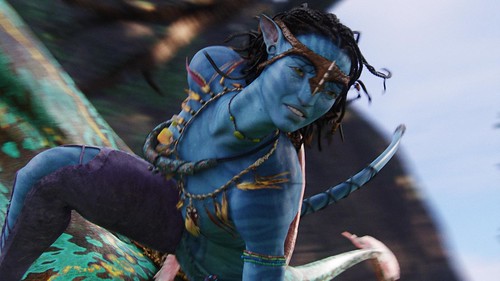
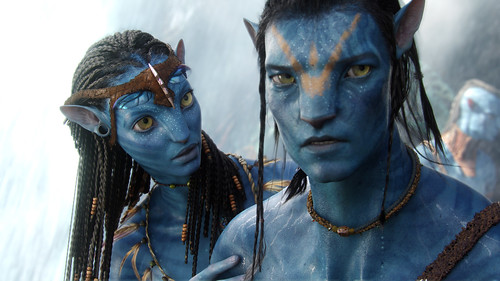
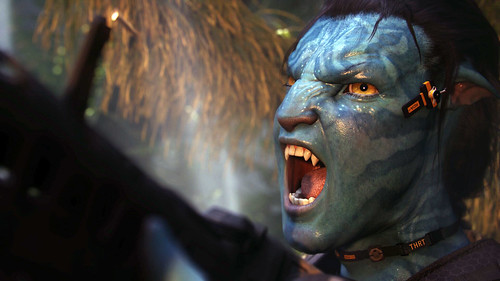
I think it's quite interesting to consider the fact that one of the most recent science fiction films, one involving state of the art special effects and computer generated graphics, not to mention the fact that it is on course to become the highest grossing motion pictures of all time, presents a vision of alien life forms cut from the same cloth, tribal peoples.  Of course, our attitudes towards such cultures, and towards colonialism, have changed dramatically, but the source remains the same, after over a century.  

I'm referring of course to Avatar, James Cameron's new blockbuster.  And, just to refresh your memory, here are some images:


And here's a brief mini-documentary that provides a look at these noble-savage-type aliens:


So, going from A Trip to the Moon in 1902 to Avatar in 2009 provides a wonderful example of the changes and the continuities within the genre.

As for the return voyage in A Trip to the Moon, well, once again we are in the realm of fantasy and entertainment, not science fiction, as the capsule simply falls off of the moon and down to earth.  But the splashdown does accurately predict how capsules would return during the pre-space shuttle parts of the American space program.  And by all means, let's end with a party (not seen in the embedded version, but you can catch it in the Internet Archive file).

Oh, and one more thing.  Crossing genres, just for a moment, I can't help but note the fleeting connection between A Trip to the Moon and the early television program, The Honeymooners, starring Jackie Gleason.  Beginning as a sketch in 1951 on the variety show Cavalcade of Stars, hosted by Gleason, it had a brief but memorable run as a situation comedy in 1955-1956.  In the opening to that program, a similar but somewhat different image of the moon, and the man in the moon played a prominent role.


The moon also figures prominently in one of Jackie Gleason's famous lines, as told to his character, Ralph Kramden's wife, Alice, played by Audrey Meadows.  If you know what I mean, there's no need for me to repeat it here, and if you don't, well, here's one more video for you.  This includes an early version of the program's moon-oriented opening, and then goes on to play the line in all of its manifestations.  If you just watch the first couple of minutes, you'll get the point--if you can watch it all in one sitting, my hat's off to you!


And with this I say, to the moon indeed, to the moon!