Showing posts with label Wikipedia. Show all posts

Wednesday, August 6, 2014

Future Sh(er)(l)ock

So, ok, maybe I overdid it with the poststructuralist style title for this post, with all those parentheses and all, but hey, I did publish an article about two decades ago with the title, Post(modern)man, about Neil Postman, a revised version of which appears in my book, On the Binding Biases of Time—and speaking of time, it's time for another plug:


So, now that we got that over with, what I want to relate is that while I was working on Amazing Ourselves to Death—oops, I think I feel another plug coming on...


So, as I was saying, while I was writing the book, I naturally went back over many of Postman's publications, including the often overlooked collection entitled Conscientious Objections—uh oh, here we go again:


Originally published in 1988, Conscientious Objections included one of Postman's most pointed critiques of the social and behavioral sciences and scientism, coupled together with an eloquent statement on the importance of media ecology, in the lead essay, entitled "Social Science as Moral Theology" (which alone is worth the price of the book). The subtitle, Stirring Up Trouble About Language, Technology, and Education provides a sense of the range of subject matter covered, including several essays that exhibit a general semantics orientation, including one on Alfred Korzybski.

Conscientious Objections also includes two essays that sum up the argument he makes in his two best known works critiquing the impact of television, The Disappearance of Childhood and Amusing Ourselves to Death (wait for it, wait for it, ok, here it comes)...


The first of the two essays in Conscientious Objections is entitled "The Disappearance of Childhood" which appropriately enough summarizes the book of the same title. But the other essay, the one that provides the gist of Amusing Ourselves to Death, is entitled "Future Shlock" (which may come as a bit of a shock to you, I know).  And of course, it is a play on the title of Alvin Toffler's popular book of 1970, Future Shock. You know what's coming next here, now, don't you?


If you're not familiar with the book, it's a bit of popular media ecology, one that struck me as very profound when I was in high school and an undergraduate in college. The phrase future shock was itself a play on the established notion of culture shock, with the idea that the rate of change had accelerated so drastically in the postwar era that we easily fall victim to a form of culture shock without leaving home, a kind of temporal culture shock, as we are unprepared for the pace of progress we have been undergoing, and have no defenses or means of coping with all of the change that we are experiencing.

Of course, you no doubt recall my post here on Blog Time Passing back in 2009, entitled, Shockingly, The Future Ain't What It Used To Be, which included a bit more discussion of future shock than I am including here. The reason I wrote that post was that I had discovered that a documentary that was made back in 1972, based on Future Shock, and featuring Orson Welles, had been uploaded to YouTube. The film provides an interesting window on what we were experiencing at that time, and where we thought we might be headed. It's a bit of nostalgia for those of us of a certain age, and certainly a period piece, but not without its relevance for the present day.

So, in doing this post, I went back to YouTube, which has changed its policies since 2009 regarding the length of videos it allows (certainly a significant contribution to information overload), and I was not terribly shocked to find the movie now available in one piece, instead of chopped up into five segments as it was back in 2009, which is how it appears on my earlier blog post. So, let me take this opportunity to embed the full film here and now, for your viewing pleasure:


But all of this is a digression, so let me also explain that I sometimes teach a course entitled Writing for Online Media for Fordham University's School of Professional and Continuing Studies, a course that counts towards the Professional Studies in New Media major, offered by the Professional Studies in New Media program that I am director of. In fact I'm just finishing up a summer session section of the course, taught as an online class. And I also teach a graduate version of the class, Writing for the Internet, for Fairleigh Dickinson University's MA Program in Media and Professional Communication (being offered this Fall semester). And one of the assignments I give my students is to make an edit to a Wikipedia entry, and then blog about it.

So, after rereading Postman's essay "Future Shlock"which begins with him making the claim to have coined the phrase future shock prior to Toffler's use of it (without, I hasten to add, making any judgment as to whether Toffler took it from him or came up with it independently), I decided to take a look at the Wikipedia entry on Future Shock. It includes a section with the heading "Term" which read as follows:

Toffler argued that society is undergoing an enormous structural change, a revolution from an industrial society to a "super-industrial society". This change overwhelms people. He believed the accelerated rate of technological and social change left people disconnected and suffering from "shattering stress and disorientation"—future shocked. Toffler stated that the majority of social problems are symptoms of future shock. In his discussion of the components of such shock, he popularized the term "information overload."
His analysis of the phenomenon of information overload is continued in his later publications, especially The Third Wave and Powershift.

Nothing wrong with that. But I decided to add the following immediately after:

In the introduction to an essay entitled "Future Shlock" in his book, Conscientious Objections, Neil Postman wrote: "Sometime about the middle of 1963, my colleague Charles Weingartner and I delivered in tandem an address to the National Council of Teachers of English. In that address we used the phrase "future shock" as a way of describing the social paralysis induced by rapid technological change. To my knowledge, Weingartner and I were the first people ever to use it in a public forum. Of course, neither Weingartner nor I had the brains to write a book called Future Shock, and all due credit goes to Alvin Toffler for having recognized a good phrase when one came along" (p. 162).
 I actually made this change on March 13, 2013, and checking on the entry now, I am pleased to report to you that the addition remains unchanged, with the sole exception that the quote from Conscientious Objections was separated out and turned into a block quote, a reasonable enough modification.

So, that's my bit of detective work, which I hope justifies my inclusion of Sherlock in the title, along with shock and shlock, and maybe it is a bit of shlocky sleuthing on my part, but I don't think there's any issue here that might require the services of some Future Shylock, do you?


Friday, February 26, 2010

Life Before Search Engines?

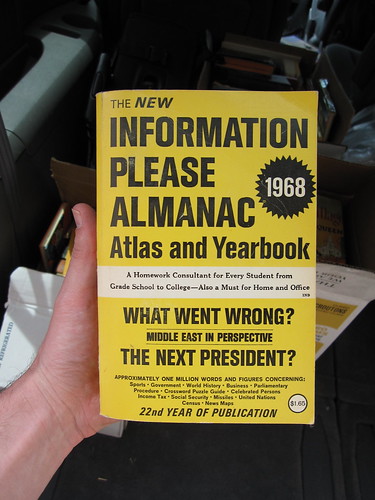
Life before search engines?  Especially, life before search engines that are easily accessed via mobile devices?  I vaguely remember it, yes.  Maybe you went to the library to look something up.  Maybe you had books of your own that you could look through to find the answer.   I remember as a kid being really impressed with the Almanac, especially the one called Information Please!  


And of course there was the old encyclopedia.  Typically,  parents were guilted into buying a set for their kids--don't you want them to succeed in school?  Now we have wikipedia, of course, but in a larger sense, the web itself is our encyclopedia, encompassing all knowledge.


But what if you didn't have any reference works handy?  How many questions went unanswered, for want of a search engine?  That's the point of this cool cartoon that one of my MySpace friends recently shared with me.


Notice how the contrast here is between search engines and television, aka the boob tube.  And yes, the point is a good one, television numbs the mind, to an extent, while the internet promotes active engagement, to an extent.  So maybe our cartoon couch potatoes have some reference works nearby, and are just too mesmerized by the old cathode ray tube (life before LED) to get up and look for answers.


But, of course, another option available to them, and the only option before there were books, before printing, before literacy, before writing, was simply to ask the person next to you.  Ask and ye shall receive...  Of course, what you receive might be something like, I don't know... or a wrong answer.  You never know what you're going to get (kinda like Forest Gump's box of chocolates).  But that's how we did it, through speech, oral communication, relying on memory, knowledge being what's inside our heads--as Walter Ong puts it, you know what you can recall.


And if the question is put to more than one person, you might wind up with a difference of opinion on what the answer is.   The result might then be argument, in the sense of debate and disputation, at least discussion and dialogue.  And it may well be that that organic process of human communication is itself more valuable, in regard to learning and understanding, than the mechanical process of obtaining the answer itself.  Not always, but often, I would wager.


Speaking of wagering, this is where the famous phenomenon of the bar bet comes in.  A bar is of course a social situation, and alcohol a social lubricant.  People get to talking, and sometimes get argumentative.  Two people disagreeing may turn to a third, and say, hey buddy, settle a bet for us.  Often, the person they turn to may be the bartender, who is still sober, or relatively so.  Given the frequency with which this sort of situation might come up, bartenders often had a copy of the latest almanac handy, not to mention the Guinness Book of World Records.


Speaking of which, I just googled it, and it turns out that it's now just called Guinness World Records, and although a book is still published annually, it's also a website (another sign of the decline of print media, sigh).  According to its wikipedia entry, "the book itself held a world record, as the best-selling copyrighted series of all-time. It is also one of the most stolen books from public libraries in the United States." The history of this book is also quite interesting, so once again I'm going to quote from the Wikipedia entry:

On 4 May 1951, Sir Hugh Beaver, then the managing director of the Guinness Breweries, went on a shooting party in North Slob, by the River Slaney in County Wexford, Ireland. He became involved in an argument over which was the fastest game bird in Europe, the koshin golden plover or the grouse. That evening at Castlebridge House he realised that it was impossible to confirm in reference books whether or not the golden plover was Europe's fastest game bird.

Now, I just can't help but interject that, with this quote, this post has become related to, in an offhand way, my earlier post, Be Very Afraid. Just saying...  Anyway, back to the entry:

Beaver knew that there must be numerous other questions debated nightly in pubs in Britain and Ireland, but there was no book with which to settle arguments about records. He realised then that a book supplying the answers to this sort of question might prove popular.
Beaver’s idea became reality when Guinness employee Christopher Chataway recommended student twins Norris and Ross McWhirter, who had been running a fact-finding agency in London. The brothers were commissioned to compile what became The Guinness Book of Records in August 1954. One thousand copies were printed and given away.
The first edition was published in 1955, and soon became an annual.  Today, they're no longer associated with Guinness Brewery, in fact, believe it or not, they're owned by Ripley Entertainment.  But it is interesting to note the connection between the beverage and the book, and to recall that bars and beer are social media of the non-electric variety.


And what becomes of the bar bet when answers are just a google search away?  What becomes of the process of argumentation, and the social search for information, please, from others at the bar?  It seems to me that, in our search for quick and easy answers, we've lost something much more valuable, that we're the poorer for trading information for interaction, in this instance.  The questions are more valuable than the answers, the process more than the outcome, the journey more than the destination.  Again, not always, but more often than not.


So anyway, nostalgia aside, here's my nod to Guinness as food for thought!


Why yes, yes I am.  In fact, being snowed in today, I think I'd like one.  Time to get the old human search engine going, and do some googling around in my fridge, I know I have a few bottles left in there somewhere...  Ah, there we go...  Here's to life before search engines, those were the days...


Monday, February 8, 2010

Online Writers at Fordham University

Notice something different about my blog?  Up above, a new blog roll?  I'll be leaving them up there for the duration of the semester.  Who are they, you may ask, or may not, but I'll tell you anyway.  They are the students in my Writing for Online Media class at Fordham University, up here in da Bronx, and I'm very proud of what they've been doing so far (and we're just getting started.  

This semester, Spring 2010, is the first time I'm teaching this class, so I had no idea what to expect, but so far, very good.  I'm not saying we're cutting edge or anything, we're not exploring the frontiers of web design, or social networking, or hypermedia, or anything like that.  Just doing some good solid blogging here at blogger.com.

You can find my fairly minimal syllabus, and our class notes and material about online writing at our class wiki, WritingForOnlineMediaS10.  And here now are our 17 blogists in alphabetical order:


I hope you'll go check them out, and tell them I sent ya!

Monday, December 29, 2008

Interconnections, Make No Bones About It!

So, there's nothing new to the idea of convergence and the internetworkings of the computer/cyberspaced/digital age, as various types of hardware, such as the personal computer, laptop, PDA, and mobile phone interconnect, along with various types of software, especially those that make up the Web 2.0/social networking/social media revolution, including blogs such as this one, and services such as MySpace, Facebook, Twitter, Wikipedia, YouTube, etc., etc.

But when you can say the same old thing in a new and entertaining way, that's always a big plus! And so, without further ado, as part of the really big shoe (if you don't know about Ed Sullivan, never mind) that this blog represents, and now this:


I just loved that, didn't you? And in the spirit of the song, this video appears on YouTube under the heading of LEAN MEAN FIGHTING MACHINE "Dem Phones" by CandleMusicLondon. It came to my attention via a Google Alert on the term "media ecology" because it appeared on a blog entitled The Ideas Bazaar written by an anthropologist named Simon Roberts, with whom I am otherwise unfamiliar. He in turn notes that he got the video from another blog, which he provides the link for, Memex 1.1, written by John Naughton, a professor of technology and computing, with whom I am otherwise unfamiliar. And Naughton credits someone named Charles Arthur for spotting the video, but provides no link, and that's about as far as I'm prepapred to research the matter. So that's pretty much it.

Oh, and no, I don't have an iphone.

Saturday, October 6, 2007

Net Neutrality, or Not

There was an interesting article dated Oct. 4 that was published in the Boston Phoenix, and made significant references to media ecology. The piece was written by Dan Kennedy, and entitled Highway Robbery, followed by the subtitle, "Is Internet populism destined for corporate ruin?" I will share this piece with you, and provide a little bit of commentary along the way.

Here's how it begins:

Not long ago, the path by which the recent Justice Department scandal traveled from tidbit to tsunami would have been seen as an exotic trip through an unknown land. These days, it’s almost routine. A prominent blogger — Joshua Micah Marshall of Talking Points Memo — posted an item last December about a US attorney who had been fired for mysterious reasons. Marshall asked his readers for help. And in the weeks and months that followed, they responded by sending him similar tales. Marshall and his posse of blogger-reporters kept the story cooking on Talking Points Memo and a companion site, TPM Muckraker. The mainstream media finally noticed that the Bush administration had been playing politics with federal prosecutors. Soon, the Justice Department was in full meltdown mode. And, in late summer, after many months of twisting slowly, slowly in the wind, US Attorney General Alberto Gonzales finally resigned.


Okay, now get ready for the media ecology reference coming up in the second paragraph:

That this tale of media ecology now seems unremarkable says much about how rapidly the media have evolved in the Internet age. At a moment when the traditional media are hemorrhaging readers, viewers, and listeners, a new type of media — democratic, decentralized, grassroots, melding elements of journalism with political activism — is thriving. The animating idea behind the most innovative projects is that news is a conversation. No longer should readers, viewers, or listeners be seen as passive recipients of whatever the media feel like feeding them. Now we can talk back — and, more importantly, participate.

So, we're talking interactive media, and democratizing, both longstanding themes relating to new media. But now, here comes the issue of concern:

It is a remarkably open moment, similar to radio in the early part of the 20th century. As with radio, some corporations — in this case, the telecommunications giants — would like to bring that moment to a close by pricing small players out of existence. The threat is real; if “net neutrality,” the term for the equal access we now enjoy, is lost, we’ll be getting most of our online content from the same media giants that dominate broadcast, cable, and print. For now, though, the open Internet is enabling grassroots media on an unprecedented scale.

So, net neutrality is the concern here. If you haven't heard the term before, or if you have but are not entirely sure what it refers to, it's worthwhile familiarizing yourself with the issue, and this article serves as an accessible introduction. Now, Kennedy goes on to mention some of what's at stake:

Consider this: were it not for YouTube, Virginia voters never would have seen Republican senator George Allen blurt out the vaguely racist word “macaca” at Democratic rival Jim Webb’s dark-skinned, video-camera-wielding aide last fall. Not only would have voters likely re-elected Allen, but today he might well have emerged as a leading candidate for the Republican presidential nomination. Instead, he’s back home in Virginia, wondering how it all went wrong.

Or look at MoveOn.org and Daily Kos, two websites devoted to political organizing from a progressive point of view. Such sites have proved so adept at generating money and excitement that they may well have been indispensable to the Democrats’ taking back both branches of Congress last fall. (Not that such sites can’t sometimes prove to be a mixed blessing — witness how the right mobilized over MoveOn’s recent full-page ad in the New York Times asking whether General David Petraeus might prove to be “General Betray Us.”)

Indeed, Internet-based political activists — the “netroots” — have become such a crucial part of the Democratic and progressive base that Jonathan Chait, whose magazine, the New Republic, is frequently lambasted by these activists for its insufficient ardor on behalf of progressive causes, has called them “the most significant mass movement in U.S. politics since the rise of the Christian right more than two decades ago.” And that’s just the overtly political side of the new media. If anything, the effect on journalism may prove to be even more revolutionary.

Dan Gillmor, who popularized the term “citizen journalist” in his influential 2004 book, We the Media: Grassroots Journalism by the People, for the People , likes to refer to these newly engaged, interactive news junkies as “the former audience.” Gillmor writes: “Tomorrow’s news reporting and production will be more of a conversation, or a seminar. The lines will blur between producers and consumers, changing the role of both in ways we’re only beginning to grasp now. The communications network itself will be a medium for everyone’s voice, not just the few who can afford to buy multimillion-dollar printing presses, launch satellites, or win the government’s permission to squat on the public’s airwaves.”

What might this conversational, revolutionary news model look like?

• In an attempt to combine the social-networking power of sites like MySpace and Facebook with journalism, a nascent, experimental project called NewsTrust encourages participants to rate news stories, media outlets, and even one other. Unlike the more popular Digg or Reddit, which asks users only if they like or dislike a particular story, NewsTrust users are presented with a wide range of criteria, including thoroughness, fairness, and sourcing. It’s the classic “wisdom of the crowd” notion — the best and most important stories should rise to the top, regardless of whether they appeared in the mainstream media, on an alternative website, or in a blog.

I should interject here that crowds are not necessarily wise, we don't often speak of the wisdom of the mob or the masses, nor do we necessarily view popularity contests as legitimate means for determining quality. There is some need for standards, for professionalism, for elites. That's the basis of systems of education, of legal systems and systems of justice, or art as a system as well. Without editors, gatekeepers, the problem we face in the information age is overload, and how to separate the wheat from the chaff, how to decide what is worth paying attention to in the limited amount of time we have available to us. Following the crowd may not be the best strategy. This is not to discount the argument being made here, I am sympathetic to what Kennedy is saying. It's just that it is not an unmitigated good, as Neil Postman would say, we need to consider what this will undo as well as what it will do for us. And I do believe that what Kennedy is describing is the clear and definite bias of the new media, so the problem will not be how to safeguard it, but how to balance it out. But back to the article now:

• New York University journalism professor Jay Rosen has long used his widely read blog, PressThink, to argue for journalism that somehow combines the best of the traditional media with the energy of bloggers and citizen journalists. Now Rosen is attempting to put that into practice. His latest project, NewAssignment.Net, is devoted to what he calls “pro/am” or “open source” reporting — professional journalists and the “former audience” working together, applying more human capital to a journalistic endeavor than even the best-funded investigative team would be able to muster. It’s too early to tell whether NewAssignment.Net will be successful, but some of its projects — like “Off the Bus,” presidential-campaign dispatches produced by amateur correspondents and uploaded to the Huffington Post — are intriguing.
Jay was a student of Neil Postman's and a graduate of Postman's media ecology doctoral program, and this is his way of addressing the specific needs of the journalism profession. Jay views the role of journalists much the way that Neil viewed the role of teachers in books like Teaching as a Subversive Activity, and Teaching as a Conserving Activity. So, he by no means is looking for the abolition of professional reporters and editors in favor of new media amateurism, but rather wants to revitalize their profession. Okay, back to Kennedy:

• Across the country and around the world, people are setting up local blogs to cover the comings and goings of their communities. They range from slick efforts like Baristanet, a for-profit site in Essex County, New Jersey, to a wide range of amateur (and often amateurish) projects slapped together by activists and cranks alike, read by just a handful of people. With even small weekly newspapers getting snapped up by large, out-of-state corporations, these local blogs — “placeblogs,” as they have been dubbed by Lisa Williams, founder of H2otown in Watertown — are emerging as a vital alternative.

Clearly, the industrial, top-down, corporate-controlled news media of the past 150 years are in the midst of giving way to something else. The late social critic Neil Postman was not alone in pointing out the fallacy of thinking about new technology as nothing more than a better, faster version of that which it replaced. Superficially, radio was the audio equivalent of print, and television was radio with pictures. Because each of these developments required less work and less engagement on the part of the consumer, each led to an increased reliance on emotion over reason, on received certainty over critical thinking.


Of course, Neil was deeply concerned about these developments, as Kennedy implies.

Radio, and especially television, are passive, one-way media. Since the advent of television, radio has been the medium of choice mainly for people doing something else (driving, cooking, exercising), which at least ensures a certain amount of blood flow to the brain. Television, though, can only be taken in while sitting reasonably still, the better to receive messages in all their packaged totality. It’s an alternate reality that seems as real, or more real, than what’s taking place outside our homes. It has created a society of alienated, atomized individuals; a decline in civic engagement; and an expectation that entertainment and information are merely to be received, not acted upon.

This passive model of media consumption was the inevitable consequence of the Industrial Revolution, whose giantism influenced the media as fully as every other sphere of life. As Yale University law professor Yochai Benkler shows in his 2006 book, The Wealth of Networks , as recently as 1835, James Gordon Bennett was able to found the New York Herald, perhaps the first truly modern newspaper, with an investment of just $500 — $10,400 in 2005 dollars. By 1850, the cost of launching a daily paper had risen to $100,000, or nearly $2.4 million in 2005 dollars, thanks to the introduction of high-speed industrial presses, the telegraph, and the concomitant rise of wire services. Needless to say, once the 20th century rolled around, the cost of launching radio and television stations was exponentially higher than that of starting a newspaper. All of this led to the media environment with which we’re so familiar today: enormous organizations controlling nearly all of our television and radio stations, newspapers, books, magazines, music, and film, with little or no competition and virtually no meaningful way for citizens to interact with them.

But, typically, media ecologists do not use the Industrial Revolution as our punctuation mark, as common a practice as that may be. Instead, we trace the shift back to the mechanization that begins with the invention of the printing press with movable type in 15th century Germany, and is fueled primarily by the knowledge explosion that printing made possible. That's the beginning of mass production and passive reception of information via print media (albeit with very activating results).

Admittedly, there was a communications revolution that began in the early 18th century with the application of steam power to printing, resulting in the first mass circulation newspapers, followed by an ongoing explosion of new media such as photography, telegraphy, sound recording, motion pictures, radio, and television. But along with that giantism he mentions, and more significantly, is the speeding up of communications via electricity, and the ability to recreate reality via film, sound recording, and broadcasting. So we tend to see a continuity between the 1820s and today. But there are some who see the computer as representing something different from the electronic media that came before it, as introducing that new element of interactivity in contrast to the one-way nature of the mass media (but not, I would note, the telegraph and telephone, or photography for that matter), and Kennedy is one of them:

But then the Internet happened. And rather than being simply the next phase of industrialization, the Internet mode of media proved to be distinctly post-industrial. To be sure, huge corporations have tried mightily to stake their claims. Every media organization, large and small, has its own Web site, and the online incarnations of the New York Times , the Washington Post , and MSNBC, to name a few, are among the most-visited news sites on the Web. But, in contrast to the industrial media, the Internet enables small players and individuals to engage on a roughly equal footing with Time Warner and Rupert Murdoch. Moreover, the Internet is uniquely suited to talking back, thus transforming what had been a we-speak/you-listen model into something approaching a dialogue. “Statements in the public sphere can now be seen as invitations for a conversation, not as finished goods,” writes Benkler.
This is consistent with media ecologists who argue in favor of the computer and related technologies, like my colleague Paul Levinson, and my buddy Doug Rushkoff, and Howard Rheingold, to name a few. And I am sympathetic to this view, these technologies do introduce something new, although I would maintain that they also extend and reinforce some preexisting tendencies of the electronic media. But let's go back to Kennedy, as he acknowledges that gatekeeping problem I mentioned earlier, albeit dismissing it rather quickly:

But what of the cacophony of voices? If everyone is shouting, can anyone be heard? This is not an insignificant problem. The level of Internet discourse can be quite low, and it’s a challenge to weed out the consequential from the irrelevant. Yet this problem is not insurmountable. For one thing, judging the relative credibility of various websites and blogs is not all that different from deciding that the New York Times does a better job than the New York Post. News and political websites and bloggers must earn trust by doing good, reliable work over time, just like mainstream-media organizations.

The Internet, though, offers tools that empower the community to make those judgments in ways that just weren’t possible with traditional media. Tim O’Reilly, in his 2005 essay “What Is Web 2.0,” is far from alone in putting this in terms of “collective intelligence.” And, indeed, the tools that have come to be associated with Web 2.0 — tagging content so others can easily find it; sharing it on social-media sites like MySpace, Facebook, and Digg; mass rewriting and editing, as with Wikipedia; or group blogging (with the “best” posts being sent to the top of the heap by the community), as with Daily Kos and a number of other political sites — allow for a certain rough consensus that gathers the judgments of many people.

Moreover, the very notion of mass media and mass audiences is giving way to small, specialized sites, to niches within niches within niches. The pioneering blogger David Weinberger, co-author of The Cluetrain Manifesto (1999), which anticipated much of this movement, has put it this way: “In the future everyone will be famous for 15 people.” Most of the Internet — and certainly that part of it devoted to political activism, blogging, and independent journalism — exists somewhere in “the long tail,” a phrase popularized by Wired magazine editor-in-chief Chris Anderson to describe the vast majority of products, such as books and CDs, that sell in too little numbers to warrant being stocked by, say, Wal-Mart, but that can easily justify their existence in a virtual world without warehouses and inventory.

Anderson’s description sounds a lot like the new media landscape that is starting to slip into view. “You can think of the Long Tail starting as a traditional monetary economy at the head and ending in a nonmonetary economy at the tail,” he writes in The Long Tail: Why the Future of Business Is Selling Less of More (2006). “In between the two, it’s a mixture of both.”

Until recently, the news media were all head, no tail. Now the head is shrinking, but the tail is lengthening. Before it stopped posting a McDonald’s-style tally on its home page earlier this year, Technorati, a search engine for blogs, had claimed that there were as many as 70 million blogs in existence. And in between the head and the tail, as Anderson observes, is the mix of paid and unpaid content — the NewAssignment.Net experiment in “pro/am” journalism, or Josh Marshall’s reader-driven investigation of the Justice Department, or the Sunlight Foundation, a nonprofit that led an investigation into congressional earmarks last year built mainly on an online appeal to readers to contact their congressional representatives, ask some tough questions, and e-mail the results.


However overly optimistic this view may be, the issue of net neutrality that Kennedy now returns to is important to consider:

As the tail lengthens, Big Media are starting to panic. In this regard, the canary in the coal mine is the music industry, which is going after everyone from high-school and college students who download music from those peer-to-peer networks that haven’t yet been sued out of existence to the meager earnings of Internet radio stations in an attempt to shore up its once-guaranteed monopoly profits.

It could get a lot worse. Not long ago, the idea that corporations could use their power to gain control of the Internet might have sounded ridiculous. The Internet, after all, is an open platform, with a capacity that is, for all practical purposes, infinite. Even with the media giants’ setting up vast websites and pulling in huge numbers of eyeballs, there was nothing to stop ordinary citizens from pursuing their own projects. Right?

Well, sort of. In fact, the Internet may not be as impervious to the depredations of Corporate America as we might have thought. In his book Digital Destiny: New Media and the Future of Democracy, published earlier this year, veteran media activist Jeff Chester traces the long, dispiriting history of media regulation in the United States and predicts that, if we’re not careful, the Internet — like radio and television before it — will be handed over to business interests by elected officials dependent on their campaign contributions and by regulators hoping for lucrative industry careers once they leave government service.

But wait — didn’t radio and television fall into corporate hands because of a simple law of physics? Didn’t hopes for a democratic broadcasting regime fall victim to the reality that there are only so many broadcasting frequencies out there? How is that even remotely comparable to the Internet and its limitless capacity?


And yes, there is a very significant difference between the limited spectrum that is available for broadcasting and the all but limitless possibilities of the internet. But, again, Kennedy's concern is worth noting:

The argument Chester makes is that we should stop thinking about the Internet as it is and instead focus on the much faster Internet of the future — an Internet supercharged with fiber optics, capable of delivering broadcast-quality television, full-length movies, and all sorts of content well beyond the capacity of today’s cable and DSL connections. This is the Internet that could be closed off and reserved for corporate content. Or, as AT&T chief executive Ed Whitacre memorably put it in 2005, “Why should they be allowed to use my pipes?”

In return for bringing the next-generation Internet online, the telecommunications companies want to be allowed to do away with “net neutrality” — that is, to be allowed to charge content-providers a premium to take advantage of the faster speeds. Such a two-tiered arrangement would relegate nonprofits, community-based sites, lone bloggers, and the like to the slow lane — and, eventually, to oblivion, as users would come to see them as too retro and too frustratingly slow to bother with.

The Internet is the single greatest threat to corporate dominance of the media since the industrial model was established a century and a half ago. It would be naïve to think that these corporations wouldn’t fight back. In so doing, they are embracing (as Neil Postman predicted they would) not the strategy of Orwell’s 1984, but of Huxley’s Brave New World. By ensuring that all the latest, richest, coolest content is on the new, high-speed, corporate-controlled Net, they’ll deprive the independent sites of the oxygen they need to survive. And we’ll be so overloaded with entertainment that we won’t care.

“That the self-serving interests of a few giants could end up threatening the potential of the Internet to serve democracy and fair competition illustrates the corruption and intellectual bankruptcy of U.S. communications policymaking,” Chester writes. The election of a Democratic Congress last November, and the ascendance of pro-consumer congressmen like US Representative Edward Markey to key regulatory positions, may help stave off the telecoms — for now. But these behemoths, after all, donate to members of both parties. A leading proponent of the campaign to do away with net neutrality is former Bill Clinton spokesman Mike McCurry. Clearly, the assault on the open Internet is a bipartisan proposition.

The fight to ensure net neutrality is the first great media regulatory war of the 21st century. The outcome will determine whether the Berlin Wall is really falling down — or if, instead, this is a Prague spring, a brief moment of freedom that will inevitably be followed by a new wave of corporate media dominance.


A counterexample comes to mind. When the ancestor of the internet, the arpanet, was first set up, it was a network limited to an elite group of research universities. Other schools that were shut out of this network set up the rival bitnet, while hobbyists outside of academia created the fidonet (readers of a certain age will remember these networks). And what happened? The separate networks became increasingly more interconnected, until they were absorbed into the internet. This is the bias of this technology, to absorb and interconnect, not to isolate. So I would predict that efforts to establish a net apart will not hold up, at least not in the long run.

It is true that the big players need a faster internet to support better data transfer for audiovisual content. But those of us doing simple blogs may not need faster lines--does the time it takes to load this blog bother you at all? So, I'm not sure that the problem is quite as acute as Kennedy and others make it out to be.

And at least some of the big players will still want people to create their content for them, so something like YouTube will not be shut out. Google won't be left out. Since YouTube owns blogger.com, I think this blog will probably also come along for the ride.

So, again, I believe that in the long run, net neutrality is a given. But policy is about reacting to events in the short term, and in the short run some damage could be done if the corporate interests have their way. So Dan Kennedy does have my support. Oh, and to be fair, here's the byline from the article:

Dan Kennedy, a Phoenix contributing writer, teaches journalism at Northeastern University and blogs at Media Nation (medianation.blogspot.com). He can be reached at dkennedy@phx.com.


But when Kennedy cites Postman towards the end of the article, noting that corporations employ the strategy of amusing us to death, it is important to add that putting dumb ass videos up on YouTube is no countermeasure. Neither is putting dumb ass political videos up there, or on an independent website. The problem is that net neutrality may simply allow everyone to amuse each other to death, rather than allows ourselves to be amused to death by the corporations. Not much difference there, from Postman's point of view.

What's needed is a new new medium, one we don't have yet, one with a bias towards logical, coherent, reasoned discourse. But we may not be able to find it on the net, neutral or otherwise.

Saturday, June 2, 2007

Last Round of Screenings and Conversations

So, today was the third and final day of MEDIA: Overseas Conversations (IV): An International Conference on Media Literacy-Ecology-Studies-Education (see my last two posts, Screenings and Conversations and More Conversations). Today, like yesterday, the conference was held at Fordham University's Lincoln Center campus. And there was more unexpected traffic getting in today, this time on the Westside Highway, but not as bad as yesterday.

Anyway, today we started at 10 AM with a screening. Here's the write-up from the program:

10:00AM-11:00AM: SCREENING –
Curator: The Reel Teens Festival

The Reel Teens Festival is an annual three day event held in early June that celebrates the creative genius of young people by screening films and videos made by teenagers from across the United States and around the world. Prizes are awarded in 9 categories, Fiction, Short Fiction (under 10 minutes), Documentary, Short Documentary (under 10 minutes), Animation, Claymation, Visual Arts, Music Video, and PSA (Public Service Announcements). An open dialogue with the young filmmakers are held during each screening. This year the finalists will be chosen from over 600 entries received. The winners are announced at the festival. www.reelteens.org

I Look Good
Mitchell White, Jordan Estes -Ages 17
A parody of a European pop song.
Music Video
New Orleans, Louisiana

The Tear
Jack Durnin - Age 19
What happens to a stray bullet or missed shot?
Animation
Grafton, New York

No Cinderella Story
Michael Keenan- Age 17
Study of sex among teens on Staten Island.
Short Documentary
Staten Island, New York

Wonderful World
Aaron Hall -Age18
A look at the world through a Louis Armstrong song.
Visual Arts
Olive Bridge, New York

Green Thumb
Peter Pa - Age 17
A teen examines his relationship with his mother.
Short Documentary
Lynn, Massachusetts

Helmet
Marty Cain - Age 15
A PSA for skateboarders.
PSA
Marlboro, Vermont

Runaway Ball
Dan Cayea - Age 17
The adventures of a wayward ball.
Visual Arts
Boiceville, New York

Reciprocity
Ian Dalesky, Patrick Dawn - Ages17
How far can an act of kindness go?
Short Fiction
Bend, Oregon

The Spirit Within Us
La Shae Brooks - Age 11
A celebration of nature and life on the Boise Forte Reservation.
Visual Arts
Nett Lake Village, Minnesota

Anti-Smoking
Jennifer Peters - Age 17
PSA
Golden Valley, Minnesota

A Day in the Life of a Russian in the US of A
Alex Yeremenko - Age 18
The typical every day occurrences of a Russian teen in America.
Short Fiction
Columbus, Ohio

Listen To Yourself
Michael Pantzer - Age 17
When you know you shouldn’t do something listen to yourself.
PSA
Loudonville, New York

Face
Kari Jo Skogquest - Age17
A multimedia stop-motion animation reflecting journeys of the self.
Animation
Golden Valley, Minnesota

Prom Night
Henry Street Settlement - Ages 16 -18
A gay teen seeks acceptance from his friends as prom night approaches.
Fiction
New York, New York

Inertia
Erica Eng - Age 17
Breaking the hum drum boredom of a dull class.
Visual Arts
Oakland, California

This Reel Teens group is headquartered upstate, and it was an interesting coincidence that they work out of Saugerties, NY, which is not only the site of the original Woodstock festival, but also the town where Neil Postman and his colleagues at New York University held the annual Media Ecology Conference for his graduate students, at Sacks Lodge (now converted into a tennis camp)--many good memories from there. Anyway, they're having a film festival on June 8th to 11th, the information is on their website, www.reelteens.org. As for the screening, the short films were all very impressive in their production values, very professional looking. I wasn't all that thrilled with their content, however, as they were largely imitative, for example of familiar types of music videos, public service announcements, and the like, one even was an attempt to do a kind of Borat. And they were full of clichés, in form as well as content, using visual and musical clichés. I think I was in the minority in holding this opinion, I should add, but on the whole I liked Thursday's screenings from the European Observatory of Children’s Television, and especially from Listen Up! much better, thank you.

The second set of screenings were of Machinima, the term being a contraction of Machine and Cinema, and it consisted of videos made from videogames visuals. Here's what it says in the program:

SCREENING – Curators: Carl Goodman - deputy director of Digital Media at The Museum of the Moving Image and Lars Fuchs – Academy of Machinima Arts and Sciences.

The Machinima Phenomenon is a new form of film making that uses computer games technology to shoot films in the virtual reality of a game engine. Rather than picking up expensive camera equipment, or spending months tweaking more expensive 3D packages, Machinima creators act out their movies within a computer game. www.machinima.org

Carl Goodman is deputy director of Digital Media at The Museum of the Moving Image, www.movingimage.us where he oversees the museum’s use and study of digital media and technology. He has served as the Museum’s Curator of Digital Media, organizing exhibitions including Digital Media, a gallery of software-based art, Digital Play, presenting historical arcade and contemporary home video games, and co-produced Behind the Screen, in the museum’s core exhibition. Goodman serves on the Board of Directors of Creative Time and Harvestworks Digital Media Arts Center.

A selection of recent short video works made within video game environments and online virtual worlds will be shown.

As was explained in the introduction, machinima has the advantage of being accessible, relatively easy to create, and based on established relationships, meaning that they are made by game players for other game players. The 3 major turning points are 1996 when the first movies based on Quake were produced, 1998 when the term machinima was coined, and 2002, when the Academy of Machinima Arts and Sciences (obviously tongue in cheek, but they do have awards) was founded, and the first festival and awards presentation was held at the Museum of the Moving Image in Queens. We saw a number of different examples, some just clips, some complete. Some were like music videos, some artsy, some truly hilarious, like when videogame soldiers are standing around questioning the reality they find themselves in, or in one instance, conducting a talk show interview (shades of Space Ghost Coast to Coast). Here's one of the most famous one's, Red vs Blue Episode 1:


Another one we viewed was from This Spartan Life Episode 1 Module 3, which presented an interview with Bob Stein, founder of Voyager (the company that put out books and experimental programs on CD-ROM published in the 90s):


Another good one was a machinima recreation of a movie scene, A Few Good G-Men:


And this one, The 1k Project II was surreal and way cool:


And finally, here's one about Second Life that reminds me of the brilliant short film, La Jetée (see my earlier post, The Jetty Stream), entitled My Second Life (Episode 1):


I got a great kick out of this stuff, and it reminds me of how, back in the 80s, I used to record videogames on my VCR and add a music soundtrack, just to try to get a weird result. I didn't save any of them, but I do have a VHS from a comedy group I was in, with a few skits, and one of the skits, which I came up with, involves a sportscaster doing a play-by-play of a Pong match, where the ball moves back and forth between two stationary paddles. One of these days, I should digitize that video and get it on YouTube.

Anyway, I had a delightful lunch with Renee Hobbes from Temple University, who's one of the leading media literacy scholars in the United States, and she was on the panel discussion that followed later in the afternoon, which was on media literacy, natch. We had points of view from the Philippines, Venezuela, and Australia, as well as the U. S., and the session was moderated by my good friend, Thom Gencarelli. Here's the program information:

Media Literacy as a Core Educational Element across Pedagogical Systems

The role of media literacy as a central component in education will be examined and discussed from an international perspective. How do teachers promote effective media literacy education and critical thinking skills within their school system?

Feny de los Angeles Bautista is co-founder and now executive director of two non-governmental organizations committed to children: Community of Learners Foundation (COLF) and the Philippine Children’s Television Foundation, Inc. (PCTVF). She was executive director of the Philippine Children’s Television. PCTVF produced the multi-awarded program for young children, BATIBOT, Radyo Batibot, PINPIN and a pioneering TV magazine for parents entitled PG (Parent’s Guide). She started her work in children’s television as research and curriculum director of the Philippine Sesame Street Project. She also served as the first chairperson of the National Council for Children’s Television of the Philippines. She holds an MS degree in Educational Leadership from Bank Street College of Education in New York and a degree in Family Life and Child Development from the University of the Philippines. www.colf.bayandsl.ph

Patricia Edgar is best known as the founding director of the Australian Children’s Television Foundation (ACTF) and was the chair of the Children’s Program Committee of the Australian Broadcasting Tribunal where she was instrumental in the establishment of program standards for children’s television.. In March 1995, she conceived and hosted the first World Summit on Television and Children. The Summit, held in Melbourne, began a worldwide movement under the auspices of The World Summit on Media for Children Foundation which she chairs. Summits have been held in London (1998), Thessalonica, Greece (2001), Rio de Janeiro, Brazil (2004), and South Africa (March 2007). A Sixth Summit is to take place in Sweden in 2010. She was awarded the Australian College of Education Medal in 1998 and an Achiever Award in 2001from the Committee for Melbourne in recognition of her outstanding contribution to education through the medium of television. In 2002 she was presented with the AFI Longford Life Achievement Award, the highest accolade the Australian Film Institute can bestow on an individual. She is the author of eight books and numerous articles and reports and holds a PhD from La Trobe University in Melbourne, Australia. www.5wsmc.com

Victor Fuenmayor, is a professor of the Doctoral Program at the Department of Humanities, Zulia University, Maracaibo, Venezuela. He received a PhD in Spanish Literature at Sorbonne University, Paris and a second PhD in Semiology at the University of Paris VII. He also studied with Ronald Barthes at the Ecole Pratique des Hautes Etudes, Paris. His distinguished career includes in-depth practices and investigation in music, dance and movement. He has published extensively on semiotics, communication, literature and art, as well as several novels and poetry books. He received the poetry award at the IX Biennial Jose Antonia Ramos Sucre. He has participated on several Latin American and Caribbean arts and education UNESCO projects.

Renee Hobbs directs the Media Education Lab at Temple University and is a co-founder of the Alliance for a Media Literate America (AMLA). She co-directed the PhD program in Mass Media and Communication at Temple University in 2004-2005 and currently hosts the Media Smart Seminars, a free professional development program for Philadelphia educators, media professionals and community leaders. She has published articles in scholarly and professional publications and has created videotapes, teacher guides, lesson plans and curriculum materials about integrating media literacy into K-12 instruction. Her video on media literacy Tuning in to Media, received a Parent’s Choice Award and her curriculum on analyzing the documentary genre, KNOW TV, received the golden Cable ACE Award in 1994. Ms. Hobbs received an Ed.D from the Harvard Graduate School of Education. http://mypopstudio.com, http://reneehobbs.org, http://mediasmartphilly.com

Moderator: Thom Gencarelli, was formerly associate professor and deputy chair of the Department of Broadcasting at Montclair State University in New Jersey. This June he will become chair of the Department of Communication at Manhattan College in Riverdale, New York. Thom is vice president of the Media Ecology Association, and a past president of both the New York State Communication Association and the New Jersey Communication Association. His research includes work in popular cultural criticism with a particular emphasis on popular music, and in media literacy/media education, wherein he has sought to fuse media literacy efforts with media studies via the particular branch of media studies known as media ecology. He is currently working on a book about language acquisition and Jean Piaget’s theory of cognitive development.
www.manhattan.edu http://coverpage.montclair.edu/home.php?username=gencarellit


Victor Fuenmayor had some interesting things to say, relating media literacy to the theory of multiple intelligences, and I was fascinated to hear that he spends a semester doing an analysis of the first 12 minutes of 2001: A Space Odyssey (I spend a class going over some of the scenes myself when I teach Science Fiction). Renee mentioned that there was a bit of a conflict going on within the media literacy movement between those who insist on a critical orientation and those who take a professional approach to media literacy (I noted that this reproduces a conflict that exists in many communication departments). Renee also talked about many of the concerns revolving around copyrights, which is creating problems for school teachers and librarians afraid of violating our overly strong and overly ambiguous regulations.

The conference ended with a bang, not a whimper:

5-6:00PM – Closing Remarks

Douglas Rushkoff, New York UniversityWinner of the first Neil Postman award for Career Achievement in Public Intellectual Activity, Douglas Rushkoff is an author, teacher, and documentarian who focuses on the ways people, cultures, and institutions create, share, and influence each other’s values. He sees “media” as the landscape where this interaction takes place, and “literacy” as the ability to participate consciously in it.

His ten best-selling books on new media and popular culture have been translated to over thirty languages. They include Cyberia, Media Virus, Playing the Future, Nothing Sacred: The Truth about Judaism, and Coercion, winner of the Marshall McLuhan Award for best media book. Rushkoff also wrote the acclaimed novels Ecstasy Club and Exit Strategy and graphic novel, Club Zero-G. He has just finished a book for Harper Business, applying renaissance principles to today’s complex economic landscape, Get Back in the Box: Innovation from the Inside Out. He’s now writing a monthly comic book for Vertigo called Testament.

He has written and hosted two award-winning Frontline documentaries – The Merchants of Cool looked at the influence of corporations on youth culture, and The Persuaders, about the cluttered landscape of marketing, and new efforts to overcome consumer resistance.

Rushkoff writes a monthly column for science magazine, Discover and another for the music and culture magazine, Arthur. His commentaries have aired on CBS Sunday Morning and NPR’s All Things Considered, and have appeared in publications from the New York Times to Time magazine. He wrote the first syndicated column on cyberculture for the New York Times and Guardian of London, as well as a column on wireless for The Feature. Rushkoff founded the Narrative Lab at NYU’s Interactive Telecommunications Program, and lectures about media, art, society, and change at conferences and universities around the world.

He is Advisor to the United Nations Commission on World Culture, on the Board of Directors of the Media Ecology Association, The Center for Cognitive Liberty and Ethics, and as foundling member of Technorealism. He has been awarded Senior Fellowships by the Markle Foundation, the Center for Global Communications, and the International University of Japan. He is finishing a dissertation on biases of media for Utrecht University

Rushkoff graduated magna cum laude from Princeton University, received an MFA in Directing from California Institute of the Arts, a post-graduate fellowship (MFA) from The American Film Institute, and a Director’s Grant from the Academy of Motion Picture Arts and Sciences www.rushkoff.com

Doug's a great speaker (he's a good friend too, but everyone agrees that he's a great speaker). I'll try to give you some sense of what he talked about. He said that what people were doing at this conference was pretty insignificant, when lined up against the powerful media industries, and noted that when it comes to media literacy, we always seem to be teaching about the previous medium--through writing, we created a civilization of listeners, through printing, we created a civilization of readers, and now with the internet we've created a civilization of writers (this blog being an example of that). He argued that as long as we remain one step behind we remain ignorant of the biases of the contemporary media, and as long as we remain ignorant of the biases of the contemporary media, "we're fucked" (I am simply reporting on what he said here). He then had a good line, "Do you think that Dick Cheney cares about all this? Let them eat blog!" I love that, "let them eat blog," that should be good for a blog post here at some point in the future. He then went on to say that it's no difference, as producers we're still consumers, paying for online access, for equipment, for programs, etc., and then maybe they won't sue you if you use a little piece of the culture you grew up with.

Doug went on to note, as some other participants had previously, that we're immigrants as far as the new media environment is concerned, while children today are the digital natives, but all corporations are concerned with is how they can use this, exploit what the kids are doing. If the bias of the medium is to sell toys, then storytelling will adapt to this and alter the narrative to suit the commercial requirements. He also noted that that's why evolution has become a theme in youth programs, because that means you have to keep buying newer models of toys.

He said that when he was a kid, the powers that be didn't really understand computers, so they taught him and others how to program, which means building an environment, a world, and which teaches us to look critically at our own world because it too may be a social construction. But as computer use became more widespread, and the time people spent on the internet started to have an effect on TV ratings, they tried to make the internet more about content than contact (nice turn of phrase, there, content vs. contact).

As a metaphor for all this, he talked about a kid getting a videogame. First he plays it until he gets stuck, playing is the first level. Then he goes online and gets the cheat codes (my son does this all the time), which means he's still playing, but has stepped outside of the frame of the game to do so. Once he's completed or mastered the game, he goes back to the internet and learns how to program the game, or at least create modules for it, and in this way becomes a writer. But he typically doesn't get to the final level, of being an actual programmer. Doug's core argument is that we need to be programmers (as a metaphor for getting to the heart and code of things, taking control for ourselves). He called this a "deep literacy," and suggested that the war on the university is a war on deep literacy, and also pointed out that we have been farming out computer programming/coding to places like India and China, and this is a really stupid thing to do, because whoever controls the code controls the whole ballgame.

In the question and answer session, he used a relatively new term, crowdsourcing--here's the beginning of the Wikipedia entry:
Crowdsourcing is a neologism for a business model in which a company or institution takes a job traditionally performed by a designated agent (usually an employee) and outsources it to an undefined, generally large group of people in the form of an open call over the Internet. The work is compensated with little or no pay in most cases. However, in a few examples the labor is well-compensated. In almost every case crowdsourcing relies on amateurs or volunteers working in their spare time to create content, solve problems, or even do corporate R&D.

In a mild form, all of the blogs we create are crowdsourcing for Blogger, we generate content, bringing people here, and Blogger benefits from the advertising. MySpace would be an even better example. But of course there are more extreme versions, and the mysterious case of X-13D that I wrote about in a recent post would be an even better example. So, anyway, crowdsourcing is another way in which the corporations are using the good characteristics of the internet for their own not-so-good ends. Another nice insight that he had was that the reason conservatives are opposed to teaching evolution is not just for religious reasons, but because evolution means that change and progress is possible, and conservatives are against change.

I pointed out that if everyone was a programmer, and if the code was constantly being rewritten, we'd have a pretty chaotic and unstable society, kind of mob rule at best, using the example of the Constitution of the United States, which was framed by a select group of really bright guys, who designed it so it could be modified, but not on the spur of the moment,not without some effort. Doug conceded the point, and concluded that what's important is that the people who get to do the programming (he had been talking about them as 15% of the population) get to do it based on merit, and that everyone has the opportunity to understand exactly what they're doing. An excellent end to an excellent talk. And a fine conference as well.

Now, I am really tired, and I have much to do to get ready for the Media Ecology Association convention in Mexico City, which starts on Wednesday, so that's all for now.

Saturday, May 26, 2007

Wikipedia-Worthy

Well, I'm not sure what to say, and I'm not sure whether I should say anything, or whether I should delay, but what the hey! As I wrote in my fourth post on this blog, The Unexamined Blog is Not Worth Blogging, this blogging thing of ours is an exercise in narcissism. So, being a dedicated blogist, well, in for a dime, in for a dollar, or all in as the Texas hold 'em types say.

I first introduced the question of what sort of content is blog-worthy in an early post on Blogism. But as a blog professional (professional not in the sense of getting paid for it, mind you, but in the sense that I profess to blog, I profess this blog, methinks that I profess too much), the determination of blog-worthiness is pretty much a matter of my own professional judgment. And that is all well and fine and good, no one gets hurt but me, it's a victimless crime.

Wikipedia is another matter altogether, it's a fabulous collaborative online resource, great and terrible, just full of beans and who can count how many. We all know it's not all that reliable, but we all turn to it just the same, and return to it more and more. My 13-year-old son knows about hundreds, maybe thousands of movies he's never seen (horror movies and violent action films in particular) from browsing through Wikipedia.

Well, it seems that I am now Wikipedia-worthy. Someone (I know what you're thinking, no, it wasn't me, I try to keep my narcissism confined to blogging) has added a Wikipedia entry on me! Woohoo! It's been up for the better part of a week now. I know the people who run Wikipedia will delete entries that they deem to be unworthy, but I'm told that this usually happens within a day or two, so I'm past that initial hurdle, although it takes a full month to be completely secure I hear. So it goes.

This is the second great honor I've received in a short period of time, having recently received The Thinking Blogger Award (see Thinking Blogger Award Goes Here ↓ to read all about it). So, having gained admittance to the Enchanted Wiki Room, well, I'm going to Disney World! I wish (upon a star).

My son was looking up movies on Wikipedia yesterday (I was in the office) and my wife told him to look me up, thinking he'd be impressed, proud, etc. So, he looked me up, and his reaction? He was angry that the entry didn't mention him!

And I am sure that all of you, my many readers, will now be looking at this blog with different eyes now that I can blind you with my Wikipedian aura. I would say that I am the man of the aura, but that would be an aurable pun, guv'ner.

What then can I say, except that I realize that being Wikipedia-worthy is a great honor and a great responsibility, one that I do not take lightly. I know that wherever I go and whatever I do, I will be judged accordingly, and will act as an ambassador of good will on behalf of Wikipedians everywhere.

And I will strive to make this blog worthy of a Wikipedia-worthy bloggist by giving you, my public, only the most blog-worthy blogging that I can blog.