Monday, June 6, 2011

The Choral Village

It's been a while, I know, but there's a slight chance that you remember that my last post was Spirituality at the Speed of Light, and this new post is not entirely unrelated.  One of my graduate students in my FDU Understanding New Media Class this past spring semester brought this video to my attention, and in a musical sort of way, it demonstrates a new kind of electronic spirituality. 

The video is called Eric Whitacre's Virtual Choir - 'Lux Aurumque' and, well, why don't you see it for yourself:


This is a wonderful experiment in the use of digital media and online communications for innovative collaboration.  As I understand it, Eric Whitacre posted a video of himself conducting, and then invited anyone who cared to participate to record themselves on video following his conducting and singing one or more of the parts of this piece, Lux Aurumque, and then send him the file.  He combined the audio of all the files to create this performance, and as for the video, well, you can see for yourselves.

The effect is quite amazing, perhaps also disquieting, as in one sense it generates a kind of virtual heavenly choir (and even in their most benign sense, the hosts of heaven would be awe-inspiring, at least that's the reputation they have).  Just listening, we can appreciate a wonderful product of audio editing, in the same way that we might appreciate, for example, the last few Beatles albums.  

The video though, gives this a sense of the disembodied, the discarnate, to use a term that McLuhan favored (and I imagine he would have been fascinated by this demonstration of a new sense of mediated spirituality).  

In a more profane manner, however, it also reminds me of the depiction of the phantom zone in the Superman movies.  This certainly gives talking heads a new meaning, or should it be singing heads instead?  I do like the small glimpse into each person's local background that we get.  But overall, this comes too close to a bunch of floating heads to be anything but uncanny.

Here is another video with a somewhat different shape to it, Eric Whitacre's Virtual Choir 2.0, 'Sleep':


Somehow, I find the spheres less disturbing than the flat screens.  Maybe this says something about the future of media?  The video also gives special emphasis to the international nature of this virtual collaboration.  If not quite a global village in McLuhan's sense, it is certainly a global choir, a networked choir as well, of course, and a celestial one for that matter, and to stick with the McLuhan allusion,  I guess you could call it a choral village.

If nothing else, these videos serve as a magnificent symbol of the promise of new media, digital media, participatory media, of the hope for what the human race might accomplish when we are all linked together and singing in chorus.  And if there is to be any hope for such a future, we need images like these to help us imagine it, and in doing so, try to bring it into being.  So bravo, Mr. Whitacre, bravo!!


Saturday, May 7, 2011

Spirituality at the Speed of Light

So, a few months ago Allen Flagg, who is a member of the Board of Trustees of the Institute of General Semantics and the President of the New York Society for General Semantics, asked if I would be willing to come give a talk at the annual meeting of FIONS, the Friends of the Institute of Noetic Sciences--Allen is the Vice-President of FIONS, I should add. 

I agreed to do it, if we could agree on a date.  It had to be a Thursday evening in March, and as you may recall, I was in Italy for a McLuhan conference that month (see my previous post, The Fall of Nations).  But we were able to agree on March 31st, which was just a few days after I returned from Bologna.  It was quite the whirlwind, and I wrote most of the talk while I was in Italy.

Doing this lecture was a bit of departure from my usual academic activities.  FIONS is not an academic or scholarly group.  Here, take a look at their website if you want:  http://www.fions.org.  On their home page, they state the following:


Noetic is a great word, by the way, Walter Ong often used it in his discussions of the relationship between language, media, and consciousness.  Anyway, here is what they say on their About Us page:

Who We Are
Friends of the Institute of Noetic Sciences, (FIONS), is a 501(c)(3) not-for-profit organization dedicated to exploring the meaning of consciousness in its many forms. Its founders were inspired by the Institute of Noetic Sciences (IONS), the organization founded in 1973 by Apollo 14 astronaut, Edgar Mitchell, ScD, following his return to Earth from his historic 1971 walk on the moon. On the trip back Dr. Mitchell had an "epiphany", an experience of universal connectedness so profound that it altered his life from that point on. From the unique vantage point of the space capsule, the image of the earth floating gently in space radically altered his preconceived and pragmatic view of reality: What if reality was more complex than physical science had led us to believe? Might the study of "inner space" – mind, spirit, and consciousness yield a more thorough understanding of the human experience and might this study expand our concepts abut the possibility for humanity?

IONS was founded to explore and apply scientific rigor to the inner landscape of spirit and to help us broaden and deepen our understanding of the human condition and the world we live in.

In 1989, three New York-based IONS board members created Friends of the Institute of Noetic Sciences to provide a local forum for like-minded seekers to meet regularly to discuss the ideas being generated by IONS' research, and ponder its meaning in their everyday lives. From those humble beginnings, FIONS has grown to become a vibrant organization with hundreds of members from all walks of life and interests.

What We Do
We support the research of the Institute of Noetic Sciences (IONS) and collaborate with other organizations engaged in similar transformative work. We serve those who are interested in studying and exploring consciousness, who fervently desire to bridge the gap between science and spirit, providing them with a forum for stimulating and open discussion. We honor and value open-minded approaches, rigorous inquiry, and diversity of perspectives.

How We Do It
FIONS is deeply committed to fostering community. We bring together groups of people, members and non-members alike, into community environments in a variety of ways: We offer lectures, workshops, courses, conferences, healing circles, focused discussion groups, film screenings, and book discussions.


 So, this is more of a New Age kind of group, interested in explorations and expansions of consciousness, and not surprisingly, it is a satellite organization of IONS, the Institute of Noetic Sciences--see http://www.noetic.org, which was founded in California.  I say this as a New Yorker, of course.

 I see the New Age movement as a natural outgrowth of the electronic media environment and, how shall I put it, I am not unsympathetic, aspects of it are quite appealing, others aspects not so much, but then again, it is fundamentally eclectic in nature.  But of course, I am fundamentally a media ecologist.

  Allen Flagg asked me to talk about spirituality, and I was happy to do so.  I have written essays about religion, and of course also been involved in organized religion, Reform Judaism specifically, presently as Vice-President of Congregation Adas Emuno in Leonia, New Jersey, where I've also taken a few turns as lay leader (and did you catch My Yom Kippur Sermon?).  There is a certain appeal for me in crossing over--no, not in the ghostly sense, in the sense of moving across different spheres of my life.  Admittedly, New Age spirituality tends to eschew organized religion, or at least those of the west, the Judeo-Christian or Abrahamic traditions, but interest in spirituality exists, and I believe is growing, in the old standbys as well as the eastern imports, pagan revivals, and new syntheses.  For me personally, this includes a certain grounding in the Kabbalah, which I first explored as a teenager, long before Madonna and Rosie O'Donnell made it trendy.

 I should add that media ecology is not at all disconnected from spirituality.  McLuhan especially had a strong sense of it, as did Ong, and Jacques Ellul.  So when Allen asked me to talk about how the electronic media have affected spiritual communication, I knew I'd have quite a bit to say on the subject, and in a broader sense that just looking at how we talk about sprituality.  And Alfred Korzybski and general semantics also come into play here, especially because of the fundamental concern with consciousness, but also because of the desire to create a way of thinking about the world that is consistent with the understanding of the world that is derived from science. 

 So, this talk goes over a great deal of familiar ground, but placed in a new context in considering spirituality in the age of electronic media, which of course means spirituality at the speed of light.

So, here it is:


And here's the write-up I included on the video's page over at YouTube:

An address given at the Annual Meeting of the Friends of the Institute of Noetic Sciences on March 31st, 2011, at St. Catherine of Siena Church, New York, New York. Allen Flagg gives the 5-minute introduction, and the talk is followed by a Q&A session. Videography by Mariusz Han, SJ. with just a few glitches.


In recent times, we have been experiencing a renaissance of spirituality that is closely associated with the electronic media environment that we occupy. Human consciousness and our understanding of the cosmos evolve, not only through the accumulation of knowledge, but through breakthroughs in our ways in our ways of knowing and relating to our world , to others, and to ourselves. We can experience the spiritual as part of a holistic, ecological view of the world, one that emphasizes the fluid over the solid, energy over matter, change over permanence, relativity over absolutism, patterns over things, verbs over nouns, sound over sight, and time over space.

That second paragraph was the blurb used to advertise the talk, and the lecture itself diverges from that a little bit, as I go over 7 key points about spirituality in our new age, but I'll leave that for you to see when you listen to it, or hear when you watch it, or whatever.  

The question and answer session at the end had some interesting moments as it got deeper into some of that New Age stuff, but I enjoyed it.  And after the talk, I did a book signing, which was great, and I thank Allen Flagg for setting that up, as well as including a nice plug for my new book at the end of his 5 minute introduction that opens this video, and since you were so kind as to bring it up, here we go once more:


And that's all for now from this ghostly realm of cyberspace, time for my digital double to return back to the ether from whence I came, until next time my friends, until next time...


Tuesday, April 26, 2011

Social Media Silliness on YouTube

Had a bit of fun with this semester's Social Media class here at Fordham University, exploring YouTube and digital anthropology, and here's this year's quick upload:


Thanks to all my students for being good sports!

Friday, April 22, 2011

Exodus Online

I wanted to share a post here that I put up over on the Congregation Adas Emuno blog.

has provided the following YouTube video for the Passover holiday.  What if the Exodus were happening today?


Although the title is "Google Exodus," followed by "What if Moses had Facebook?" this short video runs the gamut of the online environment these days.  

Gotta love the Amazon plagues department, but maybe there should have been some new plagues, like computer viruses, internet worms, Twitter fail whales, hard drive crashes, and no signal?  Can you think of any other online plagues for a virtual exodus?


Friday, April 15, 2011

Go the Distance for Autism

If you feel so inclined, at this sacred time of year, we are looking for donations in support of my daughter's school, EPIC, which is devoted to serving children with autism.  You can make a gift directly from my daughter's "Go the Distance for Autism" Donation page (and any amount is welcome).

Here's a picture of her, on the right, from that page:


And here's the little write-up that appears with it, written on behalf of my daughter:

I can not ride a bike but I Go The Distance everyday! I swim like a fish because a teacher from EPIC taught me to swim. I fly around an ice skating rink because teachers from EPIC taught me to skate. Teaching a person with autism is not easy and takes a lot of patience, talent and dedication. I Go The Distance each and every day - just not on wheels - and you can count up the miles I have traveled because of my awesome teachers at EPIC. 

Of course, donate only if you this does not cause you any financial hardship.  But if you can, thank you for helping us to Go the Distance for Autism.  


Friday, April 1, 2011

The Fall of Nations

So, I was one of the keynote speakers recently at a symposium held at the University of Bologna, which is in Bologna, Italy, in case you were wondering, and which also was the first university ever, anywhere, older even than the University of Paris, which is pretty cool.  

The conference was in celebration of the centenary of Marshall McLuhan's birth, and in fact was the first European event of a series scheduled for this year (McLuhan having been born in 1911).  And the event also was associated with the 150th anniversary of the founding of Italy as a nation-state, a celebration of 150 years of Italian unity as they put it (though some over there would beg to differ on the subject of unity).  

Elena Lamberti, a professor of American literature at the University of Bologna, and the organizer of the conference, brought the two anniversaries together by giving the conference the theme of La comunicazione costruisce la nazione which translates as Communication makes the nation in case your Italian has gotten a little rusty.  Here's the web page for their McLuhan Centenary events:  http://www.100mcluhan.com/en, and for the symposium:  http://www.100mcluhan.com/en/symposium.

They used a pretty cool image as the symbol of this symposium, actually one with North American origins, and it's worth including here in Blog Time Passing:


She's lovely, but seems a little wired, don't you think?  Sorry, couldn't resist.

Anyway, they had live video streaming of the talks, which was pretty appropriate given the theme, and it led to an interesting exchange at the beginning of the symposium, as Eric McLuhan was giving his lead off plenary address.  Bob Blechman was watching back in New York, and through Twitter alerted me to the fact that the video was too far away from the speaker, so I relayed this information to the folks from Bologna, and they were able to make adjustments during his talk.

All of the videos have been archived, and you can watch them here:  http://www.100mcluhan.com/en/symposium/webtv.  Not surprisingly, much of the conference was in Italian, and they were nice enough to provide English translation for the attendees, but online I'm afraid folks aren't so lucky.  But there are several presentations in English, or in what passes for English up in Canada (just kidding friends), including Eric McLuhan's keynote, and papers delivered by my friend B. W. Powe, and new friends Dominique Sheffel-Dunand, the new head of the McLuhan Program at the University of Toronto), Seth Feldman of York University, and Edward Slopek of Ryerson University.  Alexander Stille of Columbia University also participated, but he spoke in Italian (show-off!).

I was the only English-speaking American, actually, and you might ask if I would be so kind as to embed the video of my talk right here for your convenience, and yes, of course, I'd be happy to:


Actually, it's pretty cool that they gave us the embed codes, gotta love that.  Anyway, I'm introduced in Italian, but of course my talk is in English.  There was no alternative to sitting, no podium or microphone stand, so it was not an optimal speaking situation, as I find that energy is lower when sitting than when standing (not to mention the fact that I was feeling very worn out at this point).  Also, I did not have the chance to properly time or cut down my talk, and it turned out to be way too long, so if you watch this through to the end, you'll see me skipping over pages in the last part of the talk.  Even so, I think it went well, and was well received.  

We didn't have a question and answer session until after three other shorter presentations were made, but then we had some lively discussion that I was very happy with.   All in all, it was a great event, wonderful to get together and get to know a fine group of scholars, and to get to revisit some ideas about nationalism that I had worked on while I was still completing my dissertation back in the good old days of the good old media ecology program.  

And that about sums it up, think I'll go have an espresso now, might as well make it a double...


Wednesday, March 30, 2011

Phony English

Having returned from Italy on Sunday evening, it seems appropriate enough to share this video, originally brought to my attention by Corey Anton.  The song is by Adriano Celentano, and the lyrics are described as how English would sound if you didn't understand it, didn't speak the language.


This is a fake English, an attempt to mimic the sound of English, or the phonemes, to use the term favored by linguistics.  Every language has its own set of specific sounds that it uses, that differs in some ways from the phonemes of other languages.  When infants begin to babble, they make all kinds of sounds, but through interaction with others, the child learns which sounds are significant and which are not, which sounds make a difference in the meaning of words, and which sounds are ignored, and in this way starts to learn how to speak the language, before learning the meanings of words.  This is an example of how the medium is the message, by the way, as McLuhan would point out if he were with us right now.

Myself, I do have a very early memory of being at the movies with my parents, maybe it was Radio City, seeing faces up on the screen, hearing them talking, but not understanding what they were saying.  Of course, a great deal of meaning is transmitted by the nonverbal cues such as facial expression, posture and distance from one another, and tone of voice (and note that there is some mimicking of American body language in the video as well).  

But in the case of this song, it's just pure play with phonemes, or you might call it phony English.


Tuesday, March 15, 2011

Bidding A Fond Farewell to IGS

As of today, March 15th, my term as Executive Director of the Institute of General Semantics has come to an end.  Over the past three years of my tenure there, I hope that I helped the organization to move forward, and my new book, On the Binding Biases of Time, was a farewell gift to the IGS, in that all of my royalties are being donated to the Institute (have you ordered your copy yet?).  My time with the IGS has certainly been a great learning experience, and it has been an honor to walk in the shoes of Alfred Korzybski for a brief time.  But now it's time to move on, and since I'm in Italy as I write this (for a McLuhan Centenary event that I will write more about later), I'll just say, arrivederci IGS!
 

Tuesday, March 8, 2011

Children are the Living Messages We Send to a Time We Will Not See

I want to ask you to help me correct an inaccuracy out here on the net, an inaccuracy that amounts to an injustice.  Here’s the story:

Neil Postman wrote, “Children are the living messages we send to a time we will not see.”  This is the first sentence that opens his book, The Disappearance of Childhood, which was originally published in 1982 by Delacorte Press.


I can remember being a young doctoral student in the old media ecology program at NYU, I was just 22 when I started there in 1980, and seeing Neil writing the book with a black felt tip pen on yellow legal pads.

Neil Postman wrote “Children are the living messages we send to a time we will not see” as the first sentence of the Introduction to that book, appearing on p. xi.  Here, take a look:


 The Disappearance of Childhood  was the second of Postman's major works providing a critical analysis of television's influence on culture.  It was preceded by Teaching as a Conserving Activity, and followed by Amusing Ourselves to Death.  And if you find Postman's media ecology scholarship at all interesting and valuable, and especially if you've read Amusing Ourselves to Death and you haven't read The Disappearance of Childhood, then you will find The Disappearance of Childhood to be a delightful companion piece, a well-crafted extended essay, and important work of cultural criticism.

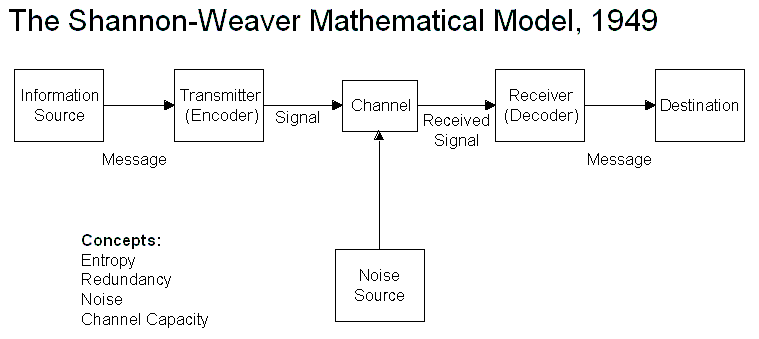
Postman begins by writing that “children are the living messages we send to a time we will not see,” because he was writing about communication, which involves the sending of messages through a channel to a receiver.  In the case of messages sent to the future, the receiver may be unknown to us, but the basic idea still applies.  This view originates in the post-war era with the Shannon-Weaver Model:


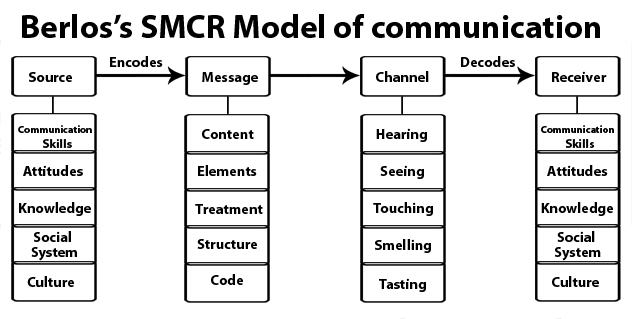
 The Shannon-Weaver Model was modified by communication theorist David Berlo circa 1960:


But the important point is that Postman was writing about communication, and thinking about children, and childhood, in terms of communication.  The idea that children are our legacy, a way of projecting something of ourselves into the future, is a time-honored, traditional notion.  But thinking of children as messages, as part of the process of  communication, is a relatively new orientation.  

And as any good media ecology scholar knows, in 1964 Marshall McLuhan declared that "the medium is the message," by which he meant (among other things) that the messages we send are influenced in significant ways by the medium that we use to create and send them   And The Disappearance of Childhood is all about how children as messages are influenced by the media that they use, and that we use to prepare our children to carry on for us in the future.  And it is about how childhood is a message that is influenced by the medium that we use to create it. 

Yes, create it, because childhood is a cultural construct (albeit one based on an underlying biological reality), a message we send to ourselves about biological and social reproduction.  In print culture, children came to be seen as special and innocent, and in need of extended protection as they were cloistered away in schools, while television culture has returned us in some ways to a view of childhood that does not allow for much distinction between children and adults, hence the title The Disappearance of Childhood (which also signals the disappearance of adulthood).

But you really have to read the book to get Postman's argument.  And I only provide this cursory summary to underline the fact that Postman's quote, “children are the living messages we send to a time we will not see,” with its particular emphasis on children and communication, originated out of a very specific set of circumstances, and its meaning is quite clear in that context.  But it also has a wonderfully poetic quality, evocative and compelling, and works quite well standing alone.  Some might even be fooled into thinking it is some kind of ancient proverb, despite its clearly contemporary sensibility.

“Children are the living messages we send to a time we will not see” is Neil Postman's most famous quote.  So what's the problem, you might ask?  And I'm glad you did.  The problem is that when you Google the quote nowadays, you get something like this:


How did this come to be, you might ask?  And I'm glad you did.  You see, this John W. Whitehead wrote a book entitled, ironically enough, The Stealing of America.


And this book was published in 1983, a year after The Disappearance of Childhood.  Just to be clear, here's the copyright page from Whitehead's book:


And here's the copyright page from Postman's book:


And just to dispel any lingering doubts, here is p. 68 of Whitehead's book, where he specifically cites Postman:


The Disappearance of Childhood also is included in the list of references that appear at the end of the book.  

So, are you ready now?  Ok, here is how Postman's quote appears in Whitehead's book, starting on the bottom of p. 116 and continuing on to p. 117:


Ah ha, you may be saying!  Caught red-handed! Well, the problem is that the circles that Whitehead travels in, and the readership that he picks up, is quite different from those associated with Postman.  So who knew?  It would have been quite the coincidence to come across it back in the 80s, or even the 90s.  But, the quote being so poetic and memorable, it got picked up from Whitehead's book, and reproduced all over the place with the wrong attribution.  It appears in some baby book, which probably amplified the error significantly.

Who is this guy, anyway, you might ask?  Well, you can read about him on this page from the Rutherford Institute website:  About John W. Whitehead.   And you can read about the Rutherford Institute on their Wikipedia entry:  Rutherford Institute.  

Not that it matters much.  I am writing this, and asking for your help, not to cast blame or level accusations.  Postman was certainly the easygoing, forgiving sort of person who would not have made a big issue out of this.  But speaking for those of us who honor his memory, and who believe in credit where credit is due, we would like to set the record straight.

The problem is that it is very hard to set the record straight on the web.  It is very hard to get the content of websites changed.  You can send a message, but it may be that the site is no longer active, or no longer actively supervised, or it may be that the individuals associated with the site just don't want to be bothered, or just don't care.  Believe me, attempts have been made, and met with no success.

But, the main thing to do when dealing with problems like this is to accentuate the positive (see my previous post, Digital Damage Control).  So, I am asking you to help to get the word out on the web, anyway that you can.

 Please feel free to repost all or part of this entry on your own blog or site or elsewhere on the web.  Or write your own post about this situation, using any part of this post that you care to, it is entirely open and available for copying and revising.

If you do post this or a similar message anywhere else, let me know, and I will add an acknowledgment and link at the end of this post.

And/or, please link to this post.

And/or, spread the word and the link via Twitter, Facebook, and other social media.  If you tweet, Neil Postman wrote, “Children are the living messages we send to a time we will not see,” that will be less than 50 characters, so you can add, please retweet, include a link to this post or another one, and/or note that we want to remedy an injustice.

 I ask that you please help me to get this particular message out there, get more positive posts and listings out there, and at least we can start to set the record straight.

Neil Postman did not live to see this time of Google and social media, but today, March 8th, 2011, is the 80th anniversary of his birth, and if he were still with us, he would joke about how what we are doing here is launching Operation Childhood, and probably ask if there wasn't some better way for us to spend our time, like reading a good book.  But deep down, he would be very much appreciative of the messages that we now can send on his behalf.  

So I ask you to be a living message now, and for the future.


Links to Posts:

This Small Favor I Ask of You on Andrew Postman's DayRiffer Site

Guest blog: Children are the Living Messages We Send to a Time We Will Not See on John McDaid's Hard Deadllines Blog

Vincent W. Hevern, SJ, Ph.D. Homepage (quote and link at the bottom)

Children are the living messages we send to a time we will not see reposted on the student blog for my Social Media class at Fordham University (which the students named, not me)

"Operation Childhood" in honor of Neil Postman posted on Mary Rothschild's Healthy Media Choices website

Happy 80th Birthday, Neil Postman posted on Peter Fallon's In the Dark blog

Children are the living messages we send to a time we will not see reposted on the student blog for my graduate class on Understanding New Media at Fairleigh Dickinson University (which, again, the students named, not me)

Children are the Living Messages We Send to a Time We Will Not See partially reposted on Laureano Ralon's Figure/Ground website

Neil Postman: "Children are the living messages we send to a time we will not see" posted with great humor on Bob Blechman's Model Media Ecologist blog

CHILDREN ARE THE LIVING MESSAGES WE SEND TO A TIME WE WILL NOT SEE posted on David Zweig's memyselfandhim blog

Children are the living messages we send to a time we will not see posted on Tumblr by secondguessmedia (also David Zweig I believe)

Quotations about Children in The Quote Garden website

Properly attributed caption on a beautiful photograph by Irena Mila on flickr

The Foundation for Scotland School for Veterans' Children website

Children are the living messages we send to a time we will not see image of first page of the Introduction from The Disappearance of Childhood posted on Tumblr by Austin Kleon (via Matt Thomas)

Properly attributed caption on a beautiful photograph by Irena Mila on flickriver

Children are the Living Messages We Send to a Time We Will Not See (Neil Postman, 1982) posted on the Technología y Sociedad blog of Fernando Gutiérrez


Quoted on an attractive letterpress card being sold by letterary press on the Artfire website

Quoted on an attractive letterpress card being sold by letterary press on the Etsy website

Children are the living messages we send to a time we will not see. posted on Tumblr by Supprosetry

80th Anniversary of Neil Postman’s Birth posted on the McLuhan Galaxy blog by Alex Kuskis

Guest blog: Children are the Living Messages We Send to a Time We Will Not See listing of the post from John McDaid's Hard Deadlines on the fwix website

Neil Postman: "Children are the living messages we send to a time we will not see" post by Bob Blechman on open salon

"Children are the living messages we send to a time we will not see." Neil Postman tweet by Bill Gross

Quotation appearing on The Nanny Collection website 

Quote appearing on Irena Mila's page on the Lurvely website 

Included in a list of quotes on Yahoo Answers 

Quote appearing in a Flak Magazine article by Angela Penny 

Quote appearing on the Court Appointed Special Advocates for Children website 

Quote appearing on the Taximom website 

Under 25 and Rebuilding Communities Using Social Media (SXSW) on the Plancast website

Series of tweets listed on the Topsy website

“Children are the living messages we send to a time we will not see.” —Neil Postman posted by the DavenportIowaNews on Friendfeed via Matt Thomas

9 Things Having a Baby Taught Me About Personal Finance blog post by Wojo Kulicki on the lendingtree blog, quote appears at the end of the post

Included in Inspiring Quotes for Us All on The Quotations Page

Teaching Excellence: Mary Pat Fallon, Dominican GSLIS speech posted on the Tame the Web site

October is Children’s Month post on the Definitely Filipino blog 

Quote used as a caption for a stunning photograph posted by Bren Parks on the Mystic's Muse blog

Quote used as a caption for a lovely photograph posted by Cassandra Clifford on the Children:  The World Affairs blog

False attribution corrected in comment on the English-Test.net site

Quote used as a caption for a cute photograph by Mystic Pekoe on flickr

Included on Relationship Quotes page of BeHappy! website 

Neil Postman entry on WorldLingo wiki

Quote used as a caption for a cool photograph by Malin Longva on Flickriver

Neil Postman Essay Topic – Technology and Its Impact on Human Life on unipapers term paper mill website


Sunday, March 6, 2011

The Spirit of Google

So, I have to hand it to good folks at Google this time.  Today's Google home page features an adaptation of The Spirit, Will Eisner's famous mysteryman from the early days of comic books, and they do a really wonderful job of reproducing Eisner's signature style.  Here, see for yourself:


It's not just the face of The Spirit, it's the way that the letters appear as apartment buildings, occupied by the kinds of people you'd find on Manhattan's lower east side back in the depression era.  I just have to say I love it!  Eisner was both a pioneer and one of the all time great comicbook creators.  Here's an example of Eisner's spirited artwork:


PC Magazine did a little post about this Google homage, with a headline of Google Doodle Celebrates Comics Legend Will Eisner.  And they start out by explaining

Google has unveiled its latest doodle—a creative play on the logo that adorns the company's primary search page. Comics artist Scott McCloud assisted in the creation of today's illustration, which pays tribute to comic book legend Will Eisner. The masked character making up the two "Os" in Google represents one of Eisner's more well-known works: The Spirit, or Denny Colt, a crime-fighting detective whose comic (of the same name) ran in newspapers between 1940 and 1952. 
I was doubly impressed to see that Scott McCloud was involved.  I brought him up in a previous post here on blog time passing, Understanding the Comics Medium, and his book, Understanding Comics, is one of the assigned readings I've included for my graduate class on Media and Symbolic Form at Fordham University.   David Murphy provides a little more information about McCloud at the end of the piece:

McCloud, who helped fashion today's Google doodle (in honor of what would have been Eisner's 94th birthday), previously illustrated Google's Chrome comic book. He's also a judge for the "Doodle 4 Google" contest, which invites K-12 students to submit Google-themed illustrations for the chance to win a $15,000 grand prize—a college scholarship, of course, in addition to other technological goodies.

The article also gives some background information about Eisner, including the following:

Subsequent work by Eisner, including his graphic novels entitled, "A Contract With God, and Other Tenement Stories," as well as a graphical retelling of Herman Melville's, "Moby Dick," earned Eisner the unofficial honor of being considered the father of modern graphical storytelling. He continue to publish graphical books up until his death in 2004, mainly focusing on using print graphics to retell stories, and expand upon the characters, of various novels and myths cemented in the public consciousness.

"For most of his career, Eisner was years, even decades, ahead of the curve. I saw him debating artists and editors half his age, and there was rarely any question who the youngest man in the room was," writes McCloud. "It helped that he never stood on ceremony. Everyone was his peer, regardless of age or status. None of us called him 'Mr. Eisner.' He was just 'Will.'"

The recognition of Eisner's influence even stretched as far as the awards platform—specifically, the creation of the Will Eisner Comic Industry Award, otherwise known as the "Oscar" of the comics industry, in 1987.

Well then, happy birthday Will, and as for Google, well folks, that's The Spirit!