Sunday, May 6, 2012

Jeering at Comcast

So, I'm still playing catch-up, and it was all the way back in February that a reporter for the International Business Times, Oliver Tree, interviewed me about the Comcast cable network's decision not to carry Al Jazeera English, the Arab world's English language news network.  His article, with the provocative title of, Why Does America Hate Al Jazeera?, was published on February 23, but the controversy lives on.

So let's look in on how Oliver Tree introduces the subject:

Last year's Arab Spring uprisings enthralled viewers around the globe with their ferocity and pace. As regimes fell like ninepins, footage of people who had long been choked by the sclerotic hand of aging dictators was beamed around the world as they rose up and overthrew decades of repression in a matter of months.

But, were it not for the efforts of one particular news-gathering service, the Arab Spring might have passed many viewers by.

Qatar-based news channel Al-Jazeera, and its sister site Al Jazeera English, burst onto the scene with incisive and daring reports as first Tunisia, then Egypt and finally Libya succumbed to revolution and bloodshed. The coverage was so good that the channel even gained an endorsement from U.S. Secretary of State Hilary Clinton, who, standing before a Senate Foreign Relations committee in May, said the network was "changing peoples' minds and attitudes... like it or hate it, it is really effective." 

 We certainly have heard a great deal about the role of new media and social media in the Arab Spring and similar protest movements, but television remains the most powerful medium of all in shaping public opinion, and the goal of much activity organized via social media is simply to use the new media to reach the old media, influence their agenda and attract their coverage.  Anyway, back to what Hilary was saying...

"Viewership of Al Jazeera is going up in the United States because it's real news," she added.

"You may not agree with it, but you feel like you're getting real news around the clock instead of a million commercials and arguments between talking heads."

A not-so-veiled reference to Fox News, I think it's safe to say, but of course MSNBC also fits the bill as Fox's opposite number, and CNN also favors the dramatic confrontation more and more in the material it uses as filler in between advertisements.  So, at this point, Oliver backs up Hilary's assessment with several factual statements:

The network has since gone on to win a clutch of awards.

On Thursday it was named as News Channel of the Year at the Royal Television Society Awards of Britain--the industry's Oscars--and has won numerous accolades for its coverage of the "forgotten" uprising in Bahrain, including a prestigious George Polk Award for the documentary "Shouting In The Dark".

The network's coverage from Cairo's Tahrir Square during the Egyptian uprising was also widely lauded as the best by any network and they even scooped every global news service as the first to report the death of Col. Muammar Gaddafi in Libya.

 Of course, it only makes sense that an Arab news network would offer the most in-depth coverage of Arab affairs, especially one that is not beholden to any authoritarian regime.  So, anyway, it's time to get to the crux of the issue, wouldn't you say, Mr. Tree?

But despite all the awards and plaudits, the channel is practically nonexistent in the U.S.

Even though Al-Jazeera English has been broadcasting from downtown Washington, D.C., since 2006, it is only readily available in a handful of cities including Toledo, Ohio; Burlington Vt.; Bristol, R.I., Washington and New York - a glaring omission in a country that holds dear the right to choose.

 Interesting set of sites, don't you think?  DC makes perfect sense, of course, given their interest in foreign affairs, and New York is a global city, after all.  Vermont is pretty radical, sure, but Toledo?  Bristol, Rhode Island? Perhaps it has something to do with local demographics. In any event, here's where I come in:

"When you get conservative-oriented folks such as Comcast, and companies that have a Christian orientation, that combination leaves them uncomfortable with an Islamic-oriented network," said Lance Strate, professor of communications and media studies at Fordham University in the Bronx, N.Y.

"Generally the reason given is 9/11, which gives cable networks the perception that their customers would see the inclusion of an Arabic network as a bad thing. This coupled, with the support for Israel among many Christian groups, is a powerful combination." 

I think this is pretty obvious, after all. Liberals tend to favor giving broad interpretation to First Amendment freedoms, free expression of opinion, and pluralism in general. Social conservatives, and that includes the Christian right, have sought to impose restrictions on speech in a variety of ways. And I'm not saying they're entirely wrong about imposing limits, I agree that there should be some, but more often than not, my sympathies are with the left on these issues.

But the root of the problem is not so much in the conservative outlook as it is in the commercial imperative.  I have previously posted my criticisms of the ways in which cable companies exert close to monopoly control over television programming, in what they allow or don't allow, and in what channels they force us to take.  For example, see my previous posts, All Foxed Up, or Time(Warn'er) for Cable Neutrality, Tell Old Pharaoh to Let My Channels Go!, Ordering TV À La Carte, ABC You Later, Cablevision!, and FCC It Now.  So here we go again:

According to Strate, cable companies also have an "arrogance" when it comes to deciding what to include in their packages and "are not even listening to their consumers on non-controversial issues, so when it comes to controversial issues they are certainly not obligated."

But the main point is that, in their drive for profits, cable companies don't want to risk losing profits by offending any part of their audience.  Edith Efron called television the "timid giant" back in the early 60s, and cable companies are not much different than their broadcasting cousins, certainly not in the courage department:

But more than that they are, in Strate's words, "timid giants."

"They are always afraid of offending someone," he added.

 But now, back to the political angle, and the conservative distaste for the network:

Of course, Al Jazeera has gained high-profile enemies in the U.S. as well. Former Secretary of Defense Donald Rumsfeld famously labeled the channel's coverage of civilian deaths during the Iraq war as, "vicious, inaccurate and inexcusable." In an interview with the channel last year, Rumsfeld famously descended into a shouting match with presenter Abderrahim Foukara, calling him "pejorative" and "disrespectful." 

In spite of the political obstacles, one of the founders of Rethink Press, Xi Wang, was confident the Comcast petition would have an impact.

"The most important part of our action is to provide access," she said.

"Influencing public opinion will evolve in an organic way. Once you start watching something, it is a lot easier to dispel any fears you may have."

"If it were to be shown, a lot of Americans might realize just how partial U.S. news networks are."

 But now, to draw the important distinction between making a channel available, and getting the audience to actually watch it.

The question remains, however, is mainstream America ready for the type of straight reporting Al Jazeera contains? If the networks caved in and channel went national, would it gather a wide enough audience to change news broadcasting in the U.S.?

 "I really doubt that it would have any impact at all," Strate mused.

"It would get a self-selected audience in much the same way conservatives watch Fox and liberals watch MSNBC. Which is really an argument for allowing it in a way, as it really wouldn't have that much of an impact."

 And you've got to know that this is true.  We get dozens of foreign stations on our cable system, and I doubt they get much of an audience at all, apart from foreign nationals and immigrants.  As I told Oliver Tree, who happens to be English, even the vaunted BBC America does not get much of the cable audience (except perhaps when Monty Python reruns are on, or Doctor Who).  Heck, even the audience for Fox News is relatively small.  Anyway, back to Oliver for an interesting note:

But according to Wang, Al Jazeera may have found a more surreptitious method of winning American hearts and minds.

"When we were handing in the petition at Comcast, I met American soldiers who were based in Iraq," she said.

"One of the soldiers said he didn't know what Al Jazeera was until he got there and that a lot of soldiers got their news from it. They found it amazing how different the news was presented there to how it is in the U.S."

This may be the case, but I have to wonder how much influence this has on the viewing audience at large, or even whether those soldiers would still be as interested in news about the Arab world after returning home from Iraq?  In any event, it still all comes down to the bottom line:


Ultimately, however, it may not even be a question of politics or numbers, but irrational fear.

"It is not the commercial aspect which is the problem, but a concern among the cable providers of how many customers they may lose by offering it," Strate concluded.

"You don't want to offend your audience, for fear of losing them." 

 And maybe the cable companies are underestimating their audiences. I can't say for sure, but I do believe they are overestimating the impact the addition of Al Jazeera would have on them, and overestimating the negative response they would get.

Ultimately, what we need is television that's more like the internet, where anyone can get access to anything they want to view, pay for what they get and only what they choose to get, and carriers are just that, not gatekeepers.  And you know, it's coming.  Sooner, or later, it's coming.


Thursday, April 26, 2012

A Not Un-Bearable Temporal Distortion

So, I had to improvise a little bit in my Science Fiction Genre class the other day because a guest lecturer I had lined up was unable to join us.  So I wound up showing a couple of anime from the Animatrix, the direct-to-DVD release that adds some of the back story to the two sequels to the Matrix.  And I showed the class the first regular episode of the SyFy Channel's Battlestar Galactica series, which is entitled "33" and I think was the best episode in the entire run.


The original series from 1978 was clearly derivative of the first Star Wars film from the previous year, and an attempt to capture some of that sparkle for TV.  It only lasted one season, followed by a short-lived attempt to revive it in 1980.  While the original series has had its fans, simply put, it was not very good.  Not horrible mind you, just not very good.

The scenario was taken from the Book of Exodus, with Lorne Greene, well known to audiences then as the patriarch of the Cartwright clan on the long running western series Bonanza, leading a ragtag fleet of spaceships on a quest to find the mythical planet Earth.  The fleet was all that was left of humanity, after an attack by the evil Cylon robot empire destroyed the 12 colonies, 12 worlds named after the 12 signs of the zodiac.

The original had an underlying religious sensibility, and in Battlestar Galactica 1980 there even was some interaction with angels, but the relationships were never clear.

Unlike the original, the remake was a high quality production, with a great deal of originality, and it very much captured a post-9/11 sensibility, really emphasizing the fact that humanity was almost entirely exterminated, and that the survivors were just barely hanging on.  The 12 colonies were again associated with the 12 signs of the zodiac, and consistent with this, human culture was depicted as polytheistic—they would say gods where we would say God—and specifically rooted in the ancient Greek pantheon (e.g., Zeus, Apollo, Athena, etc.).

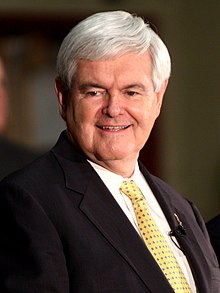
Interestingly enough, there's also a Mormon reference thrown in, a carry-over from the original series, whose creator, Glen Larson, was Mormon.  Both series make reference to Kobol as the home of the human race, and Kolob in the Mormon faith is the "is the star or planet nearest to the throne of God" (see the Wikipedia entry on Religious and mythological references in Battlestar Galactica). What impact this may have on the candidacy of Mitt Romney, it is hard to say (a number of people have speculated on the possibility that Romney is a robot, and my friend Paul Levinson thinks he might even be a Cyclon!).  Perhaps if he chooses Newt Gingrich as a running mate, Newt having made a moon base one of his campaign promises, he'd have the science fiction vote sewed up.  

Sound far-fetched?  You may be surprised to learn that Reagan gained favor in the SF community due to his "Star Wars" Strategic Defense Initiative.  Seems that many SF fans saw the militarizing of space as worthwhile in that it was a surefire way to get us up into space, and keep us there.  Those damn peaceniks are all about feeding the hungry, curing diseases, eradicating poverty, and the like.  Lewis Mumford saw quite clearly that the space program was as massive a waste of labor and resources as the building of the pyramids in the ancient world, noting that both constitute attempts to send a select few into their respective notions of the heavens.  Rationally, I know he's right, although  it's hard to shed that emotional attachment to the vision of space travel a la Star Trek.

Anyway, the humans in Battlestar Galactica were essentially as modern as us in most ways, and more so in regard to space travel, and the fact that their religion was based on the Greek gods can be seen as reflecting and symbolizing the fact that western culture is dominated by a secular humanist orientation that is rooted in Greek philosophy. By way of contrast, the Cylons believed in God--they were monotheists, and generally much more religiously oriented than the humans.  And this being a post-9/11 series, this twist clearly reflects our anxiety about Moslems generally, and Islamic fundamentalism and the terrorist initiative that sprung from it more specifically.

I should note that back when the new series was on the air, I wrote several posts about it, and you can find them by clicking on Battlestar Galactica over on the side, down at the Labels gadget, where all of the labels are displayed in cloud formation.  But I'm bringing all this up because I wanted to note the theme music for the series, which has been widely applauded for its aesthetic appeal, has some middle eastern overtones to it.  It also turns out that some elements of the theme come from a bit further to the east.  There's a bit of singing in an unfamiliar (hence alien in a sense) language, and over on YouTube the person who posted this video, , noted the following:

Turns out, the singing in BSG's opening is actual lyrics, taken from the Gayatri Mantra: oṃ bhūr bhuvaḥ svaḥ tát savitúr váreniyaṃ bhárgo devásya dhīmahi dhíyo yó naḥ pracodáyāt


The Language is Sanskrit. Basically, it translates into something like: We meditate upon the radiant Divine Light of that adorable Sun of Spiritual Consciousness; May it awaken our intuitional consciousness.
 He then added the lyrics to the video, as you can see below:


So, now, the music for Battlestar Galactica was create by Bear McCreary, who has also done music for the sequel series, Caprica (a major disappointment, the series that is, not the music), The Walking Dead (one of my favorites of current series), Eureka (a series that never lived up to its promise, and one that I gave up on), and Terminator: The Sarah Connor Chronicles (a great series that inexplicably never caught on and was canceled).  If you're interested in his work, go check out the Bear McCreary Official Site.

And this brings me finally to the point of this post, which is to share with you a short video, one that is, appropriately enough for Blog Time Passing, entitled Temporal Distortion, and which features a soundtrack by, you guessed it, Bear McCreary.  So, here goes:


And, according to the write up over on Vimeo:

What you see is real, but you can't see it this way with the naked eye. It is the result of thousands of 20-30 second exposures, edited together to produce the timelapse. This allows you to see the Milky Way, Aurora and other Phenonmena, in a way you wouldn't normally see them.


In the opening "Dakotalapse" title shot, you see bands of red and green moving across the sky. After asking several Astronomers, they are possible noctilucent clouds, airglow or faint Aurora. I never got a definite answer to what it is. You can also see the red and green bands in other shots.


At :53 and 2:17 seconds into the video you see a Meteor with a Persistent Train. Which is ionizing gases, which lasted over a half hour in the cameras frame. Phil Plait wrote an article about the phenomena here blogs.discovermagazine.com/badastronomy/2011/10/02/a-meteors-lingering-tale/
There is a second Meteor with a much shorter persistent train at 2:51 in the video. This one wasn't backlit by the moon like the first, and moves out of the frame quickly.


The Aurora were shot in central South Dakota in September 2011 and near Madison, Wisconsin on October 25, 2011.


Watch for two Deer at 1:27


Most of the video was shot near the White River in central South Dakota during September and October 2011, there are other shots from Arches National Park in Utah, and Canyon of the Ancients area of Colorado during June 2011.

 Is this video science fiction? Not exactly, not in a purist sense, but it does use science to create an alien and alienating, and in a sense fictional sense of space and time.  Perhaps we can speak, in an abstract sense, of a science fiction aesthetic that exists independently of any science fiction scenario? Or perhaps we need to create an entirely new category for this sort of experimental video?


Monday, April 23, 2012

Heating and Googlighting

 So, it seems as if Microsoft has taken a lesson from all of the negative political advertising that we've been subjected to as part of the Republican primary campaign over the past year.  We don't usually see commercial interests go on the attack in the same way as political candidates in this great democracy of ours, but take a look at this video by Microsoft that provides a humorous but pointed assault on Google's cloud services, notably Google Docs:


Ironically, perhaps, this Googlighting video appears on Google's own YouTube website (heck, Plato's criticisms of writing were put into writing in the Phaedrus). No doubt, Google's not happy about it, but they are set up as a neutral carrier, censoring only for reasons of decency and copyright.  Their little write-up there goes like this:

What happens when the world's largest advertising business tries to sell productivity software on the side? Beware the Googlighting Stranger. Learn more at http://WhyMicrosoftProductivity.com

 If you follow the link, it will take you to a somewhat more rational comparison of services.  But it's the attack ad that really fascinates me, and while some might liken it to the famous Apple advertising campaign ("Hi. I'm a Mac. And I'm a PC"), Microsoft's new approach lacks the humor of the Mac ads, or the Davy vs. Goliath appeal that they had.  After all, Mac had less than 10% of the home computer market in comparison to PC computers, whereas Microsoft dominates the market for word processing, spreadsheets, and presentation software (i.e., PowerPoint), and is just trying to crush Google's upstart alternative.  And it's the downright nastiness of the ad that amazes me.

Looking into the matter further, I came across this video from Newsy Tech about another attack Microsoft launched against Google earlier this year:


Certainly, full page newspaper ads, like their webpage on productivity applications cited above, require more of a reasoned approach than videos, a point that reinforces the arguments made by Neil Postman in Amusing Ourselves to Death back in 1985.

But reasoned or no, it seems that Microsoft has been asserting itself after what seemed to be a prolonged period of resting on it laurels.  Whether or not it would be accurate to refer to Microsoft in recent years as a slumbering giant, it is certainly true that Apple and Google have been producing one innovation after another, while Microsoft has largely been doing the same old thing year after year.  And sticking with the status quo is an almost certain way to get left behind in the new media world. Just ask IBM about the IBM PC, or AOL about dial-up, or MySpace about social networking.

That's not to discount Microsoft's entry into the search engine market with Bing. Maybe you remember the days when there actually was a choice of search engines?  I mean a serious choice.  When you would choose among such options as Yahoo, Lycos, WebCrawler, AltaVista, etc.?  Before Google wiped them all out with its amazing algorithms. So, maybe Bing has made a little ting in Google's near-monopoly. Maybe. Funny how we don't see Google sweating it, and ridiculing Microsoft's attempt to grab a piece of the search engine action.

And Microsoft has also moved into the mobile market with its Windows Phone software.  Now this represents much more of a threat to Google, who has had the run of the playing field for alternatives to the Macintosh iPhone, with Google's Android operating system.  It pretty much looked like Android was positioning itself as the MS-DOS/Windows-type system for mobile devices, with an operating system that, while of lesser quality that Mac's, could be used across all of the different hardware platforms.  In the mobile arena, Mac has been pursuing the same strategy as it had for computers, creating exclusive combinations of software and hardware as high-end products, maintaining quality over quantity.  Their major departure from this strategy was iTunes, software that works on PCs as well as Macs, which is what turned the company around (hard to believe they almost went under at one point), but of course this was only a partial departure, as iTunes only works with Mac mobile devices, e.g., iPods and iPhones.

So, it's Android vs. Windows Phone in a war of mobile operating systems.  And I think it worth noting that Android is based on Linux, the third major operating system for personal computers, after Windows and Macs.  And while Linux has gained significantly in popularity as a free, open source alternative to Windows since the introduction of the Ubuntu version in 2004, their share of the market is not significant (around 1%).  Android, then, is by far the most successful version of Linux in existence, but can it survive a concerted effort on the part of Microsoft, the company that has dominated personal computer operating systems ever since poor, shortsighted IBM asked Bill Gates to write a Disk Operating System for the microcomputers they were introducing in the early 80s?

Or will Android wind up being deactivated? Or retired, to use the old Blade Runner euphemism.

And perhaps you've noticed the new commercials on TV for Microsoft's web browser, Internet Explorer?


 You can read and see more about it on their website:  http://www.beautyoftheweb.com.  Since IE9 is only for Windows, I can't give you any firsthand feedback on it, but I really have to wonder, why is this browser different from any other browser? I suspect there are few if any differences that make a difference, except for the fact that all of our web browsers are now working towards the convergence of personal computers and mobile devices.

Now, you may remember a time back in the 90s when Netscape was the browser of choice. This was back in the early days of the Web.  And as I recall, Netscape was starting to talk about how all you really need is a browser, that a browser is, in fact, an operating system.  After all, what we're talking about are interfaces to computer hardware.  Back in those early days, Netscape was pointing to future possibilities, but no doubt Microsoft took notice, as operating systems (i.e., MS-DOS and Windows) are the foundation of its business.

So Microsoft integrated its Internet Explorer browser into its Windows operating system, making it the only accessible alternative, and this pushed Netscape aside so that Internet Explorer became the dominant browser.  Microsoft became the subject of an antitrust suit filed by the US government (see Wikipedia's entry on United States v. Microsoft), which Microsoft lost, so that it was declared a monopoly; Microsoft appealed, and finally reached a settlement with the Department of Justice in which their operating system would allow a choice of browsers.

But the damage had been done. Netscape never recovered.  Even Mac users were forced to turn to Internet Explorer because Mac's Safari browser sometimes did not agree with websites designed with Internet Explorer in mind.  And this is where Microsoft went soft, as Mozilla, a non-profit, developed the Firefox browser, which was able to achieve the same functionality as Internet Explorer, and eventually improve on Microsoft's browser in regard to its efficiency and its features.  Introduced in 2004, within a few years, Firefox seemed to be well on its way to displacing Internet Explorer as the browser of choice.

Mozilla received significant supported from Google, which is why the Firefox homepage featured a modified version of the Google homepage, at least up until recently.  Google released its own browser, Chrome, in 2008, developed by several programmers they hired away from Mozilla, but Google was relatively low key in promoting Chrome until the past year or so.  By the end of last year, Chrome had overtaken Firefox as Internet Explorer's main competition, and I believe that in about a year or so Firefox will be all but forgotten.

Chrome for Android was released this year as well.  But what is really key, I believe, is that Chrome has also been developed as an operating system, making good on Netscape's original vision.  It is a very limited operating system, to be sure, one that essentially only works with online apps, such as Google Docs.  But this does mean that the devices running the Chrome operating system require much less start-up time, and much less memory, not just for applications, but also for storage of files, as both can be accessed online, that is, stored in the cloud.  Of course, you have to have WiFi or a wireless data connection to make it all work.  To date, the Chrome operating system has only been used on a limited number of laptop/netbook type of devices, dubbed Chromebooks.

When I checked the Wikipedia entry on Chromebooks, I found the following statement:  "Some analysts viewed Google's web-centric operating system packaged with hardware as a direct attack on the market dominance of Microsoft." Um, yeah, you got it!  No wonder, then, that Microsoft is hitting back, and hitting back hard against Google.  If people start to accept and get comfortable with Google applications, especially the productivity software bundled under Google Docs, this would not only threaten Microsoft's near monopoly over those programs, but its dominance over the operating systems that represent Microsoft's very lifeblood (vampire that it is!).

So, it's Windows vs. Chrome, as well as Windows Phone vs. Android.  In other words, it's Microsoft vs. Google.  And what if Facebook comes to the aid of Microsoft, having also been threatened by Google's efforts, in launching Google+ as an alternative social network?  And what if Amazon makes good, belatedly, on the Epic predictions of a union with Google?  Would Apple remain neutral, or take one side or another?

Albert Einstein famously said, "I know not with what weapons World War III will be fought, but World War IV will be fought with sticks and stones."  But maybe the Third World War won't be a nuclear holocaust, or even a conventional land war, but a conflict in cyberspace, a series of new media battles fought with bits and bytes, memes and viruses, networks and programs.  Cry havoc, and let slip the apps of war!  Call it what you will, cybergeddon, or e-pocalypse now, I do think we're in for some interesting times.


Thursday, April 19, 2012

Pandora's Boxed In

So, last month I was asked to comment on an interesting phenomenon concerning the internet radio site (actually a streaming music service) Pandora.  This was in conjunction with an article written by Erika Morphy and published online in the E-Commerce Times on March 8, 2012, entitled , Pandora's Popularity - Too Much of a Good Thing?

It seems that the service ran into a problem that wouldn't seem to be a problem at first glance, one of growing in popularity too quickly.  As Morphy explains at the start of the article:

Pandora's popularity may not be enough to keep the company going in the long term. With growth in its user base come increases in royalty payments. "The company is trying to find the balance between free users and paid users," noted business professor David Tomczyk. Most people will choose the free accounts, and Pandora is attempting to monetize those as best as possible with short ads -- it may need to ratchet up the advertising.

She goes on to get into the specifics of the situation:

Pandora reported a 62 percent increase year-over-year in active users for its fiscal fourth-quarter, which ended Jan. 31, along with a 74 percent increase in advertising revenue and a 99 percent rise in listening hours.

However, those gains were accompanied by increases in royalty payments the online radio provider had to pay to content owners, and its overall performance fell short of analyst expectations. The stock priced dropped by some 24 percent after Pandora released the figures.

Pandora reported a loss of 3 US cents a share and revenue of $81 million for the quarter. Wall Street analysts had expected a loss of two cents a share and revenue of $83 million. Content-acquisition costs reached $48.2 million in the quarter, compared with $23.9 million a year earlier.

The company also revised its first-quarter revenue guidance downward, to $72-$75 million.

Here's where I come in, as the article raises the question, A Flawed Model?:

The stock downturn reflects investor fears that Pandora is not just experiencing new company growing pains, but that its model may be inherently flawed. The more popular it becomes, the more it has to pay in royalty fees.

"The service is employing the old, broadcasting model, where they pay for content, which they use to attract an audience, which they then sell to advertisers," Lance Strate, professor of communication and media studies at Fordham University, told the E-Commerce Times.

"Expect them to radically change their model, or disappear from the online environment," he said.

It is indeed quite amazing to see such examples of what McLuhan referred to as rearview mirror thinking, trying to do the same old job with the new tools.  Even the very fact that they think of what they're doing as radio shows how they're employing an old media map to try to navigate the new media territory.  And Pandora is not alone in this respect, as the article goes on to note:

Concern over the business model is not limited to Pandora, Lee Simmons, IPO industry specialist at Dun & Bradstreet, told the E-Commerce Times.

"New Internet music-streaming companies all face these costs, and they don't always have the cash to pay for the royalties," he said.

If a company doesn't keep a sharp eye on costs and cash flow, it could easily be sunk, Simmons noted.
That doesn't mean he's ready to write off Pandora, though, which is proving to be among the top providers in this space.

"Pandora is in high-growth mode," said Simmons. "[The] company is expanding rapidly, and it has a great opportunity to realize its upside potential." That potential includes its brand name and a user base growing at a rate that shows little sign of abating.
 The next section entitled Monthly Figures, gets into the bottom line:

Indeed, perhaps to quell questions about its future, Pandora announced that it will begin releasing its user stats on a monthly basis.

Its numbers for February indicated an increase in its share of the total U.S. radio listening market -- to 5.74 percent from 2.90 percent at the same time last year. Total listener hours reached 975 million, an increase of 101 percent from 483 million during the same time period last year. Active listeners for the month reached 49 million, an increase of 57.5 percent from 31 million during the same time period last year. 

 Somehow, though, this doesn't address the problem of the flawed model.  Anyway, the final section is called Get the Scaling Right, chalking it all up to a question of balance:


Scaling is one problem in particular Pandora must tackle if it wants to right its business model, David Tomczyk, assistant professor of management at the Quinnipiac University School of Business, told the E-Commerce Times.

"The company is trying to find the balance between free users and paid users -- the freemium model popular with many Web-based businesses. The challenge is offering a free model to attract customers and a premium service that's interesting enough people would be willing to pay for it," Tomczyk explained.

Most people will choose the free accounts, and Pandora is attempting to monetize those as best as possible with short ads every few songs, he noted. Now the company has to decide whether to increase the number of ads in order to cover growing expenses for its bandwidth and server needs, he said. Getting that balance right could mean the difference between success and failure.

 Ah yes, we all want the freebies!  And on the internet, it seems like just about everything is or ought to be free.  As my friend Richard Barbrook put it, it's cybercommunism.  Of course, free content is an old story, as it's the basic strategy of broadcasting, where the profit is in using the content to create audiences, and then selling access to the audiences to advertisers.  But that, as we see, can be a tricky business when you have to pay for content, especially when you do not enjoy a situation of scarcity and near-monopoly conditions, as broadcasters did, given the limited spectrum for transmission over the airwaves. 

It's no wonder that the big new media success stories are the sites where the content is obtained for free, whether it is through Google's use of search engines, or Facebook's user-generated content.  The other alternative would be micropayments, along the lines of Apple's iTunes.  If I might be willing to pay a penny for your thoughts, maybe I'd do the same for a song?

Anyway you look at it, Pandora's boxed in, and there's no way out for it or similar services, except to create a new strategy better suited to the new media environment.


Sunday, April 15, 2012

Going the Distance for Autism

Dear Friends,

If you can help, even just a little bit, it would mean a whole lot, it would make a great difference.

We know you understand that the diagnosis of autism is devastating, and that the treatment is terribly demanding. Our children struggle just to master the basics of everyday living.  Their teachers work with tireless dedication to forge a future for our children where they can at least live safely, take care of themselves (even if it is with assistance from others), and spend their days productively contributing to our society.

As you know, it's not easy, and it's not inexpensive.  We need donations to cover many basic costs of our daughter Sarah's school. The EPIC School in Paramus, New Jersey, is dedicated to helping children with autism between the ages of 3 and 21, and we are hoping that they will also be able to start a day program for young adults who "age-out" of the school system after turning 21.  If you've heard about the epidemic of childhood autism that has been occurring in recent years (and who hasn't heard about it?), just imagine the epidemic of adult autism that is just around the corner.  We have to start preparing now, before it's too late.


With so many fundraisers for so many good causes, we hesitate to trouble you with one more, but once in a while we need to…  Donations as little as $10 are welcome, and will make a difference in the lives of Sarah and her classmates, now and for their future.

EPIC is one of four schools collaborating in Go The Distance for Autism on May 6.  We hope you will support Sarah.  Here is the link to her page where you can make a donation.

Thank you for all of your help and support.

The Strate Family

Saturday, April 14, 2012

From Judge Napolitano to Jacques Ellul

Did you catch this YouTube video when it went viral a couple of months ago? It's called, Judge Napolitano.How to get fired in under 5 mins. It's how to get fired from Fox News, to be specific.  You may recall my view on Fox News from my post last October, All Foxxed Up!  Judge Napolitano always struck me as a bit out of place on that channel, especially when he sat in on Fox and Friends, sitting in between the leggy, blonde Republican chicks and the mesomorphic mooks with sarcastic smirks that typically hosted the program.


So, our Foxy friends, owned and beholden to old Murderin' Murdoch, pursued their "fair and balanced" agenda against the "lame-stream" media by departing from the longstanding tradition of journalistic objectivity (an ideal, mind you, something to aspire to and strive for), and mix opinion liberally in with facts, giving us POV (point of view) programming, driven by conservative, Republican ideology.  So, the judge's rant is not only a criticism of Republican primary politics, but also, implicitly, of the Fox News enterprise itself.


Now that the Republican primary season is essentially over with, with the suspension of Rick Santorum's campaign, it's worth returning to this screed.  Ron Paul's candidacy is just a bit outside of the mainstream, just enough to open things up to a more radical point of view.  And it is for that reason that he has gained support from some unexpected intellectual quarters, including my colleague, Paul Levinson.

But while the judge may have crossed the line as far as Fox is concerned, many of us would note that it amounted to not much more than stick a toe just across the boundary, and I'm sure many viewers of this video with more radical views found themselves asking, What if Judge Napolitano didn't go far enough?  You might say, in for a penny, in for a pound, but it's hard to imagine the judge turning to the leftist views of folks like Noam Chomsky, even though there is some substantial common ground with radical views informed by the theoretical context associated with Karl Marx and Marxian theorists (e.g., Theodor Adorno, Louis Althusser, Antonio Gramsci, Raymond Williams, Stuart Hall).

But a better alternative, for the judge, and for me for that matter, comes from the media ecology cannon, specifically from the work of the French social critic Jacques Ellul (1912-1994).


Ellul is perhaps the most radical of media ecology scholars, but rather than arguing that we are being dominated, oppressed, and manipulated by the rich and powerful via the economics of capitalism, Ellul went beyond Marx to argue that it is the technological imperative, what he referred to as la technique, that has been the driving force in the contemporary world.  He put forth a form of technological determinism, but not in the sense that all of history and human affairs is determined by specific technological developments, but rather, that we now have societies in which human beings have surrendered all autonomy to technological approaches.

Ellul's view is not born out of leftist politics, I should add.  It is radical, but has a conservative tinge (are you listening, Judge?) in that Ellul was grounded in Christian theology, based on the French Reformed Church, a Protestant denomination. A lay theologian, Ellul was ecumenical in his approach, and championed faith and religion in general as a form of resistance to the technological society.

It's important to note that it's not just about machines, not even primarily about machines.  The technological imperative is all about efficiency, finding the most efficient means to any given end.  No other factor can seriously be considered anymore.  You cannot effectively argue for a course of action on moral or ethical grounds anymore, only in regard to the efficiency of means in obtaining desired outcomes. 

This forms the basis of Neil Postman's argument in Technopoly, where he specifically identifies Taylorism (out of which came the idea of scientific management and efficiency experts) as the turning point in the transition from a relatively balance technocracy to the complete dominance of technopoly.

In a technopoly, or technological society, government is no longer subject to the will of the people.  Most vital matters (economics, diplomacy, war) are of such enormous complexity that they can only be managed by technical experts.  So elected officials turn to their advisers to guide them on technical matters. Politics and ideology no longer drives government, but instead must be bent and distorted to justify the decisions of technical experts, based on the sole criterion of efficiency.

Consent of the governed is still the sole source of legitimacy, but now has to be manipulated in order to be made to support the decisions of the technical experts.  And elected officials themselves are technical experts, but mainly in campaigning, which they do to get elected, and now do constantly even after they're in office.

This quick précis doesn't begin to do justice to the work of Jacques Ellul in this, the centenary year of his birth, but I would recommend reading his work, if you haven't already, including his early trilogy, The Technological Society, Propaganda, and The Political Illusion, his two follow-ups to The Technological Society, The Technological System, and The Technological Bluff, and his moral critique of image culture, The Humiliation of the Word. 

Judge Napolitano, now that you have some time on your hands, what if you read some Jacques Ellul? I think you'd find that he asks the kinds of questions that you'll never hear voiced on Fox News, the kinds of questions that you started to ask, the kinds of questions that are vital for an understanding of our contemporary media environment. Be warned that they're the kinds of questions that may get you fired, that is, that may get you fired up!


Monday, April 9, 2012

Keeping Virtual Watch

So, I must admit that I've been slacking off a bit in the blogging department, having been experiencing something of a time famine of late.  I didn't make up that phrase, by the way, time famine has been out there for some time now, at least a few decades according to the Double-Tongued Dictionary. 

Funny how the concept of time famine seems to coincide, to some degree, with the new media revolution that began with the popularization of personal computing, followed by the widespread use of the internet.  You might also say that it correlates as well to information overload.  Add spatial dislocation to the mix, and we have 3 out of 4 horsemen.  As for the 4th, well, reports of the death of civilization may be premature, but by how much?  Time is always of the essence.

Certainly, suggestions of the demise of the wristwatch carry a certain weight, as that item of jewelry has gone from an almost absolute must-have for any fully functioning member of a modern, technological society, to an optional bit of ornamentation, and this has occurred in a relatively short period of time.  The watch has been obsolesced by the cell phone, and as McLuhan long ago observed, a technology that becomes obsolescent is often repurposed as an art form.  In this instance, the watch, whose main purpose was utilitarian (what good is a watch that doesn't work? who would wear a watch that's stopped, even if, as the joke goes, it would still be correct twice a day?), is now becoming purely cosmetic, a piece of jewelry no more functional than a necklace or earring.

True enough, watches have a long history of association with precious metals, sometimes gems, and yes, they have long been considered a fashion accessory.  But not necessarily so, after all, as watches might better be compared to shoes, and shirts and pants, viewed nearly as much as necessities, rather than options.  Their obsolescence, then, eliminates the cheap, purely functional variety, and leaves only the more pricey version as a status object.

All this was inspired by another example of augmented reality technology, in this instance applied by Tissot this past holiday season as a means of trying on watches without having to make the trip to a retail outlet.  Here, take a look:


Here's an on site demonstration, outside of a store in London:


and this one is outside of Harrod's:


And you can read more about it, and find out how to try it out for yourself in the comfort of your own home, over on the Tissot Reality webpage.

Of course, the irony is that the augmented reality technology is what is making everyone go wow, not the watches themselves.  While it's a great attention-getter, this use of AR ultimately calls into sharp contrast one of the most intriguing recent manifestations of the new media environment with one of the signature technologies of the old media environment, the mechanical timepiece.

Back in the 1930s, Lewis Mumford noted that the invention of the mechanical clock in the medieval monasteries of 13th century Europe constituted a giant step on the rode to mechanization, as the true function of the clock is to control and coordinate human activity.  As such, the clock was an early example of cybernetic technology (not to mention, the first mechanical device that produced nothing physical, just pure information, and the first form of automatic machinery, the first form of robotics and automation).  Jay David Bolter likewise points to the clock as a defining technology that was a vital forerunner to the modern computer. 

Personally, I always used to say that the watch was not about strapping time to our wrists, it was us in literal bondage to time.  I resisted wearing a watch in my youth, but then I grew up.  As Bob Dylan put it, ya gotta serve somebody, and Mumford noted that it was a natural progression from keeping time to serving time.  But in recent years there have been times when I didn't wear a watch because the battery was run down or the mechanism was broken, or I lost it, or just forgot to put it on, and frankly I hardly noticed its absence.  And there are many times now that I go out without my watch, and do not miss it one bit.

The mechanical clock has been obsolesced by digital displays run by computer chips and wired technologies, such as cable boxes and computer screens.  I don't know about you, but I find that the shift from Daylight Saving Time to Standard, and back again, no longer requires the kind of effort it once did in changing the time on clocks in every room—more and more they've been replaced by displays that automatically make the switch.

It follows that the wristwatch was obsolesced at the point that the computer became so miniaturized and mobile that we could carry it around with us wherever we go, that is, at the point that our cell phones evolved from being souped up walkie-talkies into tiny PCs, with entirely accurate time displays.  But from the start, the purpose of cell phones, and beepers before them, was very much the control and coordination of human activity.  As they evolved to carry out that function in increasingly more effective manner, the wristwatch became increasingly more redundant.

Tissot, then, may be trying to sell real watches through virtual imaging, but with the watch itself becoming virtual (virtualized?), my guess is, they'd better just watch out.


Monday, March 12, 2012

Talking in Tel Aviv

So, I'm writing this blog post from Tel Aviv, where I'm spending this week (it's Fordham's spring break, in case you were wondering).


I'm here as the guest of the College of Management, which I'm told is much more than a business school, is in fact a full-fledged university, but has held onto its original name because it's an established brand here in Israel.  Anyway, within the College there is a School of Media Studies, and the Dean is an old friend and fellow media ecologist, Eva Berger.  Todah rabah, Eva!


So far, I have given a talk to the faculty on the many meanings of the medium is the message, that is, on McLuhan and media ecology.  That was on Sunday.  In Israel, Sunday is the first day of the week.  Well, actually, Sunday is the first day of the week everywhere, that's why it goes all the way on the left side of calendars, but in Israel it's the first day of the work week, and Friday is the first day of the weekend.  By the way, the days of the week in Hebrew literally translate as First Day, Second Day, Third Day, Fourth Day, Fifth Day, Sixth Day, but the seventh day (Saturday) is called Shabbat, meaning Sabbath.


And today I gave a talk to an Introduction to Digital Media class, with some faculty present, and I used a title for the lecture that I've previously used for an address I've given several times, "Eight Bits About Digital Media," but rather than give the speech, I taught the class on a more informal basis, and swapped out several bits from the address for ones that I thought would be better suited and more useful for the students.  The students were bright and attentive, and it was a real pleasure.  On, and I forgot to mention that I was also very pleased with the reception I received from the faculty yesterday.


So, tomorrow I have a day off, and then on Wednesday, I'll be giving a keynote address at a symposium, my topic being "Media and Protest" (which was assigned to me, as it coincides with the focus of the event).  There's a poster for it, here's what it looks like:


Sorry, I don't have a translation for it, but I think you get the idea.  I also received a copy of the press release that the College's PR person sent out, so I thought I'd share that as well:


So, all I can say at this point is that I hope my talk won't generate too much protest on the part of the participants.  And hey, if you're in the neighborhood, please drop by for my keynote on Wednesday, er, I mean, Fourth Day.


Thursday, March 1, 2012

Did You Say Secondary Literacy?

Recently, I had a bit of an exchange over on Facebook with my friend Bob Blechman, author of the Twitter-derived mystery, Executive Severance, discussed in my previous post, Twistery Illustrated, and easily ordered via the link over on the right of this post.

The exchange occurred in the comments section following a post by another media ecologist, Peter Fallon, and it was initiated by Bob making a comment about secondary literacy.  Now I know that there are some scholars who believe that Ong's concept of secondary orality suggests an equivalent idea of secondary literacy, but I'm not one of them.  In fact, I have some rather strong objections to the phrase, as you will see.

And yeah, sure, you can say it's just a matter of semantics, and a rose by any other name, yada yada yada.  But we know better, don't we?  We know from general semantics that words are maps of reality, and some maps are more accurate, while others can lead you astray.  In this instance, I think the map points you in the wrong direction, or at best is harder to read than it has to be.

So anyway, here is an edited version of my comments:

There's nothing secondary about electronic text, and in fact, pointing to the decline in importance of spelling and grammar online shows a distinct bias towards typographic literacy, because there is no concept of correct spelling or grammar until well into the print era. 

 I certainly agree that literacy via computers is different from print literacy, but there are distinctions to be made between newspaper literacy and older forms of typographic literacy, between manuscript literacy and print literacy, between reading from the bound books and from scrolls, between reading in the vernacular and in a learned language, and there also are distinctions to be made between alphabetic literacy and literacy involving other types of writing systems, syllabic and logographic, if you were to call those others literacy in the first place (literacy referring to letters, which is only used for the alphabet). Literacy in Chinese ideograms is certainly a different proposition from alphabetic literacy. 

All this complexity is quite distinct from the relatively straightforward distinction Ong makes between orality that occurs in a face-to-face situation, and speech that is recorded and/or transmitted via electronic technology being secondary. This distinction just doesn't work when applied to literacy, there is no equivalent.

The reason why "literacy" is used in so many different contexts (i.e., media literacy, visual literacy, news literacy) is that it was adopted by educators who need to legitimize the teaching of other competencies. It's hard to justify a curriculum devoted to television production, or even critical television viewing, but media literacy makes it sound like it fits in as a subject to be taught in schools.


Ong doesn't fully develop the concept of secondary orality, but the idea is still meaningful, because the meaning of "secondary" is quite clear in making a distinction between first-hand speech and speech heard second-hand via electronic media. He also refers to writing as a secondary symbol system, because writing is a means of representing spoken language. 

 If the term "secondary" were to be used in reference to literacy, it should be used in reference to print, which is used to mass produce handwritten documents, and leaves the reader at a secondary remove from direct contact with the writer's hand, and handwriting, just as printed reproductions of paintings leave the viewer at a remove from direct observation of the painters brushstrokes. 

So if anything, electronic text would be tertiary literacy, but again I don't see what purpose is served by such designations. There are more relevant distinctions, such as that of numeracy as a counterpart to literacy, and Havelock's distinction between craft literacy (where reading and writing is used only vocationally, say by accountants or priests) and social literacy (the type of literacy we are accustomed to, where we read for pleasure, read habitually, the culture itself is encoded in writing, and literacy is taught in early childhood in schools, even before we fully master speech so that that two become hopelessly intertwined).

I should add that for more discussion on the different types of orality, I have an essay entitled "Sounding Out Ong: Orality Across the Media Environments" in the newly published anthology, Of Ong and Media Ecology: Essays in Communication, Composition, and Literary Studies, edited by Thomas J. Farrell and Paul A. Soukup, and published by Hampton Press (2012, pp. 91-116).


Thursday, February 23, 2012

Electronic Writing and Digital Media

 I recently posted a 4 part series consisting of lecture notes for my Fordham University online course on Writing for Online Media, where I attempt to put online writing into a larger historical, and media ecological context through an overview of the history of writing.  The 4 posts, in order are
  1. Orality and Online Writing 
  2. Reading, Writing, and Rearranging 
  3. Scribes and Scribbles
  4. From Print to Screen
 So, I've since added some more notes specifically on electronic writing via digital media, and I figure since I've already posted the earlier set, why deprive you of the sequel?  So, once more, class is back in session.


A Few Notes on Digital Writing 

When personal computers, originally referred to as microcomputers, first appeared circa 1975, word processing programs were, arguably, the first truly practical use for these machines. In effect, they were an advance over typewriting, where corrections would have to be made after the words were printed, not before. Some of the first word processors were modified typewriters, dedicated to that single function, through the addition of computer memory and displays, but word processing on personal computers soon rendered the typewriter obsolete, so that all that's left of them today is the keyboard layout (known as QWERTY, reportedly set up in the 19th century to keep typists from typing too fast and jamming up the machine, but it's also the case that all of the letters for typing the word "typewriter" are easy to find because they're in the top row). 

 In general, word processing restored the ease of editing and overall freedom associated with handwriting and manuscript, which was mostly lost with typography and only partly reclaimed by the typewriter. Word processing gave writers a great deal of freedom and flexibility, but also made us more self-conscious about writing. Aside from spending inordinate amounts of time picking out fonts and adjusting margins and the like, word processing was associated with a start and stop kind of writing that was not common before, starting to write a line, deleting it, starting again, deleting part of it, inserting a word, re-editing, etc., rather than just writing away and coming back to edit the text later (which I would recommend as a better and easier way to get writing done). Studies of electronic writing suggest that the act of prewriting, that is, thinking about what you're going to write, and composing in your head before putting it down on paper, is short-circuited by electronic writing, which no doubt adds to the dissatisfaction and feeling that we need to edit what we type via the computer. 

 Following the introduction of personal computers, relatively inexpensive printers were made available as an accessory, and while quality varied widely at first, by and large they represented a significant increase in speed over typing, and opened the door to a new concept of desktop printing that became popular in the 80s. Desktop printing meant that individuals could produce what previously had only been possible via professional print shops. 

As word processing software has become increasingly more powerful and sophisticated, it has become increasingly more possible to produce professional looking results through something like Microsoft Word. The best results for desktop publishing, however, require special publishing programs like Adobe Pagemaker, now replaced by Adobe InDesign, or QuarkXPress, to name just two examples. Printing remains an important function of electronic writing, as does the digital simulation of printing, such as the Portable Document Format or PDF file. 

Text adventures, games based purely on written descriptions and typed in commands, along the lines of print-based "choose your own adventure" books, first appeared in the 70s, and became a popular form of software in the 80s. The leading manufacturer, Infocom, referred to their games as interactive fiction. Hypertext programs have been in existence since the 60s, and came into their own during the 80s as well. We'll look at these two formats in more detail later in the semester. Both represent a break from the idea of written works as linear and sequential, towards a new idea of interconnected networks of text. 

The linking together of two or more computers and the creation of computer networks meant that electronic files could be transmitted, downloaded and uploaded, from one computer to another. Online writing could therefore be said to have originated with the forerunner of the internet, the ARPANET, circa 1969. In 1971, the first email message was sent over the network, introducing a new form of electronic writing, and it soon became apparent that this and other forms of electronic text-based messaging introduced a more conversational, informal, virtually oral style of writing (and with it new sets of ambiguities and problems in some situations) in contrast to older forms of writing and letters and memorandums (memos being the format that email was actually based on). 

The creation of a hypertextual interface to the internet through the introduction of the World-Wide Web, invented by Tim Berners-Lee circa 1990, marks the beginning of the second stage of online writing, especially after the introduction of the Mosaic web browser in 1993, with its graphical user interface. This gave us websites as locations where you could not only download files, but where written information could be displayed as documents in their own right, pages to be read (aided as well by the development of high resolution computer monitors). The internet became highly commercialized as companies rushed to create websites to promote and sell their wares, much to the dismay of computer pioneers, professionals and hobbyists alike, and content became a buzzword as the search was on for material to fill these websites, and attract audiences. The humorist science fiction writer Douglas Adams (of Hitchhiker's Guide to the Galaxy fame) quipped back then: “First we thought the PC was a calculator. Then we found out how to turn numbers into letters with ASCII — and we thought it was a typewriter. Then we discovered graphics, and we thought it was a television. With the World Wide Web, we've realized it's a brochure.” 

The problem with those websites was that they required extensive knowledge of HTML coding, and therefore were difficult to modify. Typically, we would surf the web, come to an interesting site, take a look through it once, maybe come back another time, and that would be it, we'd be off to check out the next site. That's why it was called surfing the web. There was no reason to ever return because it was unlikely that anything new would be added to the site, but if something new was added, you'd look at it, and then be gone again. As this all came to a head, the e-commerce bubble of the mid 90s burst, and enthusiasm for the web died down. 

Blogging is generally thought to originate during the late 90s, weblog having been coined in 1997, and the short from blog in 1999, but its origins can arguably be traced back to earlier forms of online writing. The revolution in blogging, however, begins at the end of the millennium, with Open Diary launched in 1998, LiveJournal and Blogger (not purchased by Google until 2003) in 1999. 

A key development that made this possible, circa 1997-1998, is the introduction of XML as an alternative to HTML, which allowed for a more flexible kind of programming language for the web. This made possible the creation of software where web content could be updated easily, without recourse to programming languages, using the same tools we use for word processing. Whereas before the web, email and chat was very interactive, democratic, and participatory, the shift in emphasis to static websites threatened to turn the internet into another mass medium, but the new developments associated with XML and blogging restored a good measure of interactivity, and the democratic and participatory sensibility that previously had been dominant. Anyone who wants to can create a blog and publish their writing, making it available to the public on a global scale. And even if you aren't interested in writing your own blog, you can still participate by leaving comments on others' blogs. 

The ways it's been put, by various scholars and writers, is that there is a fundamental conflict between information and communication. This corresponds to the distinction between mass media and interpersonal communication, and even earlier to that between public speaking and dialogue, and therefore the ancient quarrel between the sophists and the philosophers. 

Blogging is considered the first form of what was dubbed Web 2.0 (first in 1999, but not really popularized until 2002), a term that covers all of the dynamic qualities of the web from the personalization used by Amazon and Google to personal publishing via blogs, podcasts, and YouTube and related video hosting sites, to social networking and social media. Indeed, according to some, blogs are a form of social media, due to the ability to leave and respond to comments, and the fact that bloggers are known to respond to each other via their own blog posts, and link to each other. Blogs can be linked to one another in the form of a list, the blogroll, appearing on any given blog, or as a group or circle or network of associated blogs typically with some kind of linking mechanism (which could be as simple as the "Next Blog>>" on the upper left of Blogger blogs (which connects all of the blogs on that site), or in reference to the blogging community as a whole, as the blogosphere. 

Blogging itself has been integrated into some social media sites, MySpace having been a prominent example (although their blogging software has been downgraded in recent years), and their distinctive identity has blurred through the addition of increasingly more sophisticated forms of status updates, and microblogging services, the best known being Twitter. 

Blogs remain the most substantial form of social media and Web 2.0, the most central in the sense that other items that we produce (videos, podcasts, images) can be incorporated into our blogs, and one of the best ways to establish yourself professionally and establish yourself as an active participant within a professional network.