Tuesday, July 15, 2014

Some More Reading for the Summer

So, this is the third year in a row that Roy Christopher asked me to contribute to his Summer Reading List feature, where he compiles the recommendations of various scholars and intellectuals, based on the books they intend to read over the summer months. And of course, I'm happy to contribute, as this also gives me an excuse to pull out a set of volumes from the rather massive piles I have stored up all over the place. And being the kind of person I am, having made this commitment, I will be sure to complete the readings I've assigned myself, no matter the distractions or other readings that might join the batch.

You can read my selections, along with those of several others, over on Roy's blog and website, under the heading of Summer Reading List, 2014, which he posted on June 25th.  But for the record, here on my own blog of record, I will record my picks, complete with links to Amazon for ease of ordering in case you are so moved to do so:


At the top of my reading list for this summer is On Reflection: An Essay on Technology, Education and the Status of Thought in the Twenty-First Century (Canadian Scholars’ Press, 2013) by Ellen Rose, an outstanding scholar. And speaking of great scholars, I have Elizabeth L. Eisenstein’s most recent work, Divine Art, Infernal Machine: The Reception of Printing in the West from First Impressions to the Sense of an Ending (University of Pennsylvania Press, 2011) high up on my stack as well.


I am also looking forward to reading B. W. Powe’s important study, Marshall McLuhan and Northrop Frye: Apocalypse and Alchemy (University of Toronto Press, 2014). This looks to be a summer for biographical and semibiographical works, as I also have lined up In Thought and Action: The Enigmatic Life of S. I. Hayakawa (University of Nebraska Press, 2011) by Gerald W. Haslam with Janice E. Haslam, and Appletopia: Media Technology and the Religious Imagination of Steve Jobs (Baylor University Press, 2013) by Brett T. Robinson, as well as The Science of Leonardo: Inside the Mind of the Great Genius of the Renaissance (Anchor, 2007) by Fritjof Capra.


I’ve picked up some second hand books that I intend to enjoy this summer, including two from Ralph Waldo Emerson. One is a stray volume of his collected works that combines two of his major publications, The Conduct of Life and Society and Solitude (Macmillan, 1910). The other is Essays And Journals (Programmed Classics, 1968), selected and with an introduction by Lewis Mumford (which alone is worth the price of purchasing the book). And then there’s Understanding Understanding (Harper & Row, 1974), by Humphry Osmond, with John A. Osmond and Jerome Agel, which I am understandably curious about.


For poetry, I can’t wait to delve into the long awaited volume from Dale Winslow, Tinderbox (NeoPoiesis, 2013). And in graphic novels, there’s The Walking Dead Volume 21: All Out War Part 2, real brain food that I’ll no doubt gobble up in one sitting when it comes out in a few weeks.


For the previous years' picks, you can take a look at my 2012 post, Some More Reading List, and last year's S'more Reading Listed.  Oh, and I almost forgot to mention, back over on Roy Christopher's Summer Reading List, 2014, he concluded with his own reading list, and can you guess which book he included? You got it, none other than Amazing Ourselves to Death: Neil Postman's Brave New World Revisited


Thanks, Roy! I hope you find it worth your while!


Monday, July 14, 2014

Texting Ourselves to Death

Time for another quote by yours truly, this one appearing in a story published in Fordham University's newsletter, Inside Fordham, on June 24, written up by Tom Stoelker. The title of the article is Texting: Do Fewer Words Equal Less Literacy? and there's also a heading that reads, "The Human Mind in Decline" (that has a catchy sound to it, don't you think?).

Anyway, the piece begins with a few paragraphs about a recent talk given at Fordham by a philosophy scholar:

On a recent visit to Fordham, philosopher Maurizio Ferraris, Ph.D., explained what many students already know and practice: cell phones are not for talking. In his new book to be published this summer by Fordham University Press, Where Are You? An Ontology of the Cell Phone, Ferraris argues that cell phones are writing machines.

“If you can use your living voice, why would you use dead letters?” Ferraris asked. “Because we don’t like the voice.”

By taking the function of the phone from voice to writing, he argues, the smart phone essentially becomes a recording machine, a journal. Since text could be publicly available well after the conversation is completed, it also outlasts the life of the actual conversation—as well as that of the writer.

“The basis of this sort of social bond is not communication, but recordability,” he said. Ferraris’ view hints at the growing debate among academics as to how texting is changing literacy and sociability.

Clearly, Ferraris does not understand communication, and the essential point made by media ecology scholars such as Harold Innis, James Carey,  Marshall McLuhan and Neil Postman, that we can communicate over time as well as over space. He certainly does not seem to be aware of Alfred Korzybski's basic concept of time-binding, which is made possible by humanity's capacity for language and symbolic communication. Whether it's preserving the cultural heritage and essential knowledge via oral tradition, or the storing of knowledge outside of collective memory through writing, print, photography, and audio and visual recording devices, or information storage and retrieval via digital technologies, communicating over time has a great deal to do with the maintenance of social bonds, as well as cultural continuity.

Okay, end of rant, and now it's my turn to weigh in:

Lance Strate, Ph.D., professor of communication and media studies, said that when this generation’s new media first arrived on the scene, its emphasis on text spurred hope of a new generation of literacy. But now that the net has become increasingly visual, Strate says that a “telegraphic discourse” has come to dominate, where images and immediacy vie for cell phone users’ attention.

Strate’s recently published book, Amazing Ourselves to Death: Neil Postman’s Brave New World Revisited (Peter Lang, 2014), reframes Postman’s assertion that image-saturated media undermine reading and rhetoric.

“New media continues to be text-based, but it’s becoming much more visual,” he said. Strate said that in Postman’s view an increased emphasis on image elicits emotional rather than rational responses to information. On the flipside, today’s emphasis on efficiency creates what Strate calls “hyperrationality,” which he compared to a numbers game.

“Both take us away from the balance of oral and literate,” he said.


And of course I am grateful for the mention of my new book. But that's it for me, and what's interesting about Tom's article is that it presents a succession of viewpoints. Here are the next two:


Swarthmore College President Rebecca Chopp, Ph.D., during a visit to Fordham, said that texting has spawned “one of the greatest crises in America.”
“Millennial students don’t know the basic rules of discourse. They are struggling to learn how to communicate face-to-face and not just on the iPhone,” she said at a recent Center for Ethics Education symposium.

But there are others who find the changes less threatening. Addressing the Fordham faculty at Faculty Technology Day, tech writer David Pogue said that “every generation has its bugaboo” and that “we tend to worry more than necessary.”


And now, returning to Fordham faculty, the view from noted education scholar and children and media expert Fran Blumberg:

Associate Professor of Education Fran Blumberg concurs. “I don’t see it as that dramatic, as if this is going to change the face of the human race, or like we’re going to have chips in our brain,” said Blumberg, Ph.D., who teaches counseling psychology in the Graduate School of Education (GSE). Blumberg, whose own research includes the development of children’s attention in digital learning settings, said the phenomenon is clearly a cross-disciplinary problem, involving media studies, childhood development, cognitive psychology, business, and, of course, computer science.

And another representative from Fordham's School of Education:

Kristen Turner, Ph.D., a GSE associate professor, is an expert on the nature of digital language and the choices students make in their digital writing. Turner said that using the written language in place of oral communication has learning possibilities that should be exploited.

“The students are very aware of their audience when they text, and as a writing teacher I’m always trying to explain ‘audience.’ In texting, they get it,” she said. “My perspective is that literacy is changing. We have to teach differently and learn differently because of that. And we better do it fast or we’ll be in trouble.”

And returning to the field of philosophy, the final commentary goes to my colleague and friend, Babette Babich:

Babette Babich, Ph.D., professor of philosophy, said that fear of new technology is nothing new, and she teaches that in a Philosophy and Media class. She points out that, in Plato’s Phaedrus, Socrates uses the Egyptian myth of the god Theuth and King Thamus to make the case for the superiority of rhetoric, memory, and the spoken word over the then-newfangled written text.

“Those who acquire [writing] will cease to exercise their memory and become forgetful,” Socrates said. “They will rely on writing to bring things to their remembrance by external signs, instead of by their own internal remembrances.”

“We live on a diet of texts, Tweets, and ‘likes,’ always hungry for the next dopamine rush of the new,” said Babich. “But the problem is that today’s students have an anxiety in the time pressures of receiving and replying to a text.”

“If for Socrates the human mind has been in decline since writing began, the ‘rules’ for texting can accelerate that decline.”

The irony, of course, is that Plato recorded Socrates’ words in text.


And that ends the article. Here are some additional comments that didn't make it into the piece:

McLuhan never predicted the disappearance of writing altogether, and anyone who is familiar with McLuhan will find comments to the contrary extremely annoying. 

When McLuhan said that writing was becoming obsolescent, he didn't mean it would be rendered extinct. McLuhan stated that a new medium does not eliminate an older one, but rather requires the older medium to redefine itself, to find a new niche, as radio did after television was introduced.

In other words, McLuhan said that a new medium does not cause an older medium to disappear, but rather to redefine itself, and he also said that when a medium becomes obsolescent, it becomes an art form. 

Moreover, I think it's clear to see that we will eventually have chips in our bodies, and that we're not that far off from it. And the thing about Socrates is that he was right, the more we rely on writing, the less we develop our memories, and it's use it or lose it. And with Google searches, memory atrophies even further.

This is not to say that we should abandon all hope, but we do need to understand what we're up against, in our efforts to preserve at least some of the civilization that brought us to this point. Otherwise, maybe we will find ourselves, among other things, texting ourselves to death.


Jewish Movie Marvels

So, another op-ed piece I wrote was published in the June 20th issue of the Jewish Standard entitled, Superhero Spring, and subtitled "Examing the midrash of popular cinematic culture." Now, if you follow me on Twitter (and if you don't, why not?), you may have seen my tweet on May 23rd:


3 movies about Marvel superheroes all out now at the same time. That's unprecedented. A tribute to Stan Lee!

Or maybe you saw it when the tweet was forwarded to my Facebook account. If not, never mind, you saw it now. And I made it a point to see all three of those movies, accompanied by my son Benjamin, who I've been dragging to see superhero movies since he was old enough for them. As I've mentioned at least at some point on this blog, buried somewhere in some past post, I have a longstanding interest and affection for superheroes and the comics medium, stretching back as far as I can remember.

And much has been said on the Jewish connection to the comics medium and the superhero genre, given that many of the early comics creators were in fact Jewish. In particular, much has been written about Superman, who was created by two Jewish teenagers in Cleveland circa 1938, and also more generally about the Golden Age of comics that followed. Much less has been said about the Silver Age associated with the 60s, and about Marvel Comics which started early in that decade. 

So these three movies were an occasion for me to think about the topic, and then write a little think piece on the subject. Here's how it begins:


The second quarter of 2014 has been rather remarkable for superhero movies, with three different films, Captain America: The Winter Soldier, The Amazing Spider-Man 2, and X-Men: Days of Future Past, in the theaters all at the same time at one point.

At this point, it makes sense to include the trailers for the three films, so that even if you haven't seen them, you can at least get a sense of what I'm referring to.


Of course, the trailers emphasize action and special effects, but at least you can get a feel for the style of the films from them. But my interest here is in the characters and essential plot lines as they relate to the characters, and how that reflects a certain ethnic and religious experience, and identity. So let me return to the opinion piece now:

All three movies are adaptations of Marvel Comics, the publishing group launched by Stan Lee (aka Stanley Lieber) in 1961, and purchased by Disney in 2009. Stan Lee was the son of Jewish immigrants from Romania, and as a teenager took a job in 1939 with Timely Publications, the company that he eventually would evolve into Marvel Comics.

The Marvel Age, as it came to be known, was in many ways the result of a collaboration between Lee, as writer and editor, and the artist Jack Kirby. Kirby (aka Jacob Kurtzberg), the son of Jewish immigrants from Austria, started to work as a comics artist in 1936, and was hired by Timely in 1940, while he was still in his early 20s. He worked with Joe Simon, just a few years his senior and also the son of Jewish immigrants, and the two created the most famous of patriotically-themed superheroes, Captain America. Fighting Nazis months before the United States entered the Second World War, this hero stood as a counter to Nazi theories of racial superiority, as the product of good old American know-how.


Captain America originally was a frail and weak young man, unfit for military duty, until he was given an experimental serum that transformed him into a super soldier. In a reflection of the egalitarianism of American culture, anyone receiving the same treatment could reach the height of human perfection just as he had. But the secret formula died with the scientist who created it—who was assassinated by a Nazi spy.

At first glance Captain America comes across as an all-American hero, but his story in fact encapsulates the intergenerational experience of immigrants and their children. Growing up in Europe under difficult conditions, immigrants tended to be relatively small of stature, sometimes sickly, while their children, born and raised in the United States, grew up tall and strong due to superior diet and medical care. The powerful resonance of this hero, resurrected by Lee and Kirby a few years into the Marvel Age, continued despite the counterculture movement (Peter Fonda’s character in the 1969 film “Easy Rider” was nicknamed Captain America), and is still present in the sequel to the first Captain America film, in which Scarlett Johansson reprises her role as the superspy Black Widow. “Captain America: The Winter Soldier” continues to remind us of the moral clarity of the American fight against Nazism (in the films largely represented by the fictional organization Hydra), as well as the ideal of the American dream, which tells us that we can improve upon and remake ourselves through our own ingenuity.

I'll just add here that, for me, this understanding of how Captain America reflects the immigrant experience came as a sudden realization. The insight is not altogether original, in that, for decades now, the character of Superman has been understood to be the ultimate immigrant, but figuring out how Captain America served as a variation on the same theme was something new to me.

Anyway, on to the next one:


Lee and Kirby also created the X-Men, a superhero team composed of mutants, born with genetic differences that resulted in extraordinary powers and abilities. While originally framed as stories about good mutants battling evil mutants, the concept naturally lent itself to stories about prejudice, drawing upon themes derived from the history of anti-Semitism and the Holocaust and the civil rights movement. Magneto, one of the X-Men’s main antagonists, espoused a variation on Nazi racial theories, arguing that mutants constitute a new species, which he dubbed homo superior. Lee and Kirby never intended for the character to be seen as Jewish, although as the back story evolved he was shown to have been a victim of the Nazis, who after all persecuted a number of other minority groups.


Decades after the character was introduced, however, he was transformed into a Jewish-Holocaust-survivor-turned-terrorist through a bit of revisionist comic book history, something of a Malcolm X and Meir Kahane for mutants. In the comics, this depiction is balanced by the presence of other, entirely positive Jewish heroes, such as the young mutant Kitty Pryde, who plays a significant role in “X-Men: Days of Future Past,” but is never identified in regard to religion or ethnicity. That balance is entirely missing in the 2011 film, X-Men: First Class, which shows Magneto’s childhood experiences in a Nazi concentration camp. While this serves to explain his militancy, the transformation from victim to villain cannot be entirely justified, and the characterization would seem to reflect changing attitudes toward Israel and Zionism in recent years. Thankfully, this year’s X-Men film (the seventh in that series) avoids any mention of Magneto’s background, as the future that he and the other heroes fight to prevent is one in which mutants—along with almost everyone else—are subjected to a new kind of holocaust. But there is an obvious bit of relativism at work in this film in that the leader of the anti-mutant crusade is played by Peter Dinklage, a New Jersey native perhaps best known for his work as Tyrion Lannister in Game of Thrones. Although no mention is made of his dwarfism, the clear implication is that even those subject to persecution are not immune from persecuting others.


And since I bring it up, here's the trailer for that previous X-Men film:


Embedding is disabled, so I can't include this other video here, but you can watch X-Men Opening Scene (2000) - Magneto in Auschwitz extermination camp over on YouTube, just click away, but be sure to come back here after you're done.

And here is the original comic book cover for the 1981 "Days of Future Past" storyline, featuring older versions of Wolverine and Kitty Pryde:


Now, let me return to my op-ed for the third Marvel to make it to the silver screen this spring:

Spider-Man is Stan Lee’s most memorable creation, and has been commonly described as Woody Allen with webs, a superhero who is a bit of a schlimazel, plagued with personal problems, perhaps even a bit neurotic, or, in the parlance of the ‘60s, full of hang-ups. Much like Captain America, Spider-Man is described as “puny” before his transformation, in this case due to an accidental bite by a radioactive spider. While meek and mild, he is a highly intelligent and diligent high school student, living with over-protective parents (actually his aunt and uncle), a type familiar enough in postwar Jewish communities like the Forest Hills section of Queens, where the story of Spider-Man begins.

I should note that I grew up next door to Forest Hills, in Kew Gardens, so I always felt a strong affinity to this character. Here's the cover from his 1962 comics debut:


 And back now to the opinion piece:


Although he is given an Anglo-Saxon name, Peter Parker, and a matching identity, the Jewish sensibility of Marvel’s most popular hero also extends to his constant use of humor even while fighting a supervillain.
But what drives Spider-Man above all else is a very Jewish sense of guilt. This is worked into his origin. He does not immediately dedicate himself to helping others after gaining his extraordinary gifts. It is only after standing idly by during a robbery that he is shocked to learn that the criminal he allowed to escape went on to murder his Uncle Ben.
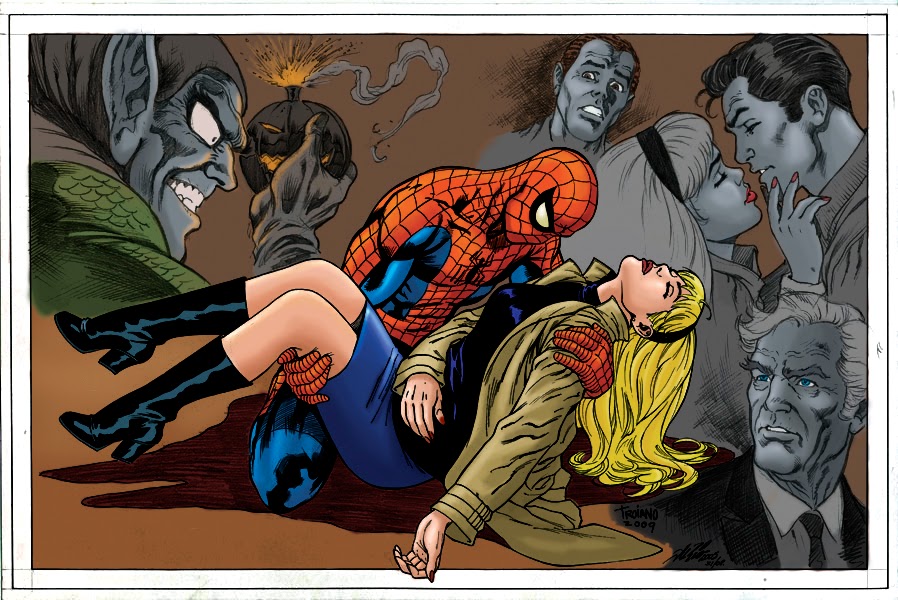
Stan Lee’s most memorable quote, “with great power comes great responsibility,” comes via this character, who serves as a father figure for Peter. The Amazing Spider-Man 2 (actually the fifth Spider-Man film, although the sequel to the 2012 series reboot) continues to emphasize the themes of guilt and responsibility as they relate to Peter’s girlfriend Gwen Stacy (another source of tragedy and guilt).


Of course Jews do not have a monopoly on guilt, but we do have our own particular brand of it. A colleague of mine whose father is Jewish and whose mother is Catholic insightfully observed that Catholics make you feel guilty for things that you do, while Jews make you feel guilty for what you don’t do. This of course corresponds to the sins of commission and omission. Ogden Nash, in his poem, “Portrait of the Artist as a Prematurely Old Man,” famously suggested that the sins of commission are preferable in that “they must at least be fun or else you wouldn’t be committing them,” whereas it is the sin of omission “that lays eggs under your skin.”


Speaking of Ogden Nash, here's what you might call the portrait of the poet...


And I feel obliged to add that the colleague at Fordham University who explained the distinction between Jewish and Catholic guilt to me is none other than my long time friend and fellow media ecologist, Ed Wachtel. And after I shared a copy of the original op-ed in the Jewish Standard with him, he chided me for not mentioning him by name, so now I am correcting that particular sin of omission. In addition to it evoking a chuckle  and a nod of recognition from anyone familiar with the two faiths, he has truly made a very significant observation, that different cultures and religious traditions can have different types of guilt. And it certainly made my essay much more interesting than it would have otherwise been. Thanks, Ed!

 And now for the conclusion of my think piece:

The guilt for what you don’t do, for standing idly by while others suffer, for not taking a stand against discrimination and injustice, for not opposing the evil that we find in the world, for not being the best that we can be and for not taking responsibility for ourselves and for others, is the underlying message of the Marvel Age, in comics and now in motion pictures. It serves as a kind of pop culture midrash for our times.


The Marvel Age of Midrash, that does sound like something Stan Lee might have written, and maybe Jack Kirby too. They did have a taste for alliteration, which maybe had something to do with ancient and medieval Hebrew's use of poetic devices of assonance and parallel structure.


Jack Kirby  (l.) & Stan Lee (r.)


from Uncanny X-Men #98 (1976)


I think it's fair to say that Stan Lee, now 91 years old, and Jack Kirby (1917-1994) are the real marvels behind the movies of this past spring. So to Stan Lee, and to the memory of Jack Kirby, I say a hearty, mazel tov!


Thursday, July 10, 2014

Twitter Goes Native

So, last month Twitter purchased Namo Media, which is described as a native ad specialist. What that means is that they make it possible for "native ads" to run in the apps designed for mobile devices. Their pitch to app makers is, "Turn your content stream into a revenue stream." The possibility of running ads within an app make not have occurred to many of the designers and distributors of games, utilities, and applications that run on smart phones, pads, and tablets. But perhaps it has. 

More to the point, sites and services that started up on the web and became platforms for advertising, for example Google and Facebook, have faced certain challenges in the mobile environment, because mobile displays either shrink the ads appearing on websites or cut them off entirely. Their answer to the problem parallels product placement in film and television, as it involves the web-based services injecting sponsored items into search results, or  status update streams.

The challenge posed by monetizing mobile devices is the reason that Facebook's stock value dropped significantly right after they went public. And this is especially a problem for new media businesses because more and more we all are accessing our social media and websites via our smart phones and iPads, not our computers.

Anyway, to get a quick update on the facts surrounding Twitter's acquisition, here's a Wall Street Journal article entitled, Twitter Buys Native Ad Specialist Namo Media.

So, I was invited to comment on this story for the "Today's Burning Question" feature run by Mike Daly for the Adotas.com website. Here is my response:

Launched in 2006, Twitter once led the way in integrating cell phones into its service, this well before most of us were sporting smart phones, so they have a particular interest in staying on top in the increasingly competitive arena of mobile applications. For a long time, there were questions about how they could monetize their service, and the answer they eventually arrived at, sponsored tweets, was not an unmitigated success. What we see happening today is a move away from single platform networks like Facebook and Twitter, and towards more specialized apps that are themselves networked together. Google has led the way on this, and with the purchase of Namo Media, Twitter can provide the equivalent of Google AdWords for mobile apps. Running ads in apps has become one of the main answers to the question of how to monetize apps for mobile devices, but nothing is more annoying to users than ads that appear to be entirely inappropriate, so using algorithms to determine ads that fit in with the content of the app is essential to its success. Whether Namo’s algorithms can compete with Google’s remains to be seen, but Twitter also needs to be concerned with Facebook’s aggressive moves into mobile territory through its purchase of Instagram and WhatApp. The one thing that is certain in the new media industry is that if you stand on your laurels, you will quickly fall behind.

You can read the responses of six others, all of whom are industry types and not academics like me, over on the Adotas site: Today’s Burning Question: Reaction to Twitter’s Native Ad Move.  The results were posted on June 9th. And maybe today's burning question should be, are you reading this on a mobile device?


Tuesday, July 8, 2014

Korzybski and I

Some of you may note the allusion in the title of this post, Korzybski and I, to the play and movie, the King and I. The similarity extends beyond both forms of special K, as you can see:


Alfred Korzybski
Yul Brynner


Of course, Alfred Korzybski passed away before I was born, so I had no chance to know the man, but I know his work, and have been influenced by his writings and ideas, most notably his general semantics. And as some of you may know, I served as Executive Director of the Institute of General Semantics for 3 years, from 2008 to 2011.


So, this past December, I was invited to join the Board of Trustees of the IGS, and accepted. And it occurs to me that I never got around to adding a post about the anthology I co-edited with Corey Anton, who is presently Vice-President of the IGS. The volume, entitled Korzybski And..., was published in 2012 by the IGS, so this is more than a little overdue. 


You may have noticed the Amazon order links for the book over on the left, though, and here they are again:


But no doubt you'd like a little more information about what's in the book, and that's perfectly understandable, so here are the contents:


Acknowledgements

Chapter 1: Situating Alfred Korzybski
                Corey Anton and Lance Strate

Chapter 2: Korzybski and Gottfried Leibniz
                Bruce I. Kodish

Chapter 3: Korzybski and Friedrich Nietzsche
                Zhenbin Sun

Chapter 4: Korzybski and Charles Sanders Peirce
                Isaac E. Catt

Chapter 5: Korzybski and Martin Heidegger
                Corey Anton

Chapter 6: Korzybski and French Structuralism
                Jean-Yves Heurtebise

Chapter 7: Korzybski and Stuart Chase
                William Henry Sharp

Chapter 8: Korzybski and S. I. Hayakawa
                William Henry Sharp

Chapter 9: Korzybski and Albert Ellis
                Martin H. Levinson

Chapter 10: Korzybski and New Trends in Psychotherapy
                  Ramiro J. Álvarez

Chpater 11: Korzybski and Marshall McLuhan
                  Lance Strate

Chapter 12: Korzybski and Cultural Studies
                  Geraldine E. Forsberg

Chapter 13: Korzybski and New Visual Language
                  John S. Caputo, Robin Wynyard & Heather M. Crandall

Chapter 14: Korzybski and Cartography
                  Bini B.S.

Chapter 15: Korzybski and Cyberculture
                  Thierry Bardini

Chapter 16: Korzybski and...
                  Deborah Eicher-Catt

Index 
About the Authors 


 It's an interesting and diverse group of essays, one that leaves lots of room for follow-up at some point in the future. And herein ends my little exercise in what Korzybski referred to as time-binding.

Monday, July 7, 2014

Yahoo for the Tube!

So, back on May 28th, the E-Commerce Times ran a story, written by Erika Morphy, on Yahoo's plans to create a video sharing service to compete with YouTube. The story, entitled Wheels Greased for Summer Yahoo-Tube Debut, is worthy of being mentioned here on Blog Time Passing because, you guessed, it included quotes from me.

Here's the blurb that precedes the beginning of the article:

Yahoo wants to give YouTube a run for its advertising money by launching its own channel for user-generated videos. Yahoo shouldn't have much trouble attracting advertisers if its product offers nonexclusive deals at more attractive rates. Getting inventory is another story, however. It won't be easy to get content creators and viewers to think twice about where to upload and devour videos.

And here's how it begins:


Yahoo is in advanced talks with video producers to launch its own online video channel this year, a product meant to rival Google's YouTube, according to Ad Age, which cited unnamed sources briefed on the company's plans.

The news has intrigued the online video and advertising industry because it would introduce some very welcome competition into this channel, owned largely—but not completely—by Google.

Yahoo reportedly hopes that generous revenue-sharing arrangements will attract producers and content creators to try out its new platform. YouTube takes a 45 percent cut.

Yahoo will offer the option of a fixed ad rate that will be 50-100 percent higher than YouTube's average net ad rate, according to Ad Age.


Sound good? Or maybe too good to be true? I weigh in on the matter in the next section of the article, which has the heading "Winning Over the Masses":

While these numbers may pique the interest of producers, Yahoo will be hard-pressed to trump Google's ownership of this market, Lance Strate, professor of communications and media studies at Fordham University, told the E-Commerce Times.

"The name YouTube is practically synonymous with user-generated online video, and it will be very difficult for Yahoo to make a dent in Google's dominance of this sector," he told the E-Commerce Times.

"The bottom line is that if you want your video to viewed by the largest possible audience, you'll upload it to YouTube. No one comes close to the number of views, viewers, subscribers and uploads that YouTube has, and even if everyone stopped providing YouTube with new material today—a highly unlikely scenario—it would take a very long time for Yahoo to come close to the enormous archive of videos that YouTube has amassed over the past decade."

Now, let's hear from someone else:

The hill Yahoo proposes to climb is indeed steep, said Warp 9 CEO Andrew Van Noy, who suggested that Yahoo get a little more imaginative as it tries to face off against Google.

"Assuming the rumors are true, I have a difficult time imagining any video platform posing an immediate threat to YouTube," he told the E-Commerce Times. "It's going to need to make concessions in order to challenge one of Google's flagship products."

In addition to better ad rates, Yahoo could offer advertisers analytics or partnership opportunities with major media publishers, Van Noy suggested.

"Another idea could include cutting down on the length of ads, which many YouTube users often complain about," he said.

And at this point, a new section begins with the heading of "The Real Problem With Scale":

Yahoo had better expect to post a loss as it moves into this space, Guido Lang, assistant professor of computer information systems at Quinnipiac University, told the E-Commerce Times.

It took Google about five years to turn a profit on YouTube, he noted—and that followed experimentation with a number of different videos ads, such as pre- and post-roll ads, as well as YouTube channels and video-editing features.

"Google's experience has shown that it is extremely difficult to monetize online video. You need scale—both in terms of content and in terms of audience—to make it work," said Lang. "I'm not sure that Yahoo will be able to bring that kind of scale to the table."

And the article ends by returning to me for the final section, under the heading of "Some Inroads":

Yahoo's plan may not be completely hopeless.

There are alternatives to YouTube, and a significant number of individuals have grown dissatisfied with YouTube over the past several years, Fordham's Strate pointed out.

"YouTube has addressed some of the grievances by lifting restrictions on the length of amateur videos, but many serious video creators have migrated to Vimeo and Blip.tv to obtain a better quality of service," he said.

Still, "one of the main complaints about YouTube is the increasing presence of advertising," noted Strate, "and Yahoo does not appear to be considering purchasing one of the YouTube alternatives or providing an ad-free environment."

And now, so they don't go to waste, here are the comments I provided, via e-mail, in their entirety, so you can see the larger context from which the article's quotes were excerpted:

The name YouTube is practically synonymous with user-generated online video, and it will be very difficult for Yahoo to make a dent in Google's dominance of this sector. The bottom line is that if you want your video to be viewed by the largest possible audience, you'll upload it to YouTube. No one comes close to the number of views, viewers, subscribers, and uploads that YouTube has, and even if everyone stopped providing YouTube with new material today, a highly unlikely scenario, it would take a very long time for Yahoo to come close to the enormous archive of videos that YouTube has amassed over the past decade.
An important and often overlooked aspect of YouTube's value is that it functions as a search engine second only to Google search itself. When you want to find out about how to fix a washing machine, change a spark plug, cook a turkey, or learn about string theory or Web 2.0, YouTube is the place to find the largest collection of informative, instructional, and educational videos, and video represents a mode of communication well suited for how-to instruction and any explanation that benefits from illustration and animation. Moreover, YouTube has been moving into Netflix and Hulu territory by providing feature films and original television programming.

Of course, there are alternatives to YouTube, and a significant number of individuals have grown dissatisfied with YouTube over the past several years. YouTube has addressed some of the grievances by lifting restrictions on the length of amateur videos, but many serious video creators have migrated to Vimeo and Blip.tv to obtain a better quality of service. But one of the main complaints about YouTube is the increasing presence of advertising, and Yahoo does not appear to be considering purchasing one of the YouTube alternatives, or providing an ad-free environment.

The chances of Yahoo having any significant impact of YouTube are small, in my opinion. Before purchasing YouTube, Google launched its own Google Video, but gave up on it in favor of YouTube. MySpace tried to establish its own video service, but that never caught on and couldn't stop the social network from imploding. Yahoo does not appear to be offering anything particularly new or different from YouTube. They may offer better deals on revenue-sharing and advertising, but the only things that matter as far as monetization is concerned are eyeballs, and it's YouTube that has the online audience's attention, and will be securing more of it as television and the internet continue to converge, and viewers spend more time watching YouTube videos on their TV screens.

Yahoo may be looking for some synergy through integration with their earlier acquisition of Tumblr, but if all they have to offer is a pale shadow of YouTube, Yahoo Video won't amount to much. It is highly unlikely that Yahoo Video will offer a serious challenge to YouTube, but they could perhaps develop a distinctive identify if they were to incorporate live streaming, short video clips along the lines of Vine, professional programming along the lines of Hulu and Netflix, combined with the amateur uploading that is YouTube's stock-in-trade.


And that is that. Will YouTube reign forever over the video-sharing world? Of course not. All good things must come to an end, as must all bad things, and everything in-between. But when, and how that will happen? That is the question. And I don't have an answer, but I don't think it's here and now, as much as Yahoo might want to have its revenge on Google for beating them out in the search engine business a decade ago. YouTube may well remain the dominant force for some time to come, and only succumb to changes in hardware at some point in the future.

Anyway, aside from all this, is more television and more video exactly what we need right now?