Saturday, January 23, 2010

What It Is

Remember when President Clinton first got in trouble over Monica Lewinsky, and came out with the line, "It depends on what the meaning of is is"?


In case you're curious, the full context of that line, made as part of a statement to a grand jury, went like this:


It depends on what the meaning of the word 'is' is. If the--if he--if 'is' means is and never has been, that is not--that is one thing. If it means there is none, that was a completely true statement....Now, if someone had asked me on that day, are you having any kind of sexual relations with Ms. Lewinsky, that is, asked me a question in the present tense, I would have said no. And it would have been completely true.


Obfuscations and prevarications aside, have you ever thought about what the meaning of is is?  Why would anyone need to look it up as basic as word as that, you might ask, but need to or not, it has to be included in the dictionary.  And, it, meaning is, is not all that easy to define, and in fact poses complex challenges.  Going to one online source, dictionary.com, and checking on the main verb form be, yielded the following results:


be

[bee; unstressed bee, bi]  Show IPA verb and auxiliary verb, present singular 1st person am, 2nd are or (Archaicart,3rd is, present plural are; past singular 1st person was, 2ndwere or (Archaicwast or wert, 3rd was, past plural were;present subjunctive be; past subjunctive singular 1st personwere, 2nd were or (Archaicwert, 3rd were; past subjunctive plural were; past participle been; present participle be⋅ing.
–verb (used without object)
1.
to exist or live: Shakespeare's “To be or not to be” is the ultimate question.
2.
to take place; happen; occur: The wedding was last week.
3.
to occupy a place or position: The book is on the table.
4.
to continue or remain as before: Let things be.
5.
to belong; attend; befall: May good fortune be with you.
6.
(used as a copula to connect the subject with its predicate adjective, or predicate nominative, in order to describe, identify, or amplify the subject): Martha is tall. John is president. This is she.
7.
(used as a copula to introduce or form interrogative or imperative sentences): Is that right? Be quiet! Don't be facetious.
–auxiliary verb
8.
(used with the present participle of another verb to form the progressive tense): I am waiting.
9.
(used with the present participle or infinitive of the principal verb to indicate future action): She is visiting there next week. He is to see me today.
10.
(used with the past participle of another verb to form the passive voice): The date was fixed. It must be done.
11.
(used in archaic or literary constructions with some intransitive verbs to form the perfect tense): He is come. Agamemnon to the wars is gone.
Origin: 

bef. 900; ME been, OE bēon (bēo- (akin to OFris, OHG bim, G bin, OSbium, biom (I) am, OE, OHG, OS būan, ON būa reside, L fuī (I) have been, Gk phy- grow, become, OIr boí (he) was, Skt bhávati (he) becomes, is, Lith búti to be, OCS byti, Pers būd was)) + -n inf. suffix. See amisare 1 waswere 


Usage note:

See me. 
Be that as it may, one of the main non-Aristotelian principles of general semantics we call non-identity, and Alfred Korzybski was fond of saying, whatever you say it is, it isn't!  Clearly, Bill Clinton has some familiarity with general semantics, and drew on Korzybski's recommendation that we be very careful about the way that we use the verb "to be" as it can mislead us much of the time, because no two "things" or phenomena or events in reality are ever exactly the same, outside of symbol systems such as mathematics and symbolic logic.


And while Korzybski did not go to the extreme of advocating for the abolition of the verb to be from our language, one of his followers, David Bourland, took that next step, calling English without to be English-Prime, or E-Prime.  Recently, one of England's leading newspapers, The Guardian, ran an article about E-Prime written by Oliver Burkeman.  Part of a regular series  called "This Column Will Save Your Life," Burkeman's piece on E-Prime is dated January 16, and subtitled, "To Be or Not To Be..."  Shakespeare's most famous line inevitably comes up in these discussions, and they added the following photo of an actor I recognize as a former Dr. Who, with the caption "Two little words that cause all sorts of trouble - and not just for Hamlet (Christopher Eccleston). Photograph: Tristram Kenton":
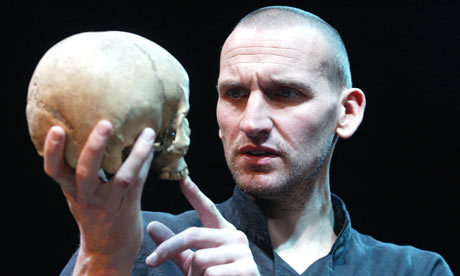


And there was also a blurb after the subtitle that read, "It's 45 years since David Bourland suggested doing away with the verb 'to be'. A silly suggestion, one might think, but look a little closer and it makes a weird kind of sense."  


Burkeman starts off by writing


Forty-five years ago, the author David Bourland published an essay proposing a radical overhaul of English based on eliminating all forms of the verb "to be". In a world where we all spoke E-Prime, as Bourland called this new language, you couldn't say "Sandra Bullock's latest film is shockingly mediocre"; you'd have to say it "seems mediocre to me". Shakespeare productions would need retooling ("To live or not to live, I ask this question"), as would the Bible ("The Lord functions as my shepherd"). The world, in short, would feel very different – though in E-Prime you couldn't actually say it "was" very different. Unsurprisingly, it proved even less popular than Esperanto, and in fairness Bourland never meant it as a serious replace­ment for English. But in this anniversary year, his eccentric vision deserves celebrating. Because in theory at least, E-Prime aimed at nothing less than using language to make our insane lives a little more sane.

I've left the links that appeared in the published piece, because they hold some interest here at Blog Time Passing.  By the way, in regard to the Bible, if you go to the original, the verb to be does not appear in the present tense in Hebrew, the language does not have words for is, am, are, and be.  As for English, Bourland may not have seriously considered the possibility of E-Prime replacing our everyday language, but he did publish three collections of writings in E-Prime by various authors, which we at the Institute of General Semantics still sell.  I myself wrote an article in E-Prime a few years ago, not an easy task, I can tell you.  But neither an impossible one.  Anyway, back to Oliver:

Bourland studied under Alfred Korzybski, a Polish aristocrat émigré who founded the philosophy of General Semantics, made famous by his slogan, "The map is not the territory." To think about and function in the world, Korzybski said, we rely on systems of abstract concepts, most obviously language. But those concepts don't reflect the world in a straightforward way; instead, they contain hidden traps that distort reality, causing confusion and angst. And the verb "to be", he argued, contains the most traps of all.
Take the phrase, "My brother is lazy." It seems clear, but Korzybski and Bourland would say it deceives: it implies certainty and objectivity, when in reality it expresses an opinion. Even, "The sky is blue" papers over the details: I really mean, "The sky appears blue to me." "Our judgments can only be proba­bi­listic," wrote Allen Walker Read, a Korzybski follower. "Therefore we would do well to avoid finalistic, absolutistic terms. Can we ever find 'perfection' or 'certainty' or 'truth'? No! Then let us stop using such words in our formulations." E-Prime provided an easy way to do this: simply stop using "to be".

Allen Walker Read actually worked on dictionary definitions of words like "is" and "be"--in fact, he wrote the Introduction to the dictionary I used all through graduate school.  And those two paragraphs, by the way, make for an excellent introduction into what general semantics is all about.  Well done, Mr. Burkeman.  And, that's not all:

All this might seem maniacally pointless pedantry. But as cognitive therapists note, thoughts trigger emotions, and "finalistic, absolutistic" thoughts trigger stressful emotions. "I am a failure" feels permanent, all-encompassing, hopeless. Restating it in E-Prime – "I feel like a failure" or "I have failed at this task" – makes it limited, temporary, addressable.
There's no question that many have found therapeutic value in general semantics.  But perhaps more to the point, E-Prime can be very useful for critical thinking, brainstorming, and problem-solving, as Burkeman explains:

"I have found repeatedly," wrote the novelist Robert Anton Wilson, an E-Prime advocate, "that when baffled by a problem in science, in philosophy, or in daily life, I gain immediate insight by writing down what I know about the enigma in strict E-Prime." Political debates might benefit, too, since E-Prime renders unyielding dogmatism – "All immigrants are scroungers!", "Taxation is theft!" etcetera – essentially impossible. As George Santayana put it, "The little word 'is' has its tragedies."
I love that Santayana quote, don't you?  And fundamentally, the problem is that our language leads us to think in terms of identity relationships, of things that are the same as each other, rather than different unique events in spacetime.  Anyway, let's return once more to Oliver for his concluding paragraph:


E-Prime never really caught on; General Semantics fell out of fashion. (It can't have helped that Korzybski's fans included that high-priest of poppycock, L Ron Hubbard.) Even so, trying to express one's thoughts without using "to be" can have a curiously salutary, bracing effect. In this column, with the obvious exception of the quoted examples, I have attempted to do this.

Bravo, Mr. Burkeman, bravo!   This article is an excellent illustration of how you can eliminate the verb to be seamlessly, without resort to any awkward constructions or convolutions, or obvious manipulations.  And when it comes to writing, the value of E-Prime is quite clear.  Simply put, minimizing the use of to be as much as possible makes for better writing.  To be indicates static relationships, rather than dramatic actions and events.

To be, simply put, is to bore.

It is raining is boring, as compared to, The rain poured down from the sky, which also leads me to find some kind of metaphor, e.g., like flop sweat from an overweight comedian performing for a stone-faced audience.  Okay, maybe not exactly deathless prose, but I think you can see my point.

E-Prime or not E-Prime, that is the question.  Well, for critical thinking and good writing, it's an excellent tool to have at your disposal.


And here's the URL for Oliver Burkeman's article, in case you want to see it in its original context:


http://www.guardian.co.uk/lifeandstyle/2010/jan/16/e-prime-change-your-life


And as for what the meaning of is is, it is what it is...


Thursday, January 21, 2010

Free to Be Free


So, last weekend I went to a Bat Mitzvah ceremony.  Nothing unusual or especially noteworthy about that, but this wasn't a Bat Mitzvah at a Reform Jewish temple, like my own Congregation Adas Emuno, or even a Conservative synagogue.  No, this was a Bat Mitzvah at an Orthodox shul, and not just Orthodox, but Chasidic.  If you're unfamiliar with that form of Judaism, here's a link to the wikipedia entry, under the alternate spelling of Hasidic Judaism.


Some consider the Chasidim (Hebrew plurals end with "im" or "eem" for masculine nouns) to be ultra-Orthodox, but it is not just a matter of a one-dimensional scale measuring greater or lesser Orthodoxy.  Rather, the Chasidim are an alternative to Modern Orthodox Judaism, and they were originally a reform movement in their own right, diverging in many ways from Ashkenazic Jewish traditions.  
Chasidism was also the first movement to popularize the Kabbalah, moving it from an elitist pursuit to mysticism for the masses; and of course in recent years the Kabbalah has been popularized anew, and taken outside of a Jewish context to some extent (e.g., Madonna, Rosie O'Donnell).  The respected 20th century philosopher Martin Buber, noted for his discourse concerning I-Thou (and the idea of the eclipse of God), was very much taken with Chasidism.  Chasids have sometimes been compared to the Amish because of their 19th century style of dress.


Chasidism is a movement that is actually composed of numerous separate sects, albeit all stemming from a common ancestor, an 18th century rabbi popularly known as the Ba'al Shem Tov.  One of the biggest of these sects is the Lubavitchers, and the particular Bat Mitzvah I attended was held at the Lubavitch on the Palisades.  Their Chabad movement is very open and inviting, and does not require (but encourages) the kind of extreme observance that their leadership practices.  Almost none of the men present at the service wore the 19th century style of dress, and many were not fluent with their manner of prayer (all in Hebrew, and very rapid, much faster than I myself can manage).


But they did maintain the traditional separation between the sexes, so that the women were all at the rear of the sanctuary, and hidden behind movable, translucent screens.  It wasn't until I got there that the thought occurred to me--how the hell are they going to do a Bat Mitzvah?  And as it turns out, they did not waver from tradition.  The women were free to pray along, but could not take the lead in any part of the service, nor could they be called up to read from the Torah, or say the blessings over the holy scroll.  


But what then?  The whole point of the boy's Bar Mitzvah ceremony is for the boy to demonstrate that he can read the ancient Hebrew calligraphy directly from the Torah, and in passing this literacy test, be initiated into adulthood.  The Reform movement introduced equality of the sexes, and with it the Bat Mitzvah ceremony for girls, and the Conservative branch of Judaism followed suit.  Clearly, these ultra-Orthodox congregations were trying to incorporate this contemporary addition to the tradition as well, but how?


As it turns out, at no point did the Bat Mitzvah girl take part in the ceremony.  There were occasional mentions that it was her Bat Mitzvah, her father was given a place of honor, and male family members and friends were called up to say the blessings over the Torah.  But it was only once the service was over that the screens were moved aside, and she was invited up to pulpit to give a speech, and she gave a short Bat Mitzvah speech.  It included her telling us about her Bat Mitzvah project, which involves charitable acts and forms of social action.  But this took place outside of the actual service.


All this is a bit of a preamble, although I think it worthwhile to report on this experience, as I myself had no idea there was such a thing as an Orthodox Bat Mitzvah, or what it would entail.  But what I wanted to relate to you was something of the Rabbi's sermon that caught my imagination.


I should add that one of the distinctive features of the Chasidic movement was a shift from a tradition of somber, serious, often mournful religious observance to one that emphasized joy and love, music and dancing, and celebration.  The sense of joy and optimism was apparent to me in the Rabbi's attitude, and this is related, to some degree, to the Messianic fervor of the Chasidic movement.  They believe that the Messiah will come, that he's coming sooner rather than later, and that doing mitzvahs (fulfilling God's laws and commandments) have a direct effect in hastening the Messiah's arrival, and the establishment of paradise on earth.  Every prayer and every good deed counts, and has a real power in this way of thinking!  

Actually, some among the Lubavitchers believe that the Messiah has already come, in the form of the late Rabbi Menachem Schneerson, whom they still refer to as "the Rebbe"--you might well ask how anyone could continue to entertain the belief that he is the Messiah after his death, but of course there is ample precedent for that, dating back a couple of thousand years.


I should interject that my own branch of Reform Judaism does not take the concept of the Messiah all that seriously, and instead suggests that we all have to work together to bring about a Messianic Age.  And although we are on the opposite end of the spectrum from the ultra-Orthodox, Reform congregations have incorporated aspects of Chasidic ceremonies into our services.


So, anyway, back to the Rabbi's sermon, where he talked about the terrible devastation from the earthquake in Haiti, and emphasized that, unlike in the past, this time every nation on earth had come to the aid of the citizens of that Caribbean country. And he took that as evidence that we are living in Messianic times.  Whether he meant that the Messiah's arrival was immanent, or that his arrival had already happened, was left ambiguous, no doubt to reflect the difference of opinion among the Lubavitchers themselves, as they wait for the question to be resolved by some further action or event.


 I admire that perspective, and the sense of hope and optimism that goes with it, even if I don't exactly share the same beliefs.  I also liked the fact that the Rabbi noted the commonality between the Haitians, who fought for their freedom not only as a nation, but for their freedom from slavery, from France and Napoleon.  And he related it all to the week's Torah portion.  I found the message inspiring, and in searching for the source of the Talmudic commentary, I found that his sermon was drawing from an essay posted on the website of another Lubavitcher congregation, Chabad Prospect Heights (fair use, as sermonizing goes).  The essay, by Rabbi Y. Y. Jacobson, is entitled Haiti: When the Slaves of Haiti Revolted Against Napoleon, and you can click on the title to read it in its entirety.  But for now, I want to call your attention to an excerpt:


When Napoleon suddenly invaded Russia on June 23 1812 (Hitler also suddenly invaded Russia on June 22 1941), most leaders of Russian Jewry enthusiastically supported Napoleon as the man who would finally grant liberty and equality to the isolated and persecuted Jews. Some Jews even hailed him as a Messiah. There was one leader, Rabbi Schnuer Zalman of Liadi (1745-1812), the founder of Chabad [aka Lubavitch Chasidic sect] and one of the greatest Jewish thinkers and leaders, who loathed Napoleon. He felt that the French emperor’s thirst for power and self-aggrandizement knew no bounds and that his secret motif tearing down the ghetto walls was not human dignity but a desire to take over the world and to destroy the inner spiritual and religious core of the Jewish people. The Rebbe believed that Napoleon would cause mass Jewish assimilation and millions of Jews would be lost to our people and he actively supported the Czar against Napoleon.


When Napoleon advanced deep into Russia, Rabbi Schnuer Zalman, not wanting to live under his rule, fled. He passed away on December 27, 1812 (the 24th of Taves 5573), while running from Napoleon.
Indeed, when it came to the half-a-million black slaves in Haiti, the ethos of freedom was obliterated from Napoleon’s vocabulary. The fact remains that the Haitian slaves are the first to collectively and successfully overthrow their colonial masters, in this case, the French. The slaves ended Napoleon’s ambition to dominate the Americas and have paved the way for the first black republic. After the Egyptian Exodus, this is the first recorded instance in history where a nation of slaves set themselves free.
The tragedy of Haiti is that if it was a hell on earth under slavery, it did not change after the slave revolt. Africans plucked and sent to Haiti to work under the lash and suddenly freed were not a model constituency for civil society. Some of the former slaves became tyrants. Haiti went from the largest sugar exporter in the world to chaos. The plantations were deserted. The former slaves refused to work on the places they were enslaved. Haiti may have been called “the mother of liberty,” but after 200 years of independence, it remains an impoverished and troubled nation. Two-thirds of the country’s workers are unemployed, and most Haitians live on about $1 a day. Life expectancy is little more than 50 years.
The last thing Haiti needed was this devastating earthquake. It is our duty and privilege to help this crushed nation and an ode to the United States of America for contributing 100 million dollars to rebuilding the country.


He then proceeded to discuss the passage in the Torah which, somewhat unexpectedly, indicates that God tells Moses to tell the children of Israel first that their slaves must be freed, before going to deliver the same message to Pharaoh.  Of course, as slaves themselves, the Israelites had no slaves, so this was a matter of instructing them about how to behave in the future, when things got better for them.  And here now is the part of the essay that really moves me:


The Jews were now groaning under Pharaoh’s yoke. What sense is there is instructing them that one day – psychologically a million light years away—they ought to free their slaves.

What is more, as the Torah states, “G-d commanded them to the children of Israel, and to Pharaoh the king of Egypt to let the children of Israel out of the land of Egypt.” Before sending them to the Egyptian leader to liberate the downtrodden slaves, G-d first sends Moses and Aaron to instruct the Jews that one day after many many years they must set free their own slaves. What’s the connection between the two things?

Who Is Free?

The answer is simple and moving, and it is a critical idea for history.

The message the Torah is trying to convey is that freedom is a gift and you are only entitled to it if you are ready to share it with others. If you are enslaving others, you deprive yourself of the right to be free.

This is true not only morally but also psychologically.

Before Pharaoh could liberate the Jewish slaves, they must be ready to become free. You can extricate a man from slavery, but you cannot extricate the slavery from within the man, that is up to him alone. He must learn to take responsibility to create his own life and make his own decisions. He must learn the joy and dignity of freedom, of self-accountability, and of self-respect.

What is the first symptom of bring free? That you bestow freedom on others.

The dictator, the control freak, or the abusive spouse or parent, is not only an enslaver but also a slave. He is too small, too insecure, mediocre, narrow minded, to allow others to shine. He feels compelled to force others into the mold that he has created for them because he never truly embraced himself as a free human being. He lives in a cycle of psychological imprisonment, in fear lest someone else overshadow him, expose his failings, or usurp his position. Outwardly he attempts to appear powerful and successful, but inwardly he is miserable and alone, shackled and insecure.

The truly free human being is comfortable with himself or herself in a very deep place. He is aware that he has his individual calling in life, and that no one can replace his true contribution. He knows that he has a light all his own, but that others carry a light all their own and must be encouraged to share that light.

Only when one learns to embrace others, not for whom he would like them to be, but for whom they are, then can he begin to embrace himself, not for whom he wishes he was, but for whom he is. When we free those around us, we are freeing ourselves. By accepting them, we learn to accept ourselves.

Who is powerful? He who empowers. Who is free? He who can free others. Who is a leader? He who creates other leaders.

 And that last paragraph pretty much sums it up for me, sums it so very, very well.  Indeed it bears repeating, and highlighting:

 Who is powerful? He who empowers.


Who is free? He who can free others.


 Who is a leader? He who creates other leaders.


Amen, and mazel tov!


Wednesday, January 20, 2010

Understanding Autism Through Asperger's

It does seem that the closest that typical individuals can come to understanding what it is like to have autism is through the reports we get from high functioning persons with autism, who are able to articulate the ways in which they experience reality, and how their mind works.  And along the same lines, individual's with Asperger's Syndrome, a form of high functioning autism, can share with us something about their perspectives and unique subjectivities.  For this reason, I was quite interested when I came across this YouTube video from a couple of years ago, made by a teenager with Asperger's.  Here's the write-up that came with it:


INFORMATION:
My name is Alex Olinkiewicz and when I was 6 I was diagnosed with Asperger's (A High Functioning form of Autism). Ten years later I made this video to help you and others understand what its like inside my head. I show you how I behave and how I think by webcam and by using cartoon pictures that I drew on MS Paints (Microsoft).

RECEPTION:
Ever since I posted this video it has received many positive things. First it became a Featured Video on the front page of YouTube. This video has won 2nd place in the 2007 East End Student Film Project and was nominated for Best Commentary Video for the 2007 YouTube Awards. This video was shown at the Western Suffolk Counselor's Association spring conference in front of 25 counselors and will be shown again this time in front of 300 counselors. Also this video have received many comments, sure I have got a few bad comments, but mostly all of them are strong positive comments from Parents who has kids who are diagnosed, Teachers, People who has friends who are Autistic, and also people who have Asperger's/Autism. Also this video will be shown on a public television station called BronxNet on a TV show called The Crystal Stairs.


Three cheers for BronxNet, a neighbor and friend of Fordham University's Rose Hill campus.  And here now, is Alex:


He makes an important point about feeling more comfortable with television than books, and finding it easier to learn via TV.  At least in some instances, autism is associated with visual thinking, as opposed to the verbal, be it spoken or written (this comes up in my book, Echoes and Reflections).   Apart from the point about image thinking, though, the video is more about the sense of aloneness and difference common to all those who find themselves on the spectrum, and does not go into the truly fascinating interior landscape in any great depth.


And that is what is truly fascinating about all this, as the spectrum represents a naturally occurring alternate form of consciousness, one that does not require drugs, or spiritual or meditational exercises, but does not afford any alternative of typical consciousness either.

Not All Google-Eyed Over China


So, one big story last week was the fact that Google may pull out of China in response to a cyber attack.


For those unfamiliar with the whole situation, Google has been operating in China using a separate search engine especially tailored to the demands of the Chinese government, http://www.google.cn, one that would meet their demands to omit objectionable content, that is, content that is critical of their government and political system.

I should add that my expertise in this area is limited, these are just my offhand musings, the expert to go to in this area is my friend Ron Deibert at the University of Toronto, head of the Citizen Lab. But in case you're interested in what I have to say, I'll continue.


Google made the announcement on the Official Google Blog, which they do right here on blogger blogspot, in a post entitled A new approach to China on January 12.  Here's what they have to say, for starters:


Like many other well-known organizations, we face cyber attacks of varying degrees on a regular basis. In mid-December, we detected a highly sophisticated and targeted attack on our corporate infrastructure originating from China that resulted in the theft of intellectual property from Google. However, it soon became clear that what at first appeared to be solely a security incident--albeit a significant one--was something quite different.

First, this attack was not just on Google. As part of our investigation we have discovered that at least twenty other large companies from a wide range of businesses--including the Internet, finance, technology, media and chemical sectors--have been similarly targeted. We are currently in the process of notifying those companies, and we are also working with the relevant U.S. authorities.

Second, we have evidence to suggest that a primary goal of the attackers was accessing the Gmail accounts of Chinese human rights activists. Based on our investigation to date we believe their attack did not achieve that objective. Only two Gmail accounts appear to have been accessed, and that activity was limited to account information (such as the date the account was created) and subject line, rather than the content of emails themselves.

Third, as part of this investigation but independent of the attack on Google, we have discovered that the accounts of dozens of U.S.-, China- and Europe-based Gmail users who are advocates of human rights in China appear to have been routinely accessed by third parties. These accounts have not been accessed through any security breach at Google, but most likely via phishing scams or malware placed on the users' computers.


 They go on to try to reassure everyone that they have already taken steps to deal with the security issues, and then conclude with the following:


These attacks and the surveillance they have uncovered--combined with the attempts over the past year to further limit free speech on the web--have led us to conclude that we should review the feasibility of our business operations in China. We have decided we are no longer willing to continue censoring our results on Google.cn, and so over the next few weeks we will be discussing with the Chinese government the basis on which we could operate an unfiltered search engine within the law, if at all. We recognize that this may well mean having to shut down Google.cn, and potentially our offices in China.

The decision to review our business operations in China has been incredibly hard, and we know that it will have potentially far-reaching consequences. We want to make clear that this move was driven by our executives in the United States, without the knowledge or involvement of our employees in China who have worked incredibly hard to make Google.cn the success it is today. We are committed to working responsibly to resolve the very difficult issues raised.


This announcement drew widespread praise from the Twitterati, at least, those new media folks that I do follow on Twitter.  And rightly so.  And while some cynics noted that Google only had a small share of the Chinese market anyway, no more than 30% and maybe only 15%, the leader being China's own search engine, Baidu, that doesn't mean that Google couldn't eventually overtake Baidu as it did Yahoo here in the United States.  And even if it didn't, 15% of the enormous Chinese market is nothing to sneeze at.  I used to say to my old Media Ecology Association crony, Casey Lum, who is very involved with China, that if he could just get one tenth of one percent of the population there to join the MEA, we'd be in great shape.


In a January 14th article by Jessica Vascellero in the Wall Street Journal, A Heated Debate at the Top, we learn that the decision involved some negotiating among Google's top executives, who held different positions on the matter:


Google Inc.'s startling threat to withdraw from China was an intensely personal decision, drawing its celebrated founders and other top executives into a debate over the right way to confront the issues of censorship and cyber security.

The blog post Tuesday that revealed Google's very public response to what it called a "highly sophisticated and targeted attack on our corporate infrastructure originating from China" was crafted over a period of weeks, with heavy involvement from Google's co-founders, Larry Page and Sergey Brin.

For the two men, China has always been a sensitive topic. Mr. Brin has long confided in friends and Google colleagues of his ambivalence in doing business in China, noting that his early childhood in Russia exacerbated the moral dilemma of cooperating with government censorship, people who have spoken to him said. Over the years, Mr. Brin has served as Google's unofficial corporate conscience, the protector of its motto "Don't be Evil."


Now, I find this quite interesting indeed.   You see, my parents, in addition to being Holocaust survivors, also fled from the Communists in the aftermath of World War Two (and had some experience with them before and during the war).  There is a big difference between people who had actually lived under Communist regimes, and those who only understand Communism in theoretical and second-hand terms.  Communist refugees do have a tendency to be overly hawkish admittedly, my father voted for Goldwater in 1964 because of his anti-Communism.  But on the other hand, the tendency that those on the left had of suggesting an essential equivalence between the U.S. and the U.S.S.R was at best naive, and in many ways absurd.  I think my mother put it best, when I recall her talking to some counterculture folks about it back in the sixties when I was a kid, that Communism sounds like a good idea, it appeals to the heart, but only in theory, in practice it just doesn't work out.


So, for me, while I don't have the firsthand experience, I got the message.  The way I'd put it is that Communism is a nice idea that's never really been tried out, except maybe in Israel by the kibbutzniks, and elsewhere on communes (the commune being the essence of Communism).  True Communism is actually anti-government, putting it in line with some of the most conservative elements today, and very much the opposite of Leninist/Stalinist/Maoist totalitarian socialist systems.


Okay, I'm ranting, I know.  Well, let's look at what the Associated Press had to say about all this in a January 14th article entitled, Google's decision on China traces back to founders:


Google Inc. co-founders Sergey Brin and Larry Page have always said they put their principles before profit, even to the point of using their control of the company to take a stand.

The billionaires' idealism underlies a potentially expensive decision disclosed this week: Google's threat to leave China's rapidly growing Internet market in defense of free speech and its users' privacy rights.

It's a bold move unlikely to be made without the explicit support of Page and Brin, given the possible fallout. Departing the world's most populous country could slow Google's earnings growth and weigh on its stock.

Although Google has thousands of shareholders, it has two classes of stock, giving Page and Brin veto power over everyone else, including the company's chief executive, Eric Schmidt. Combined, Page and Brin hold 58 percent of the voting power among shareholders while Schmidt has less than 10 percent, according to the company's disclosures.

Google said this week's China bombshell was the result of an "incredibly hard" decision, but the company declined to elaborate on the internal debate. Google declined requests to interview Page, Brin and Schmidt.

Page and Brin, both 36, pledged to strive to do the right thing in a manifesto that they distributed just a few months before Google took its stock public in 2004.

"Don't be evil," they wrote, evoking the phrase that has become Google's motto. "We believe strongly that in the long term, we will be better served -- as shareholders and in all other ways -- by a company that does good things for the world."

Critics contended Brin and Page broke that promise in 2006 when Google created a Chinese version of its search engine, at Google.cn, to be in a better position to profit from China's booming economy. To gain the toehold, Google complied with the Chinese government's demands for censorship of Internet search results about political dissent and other hot-button issues.


Okay, so it is time for me to get back into rant mode.  There is a word for what Google has been doing in China.  It's called collaborating, and not the good kind of collaborating that goes on with social media, crowdsourcing, and all that. It's collaborating with the enemy, making a deal with the devil, giving in to evil.  Can you say Vichy?

We should not forget that, despite their economic liberalization and shift to a more capitalistic system, China's government remains repressive and authoritarian.  More than that, while they may have downgraded the status of Mao Tse-Tung, and may not be going on about Marx and Lenin the way they used to, China is still ruled by the Communist Party, still essentially under a one-party political system, still the People's Republic of China, still what we once referred to as Red China. 


It sometimes seems as if China's image has become almost benign.  We really don't seem to hear all that much about Tibet, for example, or the Falun Gong religious movement, or the 1989 Tiananmen Square massacre.   We certainly don't hear much about the general lack of political freedom that exists there.   No, the main topic of discussion is China's economic ascendancy, the fact that it now has a great deal of economic power over the US, and the prediction, and fear, that China is poised to eclipse the US as the world's leading economic power sometime soon, and the world's leading cultural power, and maybe even the world's leading military power as well.


So, it's not surprising that American businesses sometimes seem desperate to do business with China.  It's a previously untapped market, with more potential consumers than anywhere else on earth, and a rising standard of living.  It's the China rush, like the gold rushes of an earlier time.  And we do need to sell a whole lot of stuff to China to buy back our currency, pay off our loans, so it's not exactly unpatriotic to seek out Chinese trading partners.


Marx said that the capitalist will sell you the rope with which to hang him, and we've seen this happen over and over again, in the pursuit of profits and short-term gains.  And of course it goes without saying that the capitalist will sell the rope that's used to hang others.  There is nothing inherent in capitalism as a system or business as an activity that draws limits, that says that enough is enough, that says that a certain level of profits or productivity is sufficient and there is no need to go any further.  No, left to its own devices, this sort of system will move inexorably to increase profits, with no upward limit, to increase efficiency, to increase productivity, limited only by diminishing returns or resources.


You have to outside of the economic system to find the other values, ideals, and behaviors that put a stop to the relentless pursuit of financial gain and technological efficiency, to systems of ethics and morals, to religion, philosophy, politics, education, and to the family.


So, let's applaud Google's leadership for considering the possibility of sacrificing profits for ethics, for considering the possibility of putting an end to collaborating with evil.


And let's return now to the AP article:


Human rights groups and even some Google shareholders have been urging Google to pull out of China for the past four years, only to have Schmidt diplomatically reject the idea. He has maintained that Google needs to be in China to protect its franchise as Chinese becomes the Internet's predominant language -- a transition that Schmidt thinks could occur within five years.

Brin, though, has never been completely comfortable with Google playing by the Chinese government's rules.

In each of the last two years, Brin abstained from voting on shareholder proposals demanding that Google defy China's censorship policies. The symbolic act was designed to show he shared some of the concerns outlined in the measures, according to Brin.

Some of Brin's misgivings can be traced to family's own experience under Communism. He was born in Moscow in 1973. He and his family fled the Soviet Union when he was 6 years old, but he has said the oppressive policies of the government and the anti-Semitism directed at his family and other Russian Jews have helped shape his thinking on political and social issues.


You can read the rest of the article for yourself if you like.  Stephen Hsu, a physics professor at the University of Oregon, posted a piece entitled Google Dead in China? on the Technology Review blog on January 14th, and after going over much of the same ground as the other articles I cited, he concludes, "'Don’t Be Evil' always did sound a bit to me like tikkun olam, or repairing the world... Not sure whether CEO Schmidt is down with that ;-)"


Tikkun olam, repairing or healing the world, completing the task of Creation begun by God, that is our responsibility as human beings, according to Jewish tradition (we talk about it all the time at Congregation Adas Emuno), stemming from the Kabbalah.  Tikkun olam, exactly!  Thank you Mr. Brin.


And that's why American capitalism is not irredeemable, as long as there are individuals willing to throw a monkey wrench into the machine, act as human beings.  And that's why American individualism, when it is not out of balance with the needs of the community, is still one of our best hopes for tikkun olam.


There's so much worry about China today.  But I remember how much we worried about Japan in the eighties, and the Arab oil sheikdoms in the seventies.  I remember how worried we were about Communism, we thought that system would continue to compete with our own centuries from now.  We never imagined the collapse of the Soviet Union, or the Japanese economy.  So, I'm not worried.  Hey, maybe I'm wrong, and I certainly have no illusions about our position in the world being eternal, and we may well have passed our peak, I don't know, but Rome didn't fall in a day, or a century.  And me, I'm not going to place any bets on the longterm prospects of China, not unless they suddenly embrace true democracy and human rights.  Not until people are clamoring to immigrate to China, the way they are to come to the US, western nations in general, and any open society.  No, for the long term, I expect the US to remain the place to be, and otherwise, I'd put my money on the southern hemisphere, and countries like Australia, South Africa, and Brazil.  Give me until the end of the century, and then let's see.  You can look me up, ha ha.  See you then!