Wednesday, March 30, 2011

Phony English

Having returned from Italy on Sunday evening, it seems appropriate enough to share this video, originally brought to my attention by Corey Anton.  The song is by Adriano Celentano, and the lyrics are described as how English would sound if you didn't understand it, didn't speak the language.


This is a fake English, an attempt to mimic the sound of English, or the phonemes, to use the term favored by linguistics.  Every language has its own set of specific sounds that it uses, that differs in some ways from the phonemes of other languages.  When infants begin to babble, they make all kinds of sounds, but through interaction with others, the child learns which sounds are significant and which are not, which sounds make a difference in the meaning of words, and which sounds are ignored, and in this way starts to learn how to speak the language, before learning the meanings of words.  This is an example of how the medium is the message, by the way, as McLuhan would point out if he were with us right now.

Myself, I do have a very early memory of being at the movies with my parents, maybe it was Radio City, seeing faces up on the screen, hearing them talking, but not understanding what they were saying.  Of course, a great deal of meaning is transmitted by the nonverbal cues such as facial expression, posture and distance from one another, and tone of voice (and note that there is some mimicking of American body language in the video as well).  

But in the case of this song, it's just pure play with phonemes, or you might call it phony English.


Tuesday, March 15, 2011

Bidding A Fond Farewell to IGS

As of today, March 15th, my term as Executive Director of the Institute of General Semantics has come to an end.  Over the past three years of my tenure there, I hope that I helped the organization to move forward, and my new book, On the Binding Biases of Time, was a farewell gift to the IGS, in that all of my royalties are being donated to the Institute (have you ordered your copy yet?).  My time with the IGS has certainly been a great learning experience, and it has been an honor to walk in the shoes of Alfred Korzybski for a brief time.  But now it's time to move on, and since I'm in Italy as I write this (for a McLuhan Centenary event that I will write more about later), I'll just say, arrivederci IGS!
 

Tuesday, March 8, 2011

Children are the Living Messages We Send to a Time We Will Not See

I want to ask you to help me correct an inaccuracy out here on the net, an inaccuracy that amounts to an injustice.  Here’s the story:

Neil Postman wrote, “Children are the living messages we send to a time we will not see.”  This is the first sentence that opens his book, The Disappearance of Childhood, which was originally published in 1982 by Delacorte Press.


I can remember being a young doctoral student in the old media ecology program at NYU, I was just 22 when I started there in 1980, and seeing Neil writing the book with a black felt tip pen on yellow legal pads.

Neil Postman wrote “Children are the living messages we send to a time we will not see” as the first sentence of the Introduction to that book, appearing on p. xi.  Here, take a look:


 The Disappearance of Childhood  was the second of Postman's major works providing a critical analysis of television's influence on culture.  It was preceded by Teaching as a Conserving Activity, and followed by Amusing Ourselves to Death.  And if you find Postman's media ecology scholarship at all interesting and valuable, and especially if you've read Amusing Ourselves to Death and you haven't read The Disappearance of Childhood, then you will find The Disappearance of Childhood to be a delightful companion piece, a well-crafted extended essay, and important work of cultural criticism.

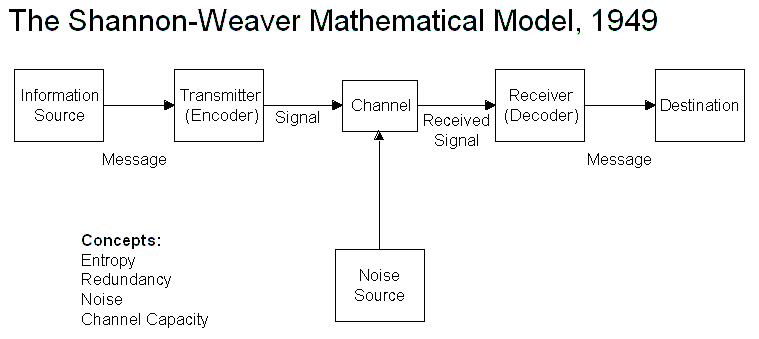
Postman begins by writing that “children are the living messages we send to a time we will not see,” because he was writing about communication, which involves the sending of messages through a channel to a receiver.  In the case of messages sent to the future, the receiver may be unknown to us, but the basic idea still applies.  This view originates in the post-war era with the Shannon-Weaver Model:


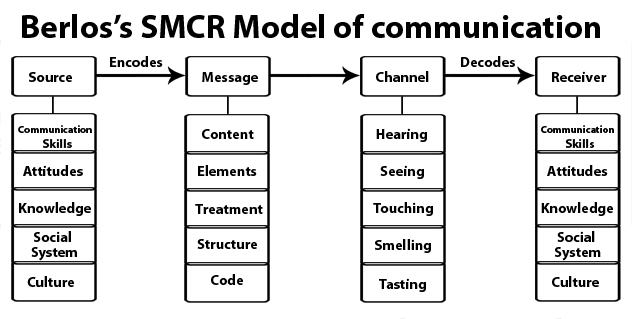
 The Shannon-Weaver Model was modified by communication theorist David Berlo circa 1960:


But the important point is that Postman was writing about communication, and thinking about children, and childhood, in terms of communication.  The idea that children are our legacy, a way of projecting something of ourselves into the future, is a time-honored, traditional notion.  But thinking of children as messages, as part of the process of  communication, is a relatively new orientation.  

And as any good media ecology scholar knows, in 1964 Marshall McLuhan declared that "the medium is the message," by which he meant (among other things) that the messages we send are influenced in significant ways by the medium that we use to create and send them   And The Disappearance of Childhood is all about how children as messages are influenced by the media that they use, and that we use to prepare our children to carry on for us in the future.  And it is about how childhood is a message that is influenced by the medium that we use to create it. 

Yes, create it, because childhood is a cultural construct (albeit one based on an underlying biological reality), a message we send to ourselves about biological and social reproduction.  In print culture, children came to be seen as special and innocent, and in need of extended protection as they were cloistered away in schools, while television culture has returned us in some ways to a view of childhood that does not allow for much distinction between children and adults, hence the title The Disappearance of Childhood (which also signals the disappearance of adulthood).

But you really have to read the book to get Postman's argument.  And I only provide this cursory summary to underline the fact that Postman's quote, “children are the living messages we send to a time we will not see,” with its particular emphasis on children and communication, originated out of a very specific set of circumstances, and its meaning is quite clear in that context.  But it also has a wonderfully poetic quality, evocative and compelling, and works quite well standing alone.  Some might even be fooled into thinking it is some kind of ancient proverb, despite its clearly contemporary sensibility.

“Children are the living messages we send to a time we will not see” is Neil Postman's most famous quote.  So what's the problem, you might ask?  And I'm glad you did.  The problem is that when you Google the quote nowadays, you get something like this:


How did this come to be, you might ask?  And I'm glad you did.  You see, this John W. Whitehead wrote a book entitled, ironically enough, The Stealing of America.


And this book was published in 1983, a year after The Disappearance of Childhood.  Just to be clear, here's the copyright page from Whitehead's book:


And here's the copyright page from Postman's book:


And just to dispel any lingering doubts, here is p. 68 of Whitehead's book, where he specifically cites Postman:


The Disappearance of Childhood also is included in the list of references that appear at the end of the book.  

So, are you ready now?  Ok, here is how Postman's quote appears in Whitehead's book, starting on the bottom of p. 116 and continuing on to p. 117:


Ah ha, you may be saying!  Caught red-handed! Well, the problem is that the circles that Whitehead travels in, and the readership that he picks up, is quite different from those associated with Postman.  So who knew?  It would have been quite the coincidence to come across it back in the 80s, or even the 90s.  But, the quote being so poetic and memorable, it got picked up from Whitehead's book, and reproduced all over the place with the wrong attribution.  It appears in some baby book, which probably amplified the error significantly.

Who is this guy, anyway, you might ask?  Well, you can read about him on this page from the Rutherford Institute website:  About John W. Whitehead.   And you can read about the Rutherford Institute on their Wikipedia entry:  Rutherford Institute.  

Not that it matters much.  I am writing this, and asking for your help, not to cast blame or level accusations.  Postman was certainly the easygoing, forgiving sort of person who would not have made a big issue out of this.  But speaking for those of us who honor his memory, and who believe in credit where credit is due, we would like to set the record straight.

The problem is that it is very hard to set the record straight on the web.  It is very hard to get the content of websites changed.  You can send a message, but it may be that the site is no longer active, or no longer actively supervised, or it may be that the individuals associated with the site just don't want to be bothered, or just don't care.  Believe me, attempts have been made, and met with no success.

But, the main thing to do when dealing with problems like this is to accentuate the positive (see my previous post, Digital Damage Control).  So, I am asking you to help to get the word out on the web, anyway that you can.

 Please feel free to repost all or part of this entry on your own blog or site or elsewhere on the web.  Or write your own post about this situation, using any part of this post that you care to, it is entirely open and available for copying and revising.

If you do post this or a similar message anywhere else, let me know, and I will add an acknowledgment and link at the end of this post.

And/or, please link to this post.

And/or, spread the word and the link via Twitter, Facebook, and other social media.  If you tweet, Neil Postman wrote, “Children are the living messages we send to a time we will not see,” that will be less than 50 characters, so you can add, please retweet, include a link to this post or another one, and/or note that we want to remedy an injustice.

 I ask that you please help me to get this particular message out there, get more positive posts and listings out there, and at least we can start to set the record straight.

Neil Postman did not live to see this time of Google and social media, but today, March 8th, 2011, is the 80th anniversary of his birth, and if he were still with us, he would joke about how what we are doing here is launching Operation Childhood, and probably ask if there wasn't some better way for us to spend our time, like reading a good book.  But deep down, he would be very much appreciative of the messages that we now can send on his behalf.  

So I ask you to be a living message now, and for the future.


Links to Posts:

This Small Favor I Ask of You on Andrew Postman's DayRiffer Site

Guest blog: Children are the Living Messages We Send to a Time We Will Not See on John McDaid's Hard Deadllines Blog

Vincent W. Hevern, SJ, Ph.D. Homepage (quote and link at the bottom)

Children are the living messages we send to a time we will not see reposted on the student blog for my Social Media class at Fordham University (which the students named, not me)

"Operation Childhood" in honor of Neil Postman posted on Mary Rothschild's Healthy Media Choices website

Happy 80th Birthday, Neil Postman posted on Peter Fallon's In the Dark blog

Children are the living messages we send to a time we will not see reposted on the student blog for my graduate class on Understanding New Media at Fairleigh Dickinson University (which, again, the students named, not me)

Children are the Living Messages We Send to a Time We Will Not See partially reposted on Laureano Ralon's Figure/Ground website

Neil Postman: "Children are the living messages we send to a time we will not see" posted with great humor on Bob Blechman's Model Media Ecologist blog

CHILDREN ARE THE LIVING MESSAGES WE SEND TO A TIME WE WILL NOT SEE posted on David Zweig's memyselfandhim blog

Children are the living messages we send to a time we will not see posted on Tumblr by secondguessmedia (also David Zweig I believe)

Quotations about Children in The Quote Garden website

Properly attributed caption on a beautiful photograph by Irena Mila on flickr

The Foundation for Scotland School for Veterans' Children website

Children are the living messages we send to a time we will not see image of first page of the Introduction from The Disappearance of Childhood posted on Tumblr by Austin Kleon (via Matt Thomas)

Properly attributed caption on a beautiful photograph by Irena Mila on flickriver

Children are the Living Messages We Send to a Time We Will Not See (Neil Postman, 1982) posted on the Technología y Sociedad blog of Fernando Gutiérrez


Quoted on an attractive letterpress card being sold by letterary press on the Artfire website

Quoted on an attractive letterpress card being sold by letterary press on the Etsy website

Children are the living messages we send to a time we will not see. posted on Tumblr by Supprosetry

80th Anniversary of Neil Postman’s Birth posted on the McLuhan Galaxy blog by Alex Kuskis

Guest blog: Children are the Living Messages We Send to a Time We Will Not See listing of the post from John McDaid's Hard Deadlines on the fwix website

Neil Postman: "Children are the living messages we send to a time we will not see" post by Bob Blechman on open salon

"Children are the living messages we send to a time we will not see." Neil Postman tweet by Bill Gross

Quotation appearing on The Nanny Collection website 

Quote appearing on Irena Mila's page on the Lurvely website 

Included in a list of quotes on Yahoo Answers 

Quote appearing in a Flak Magazine article by Angela Penny 

Quote appearing on the Court Appointed Special Advocates for Children website 

Quote appearing on the Taximom website 

Under 25 and Rebuilding Communities Using Social Media (SXSW) on the Plancast website

Series of tweets listed on the Topsy website

“Children are the living messages we send to a time we will not see.” —Neil Postman posted by the DavenportIowaNews on Friendfeed via Matt Thomas

9 Things Having a Baby Taught Me About Personal Finance blog post by Wojo Kulicki on the lendingtree blog, quote appears at the end of the post

Included in Inspiring Quotes for Us All on The Quotations Page

Teaching Excellence: Mary Pat Fallon, Dominican GSLIS speech posted on the Tame the Web site

October is Children’s Month post on the Definitely Filipino blog 

Quote used as a caption for a stunning photograph posted by Bren Parks on the Mystic's Muse blog

Quote used as a caption for a lovely photograph posted by Cassandra Clifford on the Children:  The World Affairs blog

False attribution corrected in comment on the English-Test.net site

Quote used as a caption for a cute photograph by Mystic Pekoe on flickr

Included on Relationship Quotes page of BeHappy! website 

Neil Postman entry on WorldLingo wiki

Quote used as a caption for a cool photograph by Malin Longva on Flickriver

Neil Postman Essay Topic – Technology and Its Impact on Human Life on unipapers term paper mill website


Sunday, March 6, 2011

The Spirit of Google

So, I have to hand it to good folks at Google this time.  Today's Google home page features an adaptation of The Spirit, Will Eisner's famous mysteryman from the early days of comic books, and they do a really wonderful job of reproducing Eisner's signature style.  Here, see for yourself:


It's not just the face of The Spirit, it's the way that the letters appear as apartment buildings, occupied by the kinds of people you'd find on Manhattan's lower east side back in the depression era.  I just have to say I love it!  Eisner was both a pioneer and one of the all time great comicbook creators.  Here's an example of Eisner's spirited artwork:


PC Magazine did a little post about this Google homage, with a headline of Google Doodle Celebrates Comics Legend Will Eisner.  And they start out by explaining

Google has unveiled its latest doodle—a creative play on the logo that adorns the company's primary search page. Comics artist Scott McCloud assisted in the creation of today's illustration, which pays tribute to comic book legend Will Eisner. The masked character making up the two "Os" in Google represents one of Eisner's more well-known works: The Spirit, or Denny Colt, a crime-fighting detective whose comic (of the same name) ran in newspapers between 1940 and 1952. 
I was doubly impressed to see that Scott McCloud was involved.  I brought him up in a previous post here on blog time passing, Understanding the Comics Medium, and his book, Understanding Comics, is one of the assigned readings I've included for my graduate class on Media and Symbolic Form at Fordham University.   David Murphy provides a little more information about McCloud at the end of the piece:

McCloud, who helped fashion today's Google doodle (in honor of what would have been Eisner's 94th birthday), previously illustrated Google's Chrome comic book. He's also a judge for the "Doodle 4 Google" contest, which invites K-12 students to submit Google-themed illustrations for the chance to win a $15,000 grand prize—a college scholarship, of course, in addition to other technological goodies.

The article also gives some background information about Eisner, including the following:

Subsequent work by Eisner, including his graphic novels entitled, "A Contract With God, and Other Tenement Stories," as well as a graphical retelling of Herman Melville's, "Moby Dick," earned Eisner the unofficial honor of being considered the father of modern graphical storytelling. He continue to publish graphical books up until his death in 2004, mainly focusing on using print graphics to retell stories, and expand upon the characters, of various novels and myths cemented in the public consciousness.

"For most of his career, Eisner was years, even decades, ahead of the curve. I saw him debating artists and editors half his age, and there was rarely any question who the youngest man in the room was," writes McCloud. "It helped that he never stood on ceremony. Everyone was his peer, regardless of age or status. None of us called him 'Mr. Eisner.' He was just 'Will.'"

The recognition of Eisner's influence even stretched as far as the awards platform—specifically, the creation of the Will Eisner Comic Industry Award, otherwise known as the "Oscar" of the comics industry, in 1987.

Well then, happy birthday Will, and as for Google, well folks, that's The Spirit!


Tuesday, February 22, 2011

On the Binding Biases of Time

Okay, time for the big announcement.  I have a new book out now.  It's called On the Binding Biases of Time and Other Essays on General Semantics and Media Ecology.  It's published by the Institute of General Semantics, and all of the royalties are being donated to the IGS.  Here's the cool looking cover, designed by Peter Darnell of Visible Works Design, and incorporating a cartoon image created by David Arshawsky especially for this book.


The book is available in both cloth and softcover, by the way.  As for the contents, here they are:


Introduction
Chapter One            Alfred Korzybski and General Semantics
Chapter Two            Quandaries, Quarrels, Quagmires, and Questions
Chapter Three         A Systems View of Semantic Environments and Media Environments
Chapter Four           On the Binding Biases of Time
Chapter Five            Post(modern)man
Chapter Six              Defender of the Word
Chapter Seven         Paradox Lost
Chapter Eight          The Ten Commandments and the Semantic Environment
Chapter Nine           Tolkiens of My Affection
Chapter Ten             Poetry Ring
Chapter Eleven        Be(a)Very Afraid
Chapter Twelve        The Supreme Identification of Corporations and Persons
Chapter Thirteen     Healthy Media Choices
Chapter Fourteen    The Future of Consciousness
References
Index

 And here's the write up:


On the Binding Biases of Time and Other Essays on General Semantics and Media Ecology consists of a series of explorations into our use of symbols, language, and media to relate to our environment, and how our different modes of perception and communication influence human consciousness, culture, and social organization.  These essays draw upon and integrate the perspectives of general semantics, systems theory, and media ecology, bringing them to bear upon a diversity of topics that include the future of consciousness, identity and meaning, the Ten Commandments, media literacy, The Lord of the Rings, and our relationship to time.  Throughout this volume, Strate grapples with the question of what it means to be human, and what the prospects may be for humanity's continued survival.  As he concludes in the title essay of this book:  "As a species, we are binders of time, bound up by our biases of time; we are moved by our consciousness of time, as we tell time, and as we tell ourselves that only time will tell; as we play for time, and as we pray, as we pray for time."


And as for blurbs, well, got some of those too:


A collection of essays that reads like a picaresque novel, On the Binding Biases of Time takes the reader on a journey into the heart of ecological thinking.  Lance Strate—an artist at the process of abstracting—delivers on his promise in the Introduction:  for people unfamiliar with the fields he deals with, he provides a very good summary and explanation.  But he does much more:  for readers well versed in these fields, he provides a GPS—not a map but an entire navigational system—connecting between general semantics and media ecology; between Korzybski, Johnson, McLuhan and Postman; the Ten Commandments and Tolkien; Groucho Marx, Goldilocks and Pete Seger; Heraclitus and postmodernism; World War I and 9/11; consciousness and the self; space and time. And he does this in his usual lucid prose, with a deeply touching poetic streak and wonderful sense of humor. If Neil Postman whom he quotes was right and "clarity is courage," Lance Strate gets the Medal of Honor.
—Dr. Eva Berger, Dean of the School of Media Studies, College of Management and Academic Studies, Israel


What a wonderfully compelling and utterly inviting entry point to one of the most significant conceptual frameworks of modern times. Lance Strate should be applauded for bringing Alfred Korzybski and general semantics into the contemporary conversation as never before.
—Douglas Rushkoff, author of Program or Be Programmed, and Life Inc.


On the Binding Biases of Time is a very humane book authored by a thoughtful and insightful writer. Lance Strate brings to life the central concepts of general semantics, systems theory, and media ecology in brief, sometimes poignant, sometimes hilarious essays. This volume provides a better, more engaging discussion of these complex topics than anything else published in the past quarter century. It is packed with important insights about communication, media, and living in today’s world. It also happens to be great fun to read.
—Michael Cole, Dr. Sanford I. Berman Chair in General Semantics at the University of California, San Diego


Aristotle was wrong. A thing CAN be both A and not-A—and this collection of essays, combining scholarly rigor and compulsive readability, is proof positive.  Highly recommended for discerning meaning-makers of every stripe: from the specialist to the student to the simply curious.
—Susan Maushart, author of The Winter of Our Disconnect


Anyone who has had the pleasure of hearing Lance Strate deliver one of his keenly illuminating addresses will know what to expect in this volume:  daringly original extrapolations of the work of McLuhan, Korzybski, Tolkien (that's right), and a flurry of thinkers familiar and perhaps not yet familiar to you.  If you're in search of some intellectual stimulation, coming upon this book is your lucky day."
—Paul Levinson, author of New New Media, The Plot to Save Socrates, and Twice Upon a Rhyme


This intelligent and well-crafted collection of essays by Professor Strate provides an essential, complete and accessible context for understanding the contemporary intersection of general semantics, media ecology and the broad array of disciplines that fall under the umbrella of communication studies. On the Binding Biases of Time is a “must read” not just for those interested in the historical and conceptual evolution of these fields of study, but for all who want to understand how and why these disciplines are enjoying a theoretical and practical resurgence in importance and popularity for scholars and the general public nearly 90 years after some of these ideas were first introduced.  
—Ed Tywoniak, Professor of Communication, Saint Mary’s College of California


So, you can order it directly from the Institute of General Semantics, or through online booksellers like Amazon, Barnes & Noble, and the like.  Here are the links for Amazon:


So, that's pretty much it.  I hope you like it, but more importantly, I hope you order a copy.  And don't forget to ask your college library to order it too.  And if it's not too much trouble, some favorable comments and "likes" over at Amazon would be welcome as well.    That seems to be the thing nowadays.  New media, social media, you know the drill.  But nothing beats actually buying the book.  Except maybe reading it.  One or the other, well, preferably both.  It would make a great gift too.  Or required text for a class.  Just saying...


Thursday, February 17, 2011

Media and Formal Cause in Effect!

And now this.  To follow up on my previous post, Media and Formal Cause, which provides extensive information about this important new book by Marshall McLuhan and Eric McLuhan, and which provided information about preordering the book, I'm happy to share with you the fact that it is now available for sale on Amazon, Barnes and Noble online, and elsewhere on the old interwebs.  Here's the link for Amazon:


No good media ecology scholar should be without one!

Monday, February 14, 2011

Selections from Science and Sanity

So, I don't know if you've noticed that I haven't been posting all that much lately.  I know we tend to not notice things that are absent to the same degree that we pay attention to things that are present.  And I don't imagine that all that many people are waiting for my next post with bated breath (what does "bated" mean, after all you may be thinking if you have the kind of mind that goes off on tangents a lot, and if you have the kind of mind that is a bit on the dirty side, then no, it's not what you're thinking, it's short for abated).

So maybe you think I owe you an explanation, maybe not.  And maybe I think I owe you an explanation, and maybe not.  And maybe I actually do.  Owe you.  An explanation.  Or maybe not.  But here goes.

One reason I've been less active with blogging and other new media for the past several months is that I've been involved with several book projects.  One of them was the subject of my previous post, Media and Formal Cause.  And I'll have an update on that soon, by the way.  Another will be the topic of a separate post in the near future, and a rather exciting one at that.  But this post is devoted to a book that I worked on quite extensively, as Editor of the Second Edition of Alfred Korzybski's Selections from Science and Sanity:  An Introduction to Non-Aristotelian Systems and General Semantics.   With the unabridged version coming in at over 800 pages, this authorized abridgment first published in 1948 has been sorely needed, and especially prepared for classroom use.  Here is what the cover looks like:


Pretty snazzy, huh?  Special thanks to Peter Darnell and Visible Works Design on that.  

This book represents the launching of the New Non-Aristotelian Library series, for which Corey Anton is the General Editor, and this new edition includes forewords from Corey and myself, a new introduction from Korzybski biographer Bruce Kodish, and the addition of an abridged version of the preface Robert P. Pula wrote for the Fifth Edition of the unabridged work (yes, there have been five editions of Science and Sanity, which means that Selections needs three more to catch up!).


And here's a bit more about the book:


Selections from Science and Sanity represents Alfred Korzybski's authorized abridgement of his magnum opus, Science and Sanity: An Introduction to Non-Aristotelian Systems and General Semantics. This second edition, published in response to the recent Korzybski revival, adds new introductory material and a revised index, providing an accessible introduction to Korzybski's arguments concerning the need for a non-Aristotelian approach to knowledge, thought, perception, and language, to coincide with our non-Newtonian physics and non-Euclidean geometries, to Korzybski's practical philosophy, applied psychology, pragmatics of human communication, and educational program. Selections from Science and Sanity serves as an excellent introduction to general semantics as a system intended to aid the individual's adjustment to reality, enhance intellectual and creative activities, and alleviate the many social ills that have plagued humanity throughout our history.

As for ordering a copy, you can get it from the Institute of General Semantics Store, or online from any major bookseller.  Below are direct links to get the book from Amazon, if you care to:


It's quite a selection, indeed, if I do say so myself.


Monday, February 7, 2011

Media and Formal Cause

I am very pleased to share with you the happy news that a book I've helped to usher into existence, working in an editorial capacity in conjunction with NeoPoiesis Press, is now in print and available for preorder (see below for the info).

Here's the scoop:  The title of the book is (drum roll please)...

Media and Formal Cause 


and the authors are (and this is very cool indeed, so another drum roll if you please)...


Marshall McLuhan and Eric McLuhan


So, check out the very cool cover as well:


And, to top it all off, I was privileged to have been asked to write a Foreword for the book, which I did.  Here's an excerpt from it:

On behalf of NeoPoiesis Press, I would like to express our great pleasure at being able to publish this important little book.  It is indeed quite fitting that our first venture outside of the realm of poetry and creative writing is a work that concerns itself with poetics and aesthetics, with the creative process, with poiesis both new and old.  Moreover, many have commented on the poetic nature of Marshall McLuhan’s probes and commentary, and this work, co-authored by Eric McLuhan, is no exception. . . .  as Buber indicates, there is a spiritual dimension to formal causality, as there is to all acts of creation.  But for those who prefer a more scientific outlook, let me simply note that formal cause corresponds to the systems view of Gregory Bateson, to the dissipative structures of physicist Ilya Prigogine, to the fractal geometry of Benoit Mandelbrot and the metapatterns of Tyler Volk, to the autopoietic systems of biologists Humberto Maturana and Francisco Varela, and in general to the systems concept of emergence.

McLuhan, along with other media ecology scholars, has been accused of being a technological determinist.  And while technological determinism has largely been used as a straw man argument to dismiss McLuhan and others without due consideration, the deterministic language of cause-and-effect is easy enough to slip into, by force of habit, and for wont of easily accessible alternatives. Thus, we may end up with statements like, the stirrup caused feudalism as a shorthand, in the same way that we might say that evolution caused us to walk erect.  For media ecologists and biologists alike, we understand that that kind of language is a form of shorthand, and a kind of poetry, used to represent much more complex processes.  That complexity can be better represented by the concept of formal cause, rather than cause-and-effect (otherwise known as efficient cause); formal cause is the causality of emergent properties, the causality that media ecologists often have in mind when we consider the impact of technological change on individuals and societies, on communication, consciousness, and culture.  

Of course, what counts are the words that come afterward, and they include Eric McLuhan's Introduction, "The Relation of Environment to Anti-Environment" by Marshall McLuhan, "Causality in the Electric World" by Marshall McLuhan and Barrington Nevitt, with responses by Joseph Owens and Frederick D. Wilhelmsen, "Formal Causality in Chesterton" by Marshall McLuhan, and Eric McLuhan's extended essay "On Formal Cause" (not to mention a bibliography and index, if such things matter to you, they do out in the world of librarians and scholars).


That's all well and fine, you might be saying, but what about the blurbs?  After all, that is what McLuhan said would be the future of the book, and this book certainly does have a future, so here are some advance reviews for you:

A sage and perceptive quartet of essays which capture and extend a still quintessentially unique way of thinking about media, via patterns and connections that harken to the ancient world and redound to our present and future.
- Paul Levinson, Professor of Communication and Media Studies, Fordham University; author of Digital McLuhan, and  New New Media

No one understood causality, whether Aristotelian or electric, like Marshall McLuhan. Now, in Media and Formal Cause, no one reveals understanding of formal cause in the digital environment better than McLuhan’s protégé son, Eric. In the foreword, Lance Strate writes that M. McLuhan’s Understanding Media was one of the most important books of the 20th century. For anyone who wishes to understand how things truly work, Media and Formal Cause is one of the most important books of the 21st. Arguably formal cause has been the least understood but and the most intellectually important of all of Aristotle’s four agents or processes of causation. This small volume proffers a large understanding of this formative, previously mysterious level of invisible creation. Three essays by Marshall (one with co-author Barry Nevitt) and a powerful new essay by Eric give new meaning to ye olde cliché, “like father, like son”. While reading writing that is engaging, encyclopedic, and electric, we discover that formal cause is not what you think... but it is vital to how you think.

- Thomas Cooper, Professor of Visual and Media Arts, Emerson College; author of Fast Media/Media Fast


In Media and Formal Cause Eric McLuhan updates an important part of his father’s work that is often overlooked, the quixotic role of causality in making sense of how new media change the way we construct our environment and our communication. How does novelty cause antiquity? When do effects precede causes? Read on, and you shall find out.

- David Rothenberg, Professor of Philosophy and Music, New Jersey Institute of Technology; author of Why Birds Sing and Thousand Mile Song


Like his mentor, Gilbert Keith Chesterton, Marshall McLuhan was often accused of indulging in mere paradox. But Media and Formal Cause demonstrates the profound understanding that underlies the work of both Chesterton and McLuhan, the understanding that we live in a paradoxical world. Both McLuhan and Chesterton attempted to jar readers loose from what Cardinal Newman called "paper logic" into a recognition of the total situation in which we find ourselves. This very readable and accessible volume should greatly assist new readers of McLuhan and remind long time students of just how challenging and exhilarating his explorations were.

- Philip Marchand, author, Marshall McLuhan: The Medium and the Messenger


This insightful book entices the reader to engage the legacy of McLuhan. The paradox of formal cause resonates with our post-literate environment. The reader who truly wishes to understand media will recognize the value of these essays.

- Catherine Waite Phelan, Chair and Professor of Communication, Hamilton College; author of Mediation and the Communication Matrix


This well-chosen collection of essays is essential reading for anyone who wants to think critically about how to understand the pervasive role of media in our world. A provocative and highly innovative perspective on modernity is provided by the use of the notion of formal causation, while new light is also shed on the Aristotelian tradition in which the notion was first developed. This neglected conception of causality remains of profound importance today.
- Paul Franks, Senator Jerahmiel S. and Carole S. Grafstein Chair in Jewish Philosophy, University of Toronto


Questions about the nature of causality have puzzled philosophers for a very long time. In this collection of papers by and about Marshall McLuhan, we see how these issues can gain new and wider relevance in today's media-focused age. The book illustrates and elucidates McLuhan's thoughts on formal cause, a concept that he believed could help us to grasp the complex relations between media and their effects. In addition to three of McLuhan's own characteristically challenging papers, the associated commentary from Eric McLuhan and Lance Strate help to clarify and contextualize these vital ideas for scholars, artists, and anyone else interested in the fundamental issues of human communication.

- Gerald Erion, Professor of Philosophy, Medaille College 


And if you, for some strange reason, find yourself asking who are these McLuhan fellows, well, here's a little something to tide you over before you go off making with the Google:


Marshall McLuhan (1911 – 1980) attended the University of Manitoba and there earned a B.A. and M.A. in English (1934). He then attended Cambridge University and received the B.A., M.A., and Ph.D. in English (1944). 


He taught at the University of Wisconsin, the Saint Louis University, Assumption University (Windsor, 1944) and St. Michael’s College of the University of Toronto (Toronto, 1946-1980), where he headed the interdisciplinary Centre for Culture and Technology. Besides many hundreds of articles in a broad variety of magazines and journals, he has written over twenty books. These include The Mechanical Bride: The Folklore of Industrial Man; Alfred Lord Tennyson: Selected Poetry; The Gutenberg Galaxy: The Making of Typographic Man; Understanding Media: The Extensions of Man; The Classical Trivium: The Place of Thomas Nashe in the Learning of his Time; Voices of Literature (three volumes; with Richard Schoeck); Verbi-Voco-Visual Explorations; The Medium is the Massage; War and Peace in the Global Village; Through the Vanishing Point: Space in Poetry and Painting (with Harley Parker); The Interior Landscape: The Literary Criticism of Marshall McLuhan, 1943-1962; Counterblast (designed by Harley Parker); Mutations 1990; Culture is Our Business; From Cliché to Archetype (with Wilfred Watson); Take Today: The Executive as Drop Out (with Barry Nevitt); City as Classroom: Understanding Language and Media (with Kathryn Hutchon and Eric McLuhan); D’oeil a Oreille, Autre homme autre chretien a l’age electronique (with Pierre Babin).

Posthumous publications include the following: Letters of Marshall McLuhan; Laws of Media: The New Science (with Eric McLuhan); The Global Village: Transformations in World Life and Media in the 21st Century (with Bruce Powers); Marshall McLuhan: The Man and His Message; Essential McLuhan; Forward Through the Rear View Mirror: Reflections on and by Marshall McLuhan; The Medium and the Light: Reflections on Religion and Media; The Book of Probes; Understanding Me: Lectures and Interviews; McLuhan Unbound; Theories of Communication (with Eric McLuhan); and the present volume, Media and Formal Cause (with Eric McLuhan).

Marshall McLuhan is recognized as the inventor of the field of media study. In Laws of Media, he showed the seamless relation between literary criticism and understanding new media and artifacts, and he demonstrated that the new tools for media study had dissolved the long-held division between the arts and the sciences. This book concerns one of the principal such tools.


Eric McLuhan received his B. Sc. in Communication from Wisconsin State University in 1972. He got the M. A. and Ph. D. in English Literature from the University of Dallas in 1980 and 1982. An internationally-known lecturer on communication and media, he has over forty years’ teaching experience in subjects ranging from highspeed reading techniques to English literature, media, and communication theory, and has taught at many colleges and universities in both the United States and Canada. 


He has published articles in magazines and professional journals since 1964 on media, perception, and literature, and assisted Marshall McLuhan with the research and writing of The Medium is the Massage, War and Peace in the Global Village, Culture is Our Business, From Cliché to Archetype, and Take Today: The Executive as Drop-Out. He is co-author: with Marshall McLuhan and Kathryn Hutchon, of City as Classroom (Irwin, 1977); with Marshall McLuhan, of Laws of Media: The New Science (University of Toronto Press, 1988); and with Wayne Constantineau, of The Human Equation (Toronto: BPS Books, 2010).

Eric McLuhan is the author of The Role of Thunder in Finnegans Wake (University of Toronto Press, 1997); Electric Language: Understanding the Present (Stoddart, 1998); and Theories of Communication (New York: Peter Lang, 2010). He is the co-editor of Essential McLuhan (Stoddart, 1995), and Who Was Marshall McLuhan? (1994; Stoddart, 1995), and the editor of The Medium and the Light (Stoddart, 1999); the academic journal, McLuhan Studies; and editor, for Gingko Press, of Understanding Media, Critical Edition (2003); McLuhan Unbound (2004); and The Book of Probes (2004), and was consulting editor for Voyager/Southam’s “McLuhan Project,” which produced Understanding McLuhan (1997), a CD on Marshall McLuhan and his work. 


So, where can I get a hold of this book, because I have to have a copy, you are no doubt asking at this moment.  And the answer is quite simple.  Media and Formal Cause will be available through Amazon, Barnes & Noble, and other major online distributors in the near future.


But I can't wait that long!, I have to have it now!, you might well be saying.  And who could blame you.  So, if you want to be the first on your block (or faculty office suite) to own a copy, you can do a preorder on the NeoPoiesisPress site on a link on the Media and Formal Cause page at the following URL:  http://neopoiesispress.com/58044.html


So head on over right now, and tell 'em I sent ya!