Saturday, November 28, 2009

A Workshop in Baroda

So, I was invited to India to lead a workshop on general semantics and media ecology at the new Balvant Parekh Centre for General Semantics and Other Human Sciences, in Baroda.  Prior to the workshop, I was asked to provide a write-up, which I did.  For a while now, I had been thinking of a way to designate the common ground between general semantics and media ecology, and came up with a term that might represent a new synthesis.  Although I am not entirely satisfied with it, and a google search later revealed that others have been using the phrase (not that anyone owns it, and I make no attempt to connect this to any prior usage), I went with Ecology of Knowledge, and here is the description I provided for the workshop:


Towards An Ecology of Knowledge

Lance Strate
Executive Director, Institute of General Semantics
Professor of Communication and Media Studies, Fordham University


The purpose of this workshop is to introduce the allied disciplines of general semantics and media ecology as the basis for an ecology of knowledge.  Some of the most fundamental questions that anyone can ask might include the following:  What does it mean to be human?  What is the nature of the world that we find ourselves living within?  And how are we to live our lives, effectively and harmoniously, in relation to other human beings, and to our world?  These questions all revolve around the concept of knowledge, which is to say that they are concerned with the relationship of the knower to the known, with how we know our environments and ourselves, how that knowledge guides our actions, and how we might expand and improve on the process of knowing.  Alfred Korzybski developed general semantics as a form of applied epistemology, a pragmatic system focusing on our ways of knowing, and how they influence our thought and behavior.  Korzybski describes the discipline of general semantics as focusing on the "organism-as-a-whole-in-its-environment."  By organism-as-a-whole, he indicated that he wanted to bring an holistic approach to bear on the study of human beings, and by situating the human organism in-its-environment, he indicated that he wanted to understand human beings through a contextualized and ecological approach.  Korzybski emphasizes the role of perception, language, symbolic communication, and scientific method in shaping consciousness and culture, and we will also consider related concepts such as linguistic relativism, philosophy of symbolic form, and metaphor.  Media ecology, which Neil Postman described as "general semantics writ large," contributes an additional emphasis on how modes of perception and communication, and forms of media and technology affect the way we think, feel, and act, individually and collectively, and in this workshop we will explore the thought of media ecologists such as Postman, Marshall McLuhan, and Walter Ong as well.


The workshop received some advanced publicity in the Times of India, in the following article:  Centre to tickle scholarly tastebuds (and in case you're wondering, Vadodara is the new, domestic name for Baroda, like Mumbai is for Bombay; I only used Baroda here because that is what the Centre uses in its literature, and that's also what the airlines used).

Now, here are some photographs from the workshop.  These first are from the opening:


 And here is a shot of me with the Director of the Centre, Prafulla Kar, after I opened up the package containing the Centre's first newsletter:


 Now, some views of the audience:


These shots were all taken in their lecture room, and here now is a photo of the seminar room:


And a shot of me leading the workshop on the second day:


And on the third day, I also gave a public lecture, "Eight Bits About the Digital Media Environment" (for an earlier version of the talk, click here):


And some shots of me from the final day of the workshop:


And a shot of me with three of the participants, including my good friend Devkumar Trivedi on the left:


And after the workshop was over, a shot of (some of)  the participants:


Most of the participants were English professors and graduate students, so I was able to work with them on an appropriately academic level (although we did mix it up a little on the subject of Derrida).


And finally, here's a link to A Report on The First National Workshop "Towards An Ecology of Knowledge" 28-32 October, 2009.  This was published on the official website of the Balvant Parekh Centre for General Semantics and Other Human Sciences.  The report is not entirely accurate, but it will give you an idea of what went on, and if you take a look at the rest of the Centre's website, you'll find that it's an eclectic and highly intellectual institution.  All in all, I had a marvelous time leading the workshop, was very impressed with the high level of discourse on the part of the participants, enjoyed the other public lectures and panel discussions, and the papers presented by the participants.  It was truly a four-day ecology of knowledge, and I myself learned a great deal from the experience.  A special thanks to Balvant Parekh for making it all possible!


Monday, November 23, 2009

Wisdom From the Bhagavad Gita

So, on the long trip to India, I decided to read the Bhagavad Gita, or Song Celestial, the sacred poetic text of the Hindu religion (the 1885 translation by Sir Edwin Arnold; London:  Watkins Publishing, 2006).  For a little background, here's a link for the wikipedia article on the Gita, which is believed to date from the 1st century (though some estimates put it as far back as the 5th century BCE).  And I thought I would share some passages that I found particularly significant.

First of all, this is one that is positively McLuhanesque!  At my workshop in Baroda, I told them that I was going to read a poem about the internet, and then read the following lines (Chap. 11, p. 110):

Yea!  mightiest Lord!  I see
Thy thousand thousand arms, and breasts, and faces,
And eyes — on every side
Perfect, diversified;
And nowhere end of Thee, nowhere beginning,
Nowhere a centre!  Shifts —
Wherever soul's gaze lifts —
Thy central Self, all-wielding, and all-winning!

Pretty cool, huh?   It definitely fits, which goes to show that the internet has been around for a couple of millennia now.  Or something...

And now this from earlier in the poem (Chap. 4, p. 44);

Thou sayst, perplexed, It hath been asked before
By singers and by sages, "What is act,
And what inaction?"  I will teach thee this,
And, knowing, thou shalt learn which work doth save
Needs must one rightly meditate those three —
Doing — not doing — and undoing. Here
Thorny and dark the path is! He who sees
How action may be rest, rest action — he
Is wisest 'mid his kind; he hath the truth!

I love the way the binary opposition of action and inaction becomes the triad of doing, not doing, and undoing, the latter reminding me of Neil Postman's insistence that in response to all of the technology boosters going on about all that new technology will do for us, we also need to ask what technology will undo.

Aristotle is often credited with the notion of moderation in all things (or was that moderation in all things, including moderation?), and here is the Gita's take on the Doctrine of the Mean (Chap. 6, pp. 62-63):

But for earthly needs
Religion is not his who too much fasts
Or too much feasts, nor his who sleeps away
An idle mind; nor his who ears to waste
His strength in vigils. Nay, Arjuna! call
That the true piety which most removes
Earth-aches and ills, where one is moderate
In eating and resting, and in sport;
Measured in wish and act; sleeping betimes,
Waking betimes for duty.  When the man,
So living, centres on his soul the thought
Straitly restrained — untouched internally
By stress of sense — then is he Yûkta.  See!

The theme of time being of no small import to this blog, here's a passage on that topic (Chap. 11, pp. 117-118):

Thou seest Me as Time who kills, Time who brings all to doom,
The Slayer Time, Ancient of Days, come hither to consume;
Excepting thee, of all these hosts of hostile chiefs arrayed,
There stands not one shall leave alive the battlefield!  Dismayed
No longer be! Arise!  obtain renown!  Destroy thy foes!
Fight for the kingdom waiting thee when thou hast vanquished those.
By Me they fall — not thee!  the stroke of death is dealt them now,
Even as they show thus gallantly; My instrument art thou!
Strike, strong-armed Prince, at Drona!  At Bhishma strike!  deal death
On Karna, Jyadratha; stay all their warlike breath!
'Tis I who bid them perish!  Thou wilt but slay the slain;
Fight!  they must fall, and thou must live, victor upon this plain!

We find here an aggressive, violent image of time, coupled with a religious sense of predestination that absolves the warrior Prince Arjuna from blame for his actions in war as he is merely the instrument of Krishna's will, and fate.

This next passage brings to mind a basic tenet in general semantics and media ecology, that there is no knowledge without a knower (Chap. 13, pp. 136-137):

Only that knowledge knows which knows the known
By the knower!  What it is, that "field" of life,
What qualities it hath, and whence it is,
And why it changeth, and the faculty
That wotteth it, the mightiness of this,
And how it wotteth — hear these things from Me!
...
The elements, the conscious life, the mind,
The unseen vital force, the nine strange gates
Of the body, and the five domains of sense;
Desire, dislike, pleasure and pain, and thought
Deep-woven, and persistency of being;
These all are wrought on Matter by the Soul!

I also read The Principal Upanishads on the trip (translation by Alan Jacobs; London:  Watkins Publishing, 2007), another Hindu sacred text, drawn from preliterate oral tradition.  Once again, here's a link for the wikipedia entry on the Upanishads, if you want some more information about them.  And here's one last passage, taken from the Brihadaranyaka Upanishad, Book 1, Part 2, Verse 4-5:

Death wished for a second body,
He embraced the notion of speech.
The time of pregnancy was one year,
So speech, the Master, carried
Him for twelve months,
Then Time gave him birth.
Death opened his mouth
As if to swallow him,
He shouted, "Bhan!"
And became speech.

Death pondered,
If I kill him I will have no food.
He therefore mothered this speech
And fathered it by the
Verses of all the Vedas,
The poetic meters,
Sacrifices,
Mankind,
The animal kingdoms.

The identification of speech with poetry and song is not unusual or unwarranted, but the association between speech and death is intriguing.  Speech in the form of epic poetry and song is a form of immortality (the sung hero), and speech as language is the necessary prerequisite for time-binding, the accumulation of knowledge through which we transcend death, and time.

So, maybe a few years ago, Death wanted another body, and gave birth to blogs?

Tuesday, November 17, 2009

Swine Flew Over the Cuckoo's Nest

So, it's been an insanely busy semester, making it very hard to maintain a consistent blogging regimen.  But things are finally starting to settle down, so maybe I can share a few things with you.

On the morning of October 25th, I left Ellenville, New York, up in the Catskills, where the New York State Communication Association's annual meeting had been held, after delivering a keynote address for them that Friday, and I drove back home, unpacked and then packed again, and headed over to Newark that evening, to catch a flight to India, via Lufthansa, with a stopover in Frankfurt.  I was asked to lead a workshop on general semantics and media ecology for the new Balvant Parekh Centre for General Semantics and Other Human Sciences in the city of Baroda (aka Vadodara) in the state of Gujarat.  And I'll write more about all that another time.

For now, I just want to address the topic of sickness and health.  Frankly, I'm not a seasoned traveler, and it never occurred to me that I needed to make any medical preparations for the trip until someone else brought it up.  That led to a bit of a scramble, as I got several shots, a Tetanus booster, Hepatitis A, and a flu shot (regular flu, H1N1 not being available), and a prescription for Malorone, a drug used to prevent Malaria!  I had to start taking the Malorone before I left, and continue for 7 days after (and it really did a number on me for that last week).

So anyway, having gotten appropriately medicated, I was off to India, taking a Lufthansa flight of 8 hours to Frankfurt, a 5 hour layover there, and then another flight of 8 hours, arriving in Mumbai at 3:30 AM on Tuesday, October 27.  So, exhausted and totally out of sync, I was on the immigration line to get into India, holding my passport, complete with visa (another last minute scramble as no one told me I needed one until just before the trip), and a form I had to fill out.

The form asked if I was from an, get this, Infected Country!!!!  And it included a number of questions about swine flu/H1N1, asking if I was exposed to it and/or were exhibiting any symptoms.  This struck me as a bit odd, as here in the US it's pretty much accepted that the swine flu is with us, it's not seen as all that big of a deal by most of us (my elderly mother, on the other hand, is easily frightened by the hype that she hears on the news, which most of us are inured to I believe), there aren't all that many cases, the flu itself isn't all that severe, less so that the regular flu and all.

So how strange it was to think of the United States as an "Infected Country," after all, what an odd and paranoid sounding label to use!  It's a bit of a metaphor, if you think about it, as we generally recognize that a person who is infected with a disease is diseased, ill, sick, or at least a carrier.  But in what sense can a country be infected?  Is a country just like a person, a body?  Can a country be diseased, ill, sick, or a carrier, in the way that a person is?  If one person has the swine flu, is the entire country infected?  If not, how many does it take?  Does the size of the country and its population make a difference?

Clearly, the Indian authorities were guided by this metaphor, as they had a camera set up and aimed at the people in the immigration line at the airport.  Apparently, it was a thermal camera, and wouldn't you know it, after training it on me, they pulled me out of the line and told me to go sit on the side.  I was far from the only one, I should add, and I sat next to a fellow from France who had been pulled out right before me.

They explained that the camera registered me as hot.  And this was not hot in a good sense.  They said that it indicated that I had a fever, which is the first symptom of swine flu.  So they stuck thermometers under our arms to take our temperatures.  The French guy was ahead of me, and his reading was over a 100 Farenheit, hot but not necessarily a fever, but they said it was.  He asked what that meant, and they said they'd take his temperature again in 15 minutes, and if he was still hot, they have ambulances waiting to take him to the hospital for further tests, and to isolate and quarantine him if he has the swine flu.  He asked if he could just fly back to France instead.  They said no.

Did I mention the medic (not sure if the guy was a nurse or what, don't think he was a doctor) was wearing one of those masks to filter the air.  Weird, being treated like some kind of contagious leper.

So my temperature was 99.6, and they said that was a fever.  I said, WHAT!?!?!?!   COME ON!!!!!   That's just one degree above normal.  They said that the plane is cold, so the normal temperature coming off of it is 97 degrees, so that means I have a fever.  I had never heard of such a thing.  I was going to say that I wasn't at all cold on the plane, but I was afraid that they would take that as confirmation that I had a fever.

They gave me the same line about retaking my temperature in 15 minutes.  At this point I got very agitated.  I started to speak loudly about how walking through the terminal with a heavy carry-on at 3:30 in the morning, with a bum knee that I had, made me hot, and how I'm normally hotter than average.  And after all, I had absolutely no cold and flu symptoms, not a one (the medic said fever was the first one to show, and the others did not appear until later).  And who was going to get my baggage from the baggage claim?  And it was almost 4 in the morning and I had to meet someone for lunch at noon!  And then catch a flight that evening to Baroda!  To lead a 4-day workshop!  And I also told them that I had to get shots to come to India, and was taking antimalarial medication, and they're worried about me getting them sick????

I was, you might say, hot under the collar.  The medic advised me to calm down, as getting angry would raise my temperature, and wouldn't help when they took it again.  Grrrrrrrrrrr.  I couldn't help but wonder if this wasn't some payback for the way the United States (and western nations in general) treats people coming to us from abroad.  Maybe it wasn't arbitrary, but maybe they were taking advantage, latching on to the excuse to put us through the ringer.  I couldn't help but also think about what had happened at Ellis Island if, say tuberculosis was detected in an immigrant and they were sent back, but in that I always identified with the immigrants, as the child of immigrants, and not with the indigenous authorities.

So, I calmed myself down.  The chair I was sitting on had metal armrests, which were cool, so I placed my wrists against them.  The wall behind me was also cool, so I rested my bald spot against it (never thought there could be an advantage to hair loss).  I slowed my breathing, and relaxed.

The French guy got up and told the medic he was going to the restroom.  A little later, I did the same thing, and ran cold water over my wrists for 60 seconds, and then splashed cold water on my face.  When I came out, I mentioned it to my friend from France, and he said he had done the same thing.

Soon after, his temperature was down and they let him go, and soon after that mine was down below 99 and they let me go.

I finally got to my hotel room around 4:30 AM, and got a couple of hours of sleep before my luncheon.

Now for the ironic ending.  The day that I was leaving Baroda, there was a news report that Narendra Modi, the prime minister of the state of Gujarat, where Baroda is located you may recall, who had just returned from a visit to Russia, had the swine flu.  Here's the story:  Modi down with swine flu, Gujarat ministers fretHah!  I said, Serves him right!

Instant karma's gonna get you...

Monday, November 9, 2009

Hiphop Holocaust

With the 71st anniversary of Kristallnacht upon us (we have a special commemoration planned for this Friday at Congregation Adas Emuno, for example), the question of how to communicate the Holocaust would be a timely one.  Simply put, the magnitude of the event seems to go beyond our meager abilities to express it, that any attempt to put it into words or any other type of symbol system cannot help but fall short, and thereby trivialize it.  And yet, at the same time, we feel an obligation not to remain silent, and more importantly, an obligation to remember, to keep the memory alive in the hopes that such an event might never happen again, or failing that, might at least not go unchallenged.

This has special significance for me, as the child of Holocaust survivors.

It was therefore with more than a little interest that I viewed an Israeli hiphop YouTube video about the Holocaust when it was brought to my attention.  The intent, clearly, is to communicate to young people, to the generations that are growing increasingly more distanced from the Holocaust, as the number of survivors are dwindling, and the past recedes from memory.

Here is the information provided with the video:

This song is dedicated to the Jewish Holocaust and is part of the Gedenk movement.

The Gedenk Movement (Remember!)
A humanitarian campaign to raise youth awareness about genocide through art and education.
Gedenk is a word that means "remember" in Yiddish.
Gedenk is a movement established in 2006 as a humanitarian campaign that promotes youth education about anti-Semitism and the Jewish Holocaust.

Gedenk will use commercial outlets, i.e. music, dance, billboards and celebrities, to communicate its message and make the Jewish Holocaust relevant to today's youth. Those that do not speak up are as guilty as the criminals themselves!

Our broader mission is to educate the youth and the general population about the consequences of bigotry and hatred- from the Armenian genocide, during World War I, the Jewish and Roma Holocaust of World War II, Rwanda in the 1990s, to Darfur today.

We believe it is no longer acceptable to remain silent, for it is today's generation that is responsible for remembering the history of the world and insuring that such heinous crimes will never be tolerated again.

"My father and mother lost most of their family in Iran and in Tunis. They found refuge in the land of Israel at 1948, leaving everything they had behind. With everything that's going on in the world today, my mission is to make my country a better place to live in. In order to do so, we must take the lessons that we have learned from past events, especially with Iran's agenda to deny that the Holocaust never happened, and remember that such tragic events must not be repeated!
NEVER AGAIN!"

Subliminal, Best selling Hiphop artist in Israel & Ambassador of honor for the Israeli Government.

"I am third generation to Holocaust Survivors and it is my responsibility to tell the story. Remembrance of the Holocaust is critical to preventing further acts of genocide, if we don't tell the story of these terrible events we could increase the risk that it will be repeated."

Miri Ben-Ari, Grammy Award Winner Violinist

Gedenk Web Site: www.gedenkmovement.org

Tact Records official site: http://www.tact-records.com

And here now is the video, entitled, God Almighty When Will It End?


There is no point in asking if this video trivializes the Holocaust, because as already noted there is no way to avoid it when expressing the inexpressible.  And I will be the first to admit that I don't relate to this genre of music.  It is clear to me that rap and hiphop generally involve a very serious, often angry and assertive presentation.  In this, there is something in common with the folk music movement of the sixties, which was characterized by an earnest social conscience, and expressions of protest.  Rap seems to be more personality driven, though, more a product of television's culture of narcissism rather than the group-centeredness of oral culture.  As Neil Postman might have asked, is this video about the Holocaust, or about this Subliminal fellow?  For my part, rap and hiphop bring to mind the parodies I've seen on the part of Weird Al Yankovic and Sascha Baron Cohen, aka Ali G.  But again, that's just me, and I do think it is commendable to try to translate the memorial into a language that is spoken by young people all over the world.  How successful it is in achieving its goal it is hard for me to assess.  The dance that is included does seem to express some sense of the agony of the Holocaust in an appropriate manner.  The violin provides a much-needed link to the culture of Holocaust Jewry.  And the rapper speaks from a contemporary position in a serious and respectful manner.  With some reservations, then, I commend and recommend this video.

Since I brought up the subject of folk music, the song that was used to represent the Holocaust when I was growing up was a Yiddish folk song entitled "Dona, Dona" (or some variation thereof), which we typically sang in English translation.  Here is a live amateur recording of Joan Baez (who made the song famous in the sixties) performing the song live in concert on July 14 2007, in Abenberg, German:


And here's a studio recording by Donovan:


Now here's a version with different lyrics, a looser translation, I believe, by Esther and Abi Ofarim (whom I've never heard of before):


Finally, let me share with you a performance of the original Yiddish version by Lisa Fishman:


And here is the information she provided to accompnay the video on youtube:

This is a performance I did of the Yiddish classic, "Dona Dona," on the 'Jewish Entertainment Hour,' a cable show broadcast out of New York City, in 2001.

I grew up singing the ENGLISH version made popular by Joan Baez at summer camp. It wasn't until I was an adult and discovered Eastern European Jewish Music (= often referred to as "Klezmer" music) and started studying Yiddish that I learned that the song was actually originally written in Yiddish for the Yiddish Theatre.

Accompanying me on piano is New York's AMAZING pianist, arranger, composer, and musical director, Alex Rybeck.

---------------------------------------- -----------------

More from Wikipedia, the free encyclopedia:

"Donna Donna" (דאָנאַ דאָנאַ "Dana Dana", דאָס קעלבל "Dos Kelbl") was a very popular song in America, and also in a number of other countries, for example, in Japan it has long been sung in schools.

History

The song was written as "Dana Dana" in Yiddish, for the musical play "Esterke" (1940-1941); words written by Aaron Zeitlin, music written by Sholom Secunda. Both of them were Jews, and the song was written in days of Nazism. The song was prohibited in South Korea as a communist song [1].

The first translation into English was made by Secunda himself but did not become popular. The song in English became well known as "Donna Donna" when it was translated approximately in 1956 by Arthur Kevess and Teddi Schwartz. The song became especially popular after the performance of Joan Baez in 1960 and Donovan in 1965, and was even featured on "More Chad & Jeremy", a Capitol Records compilation of standards sung by the British duo.

The song has been translated into many other languages including German, French, Japanese, Hebrew, and Russian.

The song has been sung by many singers including André Zweig, Joan Baez, Donovan, Chava Alberstein, Esther Ofarim, Theodore Bikel, Karsten Troyke, Hélène Rollès in duet with Dorothée, Claude François, and Russian ensemble of the Jewish songs on Yiddish "Dona".
Lisa Fishman also commands an amazing opera version aired on the Jewish Entertainment Hour, which is a cable show broadcast out of New York City, in 2001. It can also be found on the soundtrack to the anime "Revolutionary Girl Utena".

---------------------------------------- -----------------

PS: To all Yiddish speakers: I am aware of my lyric flub in verse 2 -- It was a live performance and I momentarily blanked!

PPS: I didn't know until just now when I copied and pasted the 'Wikipedia' article that my performance is actually mentioned in their piece -- wow!

PPPS: THANK YOU SO MUCH to everyone who has posted their sweet and informative comments here! -- I SO appreciate it!

warmly,
lisa 


Please note that my intent here is not to try to suggest that one song is superior to another, or one artist for that matter.  These are apples and oranges, after all, and the point is to communicate and connect through any and all means possible.  I just wanted to share with you the music that connected with me back in the sixties, and continues to connect with me today.  Ultimately, there is no substitute for memory as commemoration, as a living, shared tradition that no doubt will continue to evolve over time.  So maybe what we need is a"Dona, Dona" hiphop version?


Wednesday, November 4, 2009

Television in Time

Here are a couple of videos that friends from the virtual world have brought to my attention.  First is a YouTube remix/mashup video entitled The Golden Age of Video - By Ricardo Autobahn, which is an amazing bit of editing work.  Here it is:


The lyrics are listed on the YouTube page, so here they are:


1,2,1,2,3,4
We accept her, one of us, we accept her, one of us!
Gooble gobble gooble gobble!
We accept her, we accept her!
We accept her, one of us, we accept her, one of us!
Gooble gobble gooble gobble!
We accept her, we accept her!

(We-we) we came, we saw, we kicked it's ass,
I was testing you - and you passed,
Dental plan! Lisa needs braces,
Be required to fart on a regular basis,
I'm gonna make him an offer he can't refuse,
Channel 13 - Eyewitness news!
Robocop, who is he?
Dead or alive you're coming with me.

In a hurry to be fed, beady eyes and big blue head.

I'm telling the truth Doc, you gotta believe me,
Why does everything I whip leave me?
My beautiful chocolate! Candy is dandy,
Fava beans and a nice Chianti,
You can count on Slippery Pete,
Suicide will be nice and neat!
I didn't build the Panama canal,
Open the pod bay doors please, HAL,

These aren't the droids you're looking for,
These aren't the droids we're looking for,
I am not a number I am a free man!
Rosebud.
To The Idiotmobile!
Right away Michael,
I-I-I-I will not be pushed, filed, stamped, indexed, briefed, debriefed or numbered.

We came, we saw, we kicked it's ass,
You don't understand I coulda had class,
Round and tasty on a bun,
Ooh Zippy look what you've done!
Finally! Cast off those lines!
No, I've been nervous lots of times,
Red Rum! What's the matter honey?
Just robbed Boss Hogg all of his money!

We came, saw, we kicked it's ass,
Writing checks your body can't cash,
I was elected to lead, not read,
I feel the need - the need for speed,
Watch out for snakes, a good man's loafer,
HQ - my hat looks like a muffin - over,
My god it's full of stars,
There was no driver in the car..

In the car (repeat)

Well you see I'm in hot pursuit!

There are only two things I love in this world - everybody and television!
#The Simpsons
#Run With Us!
Ugh - you must be shrooming,
Wait for me Moomin!
Cross live to meet the host of that show, Meat Boy,
I want to go to there.

We came, we saw, we kicked it's ass,
An oil tycoon - like a.. moustache,
Nice beaver! I just had it stuffed,
I don't give a shit, close enough,
Where's me washboard? I'll get me coat,
Y-y-y-you're gonna need a bigger boat,
What'd she say? I think she bought it,
Suck it monkeys! I'm goin' corporate!
C'mon let's take a drive! A drive?
Number 5 is alive!
It's only a laugh, no harm done,
Pickles, french fries, yum yum yum,
Bueller, Bueller, Bueller,
It's 2 degrees cooler,
The light that burns twice as bright burns half as long,
Six words in the whole song.

We-we-we accept her, one of us, we accept her, one of us!
Gooble gobble gooble gobble!
We accept her, we accept her!
You are number 6 5 4 3 2
I am not a number, I am a free man

We came, we saw, we kicked it's ass,
Give me my 20,000 in cash,
We came, we saw, we kicked it's ass,
I think you woke up the dead with that blast
We came, we saw, we kicked it's ass,
I think fast, I talk fast,
We came, we saw, we kicked it's ass,
Lois, this is not my Batman glass,

And now this:  an episode from the TV series, The Flashhttp://www.dailymotion.com about the silver age superhero of the same name (secret identity is Barry Allen, but don't tell anyone).   This comes to us from DailyMotion.com, the title is The Flash: Ghost In The Machine (Ep. 108), and the write-up is as follows:

A demented electronics genius, who once tried to blackmail the city, reappears after 35 years only to face the masked crime fighter who defeated him in 1955 and a new crime fighter -- the Flash (JOHN WESLEY SHIPP) .
Note that this is the full episode, which is about fifty minutes long, which may be more time than you're wiling to spend, but at least check out the cool retro beginning, before the bad guy travels to the future, the program's present, our past (1990 that is) via suspended animation.


Television is a fascinating medium, it really is a means to become unstuck in time, as Vonnegut described it in Slaughterhouse-5.   It's a time machine, but one that's discontinuous and nonlinear.  And so it goes...

Tuesday, November 3, 2009

Shockingly, The Future Ain't What It Used To Be

The future ain't what it used to be, or so Marshall McLuhan quipped. 

Traditionally, the future seemed remote, a distant, undiscovered country, be it the afterlife, or a return to Eden, or some utopia or dystopia or time of wonders.

Modernity brought the future closer and closer, and we can actually study the history of the future, that is, the history of conceptions of the future, which would include assorted science fiction scenarios.

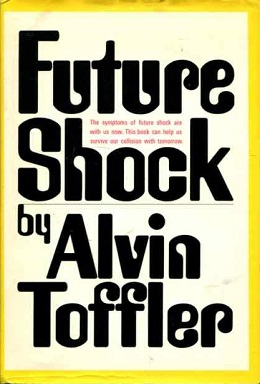
During the sixties, things seemed to be changing so rapidly that there was a sense that the future was collapsing in upon the present.  Alvin Toffler famously wrote about "future shock," which took the concept of "culture shock," which is based on traveling in space, and substituted time in its place, so that the future suddenly appearing in the present results in an effect similar to culture shock, a sense of alienation and disorientation.

Neil Postman, in his book of essays entitled Conscientious Objections, claimed to have coined the phrase, and perhaps Toffler took it from Neil, although it is also possible that he arrived at it independently.  Whatever the case may be, Toffler was the one who ran with the concept in his book of the same name:


I remember when this book came out in 1970, it appeared in paperback in four different colors, which I had never seen before.  That actually illustrated one of the trends contributing to future shock that Toffler identified, overchoice.

I remember being really wowed by this book when I was in high school, and seeing a film about it in my freshman Introduction to Communication Theory class.  When I got to graduate school, though, Toffler was dismissed as a derivative popularizer, in contrast to genuine seminal thinkers like McLuhan, Innis, Mumford, Ellul, Fuller, etc.  I haven't thought about it very much since, although I didn't forget that this book had an effect on me early on, and inspired me to continue to study media and technology, and time.

And I was delighted to see one of my friends on Twitter mention it today, and discover that that movie that was shown in my freshman class back in the fall of 1974 is on YouTube.  What's especially cool, and something I had forgotten over the decades, is that Orson Welles narrates and appears in the film.  Here's the write-up on YouTube:

This is a little known documentary based on the book Future Shock by Alvin Toffler.

See review here:
http://oddculture.com/2004/11/13/movi...

This movie came out in 1972 and features Orson Welles as the narrator. I was most amused by the high amount of paranoia in regards to the future... some of the segments (like people choosing their own skin color) are downright hilarious. Worth a look - at the very least for its historical value.

As far as I can tell, this documentary is in the public domain.


 It's carved up into five parts to fit YouTubes arbitrary limitations, but here it is, for you to view:


And there you have it, the shocking truth about the future, or the future past, or the past future, or the future that never was, or maybe it's Postman's other coinage, future schlock


Monday, November 2, 2009

Back in the Land of Baseball

So, I just got back from a week in India, where cricket is all the rage, as their national team was doing well against Australia.  I watched a little bit of it, having no idea of what was going on, and I have to say that it is good to be back in the land of baseball, even though this was a disastrous season for my New York Mets.


I'm not a Yankee hater, I just hate how the local media fawns over them and doesn't give my team equal coverage, even when they're doing well.  But I do think the Mets need a change in their minayacal front office.  Without really good pitching, in what sense is this a New York Mets team?


Ah, but no one wants to hear about the Mets right now.  I'd wish the Yankees luck, but I don't think they need it.


So instead, I want to refer you to a blog post by Ted Walker, who is a co-blogist of the blog called pitchers & poets.  The blog post is entitled Watching the Hero Walk Alone, Together: Ritual, Community, Power, and Baseball, and it's a nice meditation on the sport, it's intellectual qualities, and it's individualism.  And I say this not only because Ted makes reference to, and says nice things about my essay, "The Medium of Baseball," which was published in Take Me Out to the Ball Game: Communicating Baseball,; edited by Gary Gumpert and Susan Drucker (Cresskill, NJ: Hampton Press, 2002, pp. 37-70).

So, if you like baseball, go read Watching the Hero Walk Alone, Together: Ritual, Community, Power, and Baseball, leave a comment if you care to, and tell Ted that I sent you!

Thursday, October 22, 2009

My Yom Kippur Appeal

As a member of the Board of Trustees of Congregation Adas Emuno, I was called upon to deliver this year's Yom Kippur appeal.  For those of you unfamiliar with the concept, it's an appeal made to the members of the congregation for donations, and also for volunteers, but mainly for financial support to help make ends meet.

It's done of Yom Kippur because that's when the most people are in attendance, people who don't go to services all year come for Yom Kippur.  It's the big one in our religion.

I found it very gratifying to be able to put my experience as a writer, public speaker, and communication scholar as the service of my congregation in this way.  Given the state of the economy, donations had been down, and that made it especially important to deliver a strong appeal this year.  And I was very moved to learn last night at our Board of Trustees meeting that donations are already much better now, with a few more months to go before the end of the year, than they were last year at the end of December.  That means more to me than anything, I can tell you.  So anyway, here it is:


You Kippur Appeal

Whenever the subject of the Yom Kippur Appeal comes up, I have to force myself not to call it the Kol Nidre Appeal.  That's what it was called in the Reform Temple I went to when I was growing up, over in Queens, because the appeal was made during the Kol Nidre service on the eve of Yom Kippur.  I recall that it was always given by an older member of the congregation, which makes me wonder what I'm doing up here because it seems like just yesterday that I was that little kid.  And I remember them saying every year that the Kol Nidre Appeal is a silent appeal, which always puzzled me, because it always involved quite a bit of talking, sometimes for quite a length of time.  As a kid, I realized that adults often don't say what they mean, or don't say everything they mean to say, and eventually I came to understand that this silent business meant that no one would come out and ask for donations, that was what the little white envelopes were for.  Even in the years when my old Temple in Queens was facing severe financial hardships, that was not something that would be mentioned during the Kol Nidre Appeal, which always focused on the value and importance of Jewish identity, the Jewish religion, and specifically Reform Judaism and our congregation.  The Appeal did not ask for support, not for financial support, nor for volunteers to give of their time, effort, skills and services.  The speaker simply gave the reasons why we should support our congregation, and left it up to the audience to fill in the missing part of the message, that the Temple wanted, and in fact needed their support.
The Kol Nidre Appeal was a silent appeal in part because it would be crass to speak of such things in what used to be called polite society.  It was a silent appeal as well because in Jewish religious tradition we are not supposed to work or deal with money on the Sabbath or holidays.  And how much easier it would be if we could just pass around the hat, or collection plate, or set up a basket or bin.  But we don't do that.  It would also be easier if we could threaten you with eternal damnation in the fiery depths of hell.  But we don't do that.  And it would be easier if we could tempt you with visions of an eternal reward in heaven, especially one filled with the pleasures of feasting and frolicking.  But we don't do that.  Maybe I could just say something about the opportunity to get some good karma.  Karma, mitzvah, they're both Yiddish words, right?
Back when I was a kid, one topic that would come up now and again in the Kol Nidre appeal was the Holocaust.  Almost all of the adults present had lived through the Second World War, had had personal experience with anti-Semitism, and felt the threat of the Nazis even from afar.  Many of those present had escaped from Europe just before the war, and a number of congregants were Holocaust survivors, my parents among them.  Growing up in that milieu, in the shadow of such monstrous evil that had been directed specifically at our people, it was easy to summon up a sense of obligation, to agree that we must not let the light of living Judaism go out.  And we were reminded that it didn't matter if you were a member of a congregation or not, if you practiced or not, if you believed or not, even if you converted to Christianity, it didn't matter.  To the Nazis, a Jew was a Jew was a Jew, there was no escaping who you are, no escaping your identity, no ticket out of Auschwitz.  Like the prophet Jonah, we cannot run away, we cannot live in denial indefinitely, we have no choice then but to claim our birthright, like Isaac, like Jacob.
But the generation of survivors is dwindling, and with them the living memory of the Holocaust.  Time passes, new generations are born, wounds that may never heal can still grow less raw, less painful.  Memory, that may not fade entirely, grows less vivid, more distant.  We still live in a world marked by anti-Semitism, Holocaust denial, and threats to our very existence, but here in the United States we have grown very comfortable and secure, doors that once were closed to us are wide open now.  Where we once huddled close together for mutual protection, we now walk confidently alone in search of the American dream.  Earlier, I mentioned the word mitzvah, and I think that it is not a coincidence that this word, which means commandment, to us means good deed.  In other words, what was once understood to be an order, from on high, is now seen as an option.  And that is, in fact, what Reform Judaism is all about it's about making your own choice, as an individual, about what you believe or don't believe, making your own choice about what laws and rituals to observe and what not to observe, making your own choice about how to worship and how not to worship.  It's all about choice, which is a matter of freedom, which is what our nation founded upon, freedom for democracy, and what our tradition is founded upon, freedom from slavery in Egypt.
In Reform Judaism, we also speak of choice in respect to conversion, and we now  refer to converts to Judaism as Jews by Choice.  Conversion was relatively rare when I was a kid, this too has changed over the years, and our branch of Judaism has always been especially open and welcoming.  But the point I want to make to you is that all of us are now Jews by Choice.  We all have to make the active decision to be Jews, to live as Jews, to be a part of the Jewish community.  We all have to make the active decision to carry on our religious and cultural traditions, to provide our children with a Jewish education, to be members of a Jewish congregation.  If we didn't make these decisions, if we chose to do nothing, that too would be a choice.  It would be a choice to abandon who we are, not all at once, but little by little, a choice gradually to melt into this truly great society that we live in, a choice to fade from history like the fabled ten lost tribes of Israel.
It is not an easy choice to make.  There are so many distractions today, so many different voices competing for our time and attention.  There's so much shopping to do, so many wonderful things to buy, and have fun with.  And there's so much entertainment to watch and listen to, so many websites to surf, so many videogames to play.  As my old mentor Neil Postman put it, we are in danger of amusing ourselves to death.  But we are also working ourselves to death, because today we work harder and longer than anyone ever has, except for factory workers during the Industrial Revolution.  Our lives are full of obligations and assignments, and interruptions.  How do we decide what's important.  How do we decide what matters?  Maybe it helps to think about those times in our lives when everything grinds to a halt, when we have to drop whatever we're doing, when we have to focus on the moment at hand.  The death of a loved one is such an event, and where do we turn, for guidance and comfort?  The birth of a child is another such time, and where do we turn to celebrate that new life?  Marriage too is an occasion when all other activities are set aside, and where do we turn to consecrate that union.  Our rites of passage, the bar mitzvah and confirmation ceremonies, are also unique moments when time seems to stand still, moments that only occur in the context of a congregation such as ours.  These special times, when everything else gets put into perspective, when we are called out of our everyday lives and put in touch with the sacred, these are our best guideposts to knowing what is important.  We have an overabundance of almost everything, of consumer products, of activities, of demands.  But what we don't have an abundance of is meaning in our lives.  We search for meaning, we want to live meaningfully, but where do we go to look for meaning?  You can't find it by googling it.
We are all seekers, in one way or another, and our branch of Judaism is not so much about having the answers handed down to us from authority figures, as it is about working together to find our own answers.  And we are indeed fortunate here at Adas Emuno to have a spiritual leader who is so caring and compassionate, so dedicated, and talented as our Cantor.  With her help, our little shul is full of music and joy, comfort and enlightenment, learning and meditation.  And ours is a congregation where everyone has the opportunity to participate, everyone can take an active role, indeed, everyone is needed to lend a hand.  We are a do-it-yourself, open source congregation, but we also have the benefit of a fulltime spiritual leader, a thriving and outstanding religious school, an excellent location, and facilities that need some work, but are certainly adequate for our needs.  We are blessed here at Adas Emuno, but those blessings, like the fruit of the earth and vine, are the product of labor and investment on the part of many individuals, stretching back for many years.
My family joined Adas Emuno over a decade ago, when we moved to Palisades Park.  My son Benjamin had his bar mitzvah here a few years ago, which was an occasion of great happiness, and meaning.  But there was a touch of sadness too, because we thought that our daughter Sarah would never have the same opportunity, because Sarah, as many of you know, has moderate autism.  But Cantor Shapiro insisted that Sarah could have her own ceremony, and went out of her way to learn how to work with children with autism.  I have to tell you that we have heard numerous horror stories about congregations from all of the different religions being unwilling to allow autistic children to take part in ceremonies, including even the son of one congregation's rabbi.  What makes Congregation Adas Emuno special is that here we chose to include rather than exclude, and last April Sarah had a brief but very beautiful bat mitzvah ceremony.  It didn't have to happen, we had to choose to make it happen.  And from Sarah's bat mitzvah came the idea to hold a monthly Saturday afternoon service for children with developmental disabilities, the first one being this Saturday at 2 PM.  If you live in Northern New Jersey, chances are you know someone who has been touched by autism, and I hope you will let them know about this special Shabbat Meyuchad service.
Ours is just one of so many stories in this congregation.  When we came here, a decade ago, there was a family with children who were hearing impaired.  As a consequence of that, they started to use sign language in our religious school when they sang the Sh'ma.  That family has since moved away, but that gift, and it truly is a beautiful gift to see our children praying through such beautiful gestures, that gift remains.  Here, at Adas Emuno, you have a chance to make a mark, to make a difference, to make something meaningful, and lasting.
The new year that we are celebrating is called fifty-seven seventy, but have you stopped to think about what that means?  Five thousand, seven hundred and seventy years!  What does our calendar, the oldest one in existence, trace back to?  We know it's not the creation of the world, as was once believed.  But five thousand, seven hundred and seventy years ago, the first system of writing was being developed by the Sumerians in Mesopotamia.  This was the beginning of what has traditionally been called civilization, the first cities, and the first historical records, which could only be possible after writing is invented.  We live by a calendar as old as recorded history, as old as civilization.  We are the living links of a sacred chain that goes back to humanity's awakening.  The Jewish people emerge out of Mesopotamia about four thousand years ago, that's the story of how Abraham left the Mesopotamian city of Ur. When I think about how we search for meaning, how we look to be a part of something greater than ourselves, I think about those four thousand years, about being a part of the world's oldest community, about all of the people who came before us who chose to be a part of that community, and in doing so, chose to keep that community alive.  And I think about how we, each one of us, have to make the choice for ourselves, to chose whether the community continues on into the future, or comes to an ends here and now.  We each have to make that decision.
I think sometimes about all the times when I've been to a stadium or arena where people have done the wave.  You know what I mean, when people stand up and sit down in coordinated sequence, and it looks like a wave is passing through the stands, from one end to another.  And the funny thing is, each time the wave comes around, it doesn't really matter whether I myself stand up or remain seated, the wave keeps going regardless.  But other times, the wave dies out because too few people made the decision to stand.  Somehow, the wave is made up of all of our individual choices, it depends on all of our individual choices, and yet it is greater than all of our individual choices too.  We are part of the great wave of Jewish history, and our congregation is a little wave within that greater tide.  And being a little wave means that our decision to stand, or not to stand, makes a big difference.  We all have to choose to stand up and support our congregation to keep it going now, and to keep it going into the future.  This is my silent appeal to you.  And I ask that if you understand my appeal, if it rings true for you, that you respond, silently by standing now for Congregation Adas Emuno.


When I gave this talk, I finished, said Shana Tova (which means happy new year, Yom Kippur being the completion of the 10-day period that begins with Rosh Hashana, the Jewish New Year), and turned to go back to my seat (the board members were sitting up on the bimah so there'd be more room in the pews), and while I was walking back, everyone actually did stand up!  I didn't realize it until someone told me to turn around and look.  As I said, this really meant the world to me.


Wednesday, October 14, 2009

Time-Binds and Biases

So, I know I'm not blogging as much as I should be, but right now I'm working on my keynote address for the 67th Annual Conference of the New York State Communication Association.  You can read all about the event by heading over to their website, New York State Communication Association, but here's the deal.


The conference is on October 23-25, and it's in the Catskills, about an hour north of New York City.  NYSCA always has a great little conference, small and intimate, with meal plan included and meals taken together so there is lots of time to get to know each other and otherwise schmooze.  Neil Postman loved NYSCA, and was a great supporter of the organization, and James W. Carey was also part of the crew.


In fact, this year's conference theme was chosen, by conference organizer and NYSCA Vice-President Donna Flayhan, to honor Carey's memory:  Examining Ritual, Technology, and Community in This New Century.


John Durham Peters from the University of Iowa, author of the excellent book on communication, Speaking into the Air:  A History of the Idea of Communication, is one of the keynote speakers, and I am very much looking forward to hearing what he has to say, especially since his topic is "God and Google:  On Seeking in the Digital Era."  He'll be giving the Saturday night keynote.


As for the Friday night keynote, well, c'est moi.  I know, I know, they must be pretty hard up to have to resort to me, well, what can I say?  My title is, "On the Binding Biases of Time."  And as the title suggests, Alfred Korzybski and general semantics, and Harold Innis and media ecology will be a part of it.  James Carey too.


I'll also be chairing a couple of sessions, one on general semantics, one on media ecology.  And I'll be participating on a session devoted to poetry!


Hey, NYSCA is relatively affordable, and always a great time, so come join us if you can.


And, ok, as a bit of a teaser, here is an excerpt from my address (still in draft form and subject to change): 


Korzybski was wounded as a Polish soldier in the Russian army during the First World War, and went on to publish Manhood of Humanity in 1921, Science and Sanity in 1933, and found the Institute of General Semantics in Chicago in 1938. Harold Innis was wounded as a Canadian solider in the British army during the First World War, earned his PhD from the University of Chicago in 1920, and went on to teach at the University of Toronto, where he became Canada's leading economist. The parallels are interesting, but as far as I can tell, they never met or communicated with one another. Innis published several books on the subject of Canada's political economy during the twenties, thirties, and forties, and did not turn his attention to the study of communication until after the Second World War. It was not until 1950, the year that Korzybski died, that Innis published Empire and Communications, followed the next year by The Bias of Communication, and then by Changing Concepts of Time, published in 1952, the year that Innis died. And it was in The Bias of Communication in particular that Innis discussed the biases of time, and space. Whereas Korzybski was concerned with the question of what distinguishes humanity from other forms of life, Innis was concerned with the question of what distinguishes one type of human society from another. And whereas Korzybski brought an engineer's concern with work and energy to the study of time, Innis brought an economist's concern with raw materials and staples; if time is energy to Korzybski, the media by which we communicate over time is akin to coal and oil to Innis.

So, if that hasn't scared you off, and you have the time and means, I hope to see you there!  If not, well, I'll let you know how it went.  In time.


Monday, October 5, 2009

He's Making a List...

A bit early for a Christmas post?  That's okay, I don't really do Christmas.  In fact, this post is about something that occurred to me during Rosh Hashanah services at Congregation Adas Emuno not too long ago.  Rosh Hashanah, that's the Jewish New Year, at which time we say:  May you be inscribed in the book of life for the coming year.  It's actually a fascinating metaphor, if you think about it.  In this conception of the divine, God writes down in his book everything that's going to happen to us.  It's all recorded (but not finalized, or sealed, until Yom Kippur).  This complements the idea that God records everything we do, keeps track of it all, and punishes or rewards us accordingly.  A popular Christian corollary is that when you get up to heaven, St. Peter is there at the pearly gates with his book, examines the records of everything you've done, and then informs you of whether you gain admittance to your eternal reward, or are damned to the fires of Hell (or have to endure the interzone of purgatory).  And of course the popular image of Santa Claus is that he too is keeping track of good and bad deeds, at least among children, making a list, checking it twice, gonna find out who's naughty or nice...

The point I'm getting at is that in a literate culture, we are afraid of (at least concerned about) what's being recorded.  The written word is a visual form, and with it comes the notion of divine surveillance.  And literacy facilitates high-level abstractions, so we imagine total surveillance by an all-knowing, all-seeing omnipresent God, and divine record-keeping that accounts for everything that we do.  In contrast, in oral cultures, the anxiety is whether you are being heard or not, whether your deeds go unsung.  The gods are fallible (and sometimes crazy) and can easily miss what you're doing, but that means it's also possible to trick the gods--you might even fool mother nature!

And now that we're in an electronic culture?  Well, there may be a sense that everything we do becomes data that's entered into the heavenly memory banks, but it's not so much about judgment as it is an automatic process--call it karma, which is essentially gigo, the computing acronym that means garbage in, garbage out.  So as for God, it's like he's TiVOing us, but will he ever get around to actually watching what he recorded?  The fear today, then, is that (along the lines of Martin Buber's Eclipse of God) we lost our divine audience (or never had one to begin with)!

Sunday, October 4, 2009

To Blog or Not to Blog

To blog or not to blog, that is the question.  Sort of, maybe.  It's not that I've abandoned Blog Time Passing, or run out of things to write about.  It's just a matter of my being worn out after the conference, and with tons of stuff to catch up on.  This is a very busy semester for me, so I hope you will bear with me, I will try to be a better blogger.   Be a better blogger.  Let me try saying that ten times fast...

Be a better blogger
Be a better blogger
Be a bletter bogger
Be a bletter bogger
Be a blegger botter
Be a blegger botter
Be a beggar blotter
Be a beggar blotter
Be a booger beater
Be a booger beater

Okay, something more substantial, next time, soon, I promise...