Friday, July 14, 2017

Post Truth, Alternate Facts, & Fake News

Given my previous post, Information Overload vs. Facts and Truth, and more importantly, given all that's been going on over the past year and more, it is only fitting that I share here on Blog Time Passing a panel discussion that I organized on behalf of the New York Society for General Semantics (which, as you may recall, I have been serving as president of for the past year and more).  

Here's the write-up as it appears over on the NYSGS site:

On February 8th, we held a panel discussion on the theme of post-truth, alternate facts, and fake news, all subjects of great interest within the discipline of general semantics, and issues that general semantics can help to solve. These three relatively recent coinages may be viewed as symptoms of a larger concern that our culture is in crisis, making this particular topic especially vital to try to understand.

Participants on this background hailed from a variety of backgrounds, making for an especially lively and insightful discussion about science, journalism, philosophy, and language. Here is the list of panelists:

Babette Babich, Professor of Philosophy, Fordham University

Peter Brown, Science Writer and former Editor-In-Chief of The Sciences, and Natural History, and member of Scientific American's Editorial Board.

Katherine Fry, Professor of Media Studies and Chair of the Department of Television and Radio, Brooklyn College, City University of New York

Paul Thaler, Professor of Communications, Adelphi University

Moderator: Lance Strate, NYSGS President & Professor of Communication & Media Studies, Fordham University

And here is the description of the program:

Post-Truth, Alternate Facts, & Fake News:

Our Culture in Crisis

On November 8th of last year, Election Day in the United States, Oxford Dictionaries announced its word of the year: post-truth. The selection represents a response to both the American presidential election campaign and Great Britain's Brexit vote.

Over the past year, the phrase fake news has also been frequently invoked, especially in regard to online communications and social media.

On January 22nd of this year, Counselor to the President Kellyanne Conway used the phrase alternate facts during a Meet the Press interview.

Modern science and journalism both are based on the ideal of objectivity, that we can gather data about our environment, examine the evidence available to us, and evaluate facts and claims regarding reality. General semantics is based on the understanding that scientific method can be applied to human communication, thought, and action, to the benefit of individuals, and humanity as a whole.

There is nothing new, however, about the idea that we have lost all sense of cultural coherence, that we are subject to all manner of Orwellian doublespeak, or that public discourse has been trivialized by an emphasis on sensation and amusement.

But, have we turned a corner over the past year, as the emergence of terminology like post-truth, alternate facts, and fake news might seem to suggest? Have we reached a crisis point in our culture regarding the role of rationality and reality-testing? Are we on the verge of the kind of dystopian society commonly depicted in so many of our recent young adult novels?

Or is there hope? And are there ways of coping and strategies for fighting for the future that can be adopted by writers, journalists, educators, and citizens?

 And yes, the session was recorded, we have the video, it's over on YouTube if you prefer watching it over there, or you can just scroll on down and watch it right here:


A fascinating discussion, if I do say so myself, and one every bit as relevant half a year later, if not more so!

Thursday, July 13, 2017

Information Overload vs. Facts and Truth

So, back on April 14th, I was the main guest on Connecticut's public radio program, Where We Live, for an installment entitled Information Overload: Finding The Facts And Knowing The Truth In The Digital Age, hosted by David Desroches and produced by Jeff Tyson. 

I've been on the program several times in the past, courtesy of producer Catie Talarski and former host John Dankowsky, but this was the first time in a while, with David Desroches filling in as host, and with producer Jeff Tyson as my primary contact. It was also the first time that I did my part from the WFDU studio at Fairleigh Dickinson University's Teaneck, NJ campus (where I used to teach courses for their MA program in Media and Professional Communication). 

Here's the write-up on the program from their website:


Ever since the Presidential election we’ve heard the buzzwords—“echo-chamber,” “facts,” “alternative facts.” More than ever our country is divided by how we get our information and what we see as the “truth.” Even reality itself has become debatable.

What’s the difference between a fact and the truth? And if people can’t agree on what a fact is, what does that mean for a democratic society?

This hour, we tackle big questions with big thinkers in the age of digital news.

We try to understand just how the complex world of information we live in today has evolved. And we explore how critical thinking and news literacy can help us wade through information overload.

Has the internet and social media shaped the way you understand truth? Or, how about your understanding of what’s real or fake?

Unfortunately, I can't embed the sound file here on Blog Time Passing, but you can go on over to their site to listen to the 49 minute program. Some of the content may be familiar to folks who know me, and/or general semantics and media ecology, but this is more of an interactive format, and there's always something new that emerges out of these events.


Tuesday, July 4, 2017

Fear and Hope on the Fourth of July

Just in time for our Independence Day, I thought I'd share my latest op-ed for the Jewish Standard. The title as it originally appeared in the June 30th issue, is Fear and Mostly Hope on the Fourth of July (the "mostly" having been added by the editor to give my piece a more positive spin). So anyway, here it is, fireworks (metaphorically speaking) and all:


It was the summer of 1974, I had just graduated high school and was looking forward to starting my first year of college in the fall, and I had been accepted into a special summer program called Torah Corps, sponsored by what was then known as the Union of American Hebrew Congregations, now the Union for Reform Judaism. It was an intensive learning experience for a small group of students, all of whom had just completed 10th, 11th, or 12th grade. Most of us were from the United States, but the group also included several students from Canada.

The program was held at a lodge in Littleton, New Hampshire, and I well recall how we all gathered around the lone television set available to us on the night of August 8 to watch President Richard Nixon deliver a speech to the nation. We knew that he was in trouble over the Watergate scandal, but it still came as a tremendous shock when he uttered the words, “I shall resign the presidency effective at noon tomorrow.” We vocalized our sense of dismay at this unprecedented development collectively, through gasps and cries and the like. At least those of us who were Americans did so, in response to what we perceived to be a somber and tragic event. But in a somewhat irreverent manner, one of the Canadians started to say, “Yitgadal v’yitkadash…”

Reciting the first few words of our Mourner’s Kaddish did succeed in breaking some of the tension of the situation and injecting a note of humor. But many of us were not amused. There is a time to weep and a time to laugh, and this was a time to shed a tear, not for Nixon himself but for the way in which he had tarnished the institution of the presidency and tried to undermine the democratic process.

And yet, somehow, we survived Watergate and moved forward as a nation. Just as we had survived the assassination of John F. Kennedy 11 years earlier. Apart from the loss of idealism and proliferation of conspiracy theories, some commentators started to point to historical parallels between the United States, characterized at that time by the intensifying social and political unrest of the 1960s, and the decline and fall of the Roman Empire. This especially was the case after the assassination of Robert F. Kennedy in 1968 at the hands of a Palestinian immigrant, Sirhan Sirhan, just two months after the Rev. Martin Luther King Jr. was assassinated by a white supremacist, James Earl Ray.

The decades that followed certainly were not free from scandal. Ronald Reagan gave us Iran-Contra and Bill Clinton was impeached for lying about the Monica Lewinsky affair, narrowly avoiding a conviction and removal from office. But neither event seemed to threaten the viability of the American republic as a whole, and in between we witnessed the sudden collapse of the Communist bloc, first in Eastern Europe and culminating with the dissolution of the Soviet Union.

The end of European Communism came about so quickly that it seemed almost unbelievable. We celebrated the fall of the Berlin Wall and the coming of freedom and democracy to Russia, and presumably to the other former Soviet republics (prematurely in some cases). Some wondered what would happen to the United States without its one-time adversary serving as a foil and contrast. And some even wondered if the sudden collapse of the Soviet Union might be followed by an equally sudden collapse of the West at a later date.

But for the most part, we emitted a collective sigh of relief at what some philosophers referred to as the end of history, that is, the triumph of liberal democracy.

But we also live with a historical consciousness that has been rare in human history. As the late Elizabeth Eisenstein explained, the ready availability of books, pamphlets, and periodicals, made possible by the printing revolution that began in the 15th century, eventually resulted in widespread awareness of the chronology of calendar time. (Calendars also were produced by printing.) Especially starting in the 19th century, more and more people came to recognize and understand their place in world history. As limited as the historical knowledge of the average American may be, everyone learns about the years 1492 and 1776. And we study history in grade school, and learn about our Civil War, and other events such as the impeachment of Andrew Johnson, the scandals associated with the Ulysses S. Grant administration, and the Teapot Dome scandal during Warren G. Harding’s presidency.

At a time when we are witnessing an unprecedented number of scandals and improprieties associated with the White House, and the election of Donald J. Trump has been described by some as an extinction level event for American democracy, history may offer some solace by reminding us that our republic has weathered many storms in the past. And on this Fourth of July, at a time when many of us fear for the future of our country, I think it only fitting to recall the fact that we have survived the legal, moral, and ethical failings of more than a few of our elected officials, and that we have done so while expanding civil liberties, human rights, and the rule of law.

Taking the long view of American history gives us cause to be optimistic. At the same time, taking the much longer view of Jewish history can provide a somewhat different perspective, as we have seen the great nations and empires of the past come and go over the millennia. We, the Jewish people, have seen the rise and fall of great powers, and from that deep historical consciousness we know that nothing in the temporal realm lasts forever, not even the American republic that we love so much. And so, we cannot so easily dismiss the possibility that the end is nigh. Or the understanding that we just don’t know when the end might come, or if it might come as suddenly as it did for the Communist bloc and the USSR.

Once, long ago, I attended a lecture given by a major scholar and intellectual, and during the question and answer session, he was asked if he was optimistic or pessimistic about the future. His answer stuck with me, because it expresses my own sense of ambivalence. He said that on Mondays, Wednesdays, Fridays, and Sundays he was an optimist, and on Tuesdays, Thursdays, and Saturdays he was a pessimist. Or was it the other way around?

Either way, for this Fourth of July, I think it only fitting to be an optimist, and to underscore the resilience of our republic. We have seen dark times in the past, and survived, and if we the people are willing and able, and with the help of divine providence, our great Enlightenment experiment will continue for generations to come.

May it be so.


Thursday, June 29, 2017

Media Literacy and Media Ancestry

So, last year media literacy maven Renee Hobbs published an anthology she edited entitled, Exploring the Roots of Digital and Media Literacy Through Personal Narrative through Temple University Press. The volume includes a chapter I wrote for Renee on Marshall McLuhan, in case you were wondering. Here's the write-up for the volume:


Exploring the Roots of Digital and Media Literacy through Personal Narrative provides a wide-ranging look at the origins, concepts, theories, and practices of the field. This unique, exciting collection of essays by a range of distinguished scholars and practitioners offers insights into the scholars and thinkers who fertilized the minds of those who helped shape the theory and practice of digital and media literacy education.

Each chapter describes an individual whom the author considers to be a type of "grandparent." By weaving together two sets of personal stories⏤that of the contributing author and that of the key ideas and life history of the historical figure under their scrutinymajor concepts of digital media and learning emerge.

And here is the Table of Contents:

Introduction ■ Renee Hobbs

1 Historical Roots of Media Literacy ■ Renee Hobbs
2 David Weinberger on Martin Heidegger ■ David Weinberger
3 Lance Strate on Marshall McLuhan ■ Lance Strate
4 Dana Polan on Roland Barthes ■ Dana Polan
5 Cynthia Lewis on Mikhail Bakhtin ■ Cynthia Lewis
6 Srividya Ramasubramanian on Gordon Allport ■ Srividya Ramasubramanian
7 Michael RobbGrieco on Michel Foucault ■ Michael RobbGrieco
8 Gianna Cappello on Theodor Adorno ■ Gianna Cappello
9 Douglas Kellner on Herbert Marcuse ■ Douglas Kellner
10 Henry Jenkins on John Fiske ■ Henry Jenkins
11 Amy Petersen Jensen on Bertolt Brecht ■ Amy Petersen Jensen
12 Donna E. Alvermann on Simone de Beauvoir ■ Donna E. Alvermann
13 Jeremiah Dyehouse on John Dewey ■ Jeremiah Dyehouse
14 Renee Hobbs on Jerome Bruner ■ Renee Hobbs
15 Vanessa Domine on Neil Postman ■ Vanessa Domine
16 Peter Gutierrez on Scott McCloud ■ Peter Gutierrez
17 Susan Moeller on Roland Barthes ■ Susan Moeller

Epilogue ■ Renee Hobbs

And you may notice that the title of each chapter follows a strict formula, so I want to stress that this was not a bit of narcissism on my part. In fact, the title I had given for my essay, not knowing that it would take this final form, was, "The Medium, the Message, and Me: Marshall McLuhan and Media Education" (just so you know).

By the way, Renee's Introduction to the volume can be read online on the Temple University Press's website. And of course the book itself is available for purchase there, and on Amazon:


************************************

And just recently, Renee launched a website entitled Grandparents of Media Literacy that you might want to go check out. Here's the welcome message:


Welcome to the Grandparents of Media Literacy website! You can explore the many people who have influenced the field of media literacy through their work, ideas and creative contributions. These intellectual grandparents may come from fields including philosophy, sociology, literature and more. You can contribute to the website by uploading information about an author, scholar or creative individual whose work influenced your own. You can also share your own story of how an intellectual grandparent influenced your work in media literacy.


And here is some further explanation of the site:


A CROWD-SOURCED NARRATIVE APPROACH TO INTELLECTUAL HISTORY

Reflect on your experience with media, technology, society and culture and think about the writers, artists, filmmakers and others who have influenced your work in media literacy. People with interests in media literacy come from a variety of fields, including writing and composition, media psychology, literacy education, technology in society, sociology, cultural studies, media studies, and communication arts. As an transdisciplinary topic, media literacy scholars and practitioners do not all share the same foundational knowledge. We do not all rely on the same canonical texts that "tell the story" of our shared values and beliefs.

Personal storytelling can help people discover how we have been influenced by the generation of scholars and thinkers who came before us. Anyone can upload an intellectual grandparent, providing information about their work that will enable readers to understand their key ideas and contributions. Anyone can share a story about any grandparent, explaining "how they influenced you." Through this website, we aim to discover threads of previously overlooked connection to understand the subjectively-experienced history of media literacy education around the world.


So, anyone can sign up, log in, and leave their comments and stories. As one of the contributors to the anthology, there's a page already set up for me. Not the best photo of me, but what can you do? And there's an excerpt from my chapter that can be found under the profile set up for McLuhan, along with any other comments left by others (as of this writing, there's one other comment on McLuhan). It can also be found on my page, under "Stories" and, why not, right here as well:


The experience of suddenly getting McLuhan has been described as akin to a religious experience by some or in more general terms as an epiphany; to use a term popular during the sixties, I was able to grok McLuhan (grok was coined by the science-fiction writer Robert Heinlein in his novel Stranger in a Strange Land to refer to an extreme form of understanding and empathy). In visual terms, it was the kind of experience depicted in comic strips of a light bulb being switched on over a character’s head, which would certainly be fitting, given that McLuhan argued that electric technology and electronic media constituted the basis of a revolution that was reversing the course of some three millennia of Western civilization.

Television was the specific electronic medium that had pushed our culture over the edge, he argued, and one of the characteristics of television was its low resolution image, which McLuhan compared to that of the printed cartoon, which elevated the comics medium in importance (see Scott McCloud’s insightful, McLuhan-inspired graphic nonfiction, Understanding Comics [1993]).

This idea had no small significance for me because I had been reading comics since before I could read (my parents read them to me), despite the fact that the hybrid medium was often disparaged by teachers and others arguing in defense of elitist literary culture. The fact that comics crossed—or, if you like, transgressed—the boundary between literate and pictorial media contributed to my own developing awareness of differences among media, differences in their biases towards different types of content, differences in their effects on the ways we think, feel, act, perceive, and organize ourselves, differences that McLuhan famously summed up by saying, “The medium is the message” (1964, p. 7).

The image of a light bulb turning on is a visual metaphor for an idea (the word is derived from the Greek term for seeing) and perhaps the most basic way of describing the effect of my reading The Medium Is the Massage was that I was suddenly able to see the world from an entirely new perspective (in addition to being a field or intellectual tradition, media ecology has often been referred to as a perspective, although I prefer to use approach in order to avoid the visual metaphor). Or, to invoke Aldous Huxley’s well-known phrase, used to describe his experiments with hallucinogens, the “doors of perception” suddenly opened for me. The reference to perception is particularly significant because McLuhan’s specific approach to media ecology emphasized the primary role that sensory organs play in our thought processes.

Although there are differences between media literacy and media ecology, there is some significant overlap, as can be seen by the inclusion of Neil Postman as well as Marshall McLuhan in the anthology, as well as comics creator and theorist Scott McCloud. And depending on who you ask, other "grandparents" such as Heidegger, Barthes, Bakhtin, Foucault, Brecht, Dewey, and Bruner would also be characterized as media ecologists (not that anyone on that list would necessarily be excluded). 

The Grandparents website itself is an interesting experiment in fostering participation in this project, and perhaps exploring possibilities for a second edition or volume of the anthology. So I would certainly recommend it to you, to at least go take a look, and maybe even sign up, log on, and share your stories.


Friday, June 9, 2017

Trump, McCarthy, and the Art of the Pseudo-Event

I've been thinking lately about Daniel Boorstin, and how well his discussion of pseudo-events, a term he coined, applies to the contemporary political scene. In a sense, the concept of the pseudo-event presages that of fake news, but it's not the news that is fake when it comes to pseudo-events, but rather the event that the news supposedly reports on.

Boorstin's argument is that the introduction of steam-powered printing, as opposed to printing presses powered by hand, made it possible to produce mass circulation papers that could be manufactured cheaply, hence the penny press, and could be distributed on a daily basis. So the technology was in place for the daily newspaper, but the problem was that there just wasn't enough news to fill the papers day after day after day.

For this reason, Boorstin argues, newspapers shifted from news gathering to news making, from relying solely on events that actually occurred in reality, that would have occurred regardless of whether they were reported on or not, to events that were manufactured solely for the purpose of providing content for the media, events that therefore were not real or true events, but pseudo-events.

  Pseudo-events include the interview, the publicity stunt, the press release, the press conference, the background briefing, trial balloon, and news leak. These provide content for the news media, but based on nothing that actually happened in the world. Boorstin notes that pseudo-events are designed to be dramatic, vivid, easy to disseminate and to digest (although also quite ambiguous as to their meaning, but that adds to their interest and intrigue), because they are specifically designed to be reported on or appear on the news media, whereas real events are not. He also notes that pseudo-events spawn other pseudo-events in geometric fashion, as an interview, for example, will lead to further discussion and interviews, etc.


This is a very quick and cursory summary, so let me take this opportunity to encourage you to read the book Boorstin wrote on this subject, The Image. The original version, published way back in 1961, was entitled The Image or What Happened to the American Dream, but a revised edition was published in 1978 with the new title, The Image: A Guide to Pseudo-Events in America


..........................................


This book is essential reading for anyone interested in media ecology, and apart from the topic of news, Boorstin also discusses the shift from heroes to celebrities (something I've written about), from travel to tourism, and other topics related to a loss of authenticity and coherence. Much of it is a conservative critique, but one that is more often than not right on target, and forms the basis of others that followed, including Neil Postman's Amusing Ourselves to Death.


So, there is no question that Trump, as a celebrity, is a human pseudo-event, but also someone highly skilled at publicity, which is to say, at manufacturing pseudo-events and manipulating the press. This has been the case for decades, but what seems especially relevant now is the way that he used Twitter as a candidate, and uses it now as president, as a kind of instantaneous press release. And every tweet has been treated by the news media as if it were a singular event requiring attention and analysis.

And in thinking about that, Boorstin's discussion of Senator Joseph McCarthy just recently jumped out at me. I think the parallels are quite clear, and altogether stunning (and if you don't know who McCarthy was or don't know much about him, no judgment, it has been a long time now, I've linked his name above to the Wikipedia entry on him, and please go take a look).


So let me turn now to Dr. Boorstin, and consider what he had to say:


... it is possible to build a political career almost entirely on pseudo-events. Such was that of the late Joseph R. McCarthy, Senator from Wisconsin from 1947-1957. His career might have been impossible without the elaborate, perpetually grinding machinery of "information" ... And he was a natural genius at creating reportable happenings that had an interestingly ambiguous relation to underlying reality. Richard Rovere, a reporter in Washington during McCarthy's heyday recalls:


He knew how to get into the news even on those rate occasions when invention failed him and he had no unfacts to give out. For example, he invented the morning press conference called for the purpose of announcing an afternoon press conference. The reporters would come in—they were beginning, in this period, to respond to his summonses like Pavlov's dogs at the clang of a bell—and McCarthy would say that he just wanted to give them the word that he expected to be ready with a shattering announcement later in the day, for use in the papers the following morning. This would gain him a headline in the afternoon papers: "New McCarthy Revelations Awaited in Capital." Afternoon would come, and if McCarthy had something, he would give it out, but often enough he had nothing, and this was a matter of slight concern. He would simply say that he wasn't quite ready, that he was having difficulty in getting some of the "documents" he needed or that a "witness" was proving elusive. Morning headlines: "Delay Seen in McCarthy Case—Mystery Witness Being Sought."

 I'm not sure I want to characterize Trump as a genius, but this seems so very similar to the ways in which Trump has masterminded the process of getting the attention of the news media, often in attempts to distract from other less favorable news items. The ambiguity characteristic of pseudo-events is very much a part of this process, as an inordinate amount of time and space is devoted to trying to figure out what his tweets mean, whether they're to be taken literally or figuratively, whether they represent policy, or simply what the hell covfefe means.

The really perverse part of all this is the ways in which journalists are manipulated to serve the politician's ends, despite their own best intentions. Let's read a little more of what Boorstin has to say about McCarthy:

 He had a diabolical fascination and an almost hypnotic power over news-hungry reporters. They were somehow reluctantly grateful to him for turning out their product. They stood astonished that he could make so much news from such meager raw material. Many hated him; all helped him. They were victims of what one of them called their "indiscriminate objectivity." In other words, McCarthy and the newsmen both thrived on the same synthetic commodity.

Senator McCarthy's political fortunes were promoted almost as much by newsmen who considered themselves his enemies as by those few who were his friends. Without the active help of all of them he could never have created the pseudo-events which brought him notoriety and power. Newspaper editors, who self-righteously attacked the Senator's "collaborators," themselves proved worse than powerless to cut him down to size. Even while they attacked him on the editorial page inside, they were building him up in front-page headlines. Newspapermen were his most potent allies, for they were his co-manufacturers of pseudo-events. They were caught in their own web. Honest newsmen and the unscrupulous Senator McCarthy were in separate branches of the same business.
And that business is entertainment, as Postman would point out. And this is where we really need to take our journalists to task as collaborators. They were seduced by the higher ratings they gained by reporting on Trump, when what they really needed to do during the election was to stop reporting on him so much of the time with no valid justification, stop giving him so much attention for no real reason, stop feeding the beast. The constant mentioning of his name, the continual focus on his candidacy, reinforced his image as an important figure, and therefore as someone who could legitimately become president. Journalists simply could not help themselves, but all that coverage, even when it was not positive, helped him much more than it hurt him.

So now, we have a human pseudo-event as president. I guess you could say that what we have now, I am sorry to say, is a pseudo-president. And, what else is there to say but that what we have now is the triumph of the image.


Thursday, June 1, 2017

On Media Ecology Books and Book Series

In my previous post, A Good Causality, I neglected to mention that our new co-edited anthology, Taking Up McLuhan's Cause: Perspectives on Media and Formal Causality, was published as part of the UK publisher Intellect's new book series on media ecology, which is being edited by my friend and fellow media ecologist Phil Rose. 

This represents the third book series devoted to the field of media ecology to have been launched. The first one, which I proposed and was supervisory editor for, came courtesy of Hampton Press, back circa 1994-1995. After publishing many books in the series for well over a decade, Hampton decided to stop publishing new books of any kind, the owner was essentially retiring, so although the books that were published would continue to be sold, this essentially brought the series to a close.

For several years, there was no active book series devoted to media ecology, and I have to credit Phil Rose for the push to find a new publisher to start one up. It was at his urging that, following the successful publication of Amazing Ourselves to Death, that I proposed a new book series to my publisher, Peter Lang, which was accepted with the title, "Understanding Media Ecology" (that's a title I was going to use for a book of my own, but Peter Lang wanted to distinguish the new series from the old Hampton Press series, and like that title, so I gave it up).

So far, three books have been published in the Peter Lang Series: the second edition of Bob Logan's Understanding New Media: Extending Marshall McLuhan; Bob's collaboration with Marshall McLuhan that had never been published, with additional material updating it for the contemporary media environment, The Future of the Library: From Electric Media to Digital Media; and Dennis Cali's attempt to produce a media ecology textbook, Mapping Media Ecology: An Introduction to the Field.


........................ 


The next book in the series is one that is very near and dear to my heart, and is already listed for pre-order:

........................

But more on that when the time comes...

In the meantime, as I mentioned, Phil Rose was also able to successfully propose a new media ecology series for Intellect, and Taking Up McLuhan's Cause was the first book published in the series, and hard on its heals was another anthology, this one edited by Phil, entitled Confronting Technopoly: Charting a Course Towards Human Survival. The term technopoly was coined by Neil Postman, and the book follows up on his major media ecological work, Technopoly: The Surrender of Culture to Technology.

.................................

As you can see, this second offering from Intellect is also, unfortunately, only available in hardcover, and priced for library sales. In any event, here is the blurb describing the collection:


In 1992, Neil Postman presciently coined the term “technopoly” to refer to “the surrender of culture to technology.” This book brings together a number of contributors from different disciplinary perspectives to analyze technopoly both as a concept and as it is seen and understood in contemporary society. Contributors present both analysis of and strategies for managing socio-technical conflict, and they also open up a number of fruitful new lines of thought around emerging technological, social, and even psychological forms.


And here are the contents (you'll probably notice a familiar name early on):


Introduction: The Question Concerning Technopoly
Phil Rose
 
Part I: Contextualization 
Chapter 1: Contextualizing Technopoly
Lance Strate
 
Part II: Digital Manifestations  
Chapter 2: The Omnipresent Opiate: Rethinking Internet Addiction in the Network Era
Ryan S. Eanes
 
Chapter 3: Probing the Media Ecology of Self-Tracking Technologies:  A Postmanist Critique and Defence
Yoni Van Den Eede
 
Chapter 4: Navigating the Mobile Village
Zack Stiegler and Nick Artman
 
Chapter 5: Insolent Networks: The Auto-Mated Social Life
Gary Kenton
 
Part III: Ideology and Geopolitical Considerations  
Chapter 6: Striking Symbols: Re-Sounding Words from Leonard Cohen to Neil Postman
Ruthanne Wrobel
 
Chapter 7: Jane, Stop This Crazy Thing! The End of Progress and the Beginning of a Third Way
Arthur W. Hunt III
 

Chapter 8: Divinizing Technology and Violence: Technopoly, the Warfare State, and the Revolution in Military Affairs
Phil Rose
 
Chapter 9: Posthuman Postmanism: Confronting Technopoly with Deep Media Ecology
Niall Stephens
 
Part IV: Confrontations: From Education to Liberation  
Chapter 10: Postman’s Hope: Rethinking the Role of Education in Technopoly
Ellen Rose
 
Chapter 11: The New Social Media Curriculum: Confronting Technopoly with Education
Geraldine E. Forsberg
 
Chapter 12: Black Mountain College: Experiments in Form
Michael Plugh
 
Chapter 13: The Arts of Liberation in the Age of Technopoly
Edward E. Tywoniak


A very nice collection of work indeed, and an important addition to the media ecology literature. It may be too much for most folks to buy, but again, maybe you can beg, borrow, or steal a copy!


Wednesday, May 31, 2017

A Good Causality

So, while I'm on the subject of books published relatively recently, as per my previous post, Mandarin McLuhan and Media Ecology, I would like to share with you the publication of an anthology that I co-edited along with my media ecology colleagues, Corey Anton and Bob Logan.


But first, let me remind that back in 2011, in conjunction with NeoPoiesis Press, I helped to get Media and Formal Cause by Marshall and Eric McLuhan published. It is, of course, required reading for any card carrying media ecologist, and on the off off chance you don't have a copy, well, here:


ºººººººººººººººººººº ºººººººººººººººººººº


You can also read my posts here on Blog Time Passing introducing the book back in 2011, Media and Formal Cause and Media and Formal Cause in Effect!, and see also Artforum Informs that Media and Formal Cause is 1 of the 10 Best of 2011 why don't you? 

Now then, this little book was considered such a big breakthrough in understanding McLuhan, and providing a new way of understanding our understanding of media, and the kinds of media effects we tend to be concerned with in the field of media ecology, that it generated a great deal of interest and ferment in the field.

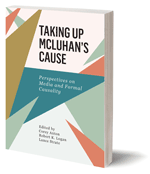
For some, it meant a retrieval of Aristotelian metaphysics, for others a link back to Thomas Aquinas and Thomist philosophy, and for some a link forward to systems theory and the concept of emergence. And given all the interest that has been generated, a follow-up volume was inevitable, hence the anthology we co-edited, Taking Up McLuhan's Cause: Perspectives on Media and Formal Causality (do you like the pun in "taking up McLuhan's cause"? I came up with it).


The anthology is published by Intellect out of the UK, and distributed in the US by the University of Chicago Press Here's the blurb that goes with it:

This book brings together a number of prominent scholars to explore a relatively under-studied area of Marshall McLuhan’s thought: his idea of formal cause and the role that formal cause plays in the emergence of new technologies and in structuring societal relations. Aiming to open a new way of understanding McLuhan’s thought in this area, and to provide methodological grounding for future media ecology research, the book runs the gamut, from contributions that directly support McLuhan’s arguments to those that see in them the germs of future developments in emergent dynamics and complexity theory.


And here is the listing of the books contents:


Foreword
Eric McLuhan
A Trialogic Introduction
Robert K. Logan, Corey Anton, and Lance Strate
Chapter One: The Form of Things to Come: A Review of Media and Formal Cause
Corey Anton
Chapter Two: McLuhan, Formal Cause and the Future of Technological Mediation & Postscript
Corey Anton
Chapter Three: Medium as ‘Metaform’: An Inquiry into the Life of Forms
Paolo Granata
Chapter Four: From Aristotle via Aquinas: Understanding Formal Cause in Marshall McLuhan’s Philosophy
Laura Trujillo Liñán
Chapter Five: The Effects That Give Cause, and the Pattern That Directs
Lance Strate
Chapter Six: McLuhan and Causality: Technological Determinism, Formal Cause and Emergence
Robert K. Logan
Chapter Seven: Formal Cause: McLuhan’s ‘Objective Turn’?
Yoni Van Den Eede
Chapter Eight: Forms of Causality
Chad Hansen
Chapter Nine: Anti-Environmental Art and Its Role in Making Formal Cause Visible
Steve Reagles
Chapter Ten: Of Memes, Modes, Minor Audiences and Formal Cause
Eric S. Jenkins
Chapter Eleven: After Effects, Before Causes: Technique, Artistic Intent and Formal Causality
Kirk Zamieroski
Chapter Twelve: Re-Cognizing Formal Cause
Peter Zhang
Chapter Thirteen: Disrobing the Probe, Unpacking the Sprachage: Formal Cause or the Cause of Form Reframing McLuhan and the Kabbalah
Adeena Karasick


And here's a nice review blurb that we received:


'Very good essays on a crucial intellectual topic. I’m hopeful that this anthology will help kick off another McLuhan movement rooted in McLuhan’s place in the great tradition of philosophies of causation. ' – Graham Harman, American University in Cairo 
 
Not too shabby, huh? Well, that's all the good news, but now here's the bad news:


ºººººººººººººººººººººººººººººººººººººººº


 Notice the price? Unfortunately, it's only available in hardcover, and while the pricing is not that bad when it comes to academic books priced for library sales, it's not terribly affordable for the average Joe Scholar. But please do ask your library to order a copy if you can. And beg, borrow, or steal a copy if the cost is too much to bear, I really do think you'll find the collection worth your while.


Tuesday, May 30, 2017

Mandarin McLuhan and Media Ecology

So, it's time to get back to the old blogging board, and long past time to let you know about a book I published last year. It was a bit different from the other books I've published, as you can no doubt detect from the books title:


麦克卢汉与媒介生态学

And just in case your ability to decode the Chinese logographic writing system has gotten a little bit rusty, that translates to


McLuhan and Media Ecology


And now, before you get the impression that I am anything other than a typical monolingual American, let me assure you that I did not write the book in Mandarin. The translator was Hu Julan, who is also on the faculty of Henan University, where I have been a guest, and the book is published by Henan University Press. Here is what it looks like:


There's a nice view of it on this Chinese website where it's being sold, and here's a link to it's Amazon.cn page. And I don't know if it will work right, but I also see it strangely appearing after scrolling down a little on this Amazon.cn page, mixed in with a random assortment of products.

Of course, you can find it on a number of other sides as well. The cover is kinda small on this one, there's a really interesting effect when you scroll over the cover on this one, and then there' a funny version on this one, let me see if I can get it on here:


But as we all know, you can get anything you want on the original American Amazon's restaurant, and just in case you want to purchase a copy here in the good old USA, here you go:


*** 麦克卢汉与媒介生态学 (McLuhan and Media Ecology) ***

I also want to make it clear that this is a new book, not a translation of a book that was already published in the English language. It is an original collection of essays, some of which you may have read elsewhere. In case you're wondering what you're missing out on, assuming you can't written Chinese, here's the contents:

Introduction to McLuhan and Media Ecology

Media Ecology and the Legacy of McLuhan

The Medium and McLuhan's Message

Korzybski and McLuhan

The Effects that Give Cause, and the Pattern That Directs

McLuhan and New Media

Counting Electric Sheep: Understanding Information in the Context of Media Ecology

The Fall of Nations: The Fate of Social Systems in the New Media Environment


On the Binding Biases of Time

Heroes and/as Communication

Drugs: The Intensions of Humanity

Narcissism and Echolalia: Sense and the Struggle for the Self


And there you have it, my first foray into Chinese book publishing. And not my last, as translation is already underway for another collection. I'll keep you posted!


Saturday, April 29, 2017

On Being Weary and Wary of ‘Awareness’

Before the month ends, I think I better share my latest op-ed published in the April 28th issue of the Jewish Standard, and posted online on their website hosted by the Times of Israel. The title of the piece is On Being Weary and Wary of ‘Awareness’ and I think I'll let it speak for itself:


April is Autism Awareness Month. As we are close to the end of the month, chances are that you’ve already seen or heard that statement.

So let me ask you: Are you more aware of autism now than you were at the beginning of the month? And what do we mean by this vague thing we call “awareness” anyway?

I looked online and found a “Cause/Awareness Monthly Calendar,” which confirmed my suspicions that almost every month of the year has multiple causes assigned to it. April has six listings, including Parkinson’s Disease Awareness Month and Sexual Assault Awareness Month. If there’s a cause out there that does not emphasize the goal of awareness, I have yet to come across it.

And yet I don’t see much in the way of assessment of this goal. How is awareness measured? Who measures it? How are the results distributed? I believe that awareness actually refers to attention, which is the basic currency of our electronically mediated environment. The primary question is: Is the cause in question getting enough attention from the news media, the entertainment media, and our social media? And secondarily, are the audiences and participants paying enough attention to these messages?

My daughter turned 21 this winter. When she was 2½ years old, she was diagnosed with autism. Looking back some 18 years ago, I know that what we call autism awareness was not very widespread, not even here in northern New Jersey, where there are the largest numbers and the greatest concentration of children with autism in the United States.

Back then, most estimates ranged from 1 in 1,000 to 1 in 500 children with autism nationwide. Increased awareness coincided with increased incidence, and now the estimates range between 1 in 45 and 1 in 68. And given the higher numbers in our region, this means that chances are you know someone with autism, or someone with a family member who has autism.

As the numbers grew, autism advocates began to call it an epidemic. Specifically, they referred to the epidemic of childhood autism. And it was an epidemic that affected families from all walks of life, from every income bracket and socioeconomic status, as well as every race, ethnicity, and religion.

A major turning point in autism awareness came when a grandson of Bob Wright was diagnosed with autism. Wright was the CEO of NBC at the time, and he and his wife, the late Suzanne Wright, founded Autism Speaks in 2005. Through his influence, autism suddenly received much more attention in the news and entertainment media than it ever had before.

It is worth asking ourselves why social problems only receive attention when the rich, the famous, and the powerful are touched by them, when the problem is experienced by someone close to a media professional or politician. Of course we are grateful when someone with a public platform finally speaks out. But why do awareness and attention have to depend on a contemporary variation on noblesse oblige?

And again, what is “awareness” all about? It is certainly a far cry from understanding.

I recently spoke with a friend and colleague whose son, about 10 years older than my daughter, also has autism. And we talked about the fact that our children will never really grow up, be able to live independently, have their own place, hold a normal job, marry, or raise children. About how much they depend on us and continue to depend on us. And about how uncertain their future is as we grow older, grow less and less able to care for them, and eventually will become unable to provide them with a home and necessary supervision.

We talked about what will happen to them when we’re gone.

It is so very hard for us to watch the parents of typical children celebrate the usual rites of passage and talk with mixed feelings about becoming empty nesters, knowing that fate has something else in store for us. Our special needs children require so much more of their parents than typical children as they’re growing up, and their special needs do not magically disappear when they become adults. The pressure never lets up, and it never goes away.

Awareness? Feh! Let’s face it, if you don’t live it, you just don’t understand, just can’t understand, not really. Not fully. So forgive me if I find all this talk about awareness to be awfully shallow, promoting the illusion that something real is happening merely by calling attention to causes on our news, entertainment, and social media.

I remember when Ronald Reagan was elected president, budgets were cut, policies were changed, and all of a sudden we saw schizophrenic individuals who previously had been institutionalized winding up on the streets, homeless and helpless, unable to take care of themselves. It was a shonda, a national disgrace.

Now think this through with me. For the past two decades, we’ve been made aware that there is an epidemic of childhood autism, with numbers steadily increasing. And be aware that there is no cure for autism. So now, be aware that we are facing an epidemic of adults with autism. And let me ask you, are you aware of what is being done to deal with this ticking social time bomb?

Nothing.

Local school districts are required to provide people with autism with an appropriate education until they age out after their 21st birthdays. After that, services are limited, if any exist at all. And for all but the most severe and violent individuals, we parents will try our best to take care of our children for as long as we are physically and psychically able.

How much longer do you think that will be?

We could have begun to prepare for the problem when Barack Obama was elected president. He had the right outlook. But the economy had just crashed under George W. Bush, Obama understandably was preoccupied with recovery from recession and with affordable healthcare, and he was faced with an obstructionist Congress for most of his tenure. Now that we have a Republican president, House and Senate, our government is back to cutting social services, so I doubt we can expect any proactive measures in the near future.

No, in all probability nothing will happen until the time when the parents of adults with autism no longer are able to provide them with a home, and the streets again are flooded with homeless people helpless to take care of themselves. When that happens, in the not too distant future, awareness will become more than a matter of news reports, feel-good films and TV programs, and social media memes. Awareness will become a face-to- face reality, an embarrassment, a source of guilt for the more enlightened, a source of fear for others. And only then will the public demand action, and public officials respond in kind. That’s what happened with the schizophrenics on the streets back in the 1980s.

So what does awareness mean to you? I guess it means that you’re aware that it’s Autism Awareness Month. I guess that amounts to awareness of awareness. And maybe, maybe, if you’re really made aware, that can lead to being informed. Maybe.My guess is that how well informed you are about autism depends on how close you are to an actual person with autism. And even then, after all, being informed is a far cry from actual action.

So please forgive me for being weary and wary of awareness. But please be aware of what’s coming down the pike, and when it happens, be aware that you were warned about it. And be aware that it was a failure of understanding, compassion, and foresight, and above all political will, that caused the problem.

That is the kind of awareness that we need to get across right now, in this month of April.