Following up on Desert Island Poems Part One and Desert Island Poems Part Two, here's the third installment in this series. It has been argued that Tolkien was "the author of the century," in reference to the 20th century, and when it comes to the 19th century, I think a case could be made for Edgar Allen Poe, who invented the detective story, pioneered genres such as horror, science fiction, the flâneur tale, etc., and wrote some of the most memorable poetry imaginable. And while I was tempted to go with one of his lesser known works, such as "Eldorado," the fact remains that "The Raven," with its innovative rhyme structure and haunting imagery, is his masterpiece:
The Raven
by Edgar Allen Poe
Once upon a midnight dreary, while I pondered weak and weary,
Over many a quaint and curious volume of forgotten lore,
While I nodded, nearly napping, suddenly there came a tapping,
As of some one gently rapping, rapping at my chamber door.
"'Tis some visitor," I muttered, "tapping at my chamber door --
Only this, and nothing more."
Ah, distinctly I remember it was in the bleak December,
And each separate dying ember wrought its ghost upon the floor.
Eagerly I wished the morrow; -- vainly I had sought to borrow
From my books surcease of sorrow -- sorrow for the lost Lenore --
For the rare and radiant maiden whom the angels named Lenore --
Nameless here for evermore.
And the silken sad uncertain rustling of each purple curtain
Thrilled me -- filled me with fantastic terrors never felt before;
So that now, to still the beating of my heart, I stood repeating
"'Tis some visitor entreating entrance at my chamber door --
Some late visitor entreating entrance at my chamber door; --
This it is, and nothing more,"
Presently my heart grew stronger; hesitating then no longer,
"Sir," said I, "or Madam, truly your forgiveness I implore;
But the fact is I was napping, and so gently you came rapping,
And so faintly you came tapping, tapping at my chamber door,
That I scarce was sure I heard you" -- here I opened wide the door; --
Darkness there, and nothing more.
Deep into that darkness peering, long I stood there wondering, fearing,
Doubting, dreaming dreams no mortal ever dared to dream to dream before;
But the silence was unbroken, and the darkness gave no token,
And the only word there spoken was the whispered word, "Lenore!"
This I whispered, and an echo murmured back the word "Lenore!"
Merely this and nothing more.
Back into the chamber turning, all my soul within me burning,
Soon again I heard a tapping somewhat louder than before.
"Surely," said I, "surely that is something at my window lattice;
Let me see then, what thereat is, and this mystery explore --
Let my heart be still a moment and this mystery explore; --
'Tis the wind and nothing more!"
Open here I flung the shutter, when, with many a flirt and flutter,
In there stepped a stately raven of the saintly days of yore.
Not the least obeisance made he; not an instant stopped or stayed he;
But, with mien of lord or lady, perched above my chamber door --
Perched upon a bust of Pallas just above my chamber door --
Perched, and sat, and nothing more.
Then this ebony bird beguiling my sad fancy into smiling,
By the grave and stern decorum of the countenance it wore,
"Though thy crest be shorn and shaven, thou," I said, "art sure no craven.
Ghastly grim and ancient raven wandering from the Nightly shore --
Tell me what thy lordly name is on the Night's Plutonian shore!"
Quoth the raven, "Nevermore."
Much I marvelled this ungainly fowl to hear discourse so plainly,
Though its answer little meaning -- little relevancy bore;
For we cannot help agreeing that no living human being
Ever yet was blessed with seeing bird above his chamber door --
Bird or beast above the sculptured bust above his chamber door,
With such name as "Nevermore."
But the raven, sitting lonely on the placid bust, spoke only
That one word, as if his soul in that one word he did outpour.
Nothing further then he uttered -- not a feather then he fluttered --
Till I scarcely more than muttered "Other friends have flown before --
On the morrow will he leave me, as my hopes have flown before."
Then the bird said, "Nevermore."
Startled at the stillness broken by reply so aptly spoken,
"Doubtless," said I, "what it utters is its only stock and store,
Caught from some unhappy master whom unmerciful Disaster
Followed fast and followed faster till his songs one burden bore --
Till the dirges of his Hope that melancholy burden bore
Of 'Never-nevermore.'"
But the Raven still beguiling all my sad soul into smiling,
Straight I wheeled a cushioned seat in front of bird and bust and door;
Then, upon the velvet sinking, I betook myself to linking
Fancy unto fancy, thinking what this ominous bird of yore --
What this grim, ungainly, gaunt, and ominous bird of yore
Meant in croaking "Nevermore."
This I sat engaged in guessing, but no syllable expressing
To the fowl whose fiery eyes now burned into my bosom's core;
This and more I sat divining, with my head at ease reclining
On the cushion's velvet violet lining that the lamp-light gloated o'er,
But whose velvet violet lining with the lamp-light gloating o'er,
She shall press, ah, nevermore!
Then, methought the air grew denser, perfumed from an unseen censer
Swung by angels whose faint foot-falls tinkled on the tufted floor.
"Wretch," I cried, "thy God hath lent thee - by these angels he has sent thee
Respite - respite and nepenthe from the memories of Lenore!
Quaff, oh quaff this kind nepenthe, and forget this lost Lenore!"
Quoth the raven, "Nevermore."
"Prophet!" said I, "thing of evil! -- prophet still, if bird or devil! --
Whether Tempter sent, or whether tempest tossed thee here ashore,
Desolate yet all undaunted, on this desert land enchanted --
On this home by Horror haunted -- tell me truly, I implore --
Is there -- is there balm in Gilead? -- tell me -- tell me, I implore!"
Quoth the raven, "Nevermore."
"Prophet!' said I, "thing of evil! -- prophet still, if bird or devil!
By that Heaven that bends above us -- by that God we both adore --
Tell this soul with sorrow laden if, within the distant Aidenn,
It shall clasp a sainted maiden whom the angels named Lenore --
Clasp a rare and radiant maiden, whom the angels named Lenore?"
Quoth the raven, "Nevermore."
"Be that word our sign of parting, bird or fiend!" I shrieked upstarting --
"Get thee back into the tempest and the Night's Plutonian shore!
Leave no black plume as a token of that lie thy soul hath spoken!
Leave my loneliness unbroken! -- quit the bust above my door!
Take thy beak from out my heart, and take thy form from off my door!"
Quoth the raven, "Nevermore."
And the raven, never flitting, still is sitting, still is sitting
On the pallid bust of Pallas just above my chamber door;
And his eyes have all the seeming of a demon's that is dreaming,
And the lamp-light o'er him streaming throws his shadow on the floor;
And my soul from out that shadow that lies floating on the floor
Shall be lifted -- nevermore.
Christopher Walken seems to be perfectly suited for a reading of the poem:
But Vincent Price's version is the classic. It may come across as a bit campy today, but it certainly demonstrates the dramatic potential of the poem:
And that's all for this installment of Desert Island Poems, stay tuned for Part Four, coming soon to a Blog Time Passing near you!
Wednesday, March 25, 2009


Tuesday, March 24, 2009
Desert Island Poems Part Two
Picking up where I left off in Desert Island Poems Part One, Beowulf was an obscure composition before a professor of philology at Oxford University brought it to the attention of students of English literature. That professor was J.R.R. Tolkien, best known as the author of The Hobbit and The Lord of the Rings, books that would be first on my list to take with me to that desert island if I could include novels. Tolkien was also a poet of no small talent, and I would definitely include one of his poems in my group of seven. Choosing just one is difficult, but I'm going to go with a poem that is written in both English and one of the fictional Elvish langauges that he created, Quneya, and that expresses his special sense of spirituality which blends the Christian with the pagan (Elbereth is much like a mother goddess, but in Tolkien's cosmology is more like an angel of the One God known as Eru Ilúvatar.
Elbereth
by J. R. R. TolkienAnd here is Tolkien reading an excerpt in Elvish:
And that's all for this installment of Desert Island Poems, stay tuned for Part Three, coming soon to a Blog Time Passing near you!
Elbereth
by J. R. R. Tolkien
Snow-white! Snow-white! O lady clear!
O Queen beyond the Western Sea!
O Light to us that wander here
Amid the world of woven trees!
Gilthoniel! O Elbereth!
Clear are thy eyes and bright thy breath.
Snow-white! Snow-white! We sing to thee
In a far land beyond the Sea.
O stars that in the Sunless Year
With shining hand by her were sown,
In windy fields now bright and clear
We see your silver blossom blown.
O Elbereth! Gilthoniel!
We still remember, we who dwell
In this far land beneath the trees,
Thy starlight on the Western Seas.
A Elbereth Gilthoniel,
Silivren penna miriel
O menal aglar elenath!
Na-chaered palan-diriel
O galadhremmin ennorath,
Fanuilos, le linnathon
nef aear, si nef aearon!
Ai! laurie lantar lassi surinen!
Yeni unotime ve ramar aldaron,
Yeni ve linte yuldar vanier
Mi oromardi lisse-miruvoreva
Andune pella Vardo tellumar
Nu luini yassen tintilar i eleni
Omaryo airetari-lirinen.
Si man i yulma nin enquantuva?
An si Tintalle Varda Oilosseo
Ve fanyar maryat Elentari ortane,
Ar ilye tier undulare lumbule;
Ar sindanoriello caita mornie
I falmalinnar imbe met, ar hisie
Untupa Calaciryo miri oiale.
Si vanwa na, Romello vanwa, Valimar!
Namarie! Nai hiruvalye Valimar.
Nai elye hiruva. Namarie!
Ah! Like gold fall the leaves in the wind,
Long years numberless as the wings of trees!
The long years have passed like swift draughts of the sweet mead
In lofty halls beyond the West
Beneath the blue vaults of Varda
Wherein the stars tremble in the song of her voice,
Holy and queenly.
Who now shall refill the cup for me?
For now the Kindler, Varda,
The Queen of the Stars, from Mount Everwhite
Has uplifted her hands like clouds,
And all paths are drowned deep in shadow;
And out of a grey country darkness lies on the foaming waves between us,
And mist covers the jewels of Calacirya for ever.
Now lost, lost to those from the East is Valimar!
Farewell! Maybe thou shalt find Valimar.
Maybe even thou shalt find it! Farewell!
Gilthoniel A Elbereth!
A Elbereth Gilthoniel
O menel palan-diriel,
Le nallon si dinguruthos!
A tiro nin, Fanuilos!
A! Elbereth Gilthoniel!
Silivren penna miriel
O menal aglar elenath,
Gilthoniel, A! Elbereth!
We still remember, we who dwell
In this far land beneath the trees
Thy starlight on the Western Seas.
And that's all for this installment of Desert Island Poems, stay tuned for Part Three, coming soon to a Blog Time Passing near you!
Monday, March 23, 2009
Desert Island Poems Part One
Over on MySpace I was asked by Si Philbrook, aka Si, aka Captain Poets (ok, no I just made that last one up) to do this Desert Island Poems thing that he came up with, choosing seven poems that I would want to have with me if I were going to be stranded on a desert island and could only take seven poems. How this could ever come to pass is beyond me, but I guess that's besides the point. So I did it and posted it on my blog over there, but I think this is something worth adding to Blog Time Passing as well, so I'm going to post it here as well, but I'll post each selection separately, so as not to get all overwhelming like.
Now, I have to confess that when I agreed to do this over on MySpace, it was based on a misunderstanding. I thought Si had asked me to pick seven island desserts that I would take with me, which would have been much easier, as they all would have involved pineapple, coconut, and ice cream, and rum.
So, ok, it's desert island poems, which is just a fancy way of asking me to choose seven poems that mean something to me. But how to pick just seven? I have to begin by admitting that the whole thing is a bit artificial and arbitrary. But all right then, a desert island, no wifi, no kindle, no laptop, no phone, no lights, no motorcars, not a single luxury.
No books. Fine, then, I'm also going to rule out certain categories to make my task easier.
First of all, I'm not going to pick any poems from MySpace poets, and from any other poets that I know personally. Sorry guys, and gals, but I just don't want to play favorites.
Second, I'm assuming that no children are present on this dessert island, because if there were, I would pick poems to read to them, poems that I myself love dearly, including And to Think that I Saw it on Mulberry Street, Dr. Seuss's poetry having been very near and dear to me, and an absolute delight to read aloud.
Third, I'm ruling out song lyrics, even though they most certainly can be considered poetry. Otherwise, I would probably include some of Bob Dylan's works, like "Mr. Tambourine Man" (but I know that one by heart so why bother?). No theme songs either, like Gilligan's Island (not that I ever would pick it).
Fourth, I'm ruling out plays, even though the origin of the theater is as a modified version of poetry, as for example the great Attic playwright Aeschylus shifting the performance from one reader to three. Otherwise, I'd be tempted to pick seven of Shakespeare's plays, starting with A Midsummer Night's Dream and Macbeth. But I would not pick any of his sonnets, which simply do nothing for me.
And fifth, speaking of epics, and with a tendency to take things literally, if I were going to be stuck on a dessert island, I would probably grab seven epic poems because their length would give me something to occupy myself with in my isolation. I'd be particularly interested in taking epics that were originally produced without any recourse to writing, by oral poets otherwise referred to as singers of tales. My choices would include the Iliad and the Odyssey, Gilgamesh, the Kalevala, and the Elder Edda, but I probably would include one or two epics written by literate poets—I'm particularly fond of Ovid's Metamorphoses. But somehow that would feel like cheating, so I'm only going to pick one, and that one because of its poetics as much as anything.
All right then. For my first and only epic poem, I am going with Beowulf, and in particular with the new translation by the great Irish poet Seamus Heaney that was published in 2000, the original having been composed in Anglo-Saxon, otherwise known as Old English.

You can hear Heaney read four excerpts from the epic online, courtesy of The Norton Anthology of English Literature: Archive page (just click here).
And that's all for this installment of Desert Island Poems, stay tuned for Part Two, coming soon to a Blog Time Passing near you!
Now, I have to confess that when I agreed to do this over on MySpace, it was based on a misunderstanding. I thought Si had asked me to pick seven island desserts that I would take with me, which would have been much easier, as they all would have involved pineapple, coconut, and ice cream, and rum.
So, ok, it's desert island poems, which is just a fancy way of asking me to choose seven poems that mean something to me. But how to pick just seven? I have to begin by admitting that the whole thing is a bit artificial and arbitrary. But all right then, a desert island, no wifi, no kindle, no laptop, no phone, no lights, no motorcars, not a single luxury.
No books. Fine, then, I'm also going to rule out certain categories to make my task easier.
First of all, I'm not going to pick any poems from MySpace poets, and from any other poets that I know personally. Sorry guys, and gals, but I just don't want to play favorites.
Second, I'm assuming that no children are present on this dessert island, because if there were, I would pick poems to read to them, poems that I myself love dearly, including And to Think that I Saw it on Mulberry Street, Dr. Seuss's poetry having been very near and dear to me, and an absolute delight to read aloud.
Third, I'm ruling out song lyrics, even though they most certainly can be considered poetry. Otherwise, I would probably include some of Bob Dylan's works, like "Mr. Tambourine Man" (but I know that one by heart so why bother?). No theme songs either, like Gilligan's Island (not that I ever would pick it).
Fourth, I'm ruling out plays, even though the origin of the theater is as a modified version of poetry, as for example the great Attic playwright Aeschylus shifting the performance from one reader to three. Otherwise, I'd be tempted to pick seven of Shakespeare's plays, starting with A Midsummer Night's Dream and Macbeth. But I would not pick any of his sonnets, which simply do nothing for me.
And fifth, speaking of epics, and with a tendency to take things literally, if I were going to be stuck on a dessert island, I would probably grab seven epic poems because their length would give me something to occupy myself with in my isolation. I'd be particularly interested in taking epics that were originally produced without any recourse to writing, by oral poets otherwise referred to as singers of tales. My choices would include the Iliad and the Odyssey, Gilgamesh, the Kalevala, and the Elder Edda, but I probably would include one or two epics written by literate poets—I'm particularly fond of Ovid's Metamorphoses. But somehow that would feel like cheating, so I'm only going to pick one, and that one because of its poetics as much as anything.
All right then. For my first and only epic poem, I am going with Beowulf, and in particular with the new translation by the great Irish poet Seamus Heaney that was published in 2000, the original having been composed in Anglo-Saxon, otherwise known as Old English.
You can hear Heaney read four excerpts from the epic online, courtesy of The Norton Anthology of English Literature: Archive page (just click here).
And that's all for this installment of Desert Island Poems, stay tuned for Part Two, coming soon to a Blog Time Passing near you!
Wednesday, March 18, 2009
The Twitlight Zone
So, today Christine Tracy drove me from Grand Rapids to Ypsilanti (what the hell kinda name is that, anyway?), where Eastern Michigan University is located, not far from Ann Arbor. Christine is a journalism professor and media ecologist at EMU, and I have a public lecture I'm doing there tomorrow. But today, for about an hour during the first part of the drive, I stopped getting tweets on my cell phone. I don't know what happened, was Twitter down, or was it my Sprint mobile service? All I know is that I felt vaguely uneasy about the lack of incoming messages. Just like the movies, it was quiet... too quiet.
After about an hour, though, the tweets started back up, and now that I'm in my hotel room, checking my e-mail, I found a link to a YouTube video that was sent to the Media Ecology Association listserv. The video is called Twouble with Twitters, and is described simply as, "A young man struggles against the pressure to Twitter his life away." And here it is:
I think you can understand my aha! moment, here. This is why I stopped getting tweets for this morning. I guess I entered the Twitlight Zone (cue scary music... do doo do doo do doo do doo...)!
Tuesday, March 17, 2009
Of Maps and Territories
I'm in Michigan for the week, having spent today at Grand Valley State University, giving a guest lecture in Corey Anton's class, talking about McLuhan and media ecology, and giving a public lecture this evening on digital communication (for an earlier version, see my earlier post, Eight Bits About Digital Communication, Media, and Culture). Corey is a member of the Media Ecology Association's Board of Directors, succeeded me as editor of the MEA journal, Explorations in Media Ecology, and recently joined the Board of Trustees of the Institute of General Semantics, and in fact we had some nice talks in between events about Alfred Korzybski and general semantics. So it seems only appropriate to post this video here, which circulated on the MEA listserv a little while ago, under the subject heading of The Map is Not the Terriority:
And there you have it, a hard-earned, hard-learned lesson! If only we could really get the point through to actual government officials, politicians, and policy-makers, that the maps that they draw up of any given situation are never going to be entirely accurate and they have to prepare for the unknown, and that the best laid plans of mice and men often go awry, or as Robert Burns so eloquently put it, "The best laid schemes o’ mice an’ men, Gang aft agley." And what are plans, after all, but maps of things yet to come, things that will be, or things that may be.
The great general semantics scholar Wendell Johnson famously said, "To a mouse, cheese is cheese; that's why mousetraps work," going on to note that human beings treat words in the same way, as static and unchanging. But the worlds of mice and men can be turned upside down in a moment, and that's what Robert Burns was saying in his famous poem from 1785:
To A Mouse, On Turning Her Up In Her Nest With The Plough
O, what a panic's in thy breastie!
Thou need na start awa sae hasty,
Wi' bickering brattle!
I wad be laith to rin an' chase thee,
Wi' murd'ring pattle!
I'm truly sorry man's dominion,
Has broken nature's social union,
An' justifies that ill opinion,
Which makes thee startle
At me, thy poor, earth-born companion,
An' fellow-mortal!
I doubt na, whiles, but thou may thieve;
What then? poor beastie, thou maun live!
A daimen icker in a thrave
'S a sma' request;
I'll get a blessin wi' the lave,
An' never miss't!
Thy wee bit housie, too, in ruin!
It's silly wa's the win's are strewin!
An' naething, now, to big a new ane,
O' foggage green!
An' bleak December's winds ensuin,
Baith snell an' keen!
Thou saw the fields laid bare an' waste,
An' weary winter comin fast,
An' cozie here, beneath the blast,
Thou thought to dwell-
Till crash! the cruel coulter past
Out thro' thy cell.
That wee bit heap o' leaves an' stibble,
Has cost thee mony a weary nibble!
Now thou's turn'd out, for a' thy trouble,
But house or hald,
To thole the winter's sleety dribble,
An' cranreuch cauld!
But, Mousie, thou art no thy lane,
In proving foresight may be vain;
The best-laid schemes o' mice an 'men
Gang aft agley,
An'lea'e us nought but grief an' pain,
For promis'd joy!
Still thou art blest, compar'd wi' me
The present only toucheth thee:
But, Och! I backward cast my e'e.
On prospects drear!
An' forward, tho' I canna see,
I guess an' fear!
And so Burns ends with the distinguishing characteristic of human beings as a class of life, that we engage in time-binding. And speaking of time, I better go, I'm traveling to Eastern Michigan University tomorrow, to give a lecture there on Thursday, if all goes according to plan...
Thursday, March 12, 2009
So What Do You Want, A Medal?
Why yes, yes I do, I do want a medal.
Well, actually, getting a medal was not exactly on my bucket list, or to do list, or anything like that. I mean, who gets medals after all?
Well, if you're in the armed forces, maybe you think about getting one. But I think you have to go through some kind of ordeal, be exposed to danger, demonstrate bravery, get wounded, or worse.
Or, if you're an athlete, you'd have to dedicate years and years of your life to strict discipline and training, and then come in win, place, or show in the Olympics or some such competition.
Well, I didn't get a medal for doing anything heroic or coming out victorious or anything. Rather, a line from a Billy Joel song comes to mind, I found that just surviving was a noble fight. A popular television program also comes to mind...

Well, I did outlast after a fashion, and since that required getting tenure a while back, I guess outwit and outplay might be applicable.
You see, I got a medal for being at Fordham for 20 years. Which is a lovely gesture, after all, but has it really been 20 years?? Already?? Really?? God, where does the time go?
So, specifically, I was given a Bene Merenti Medal. When I first heard about it, I thought it was some Italian crooner named Benny Marenti, or maybe a clarinet player. But no, it's a medal all right. So I consulted Wikipedia, which has an entry, Bene merenti Medal, which says:
The university convocation was held on March 8, and there were about 50 of us receiving awards, a bunch of us getting the 20-year Bene Merenti, and a few more getting 40-year Bene Merenti medals. For those not on the faculty, there were a number of recipients of the Archbishop John Hughes Medal for Service who were also in their 20th year with our shcool, and a couple more receiving the Sursum Corda Award for three decades contributing to Fordham's mission.
So, we were called up to the stage one by one, and the President of Fordham, Joseph M. McShane presented us with our medals. I had to bend a bit as he put it around my neck, and we posed for a photograph, taken by Ryan Brenizer, and thanks to Bob Howe for providing me with the file of this photograph for Blog Time Passing:

While I was up there being presented with the medal, Michael Gillan, Dean of Fordham College of Liberal Studies, read my citation. I had no idea what the citation would be until I got to Convocation and read it in the program. They don't ask us what to say, it's a complete surprise. And I only learned today that the citation was written by my old friend and colleague, Ed Wachtel (coincidentally, I recently wrote about him and our past history in a post here entitled The Name of the Medium or Getting on Track with the New). Well, anyway, here's what it says:
So, you see? Blog Time Passing figures prominently in all this! Ain't that a hoot!
So, actually, Dean Gillan only read excerpts from the citation, but he did read all about this blog, and that drew a big laugh from the audience, especially as Joe McShane put on an exaggerated gesture of astonishment and shock that I would be engaged such an activity, and I responded with gestures of innocent helplessness. What can I say, we put on a good show.
After the ceremony, we were also given beautifully framed certificates bearing the citation, so this will be hanging proudly in my office before too long. I also understand that we'll be getting copies of our photos as well a little later on. And a few days before Convocation, the Dean of Fordham College at Rose Hill, Brennan O'Donnell, sent me a lovely hand crafted glass paperweight featuring a picture of Keating Hall, Fordham's traditional signature building, you know, the one in front of which U2 played (as detailed in my previous post, Fordham Rocks and So Do U2). So lots of loot, heh, heh. Oh, and Dean O'Donnell will be leaving Fordham at the end of the school year for a new position as President of Manhattan College, where my friend Thom Gencarelli started up and is chair of their new communication department--congratulations and good luck, Brennan.
The Convocation itself also included a performance by the Fordham University Choir who, in addition to playing the National Anthem at the start of the event, and the Alma Matter at the close, gave us a delightful arrangement of a traditional Irish children's song called "Tell My Ma." For a simpler, traditional folk version that you can listen to, click here, and to read the lyrics, click here.
Also, President McShane delivered some remarks in his charming oratorical style, the essence of the Jesuit ideal of eloquentia perfecta. Significantly, he thanked our families for sharing us with the University. And afterwards, he treated our families, and us, to a lavish reception. It's good to be a medalist!
Actually, while all the faculty are invited, they especially like to get the previous Bene Merenti winners to come, and have them march into the auditorium ahead of the new recipients. So I think that I will be back next year. After all, it's a chance to wear the damn thing, the only other time would be at graduation ceremonies with the old cap and gown.
So yeah, yeah, I do want a medal, and I'm honored to have one!

Well, actually, getting a medal was not exactly on my bucket list, or to do list, or anything like that. I mean, who gets medals after all?
Well, if you're in the armed forces, maybe you think about getting one. But I think you have to go through some kind of ordeal, be exposed to danger, demonstrate bravery, get wounded, or worse.
Or, if you're an athlete, you'd have to dedicate years and years of your life to strict discipline and training, and then come in win, place, or show in the Olympics or some such competition.
Well, I didn't get a medal for doing anything heroic or coming out victorious or anything. Rather, a line from a Billy Joel song comes to mind, I found that just surviving was a noble fight. A popular television program also comes to mind...
Well, I did outlast after a fashion, and since that required getting tenure a while back, I guess outwit and outplay might be applicable.
You see, I got a medal for being at Fordham for 20 years. Which is a lovely gesture, after all, but has it really been 20 years?? Already?? Really?? God, where does the time go?
So, specifically, I was given a Bene Merenti Medal. When I first heard about it, I thought it was some Italian crooner named Benny Marenti, or maybe a clarinet player. But no, it's a medal all right. So I consulted Wikipedia, which has an entry, Bene merenti Medal, which says:
The Benemerenti Medal was instituted by Pope Gregory XVI in 1832 and is conferred on those who have exhibited long and exceptional service to the Catholic Church, their families and community. It has the word benemerenti (to a well deserving person) on its face, surrounded by a crown of oak leaves; the ribbon is made of Papal colors.So, that's where it came from. Now, here's what it says in the program guide for The 2009 Fordham University Convocation, which was where my medal was presented to me:
Alyosius J. Hogan, S.J., president of Fordham from 1930 to 1936, had the gold Bene Merenti Medal specially struck for the first Convocation of all the faculties, May 10, 1931. On the face is a reproduction of the University seal, and on the reverse is the inscription "Bene Merenti de Universitate Fordhamensi" and the name of the recipient with the years of his or her service.As for the ribbon, it's good old Fordham maroon!
The university convocation was held on March 8, and there were about 50 of us receiving awards, a bunch of us getting the 20-year Bene Merenti, and a few more getting 40-year Bene Merenti medals. For those not on the faculty, there were a number of recipients of the Archbishop John Hughes Medal for Service who were also in their 20th year with our shcool, and a couple more receiving the Sursum Corda Award for three decades contributing to Fordham's mission.
So, we were called up to the stage one by one, and the President of Fordham, Joseph M. McShane presented us with our medals. I had to bend a bit as he put it around my neck, and we posed for a photograph, taken by Ryan Brenizer, and thanks to Bob Howe for providing me with the file of this photograph for Blog Time Passing:

While I was up there being presented with the medal, Michael Gillan, Dean of Fordham College of Liberal Studies, read my citation. I had no idea what the citation would be until I got to Convocation and read it in the program. They don't ask us what to say, it's a complete surprise. And I only learned today that the citation was written by my old friend and colleague, Ed Wachtel (coincidentally, I recently wrote about him and our past history in a post here entitled The Name of the Medium or Getting on Track with the New). Well, anyway, here's what it says:
Lance Strate | Professor of Communication and Media Studies
Lance Strate has authored and edited four books and more than 100 scholarly articles. He founded and presided over the Media Ecology Association. He is a past president of the New York State Communication Association and is currently the Executive Director of the Institute of General Semantics. He has chaired the Department of Communication and Media Studies and directed the graduate program in public communications. While these few notes about Lance's life might suggest that he is entirely immersed in academic pursuits, that conclusion would be a mistake.
His latest and perhaps greatest enthusiasm is blogging. Lance maintains two blogs that attract large and fervent Internet audiences: Lance Strate's BlogVersed and Lance Strate's Blog Time Passing. The first blog is an outlet for his piquant and pun-filled poetry, as well as collaborative multi-media works. The second is, in his own words, "A blog for passing time, and passing messages about media, ... about language and symbols, about technology, about communication, about consciousness, about culture, about life and the universe, about everything and nothing, about time..."
Lance Strate is about a lot of things. Perhaps he will become known as the first Renaissance blogger. With love and dedication, Lance brings the breadth of his interests and gifts to the entire Fordham community. We are fortunate to have him with us.
So, you see? Blog Time Passing figures prominently in all this! Ain't that a hoot!
So, actually, Dean Gillan only read excerpts from the citation, but he did read all about this blog, and that drew a big laugh from the audience, especially as Joe McShane put on an exaggerated gesture of astonishment and shock that I would be engaged such an activity, and I responded with gestures of innocent helplessness. What can I say, we put on a good show.
After the ceremony, we were also given beautifully framed certificates bearing the citation, so this will be hanging proudly in my office before too long. I also understand that we'll be getting copies of our photos as well a little later on. And a few days before Convocation, the Dean of Fordham College at Rose Hill, Brennan O'Donnell, sent me a lovely hand crafted glass paperweight featuring a picture of Keating Hall, Fordham's traditional signature building, you know, the one in front of which U2 played (as detailed in my previous post, Fordham Rocks and So Do U2). So lots of loot, heh, heh. Oh, and Dean O'Donnell will be leaving Fordham at the end of the school year for a new position as President of Manhattan College, where my friend Thom Gencarelli started up and is chair of their new communication department--congratulations and good luck, Brennan.
The Convocation itself also included a performance by the Fordham University Choir who, in addition to playing the National Anthem at the start of the event, and the Alma Matter at the close, gave us a delightful arrangement of a traditional Irish children's song called "Tell My Ma." For a simpler, traditional folk version that you can listen to, click here, and to read the lyrics, click here.
Also, President McShane delivered some remarks in his charming oratorical style, the essence of the Jesuit ideal of eloquentia perfecta. Significantly, he thanked our families for sharing us with the University. And afterwards, he treated our families, and us, to a lavish reception. It's good to be a medalist!
Actually, while all the faculty are invited, they especially like to get the previous Bene Merenti winners to come, and have them march into the auditorium ahead of the new recipients. So I think that I will be back next year. After all, it's a chance to wear the damn thing, the only other time would be at graduation ceremonies with the old cap and gown.
So yeah, yeah, I do want a medal, and I'm honored to have one!

Tuesday, March 10, 2009
Media Ecology Meets Futura
So, back in August I was interviewed about media ecology for the Brazilian television channel Futura. The interview was videotaped at Fordham University's Rose Hill campus in the Bronx, and it being a beautiful day, we went outside in the late afternoon and sat on a bench and did the interview outdoors.
The interviewer, Tania Menai, a Brazilian native residing in Nova York, asked me questions in English, then asked them again in Portuguese, and I answered in English. Later, the English-language questions were edited out, so that it appears as if Tania is asking the questions in Portuguese, I'm understanding them perfectly, and then responding appropriately, albeit in English. You gotta love when they make you appear to be smarter than you really are! Ah, the magic of editing.
She was especially interested in media ecology, which I was very happy to talk about, and she had a particular interest in Neil Postman's work, which was just great. And we talked quite a bit about new media as well.
The interview was broadcast on November 7, 2008, but it was only recently that Tania got me a recording, and I was able to upload it to YouTube, broken into three parts--the segment in its entirely is about half an hour.
And that's about it. I'll just embed the three videos and leave you to watch it for yourself.
And with that, I will just say, Até logo!
Saturday, March 7, 2009
Fordham Rocks and So Do U2
So, yesterday was quite an extraordinary day, as I got up extraordinarily early in the morning, got ready, and took my son with me to see U2 play a free, private concert at Fordham University as part of the ABC's morning show, Good Morning America. I had heard about it just a couple of days ago, when my wife texted me asking about it. I was in our media lab, just a few minutes before the start of my Interactive Media class, so I called her to find out what she was on about, and learned that someone from my son's old elementary school had asked her if I could get tickets. So I asked my students, and they told me that it was free, but you had to have a Fordham ID to get in. More on this later, but here's what the New York Post, a newspaper of sorts, had to say last Sunday (or read the article on their site by clicking here):
And so the rumors spread. And as it turns out, two teachers from my son's old elementary school were big big big U2 fans and dying to get, so they asked for my help in sneaking them into the show, and we obliged. So, they came to our house at 6 AM to pick up me and my son, I drove because I know the way and to increase the chances of getting on campus, and off we went. Traffic was light, which was a relief, so we got over the bridge and into the Bronx without much trouble. And we were able to get in without any difficulty as well, also a relief. Being an oldtimer at the school does have its upside, although I must admit others were able to sneak in as well.
Anyway, it was very exciting walking onto campus from the parking garage, and around Keating Hall where the concert was staged, and onto Edwards Parade, our quad. I knew from following some of my students on Twitter that they had let folks onto the quad shorly after 5:30. We arrived at 6:30, and the front area was full, but we were comfortable standing by the white tent with the control boards, and that was still quite close to the stage. The only down side was that, while it wasn't that cold out, high forties going up to low fifties, the lawn was wet, with lots of patches of ice and snow, and it didn't take long for my feet to get numb. But we all have to make sacrifices for rock and roll, right?
So, Good Morning America did a little report, U2 Anticipation Builds, which I can't embed but you can take a look at by clicking on that link. It's followed by an interview done after the show, taped inside of Keating Hall--the interview is actually pretty interesting, aside from it being neat to see them inside the building.
Anyway, they had some comedian-type doing warm-up with the crowd when we got there, and Good Morning America started up at 7 AM. The comic told the crowd that U2 would do a soundcheck soon, and said this several times, but they never did. It was a long wait, I have to admit, but there was lots of good feeling throughout the audience, and we did get to watch Robin Roberts and Sam Champion do their stuff in front of us, while Diane Sawyer and Chris Cuomo, who's a Fordham alum, did theirs back at the studio. About 7:40 they told us that U2 had just arrived on campus, and would do a sound check soon, which never happened, and not long after they said that Chris Cuomo and Diane Sawyer are leaving the studio and coming up to Fordham, which they did in record time. How they got here so fast during rush hour is a bit of a mystery, my guess is by helicopter. ABC did have one overhead at some points.
So, anyway, here's a view of the crowd in front of Keating Hall:

A few thousand, that's it. Very manageable, and well behaved I might add. And see the white tent? I'm standing right by the lower, right hand corner. Do you see me? Do you? Oh well. Here's a view from the other end:

So anyway, before the concert began, Fordham's President Father Joseph McShane, spoke to the crowd and made everyone feel special by noting that U2 had recently played for Obama's inauguration on the National Mall in Washington, DC, and now they were playing for us. For Fordham, he said, not for Columbia, or Georgetown, or Notre Dame. Oh, and classes were canceled for the morning, in case you were wondering.
Then Diane Sawyer, Chris Cuomo, Robin Roberts, and Sam Champion huddled together and introduced the band, who proceeded to play three songs from their new album (which I'm definitely going to buy, how could I not, and the music, while a bit diferent from their previous work, was good in its own right), starting with "Get On Your Boots," then "Magnificent," then "I’ll Go Crazy If I Don’t Go Crazy Tonight," and on that last one, Bono introduced it by saying that the song was written about Fordham University's campus (ha ha).


So, how about some music? You got it, just for you. Here're a couple of youtube videos embedded for your benefit, taped off of the broadcast. First, it's "Get On Your Boots" and "Magnificent":
Followed by "I’ll Go Crazy If I Don’t Go Crazy Tonight":
A bit later on, after some other segments, including a cooking segment they did over on the side, there was an interview with the band, Bono gallantly insisting that the sound be amped up so that the crowd could hear what they were saying.

And here's the segment itself, for your viewing pleasure:
Later on, they also played "It's a Beautiful Day," which closed out the broadcast:
But just for us they went on to play two more songs, "Breathe," and "Vertigo," and here are two videos of their last two songs made by someone who was standing close to the stage:
But if you're interested in pursuing this further, if you do a search for "U2 Fordham" there are well over a hundred uploads on youtube as of this writing, and to see how many there are now, just click here, here or here.
So, here's a link to Fordham's own write up of the event, U2 Transforms Fordham into School of Rock. That's pretty clever, kudos to my friend Bob Howe on that one. They may move the article (the URL has it under top stories right now), but I doubt they'll ever remove it. The piece has a great opening, too:


As you can see, it was cloudy, but fortunately it didn't rain.

Yes, Diane Sawyer is quite the rock and roller!


Rolling Stone magazine also got in on the act with "U2 Rock Fordham University: On the Ground at the “Secret” Set." I'm particularly fond of the last paragraph of that article:
And the New York Times also had something to say with "U2 Sneaks Into Fordham, and So Do Fans" which has some relevance to the story of how I brought those two teachers in with me. The article, by Corey Kilgannon, begins like this:
A rather endearing anecdote, and here's the picture that accompanied the tale:

The article actually continues on to say
And that really was amazing! Anyway, a bit later on, the article explains
Social justice and a sense of humor, that's what we're all about!
After the concert was over, we went around to the other side of Keating Hall, to wait for the band to come out, on the urging of the two teachers who were, after all, rather rabid fans. But after close to an hour we gave up, since my son really did have to get to high school before missing any more of his classes. Anyway, here's a photo of what that scene looked like:

They didn't come out for another two and a half hours after we gave up, I was later informed, as they were, among other things, giving interviews inside Keating Hall. Here are some pictures from the post-performance interview with Good Morning America:


It's just cool to see them in this familiar hallway, and on these familiar steps:


And that pretty much sums it up, just a truly extraordinary, unique, and exciting experience. Fordham rocks, and that is just way cool! And as Fr. McShane put it, thank you, and U2!

U2 RAISES THE ROOF
BAND SET TO ROCK FORDHAM
By JAMES FANELLI and DAN AQUILANTE
It could be a "Beautiful Day" Friday for Fordham University students and faculty. U2 is expected to perform at the Bronx campus that morning for ABC's "Good Morning America," according to sources and published reports.U2'S EVENT 'HORIZON'
While the TV network and the university yesterday would not confirm the Bronx gig, the show reportedly will be strictly limited to college students and staff. Bono and the band are also slated to do five nights this week on "The Late Show with David Letterman" as they promote their latest album, "No Line on the Horizon," which goes on sale this week.
And so the rumors spread. And as it turns out, two teachers from my son's old elementary school were big big big U2 fans and dying to get, so they asked for my help in sneaking them into the show, and we obliged. So, they came to our house at 6 AM to pick up me and my son, I drove because I know the way and to increase the chances of getting on campus, and off we went. Traffic was light, which was a relief, so we got over the bridge and into the Bronx without much trouble. And we were able to get in without any difficulty as well, also a relief. Being an oldtimer at the school does have its upside, although I must admit others were able to sneak in as well.
Anyway, it was very exciting walking onto campus from the parking garage, and around Keating Hall where the concert was staged, and onto Edwards Parade, our quad. I knew from following some of my students on Twitter that they had let folks onto the quad shorly after 5:30. We arrived at 6:30, and the front area was full, but we were comfortable standing by the white tent with the control boards, and that was still quite close to the stage. The only down side was that, while it wasn't that cold out, high forties going up to low fifties, the lawn was wet, with lots of patches of ice and snow, and it didn't take long for my feet to get numb. But we all have to make sacrifices for rock and roll, right?
So, Good Morning America did a little report, U2 Anticipation Builds, which I can't embed but you can take a look at by clicking on that link. It's followed by an interview done after the show, taped inside of Keating Hall--the interview is actually pretty interesting, aside from it being neat to see them inside the building.
Anyway, they had some comedian-type doing warm-up with the crowd when we got there, and Good Morning America started up at 7 AM. The comic told the crowd that U2 would do a soundcheck soon, and said this several times, but they never did. It was a long wait, I have to admit, but there was lots of good feeling throughout the audience, and we did get to watch Robin Roberts and Sam Champion do their stuff in front of us, while Diane Sawyer and Chris Cuomo, who's a Fordham alum, did theirs back at the studio. About 7:40 they told us that U2 had just arrived on campus, and would do a sound check soon, which never happened, and not long after they said that Chris Cuomo and Diane Sawyer are leaving the studio and coming up to Fordham, which they did in record time. How they got here so fast during rush hour is a bit of a mystery, my guess is by helicopter. ABC did have one overhead at some points.
So, anyway, here's a view of the crowd in front of Keating Hall:

A few thousand, that's it. Very manageable, and well behaved I might add. And see the white tent? I'm standing right by the lower, right hand corner. Do you see me? Do you? Oh well. Here's a view from the other end:

So anyway, before the concert began, Fordham's President Father Joseph McShane, spoke to the crowd and made everyone feel special by noting that U2 had recently played for Obama's inauguration on the National Mall in Washington, DC, and now they were playing for us. For Fordham, he said, not for Columbia, or Georgetown, or Notre Dame. Oh, and classes were canceled for the morning, in case you were wondering.
Then Diane Sawyer, Chris Cuomo, Robin Roberts, and Sam Champion huddled together and introduced the band, who proceeded to play three songs from their new album (which I'm definitely going to buy, how could I not, and the music, while a bit diferent from their previous work, was good in its own right), starting with "Get On Your Boots," then "Magnificent," then "I’ll Go Crazy If I Don’t Go Crazy Tonight," and on that last one, Bono introduced it by saying that the song was written about Fordham University's campus (ha ha).


So, how about some music? You got it, just for you. Here're a couple of youtube videos embedded for your benefit, taped off of the broadcast. First, it's "Get On Your Boots" and "Magnificent":
Followed by "I’ll Go Crazy If I Don’t Go Crazy Tonight":
A bit later on, after some other segments, including a cooking segment they did over on the side, there was an interview with the band, Bono gallantly insisting that the sound be amped up so that the crowd could hear what they were saying.

And here's the segment itself, for your viewing pleasure:
Later on, they also played "It's a Beautiful Day," which closed out the broadcast:
But just for us they went on to play two more songs, "Breathe," and "Vertigo," and here are two videos of their last two songs made by someone who was standing close to the stage:
But if you're interested in pursuing this further, if you do a search for "U2 Fordham" there are well over a hundred uploads on youtube as of this writing, and to see how many there are now, just click here, here or here.
So, here's a link to Fordham's own write up of the event, U2 Transforms Fordham into School of Rock. That's pretty clever, kudos to my friend Bob Howe on that one. They may move the article (the URL has it under top stories right now), but I doubt they'll ever remove it. The piece has a great opening, too:
The biggest rock band on the planet gave a musical master class at Fordham on March 6, the likes of which no one will ever forget.I'll let you read the rest for yourself over there. Fordham also has a blog (who doesn't these days?), Fordham Notes, and the post on the event was entitled ‘Awesome’ Was The Word of the Day. You can read it in its entirety for yourself, but here's a few paragraphs I think are worth a quote:
Fordham Security was on their game at several checkpoints, aware that student I.Ds had become a hot ticket. Students, many who broke night in order to get the best “seats” in the house, enjoyed the show.Another cool blog post came from the Brooklyn Vegan, entitled U2 played Good Morning America at Fordham University - pics & setlist, and includes some really outstanding photographs. Here are some of my favorites:
“It was worth waiting outside since 5 a.m.,” said Fordham College at Lincoln Center sophomore Jenny Hirsch. “They were great!”
The front crowd was student-heavy, but the back was much less homogenous. Professors, deans, administrators, alumni and even the members of the local firehouse lingered around the fringes to watch, many on tiptoes. Some hard-core U2ers balanced precariously on gates protecting the giant speakers, weathering the thump of the heavy base to get a glimpse of Bono’s theatrics.


As you can see, it was cloudy, but fortunately it didn't rain.

Yes, Diane Sawyer is quite the rock and roller!


Rolling Stone magazine also got in on the act with "U2 Rock Fordham University: On the Ground at the “Secret” Set." I'm particularly fond of the last paragraph of that article:
Good Morning America chose Fordham for the segment for its location and “warmth.” But as a Catholic and Jesuit university dedicated to graduating “men and women for others,” it is particularly fitting that U2 would perform at Fordham. “U2 transcends rockstardom,” said Fordham-president Father McShane, S.J. “They are deeply committed to social justice and advocacy.” McShane added that the band represents a group who display “great joy in life by giving back to others.” U2’s performance brought Fordham into 4.5 million homes this morning, “rightly putting Fordham on the map,” McShane said — and helping the campus justify its 2007 Newsweek title of “Hottest Catholic School in America.”
And the New York Times also had something to say with "U2 Sneaks Into Fordham, and So Do Fans" which has some relevance to the story of how I brought those two teachers in with me. The article, by Corey Kilgannon, begins like this:
“Biggest band in the world is playing the Bronx, a block from my apartment, and I can’t get in,” said Chris McCluskey, a truck driver who lives near Fordham University, where the band U2 played on Friday morning.And now on to the sneaks:The concert was notable for its scale (small) and location (on a modest grassy quad) on the college’s Rose Hill campus on Fordham Road in the Bronx, an area better known as the home of the Bronx Zoo than a site for major concerts.
By roughly 8 a.m. the band and the crowd could already be heard, and Mr. McCluskey’s pace quickened as he hurried around the campus perimeter, trying to find a vantage point from which to get a look.“How can they hide a concert in there, where you can’t see it from outside?” he said, walking around the entire campus. “I would have been better off going up to my roof to watch.”
On Fordham Road, among the residents headed to subway and bus stops, five women — who looked generally disoriented — searched for the next campus entrance. They had already been turned away at several spots, they said.
The women said they were hairdressers from Grand Rapids, Mich., and had come to New York City on vacation because they heard U2 was playing at a college in the city, to be televised on “Good Morning America.”
“We heard it was a free concert — we didn’t know you needed ID to get in,” said one of them, Liz Jones, 28. “We’ve tried begging, pleading, jumping the fence. We can’t get in.”
They approached Officer Richard Black, who was posted on Fordham Road.
“Please, can you get us in?” Ms. Jones said.
“Look where they put me,” Officer Black said. “Do you think I could get you in? I can’t even get myself in.”
The women tried a different entrance and told the security guards there: “We don’t have any weapons. You can strip-search us.”
The guards declined and the women tried the next entrance. They heard a roar go up from inside the campus and one of them, Felicia Duron, 24, grabbed the fence and groaned. Finally, at another gate, they once again asked to be let in.
“Where yas from?” the security guard asked, looking them over.
“Michigan,” they intoned, in unison.
He paused, looked at them and said: “O.K., I’m going to turn my head now. I didn’t see anything.”
They whooped and ran in, and headed toward the grassy quad in front of Keating Hall, where the band was playing for several thousand students, faculty members, alumni and campus employees.
A rather endearing anecdote, and here's the picture that accompanied the tale:

The article actually continues on to say
By crowd size, the concert resembled a small-town summer evening pops concert. One could walk easily within a stone’s throw of Bono and still have room to dance or run a 50-yard dash.
And that really was amazing! Anyway, a bit later on, the article explains
The concert was free, but Fordham officials warned the public ahead of the time that admission was limited to students and faculty members with current Fordham identification. Still, there was no lack of people around the perimeter who had come hoping to infiltrate the campus. Few were that lucky, with a heavy police presence and a tall, spiked fence ringing almost the entire campus.
On Craigslist, there were numerous postings by people looking to sell and buy Fordham ID cards. Typical was this entry: “U2 concert at Fordham Friday, I will sell you my ID to get in!!! — $300.”
I think that's hilarious! We certainly have some enterprising students, don't we? And talk about the power of the new media! Anyway, the last part of the article is well worth including here as well, because it speaks to what sets Fordham apart from many other schools, and I'm not talking about U2 here:
After the band played a rousing two short sets of music, Fordham’s president, the Rev. Joseph M. McShane, took the stage and addressed the cheering students.
“You may wonder why U2 chose us,” he said. “They chose us because we’re in New York, because we are Fordham, because of the warmth of the campus.” He drew a parallel between the campus principles of Fordham and those of U2’s members: “social justice, service of the poor and advocacy.”
Father McShane said he was pleased to see so many students show up for the concert so early — students began lining up at 3 a.m. — and joked that the university would add extra-early classes to the curriculum.
“So ladies and gentleman, there will be class,” he said, “but you’ve had the experience of a lifetime.”
Social justice and a sense of humor, that's what we're all about!
After the concert was over, we went around to the other side of Keating Hall, to wait for the band to come out, on the urging of the two teachers who were, after all, rather rabid fans. But after close to an hour we gave up, since my son really did have to get to high school before missing any more of his classes. Anyway, here's a photo of what that scene looked like:

They didn't come out for another two and a half hours after we gave up, I was later informed, as they were, among other things, giving interviews inside Keating Hall. Here are some pictures from the post-performance interview with Good Morning America:
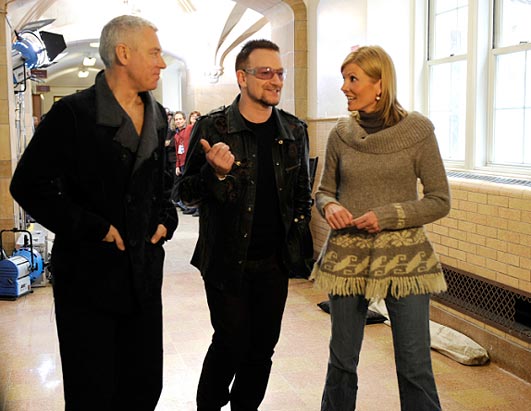
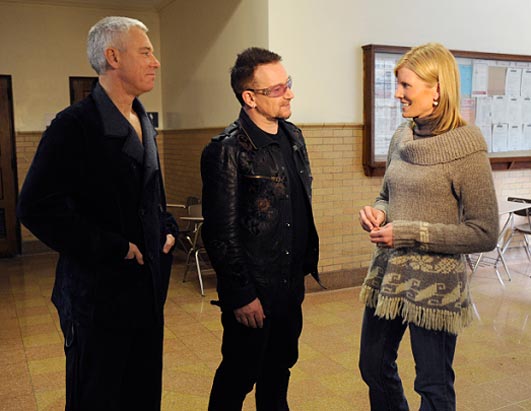
It's just cool to see them in this familiar hallway, and on these familiar steps:
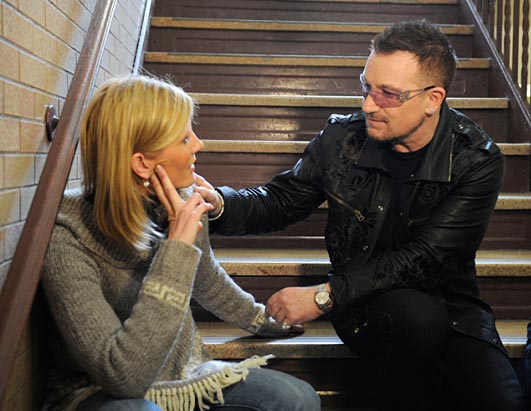
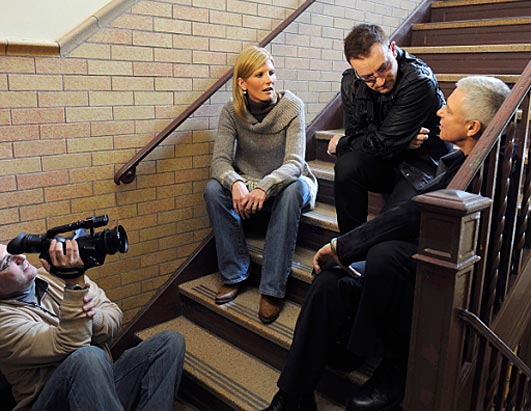
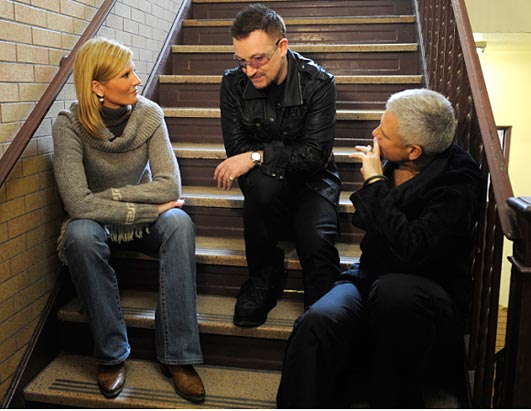
And that pretty much sums it up, just a truly extraordinary, unique, and exciting experience. Fordham rocks, and that is just way cool! And as Fr. McShane put it, thank you, and U2!

Thursday, March 5, 2009
If Life Were Like Facebook
What if Facebook interactions were turned into real life interactions? By acting them out, this hilarious skit helps to underline the artificial and obnoxious quality of some aspects of social media, and technologically mediated interactions in general.
Not that I don't want you to friend me on Facebook...
Not that I don't want you to friend me on Facebook...
Wednesday, March 4, 2009
Into the Social Matrix
In previous blog entries, I've mentioned my friend Paull Young, a social media expert working in the public relations field. The first entry came after he spoke to my Interactive Media class at Fordham University a year ago, and it was entitled The Professionalization of Social Networking, and it was followed by Social Media on Social Media. Of course, you will want to review those posts before continuing... Well? Okay, maybe later then.
So, anyway, Paull recently came back to the Bronx to give another talk to this semester's Interactive Media class. Which was great, I might add. And this time, he taped the talk because he was asked to do a video lecture for students at his alma mater, Charles Sturt University in Australia. As he writes on his blog, Young PR, in a post entitled An Introduction to Social Media for Undergrads:
You can read the entire blog post, it's not very long, by clicking on An Introduction to Social Media for Undergrads and you'll find that it includes the video of the lecture, which Paull posted on Vimeo (an alternative to YouTube that allows for longer videos), but being as always public service-minded, I'll embed that video right here for your convenience:
Paull Young on Social Media from Paull Young on Vimeo.
So, take a little time and enjoy the talk, and the outrageous Aussie accent while you're at it! And while we're on the subject, Time-Warner Cable's local news channel, New York 1 (channel one on local systems in NY and NJ), ran a story on social media that also featured an interview with Paull Young, and his colleague and boss Rob Key (who I met along with Paull last year), from the PR firm called Converseon, Inc., or in Twitter-speak, @converseon. Unfortunately, they won't allow me to embed the video report (how old school, how old media Time-Warner is, and to think that they once were buoyed up by Atari videogames, and later became known as AOL-Time-Warner!!!!). So, I'll just have to give you the link and trust in your good graces to go over to their site and watch the news report: Cleaning Up Your Cyber Image For Employers. There is some text on that site, so I can give you a quote to let you know what it's about:
We then get to the point about how a new medium defines, and redefines who we are, our identity and our selves:
On Twitter today, a number of folks have commented on the description of Paull as "very handsome and intelligent." Leave it at that. Anyway, he goes on to note the breaking down of barriers that is characteristic of all electronic media:
But when it comes to the question of what is the role of public relations in the new social media environment, here's the answer:
And there you have it. But don't take my word for it, go and get it straight from the horses' mouth. And tell them I sent you!
So, anyway, Paull recently came back to the Bronx to give another talk to this semester's Interactive Media class. Which was great, I might add. And this time, he taped the talk because he was asked to do a video lecture for students at his alma mater, Charles Sturt University in Australia. As he writes on his blog, Young PR, in a post entitled An Introduction to Social Media for Undergrads:
Last week I visited Lance Strate’s class at Fordham University on the same mission, so I took the opportunity to kill two birds with one stone. While Bathurst and The Bronx have nada in common aside from alliteration, the principles of social media unite PR students around the world.
You can read the entire blog post, it's not very long, by clicking on An Introduction to Social Media for Undergrads and you'll find that it includes the video of the lecture, which Paull posted on Vimeo (an alternative to YouTube that allows for longer videos), but being as always public service-minded, I'll embed that video right here for your convenience:
Paull Young on Social Media from Paull Young on Vimeo.
So, take a little time and enjoy the talk, and the outrageous Aussie accent while you're at it! And while we're on the subject, Time-Warner Cable's local news channel, New York 1 (channel one on local systems in NY and NJ), ran a story on social media that also featured an interview with Paull Young, and his colleague and boss Rob Key (who I met along with Paull last year), from the PR firm called Converseon, Inc., or in Twitter-speak, @converseon. Unfortunately, they won't allow me to embed the video report (how old school, how old media Time-Warner is, and to think that they once were buoyed up by Atari videogames, and later became known as AOL-Time-Warner!!!!). So, I'll just have to give you the link and trust in your good graces to go over to their site and watch the news report: Cleaning Up Your Cyber Image For Employers. There is some text on that site, so I can give you a quote to let you know what it's about:
Learning how to cleanup your online presence is an imporant step in staying ahead of the game when it comes to potential employers. NY1's Tara Lynn Wagner filed the following report.
Sure it's called MySpace, but nothing about it, or any other social networking site, is really yours. The photos, status updates and videos you post on the World Wide Web are there for the whole wide world to see, and while the whole wide world may not be looking, potential employers are.
"More and more employers are beginning to use Google and are becoming more adept at using social media to help find information about both current employees and potential employees and perspective business partners," said Converseon CEO Rob Key.
Key's company, Converseon, is a social media agency that helps companies manage their online reputation. Key says the first step to cleaning up your cyber-image is to do a Google search.
"Look at Google images, go to YouTube and search for your name there as well, you will be amazed at how many places you may end up that you don't know," said Key.
We then get to the point about how a new medium defines, and redefines who we are, our identity and our selves:
Key says when it comes to the web, job seekers need to see themselves as products being promoted. The more content you create for yourself, the more control you have over the impression you give an employer.
"You can find my blog where I've been writing for several years, you can find my linked in profile which is really my very professional CV online, you can find my Twitter page, you can find my YouTube videos," said Converseon Social Media Strategist Paull Young.
Young says while it's okay to have fun with these sites, his Twitter page announces that he is very handsome and intelligent. He adds it's important to know your audience.
On Twitter today, a number of folks have commented on the description of Paull as "very handsome and intelligent." Leave it at that. Anyway, he goes on to note the breaking down of barriers that is characteristic of all electronic media:
"Your mum could read it, your employer or future employer could read it and your significant other could read it. If all those things are fine, then you shouldn't have any problems," said Young.
But when it comes to the question of what is the role of public relations in the new social media environment, here's the answer:
While accentuating the positive is easy, eliminating the negative can be tricky. Key says you can contact the owner of a site and ask politely that the unflattering material be removed and he says you should take advantage of built in security features that allow you to untag yourself from photos posted by others. This enables you to control your image, rather than letting other people define who you are, a definition that can come back to haunt you.
"When it's digitized, it's there forever so something you do at 18 at a college party may likely be here in 10 or 15 years. It's kind of like that tattoo you got one night and years later you are going to regret that you have it, but it's going to remain there," said Key.
And there you have it. But don't take my word for it, go and get it straight from the horses' mouth. And tell them I sent you!
Tuesday, March 3, 2009
Happy Square Root Day
So, on Twitter this morning I noticed a few people sending tweets to the effect that today is Square Root Day. At first I didn't know what they were talking about, until some more sympathetic soul included the date in a message: 3/3/09.
So, one of my graduate students who just recently started following me on Twitter, Tommy Wesely, or rather @Tommywesely, tweeted in response:
Good one Tommy, and holding Mayans calendars aside, that started me thinking about Square Root Days past. Given the format, there must be nine of them every century. Well, the first one I would have been alive for would be 8/8/64, at which point I was just shy of my seventh birthday, and hardly aware of such things.
The second one that came in my lifetime was 9/9/81, and I don't recall any mention being made of it. We were probably too caught up in the shock of having an actor in the White House.
Next, there was 1/1/01. No doubt the fact that it was a Square Root Day was overshadowed by the fact that it was the first day of a new millennium! Kinda hard to top that!
The last Square Root Day was 2/2/04. Since that was Groundhog Day, the question of how much longer winter would last was no doubt monopolizing our attention.
But of course, for all of these previous Square Root Days, there was no Twitter. The whole Web 2.0/social media wave that we're currently riding was just getting started. And who would even pay attention to such things as Square Root Day in the first place?

I know I would, actually (wish I had thought of it, to be honest). When you come down to it, it's just another example of Geek Chic, my friends! But in order for Square Root Day to become a meme, you need an actual network willing to support such a meme. Like Twitter. And there you have it.
In our new media environment, the preeminent place that words have always enjoyed in human culture has been undermined on one side by images, and on the other, by numbers. This is the postmodern condition.
More on this subject next Logarithm Day...
So, one of my graduate students who just recently started following me on Twitter, Tommy Wesely, or rather @Tommywesely, tweeted in response:
3.3.9 is square root day, the next square root day will not occur until 4.4.16... if we don't cease to exist in 2012
Good one Tommy, and holding Mayans calendars aside, that started me thinking about Square Root Days past. Given the format, there must be nine of them every century. Well, the first one I would have been alive for would be 8/8/64, at which point I was just shy of my seventh birthday, and hardly aware of such things.
The second one that came in my lifetime was 9/9/81, and I don't recall any mention being made of it. We were probably too caught up in the shock of having an actor in the White House.
Next, there was 1/1/01. No doubt the fact that it was a Square Root Day was overshadowed by the fact that it was the first day of a new millennium! Kinda hard to top that!
The last Square Root Day was 2/2/04. Since that was Groundhog Day, the question of how much longer winter would last was no doubt monopolizing our attention.
But of course, for all of these previous Square Root Days, there was no Twitter. The whole Web 2.0/social media wave that we're currently riding was just getting started. And who would even pay attention to such things as Square Root Day in the first place?

I know I would, actually (wish I had thought of it, to be honest). When you come down to it, it's just another example of Geek Chic, my friends! But in order for Square Root Day to become a meme, you need an actual network willing to support such a meme. Like Twitter. And there you have it.
In our new media environment, the preeminent place that words have always enjoyed in human culture has been undermined on one side by images, and on the other, by numbers. This is the postmodern condition.
More on this subject next Logarithm Day...
Didn't You Know?
So, on a listserv devoted to all things McLuhan, run by Peter Montgomery, someone recently posted a link to this video, Did You Know?, which I've embedded below. I was impressed, and therefore decided to add it to Blog Time Passing. But that doesn't mean that I actually like it.
At first glance, it reminded me of some of Mike Wesch's YouTube videos, only slicker. But the sense of urgency conveyed by the music and rapid succession of images in this video strikes me as over the top, resulting in a bit of vertigo and nausea, which I assume is intentional.
In some ways, this video reminds me of Alvin Toffler's Future Shock, a popular book published in 1970 which was all about the fact that change was occuring so rapidly that we were unable to manage it, resulting in the temporal equivalent of culture shock--future shock. Interestingly, Neil Postman in an essay entitled "Future Shlock," which appears in his book Conscientious Objections, claims to have actually coined the term future shock, not that he was making any big deal out of Toffler's claim to have invented the phrase himself. But it was Toffler who said that change itself was changing, that the rate of change was accelerating, and that we need to learn to cope directly with change itself, not just the effects of change.
Of course, that was the way things seemed back in the sixties. By the mid-seventies, things seemed to slow down a bit, and appeared to become more manageable. So forgive me if I find myself wondering if this isn't a lot of sound and fury signifying, well, if not nothing, then at least not as much as it seems to be signifying.
Certainly, I can hear Neil Postman questioning the value of all this turmoil. Is education all about imparting the most current technical skills and information? Or is it about cultivating minds, helping to develop thoughtful, reflective individuals capable of critical evaluation and creative thinking?
I did like the reference to MySpace as a nation. And speaking of nations, it's important to realize that there's a big difference between native speakers of languages like English, and folks who learn it as a second language, and with varying levels of fluency and competency. Having been graduate director for my department at Fordham University for three years, I can tell you that there is a big difference between test scores on the GREs and TOEFL examinations that appeared on the applications of students coming from abroad, especially from students from Asia where the language and writing system is quite different from our own, and their actual ability to understand what is being said in class, take part in discussions, and write papers.
The video ends by posing the question: SO WHAT DOES IT ALL MEAN? The search for meaning is as old as history, older than recorded history, as old as human culture. It's a question that cannot be answered by information, or technology, or science. It is a question of human value, and wisdom.
But hey, look at me going on and on. Why don't you just go enjoy the video... if you can.
SO WHAT DOES IT ALL MEAN? You tell me!
Sunday, March 1, 2009
About Face(book)
So, let me start off by saying that I'm not a big fan of Facebook, and I'll tell you why. But first let me acknowledge that the opinions expressed here are my own, and not those of the management of Blog Time Passing...
...wait a minute, wait a minute... I am the management of Blog Time Passing, so this is, in fact, the official position of this blog. But I do recognize that my opinion may not be your opinion, nor am I trying to persuade you to come around to my way of thinking. And I also acknowledge that Facebook appears to be the most popular social networking site right now.
Popularity, of course, implies nothing about quality. Back when videocassette recorders were introduced to the consumer market, there were two competing formats, VHS and Betamax. When I started working as a salesman in a video store in the early days of this new medium, back when I was a graduate student (wonder if anyone remembers Video Shack?), VHS was outselling Beta by two to one, and Beta disappeared within a couple of years. VHS won out, even though Beta was actually the superior format, quality-wise. The same thing has gone on in the home computer industry as, for example, the Commodore Amiga was superior to the early Macintosh computers (both used the Graphic User Interface and a mouse), while Windows is a vastly inferior operating system to the Macintosh OS, but is far and away the best selling, no matter the inroads that Mac has made over the past year or so.
So popularity is not an argument in support of Facebook. But I will also acknowledge that Facebook is the most popular form of computer-mediated communication among my students. They tell me that they check Facebook before looking at their email (if they look at their email at all). They also admit that almost all of their interaction there is with people they already know. Many of them feel creeped out when they get friend requests from strangers.
To be honest, I can't imagine what life will be like for the younger generations who will now remain in touch with everyone they meet forever, through Facebook or whatever media take its place in the future. Previously, transitions such as the move from high school to college, or into a work environment, or geographical relocations, all presented opportunites to more or less start over, and reinvent oneself. Now, we leave a long trail or long tail behind us, one that we can never fully shake. It's total recall! This may be comforting in some ways, but leaves you in the position of growing up in a small town where everyone knows all about you from the day you were born, and in the position then of living in that same small town all your life. This relates to Marshall McLuhan's observation, almost half a century ago, that on account of electronic interdependence we live in a global village.
For those of us not native to this digital environment, for us digital immigrants so to speak, the situation is a bit different. We wind up connecting to people that we have not heard from for many years, not having maintained contact when that would have required actual effort on our parts, along the lines of telephones calls and letter writing. So there is this new drive to reconnect, which has its charms and gratifications, and certainly can rekindle old friendships and relationships, especially if the loss of contact was due to situations and circumstances beyond our control, or at least that we had limited control over. And once contact was lost, it would take extraordinary effort to reconnect, especially if the other person has moved. But renewed contact also can be awkward, and ultimately result in reminding us that there were reasons why we drifted apart in the first place (this is not about anyone in particular, in case any of my old reconnected friends are reading this).
Anyway, what I was getting at is that my students find Facebook to be very much in their comfort zone, as of all the social networks out there, Facebook is about familiar and safe connections, while the other networks are more about, well, networking, meeting new people, expanding your contacts, etc. This is risky, yes, that's the trade-off, as psychologist Abraham Maslow noted long ago, safety vs. growth. We learn the most from people we don't already know. For that matter, network research shows that we gain the most from people we don't know well, for example in job hunting--that's known as the strength of loose ties. And for me, my other social networks, MySpace and Twitter, have provided great oppportunities for meeting new people, for growth and learning and networking, as opposed to Facebook.
Of course, I could pursue a more aggressive strategy of networking on Facebook, but another problem I have with the site is its Terms of Service. Simply put, they claim to own everything you put on Facebook, every word you type, every picture you upload, etc. Now, I question whether this would ever hold up in court, but who wants to have to go to court in the first place? And I question whether they could actually enforce such terms, especially given that this is diametrically opposed to the bias of the medium, which is all about sharing--let the spice and the information flow! But it does have a chilling effect, to use an old legal/policy phrase, and it's offensive on principle.
There was a recent uproar, as you may know, when Facebook changed its Terms of Service to say that they also own everything you put there even if you delete it, or delete your profile, and they also said they own everything you link to. There was so much anger generated by this that a few days later they backed off and reverted to their old Terms of Service, which still says they own everything you put up there, just not forever.
Now, they do say that the ToS doesn't mean what it says, that it means something else, but any good general semanticist will tell you that what counts is what the words say, not any inferences that anyone draws about them. When you assume... well, I try to avoid making an ass out of anyone, especially myself. And furthermore, as any good New Yorker would say, I don't like their attitude.
By the way, speaking of Facebook's Terms of Service, here's a marvelous editorial cartoon by Jeff Koterba of the Omaha World Herald:

Neil Postman would've loved that! He always used to point out how all these gadgets and media, from televison on, were great time wasters.
Anyway, getting back to why I'm not a Facebook fanboy, the thing about Facebook is that it is very clean and orderly, closed and safe, the profiles are very quiet, homogenous, with relatively little room for personalization. MySpace, by way of comparison, is much more open and chaotic, and more in tune with the do-it-yourself ethic of the online world. Profiles are customized, so are blogs, it's all very noisy and creative, full of spam and scams and phishers and the like, and full of creative activity--it's a great place for artists, musicians, poets, etc. Twitter, while minimalistic in certain ways, allows for more personalization that Facebook, and is full of hustle and bustle--it's a great place for intellectuals. Neither one makes any claim to own your words, pictures, or soul.
Facebook is very middleclass, and that's the secret to its popularity. To make an analogy, Facebook is like Fabian whereas MySpace and Twitter are more like Elvis. Or in more recent terms, Facebook is like Vanilla Ice, MySpace and Twitter are like, uh, well, you know, real rappers (if I say Public Enemy or Puff Daddy I know I'm dating myself, I just don't know rap very well, but I know full well the sanitizing process that gives us Ice Ice Baby). Ok, how about this, Facebook is like American Idol, as opposed to real rock stars. Facebook is just so very bourgois! It's whitebread, Twitter is rye, MySpace is pumpernickel. Facebook is the suburbs, MySpace is the wild frontier, Twitter is the big city. I could go on, but I'll stop here and add a bit more in another post. Oh, and do feel free to send me a friend request on Facebook, I don't mind. Or on MySpace. Or follow me on Twitter. And of Blog Time Passing of course!
Subscribe to:
Posts (Atom)


 Posts


